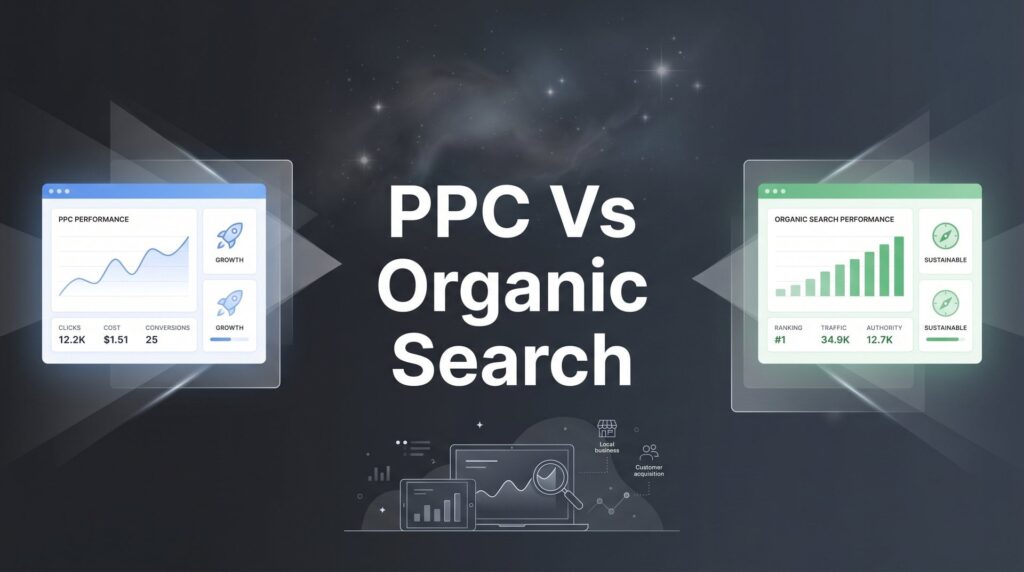
You’re staring at your marketing dashboard, watching ad costs climb while your competitor sits comfortably at the top of organic results. Meanwhile, another competitor just launched aggressive PPC campaigns, grabbing clicks you used to own. The question keeps nagging: Should you double down on paid ads for instant visibility, or invest in SEO for long-term stability?
Here’s what most local business owners miss: This isn’t an either-or decision.
The businesses crushing it in search aren’t choosing between PPC and organic search—they’re running an integrated strategy where each channel makes the other more profitable. They use paid search data to identify which organic investments will actually pay off. They dominate page one by appearing in both paid and organic results. And they systematically reduce ad spend by building organic rankings for their most expensive keywords.
This guide breaks down seven strategies that help you stop wasting budget on guesswork and start building a search presence that delivers predictable, profitable growth. Whether you’re launching a new service, defending market share, or scaling customer acquisition, these approaches show you exactly when to accelerate with PPC and when to build sustainable organic traffic.
1. The Speed vs. Sustainability Framework
The Challenge It Solves
Business owners constantly face the speed-versus-sustainability dilemma. You need customers today to pay bills, but you also need a marketing foundation that doesn’t evaporate the moment you pause ad spend. Making the wrong choice means either burning through cash on endless PPC campaigns or waiting months for organic rankings while revenue stalls.
The real problem? Most businesses approach this as a binary choice when it should be a strategic allocation decision based on specific business circumstances.
The Strategy Explained
Think of PPC as your accelerator and organic search as your foundation. The framework works like this: Use PPC when you need immediate results, are testing new offers, or facing seasonal peaks. Build organic when you have proven offers, stable business operations, and the patience to invest in compounding returns.
Here’s where it gets practical. If you’re launching a new service line, PPC lets you validate demand and generate revenue within days while you simultaneously begin building organic content around those topics. Once you’ve proven the service converts, you shift resources toward organic rankings that will eventually reduce your dependency on paid clicks. Understanding why PPC delivers faster results than SEO helps you make smarter allocation decisions.
For established services with proven conversion rates, the calculation changes. If you’re spending significant money on PPC for the same keywords month after month, that’s your signal to invest in organic rankings that could eventually replace a portion of that ad spend.
Implementation Steps
1. Audit your current PPC campaigns and identify keywords where you’ve spent consistently for 6+ months with good conversion rates—these are prime organic targets.
2. For new offers or services, allocate 70% to PPC for immediate revenue and 30% to organic content creation, then flip this ratio once conversion rates are proven.
3. Set quarterly reviews to evaluate which PPC keywords have achieved organic rankings, allowing you to reduce paid spend and reallocate budget to new opportunities.
Pro Tips
Track your blended cost per acquisition across both channels, not separately. A keyword might look expensive in PPC, but if organic rankings reduce your overall acquisition cost by 40%, that’s the metric that matters. Don’t fall into the trap of comparing channels in isolation—measure the combined performance of your integrated strategy.
2. Use PPC Data to Supercharge Organic Strategy
The Challenge It Solves
SEO feels like throwing darts in the dark. You invest months creating content around keywords you think matter, only to discover they either don’t convert or are impossibly competitive. Meanwhile, your PPC campaigns are generating real conversion data every single day—data that most businesses completely ignore when planning their organic strategy.
This disconnect wastes enormous resources on organic content that never delivers ROI.
The Strategy Explained
Your PPC campaigns are running live market research 24/7. Every click, conversion, and search query tells you exactly what your customers are looking for and which terms actually drive revenue. Smart businesses mine this data to guide every organic investment decision.
Start with your search terms report in Google Ads. Sort by conversion rate, not just volume. You’ll often find that lower-volume, highly specific queries convert at 3-4x the rate of your main keywords. These are your organic goldmine—terms where you know conversion rates, customer intent, and commercial value before writing a single word of content. Learning how to launch your first paid search campaign gives you access to this invaluable data.
The beauty of this approach? You’re not guessing about keyword difficulty or search intent. You have real data showing exactly what searchers want when they use specific phrases, and you know precisely what percentage of them become customers.
Implementation Steps
1. Export your PPC search terms report for the past 90 days and filter for queries with at least 3 conversions—this removes statistical noise and focuses on proven performers.
2. Cross-reference these converting terms against your current organic rankings using any rank tracking tool to identify gaps where you’re paying for clicks you could capture organically.
3. Build content targeting your top 5 highest-converting PPC keywords where you currently rank below position 5 organically, prioritizing terms with the highest cost-per-click since these offer maximum savings potential.
Pro Tips
Pay special attention to question-based queries in your search terms report. When you see patterns like “how to choose,” “what’s the difference between,” or “best way to,” you’ve found content opportunities that address real customer questions at the research stage. Create comprehensive guides around these topics to capture organic traffic earlier in the customer journey.
3. The SERP Domination Play
The Challenge It Solves
Appearing once on page one feels like a win until you realize competitors are showing up twice—once in paid results and again organically. They’re capturing attention at multiple touchpoints while you’re fighting for a single position. This visibility gap directly impacts click-through rates and market share, especially for high-value commercial terms.
The psychology is simple: Searchers trust brands they see multiple times in results. Double presence signals authority and market leadership.
The Strategy Explained
SERP domination means strategically appearing in both paid and organic results for your most critical keywords. This isn’t about wasting money on terms you already rank for—it’s about maximizing total clicks and controlling the narrative on page one.
Focus this strategy on three specific scenarios: branded terms where competitors are bidding on your name, high-intent commercial keywords where you rank organically but want to block competitor ads, and competitive terms where you have strong organic rankings but face aggressive paid competition. Many businesses wonder whether they should run SEO and PPC simultaneously—the answer is almost always yes for maximum SERP coverage.
The data backs this up. When you appear in both paid and organic results, you don’t just double your visibility—you often see a multiplier effect where total clicks exceed the sum of running each channel independently. Searchers perceive dual presence as market dominance.
Implementation Steps
1. Identify your top 10 revenue-generating keywords and audit current SERP positions for both paid and organic—look for terms where you rank organically in positions 1-5 but aren’t running paid ads.
2. Launch PPC campaigns for branded terms where competitors are advertising, even if you rank #1 organically, to push competitor ads below the fold and protect your brand equity.
3. For high-intent commercial terms where you rank organically in positions 3-5, add targeted PPC campaigns to capture additional clicks while you work to improve organic rankings to position 1.
Pro Tips
Monitor your branded term auctions weekly. Competitors often test branded campaigns, and you want to respond immediately with defensive PPC to maintain SERP control. Set up alerts for any new advertisers appearing on your brand terms, and be prepared to increase bids temporarily to protect your territory during critical sales periods.
4. Budget Allocation by Customer Intent Stage
The Challenge It Solves
Treating all search traffic equally is a costly mistake. Someone searching “what is PPC advertising” is at a completely different stage than someone searching “PPC management services near me,” yet many businesses bid aggressively on both or invest organic resources without considering intent. This misalignment burns budget on traffic that’s months away from converting.
The challenge is matching your investment to where prospects actually are in their buying journey.
The Strategy Explained
Customer intent falls into three distinct stages: awareness (researching problems), consideration (comparing solutions), and decision (ready to buy). Each stage demands different channel emphasis and budget allocation.
For awareness-stage queries, organic content delivers the best ROI. These searchers aren’t ready to buy, so paying per click makes little sense. Build comprehensive guides, how-to content, and educational resources that rank organically for these informational queries. You’re building authority and capturing future customers at low cost. Using the best SEO tools available helps you identify and target these awareness-stage keywords efficiently.
Consideration-stage searches warrant selective PPC investment combined with strong organic presence. These are comparison queries and “best of” searches. Use PPC to appear in these results, but keep bids moderate since conversion rates are lower than decision-stage terms.
Decision-stage queries deserve aggressive PPC investment. Terms including “near me,” “pricing,” “cost,” or specific service requests indicate immediate buying intent. These searchers convert quickly, making higher CPCs worthwhile. Simultaneously, ensure strong organic rankings for these terms to maximize total visibility.
Implementation Steps
1. Segment your keyword list by intent stage—look for patterns like questions and “how to” phrases (awareness), comparison terms and “best” searches (consideration), and location-specific or pricing queries (decision).
2. Allocate 10-15% of PPC budget to awareness terms, 25-30% to consideration terms, and 55-65% to decision-stage terms where conversion rates justify higher investment.
3. Flip the organic investment ratio—dedicate 60% of content creation to awareness topics that build authority, 30% to consideration content that positions your solution, and 10% to decision-stage pages optimized for conversion.
Pro Tips
Create separate campaigns for each intent stage in Google Ads. This allows you to set appropriate bids, write stage-specific ad copy, and send traffic to landing pages that match searcher expectations. Don’t make the mistake of sending awareness-stage clicks to hard-sell pages—they’ll bounce immediately, tanking your Quality Score and wasting budget.
5. The Organic Takeover Strategy
The Challenge It Solves
You’re spending the same money on the same PPC keywords month after month, year after year. That recurring expense feels normal until you calculate the total: thousands of dollars on clicks for terms you could potentially rank for organically. The dependency on paid search becomes a profit drain, especially as CPCs increase over time.
Breaking this cycle requires a systematic approach to replacing paid clicks with organic rankings.
The Strategy Explained
The organic takeover strategy identifies your most expensive PPC keywords and systematically builds organic rankings to reduce paid dependency. This isn’t about eliminating PPC entirely—it’s about reducing the cost per acquisition by shifting traffic sources over time.
Start by calculating your annual PPC spend per keyword. Sort by total cost, not CPC. A keyword costing $8 per click with 200 monthly clicks is costing you $19,200 annually. That’s your organic investment justification right there. If you can rank organically for that term, you’re saving nearly $20,000 per year on that single keyword. Understanding the fundamental differences between SEO and PPC helps you identify which keywords are worth the organic investment.
The execution is methodical. Select your top 5-10 most expensive keywords where you’re currently ranking below position 10 organically. Build comprehensive, authoritative content targeting these terms. As organic rankings improve, gradually reduce PPC bids to test whether organic traffic compensates. Monitor total conversion volume closely—the goal is maintaining or increasing conversions while reducing total acquisition cost.
Implementation Steps
1. Calculate annual PPC spend per keyword by multiplying average CPC by monthly clicks by 12—this reveals your true cost and organic investment opportunity.
2. For each high-cost keyword, create content that’s 2-3x more comprehensive than current top-ranking pages, including expert insights, data, and practical implementation guidance that competitors lack.
3. Once organic rankings reach positions 4-7, reduce PPC bids by 20-30% and monitor conversion volume for 30 days—if organic traffic compensates, reduce bids further until you find the optimal balance.
Pro Tips
Don’t kill PPC campaigns entirely, even when you achieve strong organic rankings. Many businesses find optimal performance by maintaining low-bid PPC campaigns alongside organic rankings, capturing both positions and maximizing total clicks. The combined presence often converts better than either channel alone, even accounting for the incremental PPC cost.
6. Remarketing Bridge Strategy
The Challenge It Solves
Organic search drives valuable traffic to your site, but most visitors leave without converting. You’ve invested in content, built rankings, and attracted qualified prospects—then they disappear. Meanwhile, your PPC budget focuses only on new traffic acquisition, missing the opportunity to re-engage these warm organic visitors who already know your brand.
This gap represents massive untapped revenue potential hiding in plain sight.
The Strategy Explained
The remarketing bridge connects your organic traffic to targeted PPC remarketing campaigns, giving you multiple opportunities to convert visitors who didn’t buy on their first visit. Think of organic search as your top-of-funnel awareness engine and remarketing as your conversion accelerator.
Here’s how it works in practice. A prospect searches for “how to improve conversion rates,” finds your comprehensive organic guide, reads it thoroughly, but isn’t ready to hire an agency yet. Without remarketing, they’re gone. With remarketing, they see your targeted ads over the next 30 days as they continue researching, keeping your brand top-of-mind and offering specific next steps when they’re ready. Understanding the difference between Google Search Network and Display Network helps you set up remarketing campaigns effectively.
The economics are compelling. Remarketing CPCs are typically 50-70% lower than search campaign costs, and conversion rates run 2-3x higher because you’re targeting warm traffic that already engaged with your content. You’re essentially getting multiple shots at conversion for a fraction of the cost of acquiring new cold traffic.
Implementation Steps
1. Set up remarketing audiences in Google Ads for visitors who spent 2+ minutes on your organic content pages but didn’t convert—this filters for engaged prospects worth re-targeting.
2. Create remarketing campaigns with ads that acknowledge their previous visit and offer a logical next step, such as “Ready to implement what you learned? Here’s how we can help” rather than generic brand messaging.
3. Segment audiences by content topic to deliver highly relevant remarketing ads—someone who read your PPC guide sees different messaging than someone who read your SEO content.
Pro Tips
Use remarketing duration strategically based on your sales cycle. For services with longer consideration periods, extend remarketing windows to 60-90 days. For immediate-need services, focus remarketing on the first 14 days when intent is highest. Don’t make the mistake of remarketing indefinitely to everyone who ever visited your site—focus on recent, engaged visitors for maximum ROI.
7. Local Business Hybrid Strategy
The Challenge It Solves
Local businesses face unique search challenges. You’re competing for “near me” searches, local pack rankings, and traditional organic results—all while trying to determine whether Google Ads or local SEO deserves your limited budget. Many local businesses choose one channel and ignore the other, leaving massive visibility gaps that competitors exploit.
The local search landscape demands a hybrid approach that most small businesses aren’t implementing.
The Strategy Explained
The local hybrid strategy combines Google Business Profile optimization with strategic Local Services Ads and traditional PPC to dominate local search results. This creates multiple touchpoints in the customer journey, from initial research to ready-to-buy searches.
Start with your Google Business Profile as the organic foundation. This is your lowest-cost, highest-impact local visibility tool. Optimize it completely: accurate business information, regular posts, consistent review generation, and service-specific details. A well-optimized profile can rank in the local pack for dozens of relevant searches without ongoing costs. Service businesses like HVAC companies and plumbers see particularly strong results from this hybrid approach.
Layer in Local Services Ads for high-intent “near me” searches and specific service requests. These appear above traditional PPC ads and operate on a pay-per-lead model rather than pay-per-click, often delivering better ROI for service businesses. They also display your Google Guaranteed badge, building immediate trust.
Finally, use traditional PPC for broader service terms and competitive keywords where local pack rankings are dominated by competitors. This three-layer approach ensures you appear regardless of how customers search for your services.
Implementation Steps
1. Audit your Google Business Profile completeness and implement missing elements—add service areas, business hours, attributes, and regular posts to maximize local pack visibility.
2. If eligible for your industry, activate Local Services Ads and set your budget to capture at least 10-15 leads monthly—this provides enough volume to evaluate performance while controlling costs.
3. Run traditional PPC campaigns for service-specific terms where you don’t rank in the local pack organically, using location extensions and local ad copy to reinforce your geographic relevance.
Pro Tips
Review generation is the multiplier for local search success. A steady stream of authentic reviews improves both your local pack rankings and your PPC Quality Score for location-based campaigns. Implement a systematic review request process for every completed job—businesses with 50+ recent reviews consistently outperform competitors with similar optimization but fewer reviews. Don’t neglect this organic ranking factor while focusing on paid strategies.
Putting It All Together
The PPC versus organic search debate completely misses the point. The businesses winning in search marketing aren’t choosing sides—they’re building integrated strategies where each channel amplifies the other’s performance.
Start with an honest audit of your current search presence. Pull your PPC data and identify where you’re overspending on keywords you could rank organically. Look for gaps where paid ads could generate immediate revenue while you build organic authority. Calculate your actual cost per acquisition across both channels combined, not separately.
The framework is straightforward: Use PPC as your accelerator for immediate results, market testing, and high-intent captures. Build organic as your foundation for sustainable, compounding growth that reduces acquisition costs over time. Let data from one channel inform strategy in the other. Dominate page one by appearing in multiple positions when it matters most.
Here’s what separates profitable search strategies from expensive experiments: allocation based on intent, timing, and proven performance rather than gut feelings or channel bias. Your most expensive PPC keywords are often your best organic investment opportunities. Your organic content generates remarketing audiences that convert at premium rates through targeted ads. Your local pack presence supports your paid campaign Quality Scores.
The businesses that win aren’t the ones with unlimited budgets. They’re the ones who allocate strategically, measure what actually matters, and systematically improve the efficiency of every dollar spent on search marketing.
Tired of spending money on marketing that doesn’t produce real revenue? We build lead systems that turn traffic into qualified leads and measurable sales growth. If you want to see what this would look like for your business, we’ll walk you through how it works and break down what’s realistic in your market.