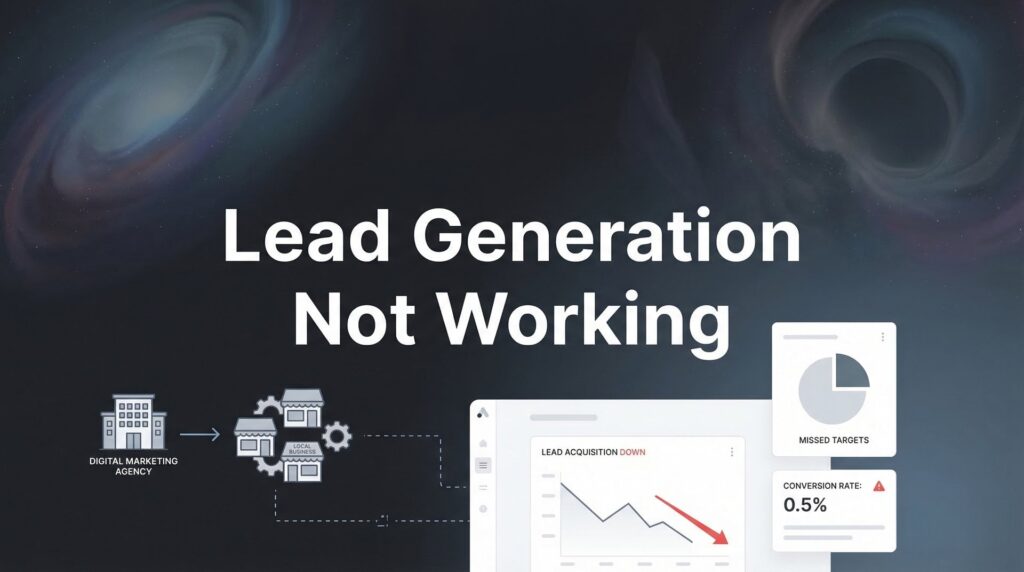
You’re spending money on ads, your website looks decent, and you’re doing “all the right things” – yet the phone isn’t ringing and your inbox stays empty.
When lead generation stops working, it’s rarely a single catastrophic failure. Instead, it’s usually a combination of small leaks that drain your marketing budget while delivering disappointing results.
The frustrating truth? Most local business owners don’t realize their lead generation is broken until they’ve wasted thousands of dollars.
This guide identifies the seven most common reasons your lead generation efforts are falling flat and provides actionable fixes you can implement immediately. Whether you’re running PPC campaigns, relying on SEO, or using a combination of tactics, these strategies will help you diagnose the problem and start generating quality leads again.
1. Your Targeting Is Too Broad (Or Completely Wrong)
The Challenge It Solves
When you try to reach everyone, you end up connecting with no one. Broad targeting wastes your budget on clicks from people who will never become customers. You might see impressive traffic numbers, but those visitors disappear without converting because your message doesn’t speak directly to their specific needs.
Many local businesses make the mistake of targeting their entire metro area when they realistically only serve a 15-mile radius. Others target by demographics alone without considering buyer intent or pain points.
The Strategy Explained
Precision targeting starts with understanding exactly who your ideal customer is and where they’re located. This means going beyond basic demographics to identify the specific problems they’re trying to solve and the exact language they use when searching for solutions.
For local businesses, geographic targeting should match your actual service area. If you can’t profitably serve customers 40 miles away, don’t pay for clicks from that area. Understanding lead generation for local business requires this geographic precision from the start.
The goal isn’t maximum reach – it’s maximum relevance. A smaller audience of highly qualified prospects will always outperform a massive audience of casual browsers.
Implementation Steps
1. Map your actual service area and exclude geographic regions you don’t serve or can’t serve profitably
2. Analyze your best existing customers to identify common characteristics, problems, and search behaviors
3. Refine your keyword targeting to focus on high-intent search terms that indicate someone is ready to buy, not just researching
4. Create separate campaigns for different customer segments so you can tailor messaging to each group’s specific needs
5. Use negative keywords aggressively to prevent your ads from showing for irrelevant searches that waste budget
Pro Tips
Start with tighter targeting than you think you need, then expand gradually based on actual conversion data. It’s easier to broaden successful targeting than to narrow down campaigns that are already bleeding money. Monitor your cost per lead by geographic area and customer segment – you’ll often discover that certain areas or demographics convert at dramatically different rates.
2. Your Landing Pages Leak Leads Like a Broken Faucet
The Challenge It Solves
You’re paying for traffic, but visitors hit your landing page and bounce without taking action. Even when your ads are perfectly targeted, a poorly designed landing page creates friction that stops conversions cold.
Common landing page problems include unclear value propositions, too many choices, forms that ask for unnecessary information, slow loading times on mobile devices, and messaging that doesn’t match what the ad promised.
The Strategy Explained
A high-converting landing page has one job: remove every possible obstacle between the visitor and the action you want them to take. This means eliminating distractions, matching the message to what brought them there, and making the next step obvious and easy.
Think of your landing page as a conversation. Your ad made a promise – your landing page needs to deliver on that promise immediately and make it dead simple for the visitor to take the next step. Every element should either move the visitor toward conversion or be removed entirely.
Mobile optimization isn’t optional anymore. Most local searches happen on mobile devices, and if your landing page doesn’t load quickly and display perfectly on a phone, you’re throwing away the majority of your traffic. When your marketing campaign isn’t working, the landing page is often the culprit.
Implementation Steps
1. Ensure your headline matches the promise made in your ad – message mismatch kills conversions instantly
2. Reduce form fields to the absolute minimum needed to qualify the lead and start a conversation
3. Remove navigation menus and other links that give visitors an escape route before converting
4. Test your landing page on multiple mobile devices to ensure it loads in under three seconds and displays correctly
5. Add trust signals like customer reviews, industry certifications, or recognizable client logos near your call-to-action
Pro Tips
Use heat mapping tools to see where visitors are clicking and how far they scroll. You’ll often discover that key information is buried below the fold or that visitors are trying to click elements that aren’t actually clickable. Run A/B tests on your headline and call-to-action button text – small changes in wording can produce dramatic differences in conversion rates.
3. Your Offer Doesn’t Create Urgency or Value
The Challenge It Solves
Generic “contact us” or “request a quote” offers don’t give prospects a compelling reason to act now. Without urgency or clear value, potential customers bookmark your site with good intentions and then forget about you entirely.
The problem intensifies when competitors are offering specific, valuable incentives while you’re asking for the same commitment with nothing in return. Prospects need a reason to choose you and a reason to act immediately rather than later.
The Strategy Explained
A strong offer provides immediate value in exchange for contact information. This could be a free audit, a valuable resource, a limited-time discount, or a low-commitment way to experience your service.
The key is specificity. “Free consultation” is weak. “Free 15-minute marketing audit where we identify the three biggest leaks in your current campaigns” is specific and valuable. The prospect knows exactly what they’re getting and can immediately see the benefit. Implementing proven lead generation strategies requires this level of offer clarity.
Urgency can come from limited availability, time-sensitive bonuses, or seasonal relevance. The urgency must be genuine – artificial scarcity damages trust and rarely works long-term.
Implementation Steps
1. Replace generic “contact us” calls-to-action with specific offers that provide immediate value
2. Clearly articulate what the prospect will receive and when they’ll receive it
3. Add legitimate urgency through limited spots, expiring bonuses, or seasonal relevance
4. Create different offers for different stages of the buying cycle – not everyone is ready to buy immediately
5. Test offers that require progressively larger commitments to see where conversion rates drop off
Pro Tips
Your offer should align with your sales process. If you need a phone conversation to close deals, offer a specific consultation rather than a downloadable guide. If your service requires education before purchase, offer valuable content that positions you as the expert. The best offers solve an immediate problem while naturally leading to your paid service.
4. You’re Attracting Tire-Kickers Instead of Buyers
The Challenge It Solves
High lead volume looks impressive in reports, but it means nothing if those leads never convert to paying customers. When your sales team spends all day chasing unqualified prospects, they can’t focus on the leads that actually have budget and buying intent.
Tire-kickers drain resources, skew your metrics, and create a false sense of success. You might celebrate hitting your lead generation goals while your revenue stays flat because the quality isn’t there. This is a classic sign of poor quality leads from marketing efforts.
The Strategy Explained
Lead quality starts with your targeting and messaging, but it’s reinforced through qualification mechanisms built into your lead capture process. You want to make it easy for qualified prospects to convert while creating just enough friction to discourage time-wasters.
This doesn’t mean making your forms longer or adding unnecessary barriers. It means asking the right questions to identify serious buyers and setting proper expectations about pricing, process, and what you actually offer.
Sometimes attracting fewer leads is actually better for your business if those leads have significantly higher conversion rates and lifetime value.
Implementation Steps
1. Add one or two qualifying questions to your lead form that help identify budget and timeline
2. Be transparent about your pricing tier or minimum project size to self-filter prospects who can’t afford your service
3. Adjust your ad copy to attract buyers rather than researchers by using language that indicates commitment
4. Create separate campaigns or landing pages for different service tiers so you can match messaging to buyer readiness
5. Track lead-to-customer conversion rates by source to identify which channels deliver quality versus quantity
Pro Tips
Don’t be afraid to disqualify poor-fit prospects early. A clear statement like “Our services start at $X per month” will reduce your lead volume but dramatically improve lead quality. Calculate your cost per qualified lead rather than just cost per lead – this metric actually correlates with revenue growth.
5. Your Follow-Up Speed Is Killing Your Conversions
The Challenge It Solves
A prospect fills out your form while they’re actively searching for a solution. You respond three hours later, and they’ve already talked to two competitors who called within minutes. By the time you reach out, they’re no longer in buying mode or they’ve already committed elsewhere.
Speed-to-lead is one of the most underestimated factors in conversion rates. Hot leads go cold quickly, and competitors who respond faster consistently win business even when they’re not the best option.
The Strategy Explained
The goal is to make contact while the prospect is still in active buying mode. This means having systems in place that notify your sales team immediately when a lead comes in and ensuring someone can respond within minutes, not hours or days.
Immediate doesn’t necessarily mean a phone call. An instant automated email that acknowledges their inquiry and sets expectations can buy you time while still maintaining engagement. Using email marketing for lead generation effectively means having these automated sequences ready to deploy instantly.
For local businesses, this is especially critical. Someone searching for a plumber or locksmith needs help now. If you don’t answer, they’re calling the next number on the list.
Implementation Steps
1. Set up instant lead notifications via text message or app alerts so your sales team knows immediately when a lead arrives
2. Create an automated email response that goes out instantly to acknowledge the inquiry and set expectations for next steps
3. Establish a goal of making first contact within 5-15 minutes for all new leads during business hours
4. Develop a follow-up sequence for leads who don’t answer initially – most people need multiple contact attempts
5. Track your average response time and make it a key performance metric for your sales team
Pro Tips
Use a CRM that automatically logs all contact attempts and schedules follow-ups. Leads that don’t convert immediately shouldn’t be abandoned – they should enter a nurture sequence. Test different contact methods (phone, email, text) to see which gets the best response rate for your specific audience.
6. You’re Not Tracking What Actually Matters
The Challenge It Solves
You’re celebrating increased website traffic and form submissions while your actual revenue stays flat or declines. Vanity metrics create a false sense of success that prevents you from identifying and fixing the real problems in your marketing.
Without tracking the complete customer journey from first click to closed deal, you can’t identify which marketing channels actually drive revenue versus which ones just drive activity. This is often why digital marketing isn’t generating revenue for many businesses.
The Strategy Explained
Effective tracking connects your marketing spend directly to revenue. This means tracking not just leads, but which leads convert to customers, how much they spend, and which marketing sources delivered them.
You need to know your cost per acquisition by channel, your lead-to-customer conversion rate, and your average customer lifetime value. These metrics tell you which marketing efforts are actually profitable and which ones are burning money.
Many businesses stop tracking at the lead level, which means they have no idea that their Google Ads are generating 100 leads at $50 each but only 2 customers, while their SEO is generating 20 leads but 8 customers.
Implementation Steps
1. Implement conversion tracking that follows leads through your entire sales process, not just to the form submission
2. Connect your CRM to your advertising platforms so you can see which campaigns drive actual customers, not just leads
3. Calculate your true cost per acquisition by dividing total marketing spend by number of new customers (not leads)
4. Track customer lifetime value so you know how much you can afford to spend to acquire each customer
5. Create a dashboard that shows revenue metrics alongside activity metrics so you can see the complete picture
Pro Tips
Focus on metrics that directly correlate with revenue: cost per acquisition, customer lifetime value, and return on ad spend. These tell you whether your marketing is actually working. Review your tracking setup quarterly – platforms change, and tracking often breaks without anyone noticing until you’ve lost months of data.
7. Your Marketing Channels Are Fighting Each Other
The Challenge It Solves
Your PPC campaigns are bidding on the same keywords your SEO is targeting. Your Facebook ads send traffic to a different landing page than your Google Ads, with conflicting offers. Your email campaigns promote one service while your website highlights another.
Disconnected campaigns confuse potential customers, waste budget on internal competition, and prevent you from building a cohesive brand message. When your marketing channels work against each other, you get a fraction of the results you should be seeing.
The Strategy Explained
A coordinated marketing strategy ensures all your channels work together toward the same goals. This doesn’t mean every channel does the same thing – it means each channel has a specific role in your customer acquisition process and they complement rather than compete with each other.
Your paid search might focus on capturing high-intent buyers right now. Your SEO might target educational content that builds authority for future buyers. Understanding the differences between Google Ads and Facebook Ads for lead generation helps you assign the right role to each platform.
Implementation Steps
1. Map out your customer journey and assign specific roles to each marketing channel based on where they fit in that journey
2. Ensure your messaging is consistent across all channels while being appropriately tailored to each platform’s audience
3. Use retargeting to stay in front of prospects who engaged with one channel but didn’t convert
4. Review your keyword targeting across PPC and SEO to eliminate wasteful internal competition
5. Create a content calendar that coordinates messaging across all channels so you’re not promoting conflicting offers simultaneously
Pro Tips
Use attribution modeling to understand how different channels work together to drive conversions. Most customers interact with multiple touchpoints before buying – understanding these paths helps you optimize the entire journey rather than individual channels in isolation. Schedule quarterly strategy sessions to ensure your channels remain aligned as your business evolves.
Fixing the Leaks in Your Lead Generation System
When lead generation stops working, the solution isn’t usually to spend more money – it’s to fix the leaks in your current system.
Start by auditing your targeting and landing pages, as these two areas account for the majority of lead generation failures. Are you reaching the right people, and are those people converting when they arrive? If not, everything else is built on a broken foundation.
Then work through your offer, lead quality filters, follow-up systems, and tracking. Each of these represents a potential leak that’s draining your marketing budget while delivering disappointing results.
The businesses that consistently generate quality leads aren’t doing anything magical – they’ve simply eliminated the friction points that cause most campaigns to fail. They know exactly who they’re targeting, their landing pages convert at healthy rates, their offers create urgency, they respond to leads immediately, and they track what actually drives revenue.
Most importantly, they view their marketing as a system where all the pieces work together rather than a collection of disconnected tactics.
If you’re tired of spending money on marketing that doesn’t produce real revenue, we build lead systems that turn traffic into qualified leads and measurable sales growth. If you want to see what this would look like for your business, we’ll walk you through how it works and break down what’s realistic in your market.