Most small business owners who say they have a lead problem actually have a prioritization problem. They’re running Google Ads before their Google Business Profile is complete. They’re posting on social media before anyone can find them in search. They’re buying leads from aggregators while their own website converts at 1%.
The channels aren’t broken. The order of operations is.
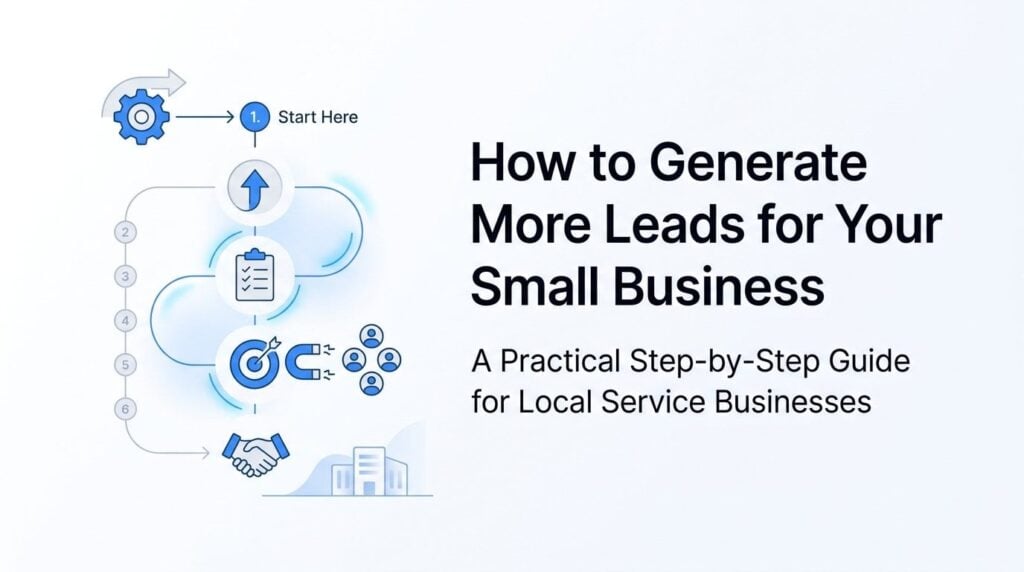
This guide walks through the exact sequence that produces consistent, affordable leads for local service businesses: fix what’s already broken first, then build outward. No channel is universally best. The right answer depends on your vertical, your market, and how fast you need revenue. But the sequence below holds across nearly every local service business we’ve worked with.
Follow it in order and you’ll stop wasting spend on channels that can’t work yet. Skip ahead and you’ll keep getting the same results you’re getting now.
One more thing before you start: leads and booked jobs are not the same metric. A phone that rings with unqualified callers isn’t progress. Every step here is designed to produce calls and form fills from people who are ready to buy in your service area, not just traffic, not just impressions, not just clicks.
Step 1: Audit What You Already Have Before Spending Another Dollar
Before you add a single new channel, you need to know what’s actually happening with the money you’re already spending. Most business owners skip this step because it feels like delay. It isn’t. It’s the difference between optimizing a working system and pouring budget into a leaking bucket.
Start with your Google Business Profile. Pull it up right now and check these specifically: Are all your service categories selected? Are your hours accurate, including holiday hours? Do you have at least ten photos showing real work, your team, and your location? Have you populated the Q&A section? And how does your review count compare to the top three competitors in your market? If any of these are incomplete, you’re leaving free visibility on the table.
Next, pull your website’s contact form submissions and call data for the last 90 days. If you don’t have call tracking installed, that’s your first fix. You cannot improve what you cannot measure. You might think your Google Ads are producing leads, but without call tracking tied to your ad campaigns, you have no idea which keywords, which ads, or which landing pages are actually driving revenue. This problem shows up across every trade we work in, not just HVAC, and it always starts with missing attribution.
Now calculate your actual cost per lead by channel. If you’re buying from Angi, HomeAdvisor, or Thumbtack, don’t use their reported CPL figure. Calculate what you’ve paid per booked job. Divide total spend by jobs that actually made it onto your calendar. The number is almost always worse than you expected.
Here’s the finding we see most often in audits: businesses are paying for leads that go to voicemail or get called back three hours later. Speed-to-answer is frequently the biggest lever, not the channel itself. A lead that goes unanswered for two hours is often a lead that called your competitor and booked with them. The channel didn’t fail. The follow-up process did.
What done looks like: You have a clear picture of current CPL by channel, your GBP is 100% complete, and call tracking is installed and attributing every inbound contact before you move to Step 2.
Step 2: Claim the Free Traffic You’re Already Losing in Google Maps
The Map Pack captures roughly 42% of local clicks for service-based searches. If you’re not in the top three results when someone searches for your service in your city, you’re invisible to nearly half your potential customers. And this traffic costs you nothing per click once you earn the ranking.
Google ranks Map Pack results on three factors. Proximity is the first, and you can’t change it. Relevance is the second, and it’s fully within your control. Prominence is the third, and it’s built over time through reviews and citations.
Relevance comes from how well your profile matches what someone is searching for. That means selecting every applicable service category (not just your primary one), writing a business description that naturally includes the services and cities you cover, and adding individual services with descriptions inside your GBP dashboard. The same optimization principles that move HVAC contractors up the Map Pack apply across every home service vertical.
Prominence is where most businesses stall. Review count and recency matter more than most owners realize. A profile with 12 reviews that haven’t been updated in eight months will consistently lose to a competitor with 40 reviews and activity in the last two weeks. The fix is simple but requires consistency: send every customer a direct review link after the job is complete. Respond to every review within 48 hours, including the negative ones. Add a GBP post at least once a week.
Citation consistency is the piece most people overlook entirely. Your business name, address, and phone number need to match exactly across your website, your GBP, Yelp, the BBB, Angi, and every industry directory where you’re listed. Not approximately. Exactly. Different phone number formats, abbreviated street names, or old addresses from a previous location all create inconsistency that suppresses your Maps ranking, particularly in competitive markets.
One pitfall worth calling out directly: don’t add service areas you don’t actually serve just to inflate your geographic reach. Google detects this pattern and it suppresses rankings for the areas you genuinely work in. Serve the area you say you serve.
Timeline expectation: GBP improvements typically show ranking movement in 30 to 60 days. This isn’t instant, but it also isn’t paid spend. The leads it produces are free.
Step 3: Make Your Website Convert the Traffic It Already Gets
Your website is probably getting more traffic than you realize, and losing most of it. Not because your services aren’t good. Because the page doesn’t answer the three questions every buyer asks in the first ten seconds: Do you serve my area? Can I trust you? How do I contact you right now?
If those answers aren’t visible without scrolling, a significant portion of your visitors leave. They don’t fill out a form or call. They just go.
Above the fold, before any scrolling, your site needs to show your city or service area, your primary service, a phone number that is click-to-call on mobile, and at least one trust signal. That trust signal can be your years in business, your license number, your review rating, or a recognizable certification. One clear signal beats a wall of badges nobody reads.
Phone numbers deserve special attention. Between 40% and 70% of local service leads come in by phone, not form. If your number is buried in the footer, or if it’s displayed as an image that can’t be tapped on a smartphone, you are losing jobs. Put the number at the top of every page. Make it tap-to-call. Check it on your actual phone, not just your desktop monitor.
Page speed matters twice. It’s a ranking factor in Google’s algorithm, and it’s a conversion factor because slow pages lose visitors before they read a single word. Your site should load in under three seconds on mobile. Use Google’s PageSpeed Insights to check your current score. If you’re below 50, that’s a fixable technical problem, not a marketing problem.
Contact forms should be short. Three fields: name, phone number, and a brief description of what they need. Every additional field you add reduces the percentage of people who complete it. Long forms feel like paperwork. Short forms feel like a quick text.
Install call tracking before you run a dollar of paid ads. CallRail is the standard tool in this space. It assigns unique phone numbers to each traffic source so you know whether a call came from Google Ads, organic search, your GBP, or a Facebook ad. Without this, you’re making channel decisions based on guesswork. The attribution gap is one of the most common reasons local service businesses overspend on low-performing channels.
What done looks like: Your site loads in under three seconds on mobile, your phone number is visible without scrolling, and every inbound contact, call or form, is tracked to its source.
Step 4: Turn on Google Ads for Immediate Lead Flow While SEO Builds
Once your GBP is optimized and your website converts, Google Ads becomes your fastest path to consistent inbound leads. Organic SEO takes six to twelve months to produce reliable traffic. Google Ads starts working within days of launch, assuming the account is set up correctly.
Our benchmarks for home services Google Ads run $18 to $35 per lead. If you’re paying significantly more than that, the problem is almost always one of three things: keyword targeting that’s too broad, a geographic radius that extends well beyond where you actually work, or a landing page that doesn’t match what the ad promised. High CPL is a diagnosable problem, not just bad luck.
Start with exact match and phrase match keywords only. Broad match will burn budget on searches that have nothing to do with your business until the account accumulates enough conversion data to self-correct. That process takes months and costs real money. Narrow targeting from day one is cheaper and faster.
Add negative keywords before the first dollar is spent. For most service businesses, terms like “DIY,” “how to,” “free,” “jobs,” “careers,” “apprenticeship,” and “license exam” should be blocked immediately. These are searches from people who will never hire you, but Google will happily charge you for the click.
Check whether your vertical qualifies for Google Local Services Ads. LSAs run on a separate auction from standard Google Ads and appear above everything else in the search results, including regular paid ads. Google pre-screens the leads before they reach you, which typically produces lower CPLs for eligible trades. If you’re in HVAC, plumbing, electrical, roofing, or several dozen other home service categories, LSAs should be part of your setup. Understanding the difference between owned channels and aggregator-style lead buying matters here.
Plan for a 30 to 90 day ramp period. Google’s Smart Bidding algorithms need conversion data before they can optimize effectively. The first month will typically cost more per lead than month three. Don’t cut the campaign before it has data to work with. Killing a campaign at week three because it’s expensive is like stopping physical therapy after two sessions because you’re still sore.
On budget: most local service businesses should plan to spend 8 to 12% of target revenue on marketing across all channels. A business targeting $500,000 in annual revenue should budget $40,000 to $60,000 per year. That’s not all Google Ads, but Google Ads will likely be the largest single line item in the early months.
The question of paid versus organic isn’t either/or. They serve different timelines. Run paid while organic builds.
Step 5: Build the SEO Foundation That Produces Leads at $7 to $15 Each
Organic search produces the lowest long-term cost per lead of any channel for local service businesses. Our benchmark is $7 to $15 per lead at the 12-month mark. But it requires patience and consistent execution, and it won’t produce much in the first six months.
The technical foundation comes first. Your site needs to be crawlable by Google, mobile-friendly, and fast. These aren’t advantages. They’re the minimum requirements to compete. If your site fails basic technical checks, no amount of content will move your rankings.
The content structure that works for local SEO is specific: create a dedicated page for each primary service you offer. Not one generic “Services” page that lists everything. A page for water heater replacement. A page for drain cleaning. A page for emergency plumbing. Each page should have at least 400 words of original content describing what you actually do, the problems you solve, and the service area you cover. Your H1 should include your service and your city. Your NAP (name, address, phone) should appear in the footer of every page.
If you serve multiple cities or counties, create location pages. A roofing company that serves five towns should have five location pages, each with content specific to that area, not the same page duplicated five times with the city name swapped out. Duplicate content doesn’t rank. Original content does.
Backlinks from local sources carry more weight for local rankings than generic link building. A link from your local chamber of commerce, a mention in a local news article, a listing in a supplier’s contractor directory, or a profile on an industry association’s website all send stronger local relevance signals than a link from a generic blog. Focus on earning local citations first.
The GBP and SEO strategies reinforce each other in a way most business owners don’t expect. A stronger website improves your Maps ranking because Google uses your site as a relevance signal. Stronger Maps rankings drive branded searches, and branded search volume improves your organic rankings. They’re not separate strategies. They’re the same strategy operating on two surfaces.
Realistic timeline: Meaningful organic traffic typically begins around six months. Consistent lead flow from organic usually establishes by twelve months. Run Google Ads in parallel the entire time. The two channels don’t compete. They cover each other’s gaps.
Step 6: Add Facebook Ads When You Need Volume or Want to Own a Market
Facebook and Instagram ads work differently from Google Ads, and that difference matters for how you use them. Google captures demand that already exists. Someone searches “emergency HVAC repair near me” because they need it right now. Facebook creates demand by putting your business in front of people who match your customer profile before they’ve started searching.
That distinction tells you when Facebook makes sense. It’s not the right first channel for most local service businesses. It’s the right channel once your foundation is in place and you want to increase volume or establish market presence before competitors do.
Our benchmark for home services Facebook CPL runs $10 to $25. The lower end of that range requires good creative and a clear offer. The higher end is common when ads run to cold audiences with no specific reason to act. “Call us for all your HVAC needs” is not an offer. “Schedule your pre-season tune-up before slots fill up” is an offer.
The creative is effectively your targeting on Facebook. The algorithm finds people who respond to your ad, so the ad itself determines who sees it. A photo of a real job you completed in a recognizable local neighborhood consistently outperforms stock photography. Real trucks, real technicians, real work. It signals legitimacy in a way that staged imagery doesn’t.
Two options exist for capturing leads from Facebook: lead forms built inside the platform (called instant forms) or traffic sent to your website. Instant forms reduce friction and produce more volume. Website traffic produces higher-intent leads but requires your landing page to convert well. If your site converts (which Step 3 addressed), website traffic is usually the better choice for quality.
Facebook ads require more active management than Google Ads. Creative fatigue sets in faster. The same ad loses effectiveness over several weeks as your audience sees it repeatedly. You need fresh creative on a regular rotation, not a set-it-and-forget-it approach.
One strong use case worth noting: remarketing. If someone visited your website but didn’t call or fill out a form, a Facebook remarketing campaign can bring them back. These audiences are small but they convert at higher rates than cold traffic because the person already knows who you are.
When to add this channel: After your GBP is optimized, your website converts, and your Google Ads account is producing consistent leads. Facebook amplifies a working system. It doesn’t fix a broken one.
What Consistent Lead Flow Actually Looks Like After 12 Months
A business that follows this sequence ends up with multiple lead sources that reinforce each other rather than competing. Maps handles high-intent local searches. Organic handles informational and comparison searches. Google Ads captures immediate demand. Facebook handles market awareness and retargeting. Each channel does a different job, and together they cover the full buyer journey.
The metric to track is not leads. It’s cost per booked job. A $20 lead that books 30% of the time costs you $67 per job. A $12 lead that books 10% of the time costs you $120 per job. The cheaper lead is actually more expensive. This is why lead quality, speed-to-answer, and sales process matter as much as the channel itself.
Review your channel mix every quarter. Markets change, competition changes, and the channel that was most efficient last year may not be this year. The businesses that struggle long-term are the ones that skip the audit step, never fix their website, and keep buying from aggregators rather than building channels they own. If you’re a small business owner looking for a practical starting point, our breakdown of the best lead generation services for small businesses compares the options that actually produce booked jobs at reasonable cost.
Before you close this page, run through this checklist:
GBP: Complete, with active review management and weekly posts.
Call tracking: Installed and attributing every inbound contact to its source.
Website: Loads in under three seconds on mobile, phone number visible without scrolling, short contact form.
Google Ads: Running with exact and phrase match keywords, aggressive negatives, and correct geographic targeting.
SEO: Individual service pages, location pages if applicable, local citations consistent.
Phone coverage: A real human answers quickly. Not a voicemail. Not a callback three hours later.
If you want a second set of eyes on what’s actually holding back your lead volume, Clicks Geek has been running local service campaigns since 2015 as a Google Premier Partner, with playbooks across 298 industries. If you want to see what this would look like for your business, we’ll walk you through what’s realistic in your market and where the biggest gaps are.