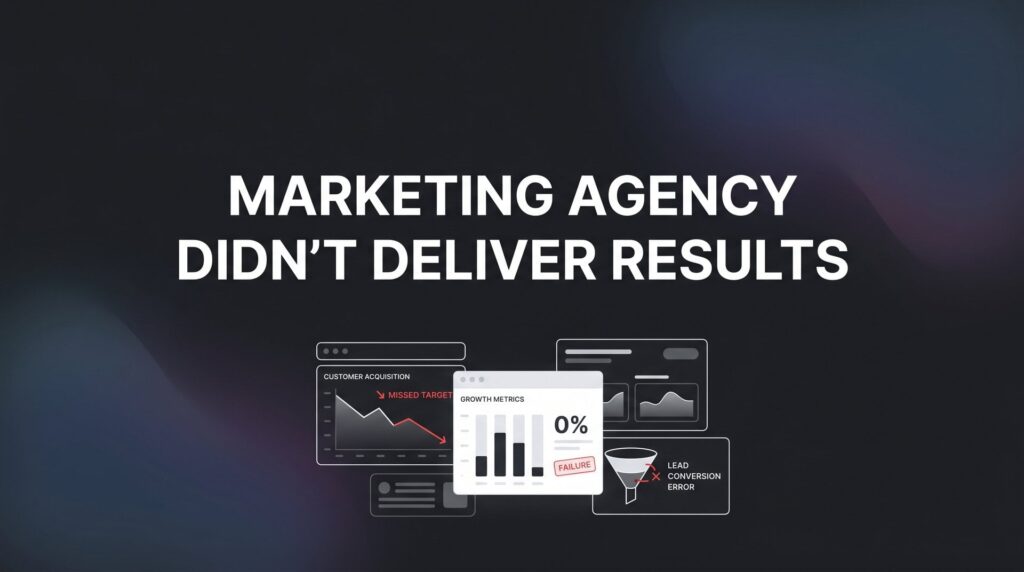
You’ve been writing the checks every month. The agency sends reports filled with colorful charts showing impressions, reach, and engagement rates. They talk about brand awareness and top-of-funnel metrics. But when you look at your actual bank account, the phone isn’t ringing more. The lead pipeline hasn’t grown. Revenue hasn’t budged.
After six months—or maybe a year—you’re left wondering if you just wasted tens of thousands of dollars on marketing that fundamentally didn’t work.
Here’s the uncomfortable truth: this scenario plays out constantly across every industry. Business owners hire marketing agencies with high hopes, only to find themselves stuck in partnerships that consume budget without delivering tangible business growth. The frustration is real, the financial impact is significant, and the emotional toll of feeling like you’ve been sold a promise that never materialized weighs heavy.
But here’s what most business owners don’t realize: there are specific, identifiable reasons why marketing partnerships fail. Some of those reasons point to agency shortcomings. Others reveal gaps in how the relationship was structured from the beginning. Understanding which factors contributed to your situation is the first step toward fixing it—whether that means salvaging the current partnership or finding the right agency to replace them.
This article will help you diagnose what went wrong, evaluate whether your current situation can be saved, and identify exactly what to look for in your next marketing partner so you don’t repeat the same expensive mistakes.
Warning Signs That Should Have Raised Concerns Earlier
Looking back, there were probably red flags before you even signed the contract. Agencies that ultimately underdeliver often reveal their approach during the sales process—you just need to know what to look for.
The biggest warning sign? Guarantees of specific results without first understanding your business fundamentals. When an agency promises to “triple your traffic” or “generate 50 leads per month” before they’ve analyzed your market, your competition, or your customer acquisition economics, they’re selling you a fantasy. Legitimate agencies know that results depend on dozens of variables they need to assess first.
The Missing Discovery Phase: Professional marketing partnerships begin with extensive discovery. What’s your average customer worth? How long is your sales cycle? Who are your top three competitors and what are they spending on marketing? What’s worked and failed in the past? Agencies that skip these questions and jump straight to tactics are building campaigns on guesswork.
Vague Strategy Communication: Did your agency clearly explain their strategic approach, or did they just list services? There’s a massive difference between “We’ll run Google Ads and Facebook campaigns” and “We’re targeting bottom-funnel search intent first because your sales cycle is short and you need immediate lead flow, then we’ll layer in remarketing to nurture prospects who aren’t ready yet.”
The absence of realistic timeline discussions is another critical red flag. Marketing channels have natural maturation periods. SEO takes months to gain traction. Paid advertising can generate leads quickly but requires testing and optimization. Content marketing builds authority over time. Agencies that promise immediate results across all channels either don’t understand how marketing actually works, or they’re telling you what you want to hear to close the deal.
No Discussion of Market Realities: Every industry has different competitive dynamics and customer acquisition costs. Marketing a local HVAC company requires completely different strategies and budgets than marketing a SaaS product. If your agency never discussed what’s realistic in your specific market, they were setting you up for disappointment from day one. Understanding digital marketing agency pricing benchmarks for your industry helps you evaluate whether expectations were reasonable.
The most telling sign? Agencies that focus their sales pitch on their process, their awards, or their team size rather than on understanding your specific business challenges and revenue goals. You’re not hiring a marketing agency to feel good about their credentials—you’re hiring them to generate profitable customer acquisition.
Why Marketing Partnerships Fail (And It’s Not Always the Agency’s Fault)
Before you place all the blame on your marketing agency, it’s worth examining whether some of the failure points originated on your side of the relationship. This isn’t about letting bad agencies off the hook—it’s about understanding the full picture so you don’t repeat the same mistakes.
The Vanity Metrics Trap: Many business owners get excited about the wrong numbers. Your agency shows you that website traffic increased 200%, and that sounds impressive. But if those visitors aren’t converting into leads or customers, that traffic is essentially worthless. The partnership fails because you’re celebrating metrics that don’t connect to revenue.
This disconnect often happens because neither party established clear definitions of success upfront. What actually matters to your business? If you’re a local service provider, you need phone calls and form submissions from people in your service area. If you’re selling a high-ticket B2B service, you need qualified discovery calls with decision-makers. Traffic, impressions, and engagement are just inputs—they only matter if they produce the business outcomes you actually need.
Budget Misalignment: Here’s an uncomfortable reality: sometimes your budget simply isn’t sufficient for the competitive landscape you’re operating in. If your competitors are spending $20,000 per month on Google Ads and you’ve allocated $2,000, you’re not going to outcompete them for the same keywords and audience.
Quality agencies should have this conversation with you upfront, explaining what’s realistic given your budget constraints. But many business owners push back on this reality, assuming the agency is just trying to upsell them. The result? Underfunded campaigns that can’t compete effectively, leading to disappointing results that weren’t actually the agency’s fault. Learning about marketing agency fees explained can help you understand what investment levels are truly needed.
The Collaboration Gap: Marketing agencies aren’t mind readers. They need information from you to build effective campaigns. What do your best customers have in common? What objections do prospects raise during sales calls? What seasonal patterns affect your business? Which service offerings are most profitable?
When business owners treat their agency relationship as “set it and forget it,” they deprive the agency of crucial business intelligence that could dramatically improve campaign performance. The agency can optimize ads and landing pages all day, but if they don’t know that your highest-value customers are actually mid-sized manufacturers in the automotive sector (not the general “manufacturing” audience they’re targeting), the campaigns will never reach their full potential.
Unrealistic Timeline Expectations: You gave the agency three months to transform your business, but meaningful marketing results often take longer. Paid advertising can generate leads relatively quickly, but building a sustainable marketing system that consistently delivers qualified prospects requires testing, optimization, and iteration over time.
The partnership fails because you expected immediate transformation while the agency was still in the foundation-building phase. Neither party managed expectations properly, and the relationship deteriorated before the marketing had time to mature.
Auditing What Your Agency Actually Delivered
If you suspect your marketing agency didn’t deliver results, you need to conduct a thorough audit of what actually happened. This isn’t about finding ammunition to attack your agency—it’s about understanding the reality of your situation so you can make informed decisions.
Start With the Data Trail: Request access to all campaign accounts and analytics platforms. You should have admin access to your Google Ads account, Facebook Ads Manager, Google Analytics, and any other platforms where your marketing runs. If your agency resists providing this access, that’s a massive red flag—these are your accounts and your data.
Once you have access, trace the complete customer journey. How many people saw your ads? How many clicked? How many landed on your website? How many converted into leads? How many of those leads turned into customers? This funnel analysis reveals exactly where the breakdown occurred.
The Conversion Tracking Question: Here’s where many agency relationships reveal their fundamental flaw: conversion tracking was never properly set up. Without accurate tracking, neither you nor the agency actually knows which marketing efforts produced results. Implementing proper call tracking for marketing campaigns is essential for understanding true performance.
Check if conversion tracking is implemented correctly. Are form submissions being recorded? Are phone calls being tracked? If you’re running e-commerce, are transactions being attributed to the correct campaigns? Shockingly often, agencies run campaigns for months without proper conversion tracking in place, making it impossible to measure true ROI.
Deliverable Comparison: Pull out your original contract and proposal. What did the agency promise to deliver? Monthly content pieces? Weekly optimization sessions? Specific campaign structures? Compare what was promised against what was actually executed.
Review the reporting you received. Did reports show actual business metrics (leads generated, cost per lead, lead-to-customer conversion rates) or just activity metrics (impressions served, content published, ads created)? Agencies that focus reporting on their activities rather than your results are often hiding poor performance behind busy work.
Competitive Context: Research what your competitors are doing. Use tools like SEMrush or similar platforms to see what keywords they’re bidding on, what their ad copy looks like, and how aggressive their marketing presence is. This context helps you understand whether your agency’s approach was competitive or if they were outgunned from the start.
Lead Quality Assessment: If your agency did generate leads, evaluate their quality. Pull a sample of leads from the past few months and analyze them. Were they in your target market? Did they have genuine buying intent? How many turned into actual customers? Sometimes agencies generate high lead volumes by targeting broad, low-intent audiences that will never convert into customers. Understanding how to identify poor quality leads from marketing helps you evaluate whether volume metrics are masking a deeper problem.
This audit process should give you a clear picture of what actually happened. You’ll know whether the agency failed to execute, whether tracking problems obscured real results, or whether other factors contributed to the disappointing outcome.
The Critical Conversation Before You Walk Away
Before you fire your marketing agency, you owe it to yourself (and your budget) to have one final, direct conversation about the underperformance. This conversation serves multiple purposes: it gives the agency a chance to explain or course-correct, it clarifies your contractual obligations, and it helps you determine whether the relationship can be salvaged.
Frame the Conversation Around Business Outcomes: Don’t lead with accusations or frustration. Instead, present the data you gathered during your audit. “Our contract started six months ago with a goal of generating 20 qualified leads per month. We’re currently averaging 8 leads per month, and only 2 of those have converted to customers. Can you walk me through what’s happening and what the plan is to close this gap?”
This approach forces the conversation to focus on measurable results rather than effort or excuses. A quality agency will respond with specific diagnostic insights and a concrete plan to improve performance. A poor agency will deflect with vague explanations about brand awareness, algorithm changes, or the need for more time and budget.
The Questions That Reveal Everything: Ask your agency to explain their optimization process. What tests have they run? What have they learned about your audience? Which campaigns or channels are performing best and worst? How have they adjusted strategy based on performance data?
If the agency can’t answer these questions with specifics, they haven’t been doing the work. Effective marketing requires constant testing and optimization. Agencies that are just running campaigns on autopilot without active management will struggle to provide detailed answers about what they’ve learned and how they’ve adapted.
Understanding Your Contractual Position: Review your contract for exit clauses, notice periods, and any performance guarantees. Some contracts lock you in for specific terms. Others allow cancellation with 30 days notice. Understanding your legal position helps you make informed decisions about next steps. Many businesses now prefer working with a marketing agency with no long term contract to maintain flexibility.
Ask directly about what happens if you terminate the relationship. Will you retain access to all accounts and data? Are there any assets (website, content, creative) that belong to the agency versus you? What’s the process for transitioning accounts to a new agency? Get these answers in writing.
When Salvaging Makes Sense: Sometimes the partnership can be saved. If your audit revealed that tracking was the primary problem, fixing that issue might unlock better results. If the agency acknowledges specific mistakes and presents a credible plan to address them, giving them another 60-90 days might be worth it—especially if switching agencies would reset your progress entirely.
Salvaging makes sense when the agency demonstrates genuine understanding of what went wrong, takes ownership of their role in the failure, and presents a specific, measurable plan for improvement. It doesn’t make sense when the agency deflects blame, makes excuses, or simply asks for more time and budget without explaining what will change.
When It’s Time to Cut Losses: If your agency can’t explain what they’ve learned from months of campaign data, if they resist providing account access, if they focus on vanity metrics instead of business outcomes, or if they’ve consistently missed deliverables outlined in your contract, the relationship is likely beyond repair. Continuing to invest in a failing partnership just delays the inevitable while consuming more of your marketing budget.
Finding a Marketing Partner That Actually Delivers
Once you’ve decided to move on from your current agency, the critical question becomes: how do you avoid making the same mistake twice? The answer lies in knowing exactly what to look for in your next marketing partnership.
Results-Focused Language From Day One: Quality agencies talk about business outcomes, not marketing activities. During initial conversations, they should ask about your revenue goals, your customer lifetime value, your acceptable cost per acquisition, and your sales process. They should want to understand your business economics before they propose any tactics.
When they present their approach, it should be framed around how they’ll generate qualified leads and customers—not how many blog posts they’ll write or how many ads they’ll create. The activities are just means to an end. The end is profitable customer acquisition. Consider exploring a performance based marketing agency that ties their compensation to actual results.
Transparent Reporting and Data Access: Your next agency should provide you with admin access to all platforms from day one. You should own your Google Ads account, your Facebook Ads account, your Google Analytics, and any other tools where your marketing data lives. This isn’t negotiable.
Ask to see sample reports from their other clients (with client names redacted). Quality agencies report on metrics that matter: lead volume, cost per lead, lead-to-customer conversion rates, customer acquisition cost, and return on ad spend. They show you the complete funnel, not just the top-of-funnel vanity metrics.
Industry-Specific Experience: Marketing strategies that work brilliantly for e-commerce often fail for local service businesses. B2B marketing requires completely different approaches than B2C. Your next agency should have demonstrable experience in your industry or with businesses that have similar sales cycles and customer acquisition models.
Don’t just take their word for it. Ask for case studies or references from businesses similar to yours. What results did they achieve? How long did it take? What was the investment required? Agencies with real industry experience can provide specific examples and realistic projections based on what they’ve accomplished for similar clients.
Realistic Expectations and Timeline Communication: Be wary of agencies that promise the moon. Quality agencies will tell you what’s realistically achievable given your budget, your market, and your timeline. They’ll explain that paid advertising can generate leads relatively quickly but requires ongoing optimization, while SEO and content marketing build momentum over several months.
They should also be upfront about what won’t work. If your budget is $3,000 per month and you’re in a highly competitive industry, a quality agency will tell you that’s insufficient to compete effectively in certain channels. They’ll recommend focusing your limited budget where it can have the most impact rather than spreading it thin across multiple ineffective campaigns.
Collaborative Partnership Structure: Your next agency should position themselves as a partner, not a vendor. They should want regular communication, feedback on lead quality, insights from your sales team, and collaboration on strategy. Learning how to hire a digital marketing agency properly can help you establish this collaborative foundation from the start.
Ask about their communication cadence. How often will you meet? Who will be your main point of contact? How quickly do they respond to questions or concerns? The structure of the relationship matters as much as the marketing tactics they’ll deploy.
Performance Accountability: While no ethical agency can guarantee specific results (too many variables are outside their control), quality agencies will commit to clear deliverables and performance benchmarks. They’ll outline what success looks like at 30, 60, and 90 days. They’ll explain which metrics they’ll optimize toward and how they’ll adjust strategy if initial results disappoint.
Building a Marketing Foundation That Actually Works
Whether you’re staying with your current agency after a course correction or starting fresh with a new partner, you need to establish a proper marketing foundation. Skipping this foundation is one of the primary reasons marketing partnerships fail—you’re building campaigns on quicksand.
Conversion Tracking Before Campaign Spending: This is non-negotiable. Before you spend another dollar on marketing, ensure that every conversion action is properly tracked. Form submissions, phone calls, live chat conversations, purchases—whatever constitutes a lead or sale in your business needs to be accurately recorded and attributed to the marketing source that generated it.
This tracking infrastructure allows you to answer the only question that really matters: which marketing efforts are producing customers at a profitable cost? Without this data, you’re flying blind. You might be getting great results that you can’t see, or wasting money on campaigns that feel productive but generate nothing.
Realistic Benchmarks for Different Channels: Each marketing channel has different performance characteristics and timelines. Paid search advertising can generate leads within days but requires active management and optimization. SEO takes months to build momentum but can deliver compounding returns over time. Social media advertising works well for certain business models but poorly for others. Understanding performance marketing vs traditional marketing helps you set appropriate expectations for each approach.
Work with your agency to establish realistic benchmarks for each channel you’re investing in. What’s a good cost per click in your industry? What’s a reasonable conversion rate for your landing pages? What lead volume should you expect given your budget? These benchmarks give you objective standards to measure performance against.
Define What Qualifies as a Quality Lead: Not all leads are created equal. A quality lead for your business might be a homeowner in your service area with a specific problem you solve, not just anyone who fills out a contact form. Define these criteria explicitly with your agency so they can optimize campaigns toward lead quality, not just lead quantity.
Create a feedback loop where your sales team reports back on lead quality. Which marketing sources produce leads that actually turn into customers? Which sources generate tire-kickers or unqualified prospects? This intelligence allows your agency to continuously refine targeting to focus on the audience segments that actually convert.
Accountability Structures That Protect Your Investment: Establish regular review meetings where you examine performance data together. These shouldn’t be one-way presentations where the agency shows you pretty charts—they should be working sessions where you analyze what’s working, what’s not, and what adjustments need to be made.
Consider structuring your agency agreement with performance milestones. Maybe the first 90 days focus on foundation-building and testing, with specific deliverables around tracking implementation and initial campaign setup. The next phase focuses on optimization and scaling what’s working. This staged approach creates natural checkpoints to evaluate whether the partnership is delivering.
Budget Flexibility Based on Performance: One of the biggest mistakes business owners make is locking in a fixed monthly budget regardless of results. A better approach: start with a testing budget to prove the model works, then scale investment as you see positive ROI. If your agency is generating leads at $100 each and those leads convert to customers worth $1,000, you should be increasing budget to capture more of that profitable opportunity.
Conversely, if campaigns aren’t performing, you should have the flexibility to pause spending while the agency diagnoses and fixes the problems. Your agency agreement should allow for this kind of performance-based budget adjustment rather than committing you to spending regardless of results. Watch out for hidden fees from marketing agencies that can erode your budget flexibility.
Moving Forward With Confidence
A failed marketing agency relationship doesn’t mean marketing doesn’t work for your business. It means you haven’t found the right partner or approach yet. The difference between marketing that wastes money and marketing that generates profitable growth often comes down to a few critical factors: proper tracking, realistic expectations, strategic alignment, and genuine accountability.
The diagnostic work you’ve done through this article—auditing what went wrong, understanding your role in the failure, and identifying what to look for in your next partner—positions you to make much better decisions going forward. You now know the questions to ask, the red flags to watch for, and the foundation that needs to be in place before you invest heavily in marketing campaigns.
Most importantly, you understand that effective marketing partnerships are built on transparency, measurable results, and shared commitment to business outcomes. Your agency should be as invested in your revenue growth as you are. They should celebrate when you close customers, not just when campaigns get clicks. They should optimize toward profit, not just activity.
The marketing landscape is filled with agencies that overpromise and underdeliver, but it also includes partners who genuinely understand how to generate qualified leads and measurable business growth. The difference is in how they approach the work: do they focus on vanity metrics or business outcomes? Do they provide transparent data access or keep you in the dark? Do they adapt based on performance or just keep running the same failing campaigns?
Your next marketing partnership should be built on a foundation of proper conversion tracking, realistic benchmarks, clear communication, and genuine accountability. When these elements are in place, marketing becomes a predictable, scalable system for customer acquisition rather than a frustrating expense that never quite delivers.
Tired of spending money on marketing that doesn’t produce real revenue? We build lead systems that turn traffic into qualified leads and measurable sales growth. If you want to see what this would look like for your business, we’ll walk you through how it works and break down what’s realistic in your market.