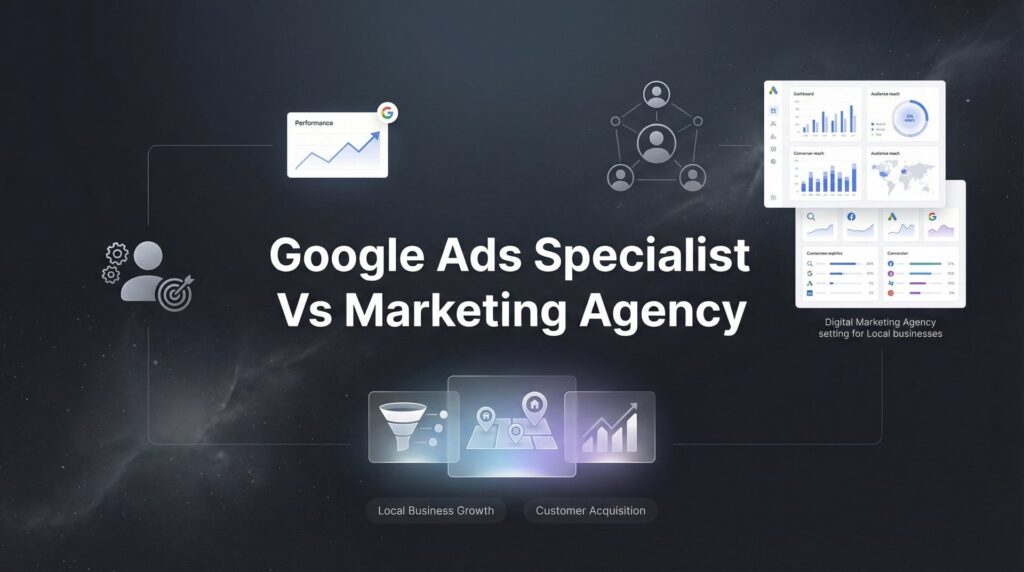
You’re spending $3,000 a month on Google Ads, and you can’t tell if it’s working. Your phone rings occasionally, but you’re not sure if those calls are worth what you’re paying. You know you need help, but now you’re stuck between two options: hire a Google Ads specialist who lives and breathes PPC, or bring on a marketing agency that promises to handle everything.
This isn’t just a vendor decision. It’s a revenue decision.
Choose wrong, and you’ll burn through months of budget while your competitors capture the customers you should be getting. Choose right, and you’ll build a customer acquisition system that scales with your business. The difference comes down to understanding what you actually need versus what sounds good in a sales pitch.
Most local business owners make this choice based on price alone, then wonder why their marketing still doesn’t work six months later. The real question isn’t “Who costs less?” It’s “Who can actually deliver the results my business needs right now?”
Let’s break down exactly how to make this call for your specific situation.
1. Audit Your Current Marketing Complexity
The Challenge It Solves
You can’t choose the right partner until you understand what you’re actually trying to accomplish. Many business owners think they just need Google Ads help, but their real problem is that their website doesn’t convert, their messaging is unclear, and they’re not tracking which leads turn into paying customers.
A Google Ads specialist will optimize your campaigns, but if your landing pages are terrible or your phone system loses leads, you’re just paying for expensive clicks that go nowhere. An agency can address these broader issues, but you’ll pay agency rates even if you only need basic campaign management.
The Strategy Explained
Start by mapping out every piece of your current marketing ecosystem. List your website, social media presence, email marketing, SEO efforts, offline advertising, and any other channels you’re using or planning to use. Then identify where the actual problems are.
If your only issue is getting your Google Ads campaigns set up correctly and optimized for your local market, a specialist makes sense. But if you’re also struggling with website conversions, need help with Facebook ads, want to improve your organic rankings, or need someone to coordinate all these pieces into a coherent strategy, you’re looking at agency territory.
The key distinction: specialists execute tactics brilliantly within their domain. Agencies orchestrate strategy across multiple channels. Neither is better—they solve different problems. Understanding the differences between agency and in-house marketing can help clarify what level of support your business actually needs.
Implementation Steps
1. Write down every marketing channel you currently use and rate each one’s performance honestly (working well, needs improvement, or broken).
2. Identify your biggest revenue leak—is it lack of traffic, poor conversion rates, weak follow-up, or something else entirely?
3. Determine if fixing your biggest problem requires deep expertise in one platform or coordination across multiple channels.
Pro Tips
If you find yourself saying “I need help with Google Ads, and also Facebook, and also my website, and also…” you need an agency. If you can finish the sentence with just “Google Ads,” start with a specialist. You can always expand later, but you can’t easily simplify an overcomplicated setup.
2. Calculate True Cost Beyond Monthly Fees
The Challenge It Solves
The sticker price is never the real price. A specialist might charge $1,500 per month while an agency quotes $3,500, but that comparison ignores everything else you’re paying for. Hidden costs destroy budgets and make seemingly affordable options expensive in practice.
Specialists typically don’t include tools, require more of your time for direction and decisions, and can’t help with adjacent problems that impact your results. Agencies absorb tool costs, provide strategic direction, and handle related issues, but you’re paying for capabilities you might not need yet.
The Strategy Explained
Build a complete cost model for each option over 12 months. For a specialist, add their monthly fee plus tool subscriptions (Google Ads scripts, bid management software, analytics platforms), your time cost for weekly meetings and providing direction, and the opportunity cost of problems they can’t solve.
For an agency, the monthly fee usually includes tools and more strategic oversight, but you’re paying for a team and infrastructure whether you use it all or not. The question becomes whether that premium delivers enough value to justify the difference. Getting clarity on what marketing agency fees actually cover helps you make apples-to-apples comparisons.
Many business owners discover that the specialist who seemed affordable actually costs more when you factor in the tools you need to buy separately and the hours you spend managing them. Others find that agency pricing includes services they don’t need and won’t use for another year.
Implementation Steps
1. Request detailed pricing breakdowns from both specialists and agencies, specifically asking what’s included and what costs extra.
2. Calculate your own time investment for each option by asking how many hours per week they need from you for meetings, approvals, and providing business context.
3. Research tool costs for platforms like SEMrush, Google Analytics 4 setup, call tracking software, and landing page builders that specialists might require you to purchase separately.
Pro Tips
Ask potential partners to walk you through a typical month of collaboration. The specialist who needs three hours of your time weekly is actually costing you $2,000+ in opportunity cost if your time is worth $150/hour. That “affordable” $1,500 monthly fee just became $3,500 in real terms.
3. Match Growth Stage to Partnership Model
The Challenge It Solves
Your business phase determines what type of marketing support actually makes sense. A startup burning through runway needs different help than an established business ready to scale, but most business owners pick partners based on who they think they should work with rather than who fits their current reality.
Hiring a full-service agency when you’re still validating product-market fit wastes money on strategy you can’t execute yet. But sticking with a specialist when you’re ready to scale across multiple channels creates a bottleneck that limits growth.
The Strategy Explained
If you’re in startup mode—testing offers, figuring out messaging, operating on limited budget—a specialist gives you focused execution without paying for strategic overhead you can’t use yet. You need someone to run campaigns while you figure out what works.
If you’re scaling—you’ve proven your model, you’re ready to increase customer acquisition, you need multiple channels working together—an agency provides the coordination and strategic thinking that turns marketing into a growth engine instead of a collection of tactics. Understanding typical Google Ads management pricing helps you budget appropriately for each growth stage.
If you’re established—consistent revenue, proven offers, looking to optimize and expand—you might need specialist-level depth in specific channels plus agency-level strategy. This is where hybrid models or agencies with deep specialist expertise make sense.
Implementation Steps
1. Honestly assess your business stage by looking at revenue consistency, customer acquisition cost stability, and whether you’re still experimenting with core offers.
2. Project where you’ll be in 12 months—if you expect to add new marketing channels or significantly increase spend, factor that into your decision.
3. Ask potential partners about their experience with businesses at your stage and request examples of how they’ve helped similar companies grow.
Pro Tips
The right answer might be starting with a specialist now with a clear plan to transition to an agency in 6-12 months. Many successful businesses begin with focused execution, then graduate to strategic coordination as they scale. Don’t pay for what you don’t need yet, but don’t lock yourself into a partnership that can’t grow with you.
4. Evaluate Expertise Depth vs. Strategic Breadth
The Challenge It Solves
Platform mastery and strategic thinking are different skills. A Google Ads specialist might know every bidding strategy, ad format, and optimization technique, but struggle to explain how your PPC campaigns should align with your SEO strategy or seasonal business patterns. An agency strategist might see the big picture brilliantly but lack the technical depth to troubleshoot why your conversion tracking broke after a website update.
You need to know which type of expertise your business actually requires right now, not which sounds more impressive in a sales conversation.
The Strategy Explained
Deep platform expertise matters when your success depends on extracting maximum performance from a single channel. If Google Ads is your primary customer acquisition source and you’re competing in a tough local market, you need someone who can optimize at the keyword level, write ad copy that converts, and structure campaigns for your specific business model.
Strategic breadth matters when your challenge is coordination, not execution. If you’re running Google Ads, Facebook ads, and SEO simultaneously, but they’re not working together, you need someone who can create a unified strategy where each channel supports the others instead of competing for the same budget. Learning how to choose between Google Ads and Facebook Ads for lead generation is just one piece of this multi-channel puzzle.
For local service businesses, this often comes down to whether you’re trying to dominate one channel or build a diversified customer acquisition system. Specialists help you win at one thing. Agencies help you orchestrate multiple things into something greater than the sum of parts.
Implementation Steps
1. Define your primary customer acquisition challenge—is it maximizing one channel’s performance or coordinating multiple channels effectively?
2. Ask potential partners about their experience with your specific business model and local market, requesting concrete examples of results they’ve achieved.
3. Test their knowledge by asking technical questions about your industry’s unique challenges—specialists should have deep answers, agencies should have strategic frameworks.
Pro Tips
Look for Google Partner or Premier Partner status when evaluating both specialists and agencies. This certification demonstrates verified expertise and gives them access to beta features and direct Google support that can benefit your campaigns. Understanding Google Partner agency benefits helps you evaluate whether this credential matters for your situation.
5. Assess Communication and Accountability
The Challenge It Solves
Marketing that you don’t understand might as well not exist. Many business owners hire experts, then feel frustrated because they can’t get straight answers about what’s happening with their money. Specialists and agencies have different communication styles and accountability structures, and picking the wrong match leads to constant frustration.
You need to know whether you’re getting a partner who explains their thinking or a vendor who expects you to trust their process without question. Both can deliver results, but only one will feel like a good fit for how you like to work.
The Strategy Explained
Specialists typically offer more direct access and faster response times because you’re working with one person or a small team. You can text them with questions and get immediate answers. But this also means their communication style is what you get—if they’re not naturally good at explaining complex concepts in plain language, you’re stuck with confusion.
Agencies provide structured communication through account managers, scheduled reporting, and formal review processes. You get professional presentations and comprehensive reports, but you might wait 24-48 hours for answers to urgent questions. The accountability is clearer because there’s a team behind your account, but you’re also one client among many.
The right choice depends on whether you value speed and direct access over structure and professional polish. Neither is wrong—they’re designed for different working styles. If you’re dealing with poor quality leads from marketing, clear communication about lead qualification becomes even more critical.
Implementation Steps
1. During initial conversations, notice how potential partners explain their process—do they use jargon or plain language? Do they assume you understand or take time to educate?
2. Ask specifically about communication cadence: How often will you meet? What happens if you have an urgent question? Who will you actually talk to?
3. Request sample reports from their current clients to see what kind of information you’ll receive and whether it actually helps you understand performance.
Pro Tips
The best partners are willing to explain their strategy decisions, not just report numbers. Ask “Why did you make this change?” about a recent campaign adjustment. If they can’t give you a clear, business-focused answer, they’re either not strategic enough or not good at communication. Either way, it’s a problem.
6. Test Scalability and Long-Term Potential
The Challenge It Solves
Switching marketing partners is expensive and disruptive. You lose momentum, waste time on onboarding, and risk losing the institutional knowledge someone built about your business. Choosing a partner who can’t scale with you means you’ll face this painful transition within 12-18 months.
Many business owners pick based on current needs without considering where they’ll be next year. Then they’re stuck either outgrowing a specialist who can’t support expansion or paying agency rates they don’t need yet.
The Strategy Explained
Project your business 12-24 months out. Will you still be focused primarily on Google Ads, or will you need to add Facebook advertising, SEO, email marketing, or conversion rate optimization? If your answer is “probably need more channels,” starting with a specialist means you’ll either ask them to learn new platforms or hire additional vendors to coordinate.
Specialists can sometimes expand their services, but you’re betting on one person’s ability to master multiple disciplines. Agencies already have teams with diverse expertise, but you’re paying for that capacity whether you use it immediately or not. Knowing how to hire a digital marketing agency that delivers results becomes essential when you’re ready to make that transition.
The strategic question: Is it better to pay a premium now for growth capacity you’ll use later, or start lean and plan for a transition when you’re ready to scale?
Implementation Steps
1. Write down your realistic marketing plan for the next 18 months, including new channels you expect to test and budget increases you anticipate.
2. Ask potential partners how they’ve helped clients expand from single-channel to multi-channel marketing, requesting specific examples of successful transitions.
3. Discuss contract terms and transition processes—what happens if you outgrow their capabilities or need to add services they don’t offer?
Pro Tips
Look for partners who are honest about their limitations. A specialist who says “I can handle Google Ads and Facebook, but if you need SEO, I’ll help you find someone great” is more trustworthy than one who claims to do everything. An agency that says “We can start with just Google Ads and expand when you’re ready” respects your current situation while offering growth potential.
7. Run a 90-Day Pilot Program
The Challenge It Solves
You can’t know if a partnership will work until you actually work together. Specialists and agencies both sound great in sales conversations, but the real test is whether they deliver results and whether you enjoy collaborating with them. Committing to a year-long contract based on a sales pitch is a gamble you don’t need to take.
A structured pilot program gives you a low-risk way to validate your choice with real performance data before you make a long-term commitment.
The Strategy Explained
Propose a 90-day trial period with clearly defined objectives and KPIs. This isn’t about expecting miracles in three months—it’s about evaluating process, communication, and whether the partnership feels right. You’re testing both results and working relationship. Many businesses find that working with a marketing agency with no long-term contract gives them the flexibility to test partnerships without excessive risk.
Set specific metrics that matter to your business: cost per lead, lead quality, conversion rates, or revenue from campaigns. But also evaluate softer factors like responsiveness, transparency, and whether they’re educating you or just executing blindly.
At the end of 90 days, you’ll have real data about performance and real experience with their communication style. This makes the decision to continue, adjust, or move on much clearer than any sales conversation could.
Implementation Steps
1. Define 3-5 specific KPIs that will determine pilot success, focusing on metrics that directly impact revenue rather than vanity metrics like impressions or clicks.
2. Establish a baseline for these metrics before the pilot starts so you can measure actual improvement, not just activity.
3. Schedule a mid-point check-in at 45 days to address any issues early and a final evaluation at 90 days to make your continuation decision.
Pro Tips
The best partners will embrace a pilot program because they’re confident in their ability to deliver results. If someone pushes back on a trial period or insists on a long-term contract upfront, that’s a red flag. Confidence shows up as “Let’s prove this works before you commit” not “Sign here for 12 months.”
Putting It All Together: Your Decision Roadmap
Here’s what this decision really comes down to: Do you need someone who can execute one thing brilliantly, or do you need someone who can orchestrate multiple things strategically?
Start with the complexity audit. If you’re primarily focused on Google Ads with no immediate plans to expand to other channels, and you’re comfortable providing strategic direction yourself, a specialist gives you focused expertise without paying for capabilities you don’t need yet.
If you’re running or planning to run multiple marketing channels, need help with conversion optimization and strategy, or want someone who can coordinate all your marketing efforts into a cohesive system, an agency provides the breadth and infrastructure to support that complexity.
Calculate the true cost including tools, your time investment, and opportunity costs. The cheapest option upfront often becomes expensive when you factor in everything else you’re paying for or losing.
Match your growth stage to the partnership model. Startups and early-stage businesses often benefit from specialist focus. Scaling businesses need strategic coordination. Established businesses might need specialist-level depth within an agency structure.
Whatever you choose, structure it as a 90-day pilot with clear KPIs. This protects you from expensive mistakes and gives you real data to make the long-term decision.
The biggest mistake isn’t choosing a specialist over an agency or vice versa—it’s choosing based on price alone without considering what you actually need to grow your business. Marketing that doesn’t produce revenue isn’t cheap, no matter what you pay for it.
Tired of spending money on marketing that doesn’t produce real revenue? We build lead systems that turn traffic into qualified leads and measurable sales growth. If you want to see what this would look like for your business, we’ll walk you through how it works and break down what’s realistic in your market.
Want More Leads for Your Business?
Most agencies chase clicks, impressions, and “traffic.” Clicks Geek builds lead systems. We uncover where prospects are dropping off, where your budget is being wasted, and which channels will actually produce ROI for your business, then we build and manage the strategy for you.