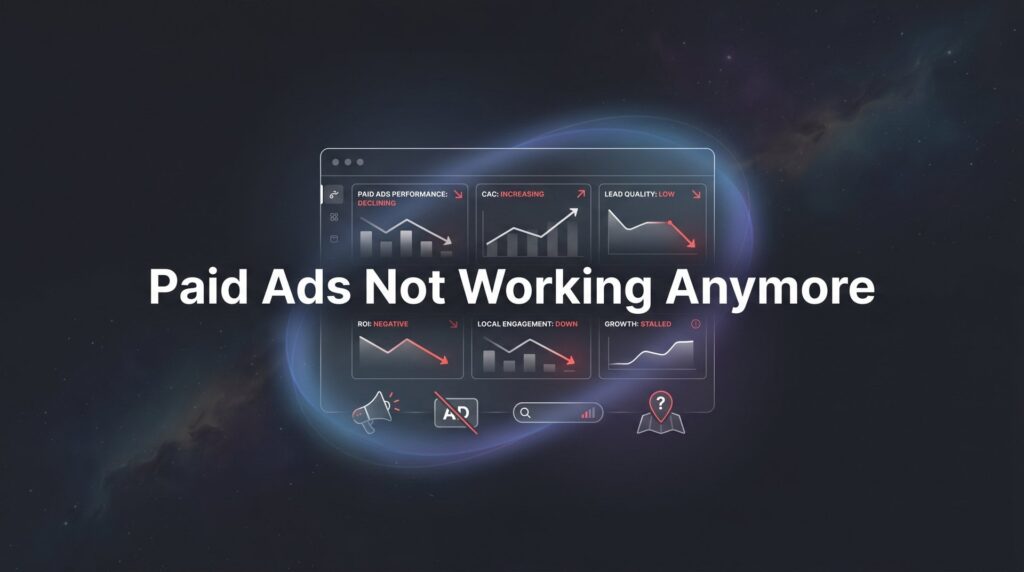
You open your ad dashboard with that familiar mix of hope and dread. The numbers load, and your stomach sinks. Clicks are up 23% this month. Cost per click is climbing steadily. But leads? Down 40%. Sales? Even worse.
You’re not imagining it. Something has fundamentally broken.
Here’s what makes this frustrating: the platform keeps telling you everything is “optimizing” and “learning.” Your ads are getting impressions. People are clicking. But somewhere between that click and an actual customer walking through your door or filling out your form, the whole system is hemorrhaging money.
If this sounds painfully familiar, you’re part of a massive shift that’s caught thousands of businesses off guard. The paid advertising playbook that worked beautifully in 2019 or even 2022 is now quietly draining budgets without delivering proportional results. This isn’t about one platform being “broken” or your business suddenly becoming less appealing. It’s about a perfect storm of market changes, privacy restrictions, and strategic gaps that compound over time until your once-profitable campaigns become expensive question marks.
The good news? Once you understand what’s actually happening beneath the surface, the fixes are surprisingly straightforward. Let’s break down the seven hidden reasons your paid ads stopped working and exactly how to address each one.
The Foundation Shifted While You Were Running Campaigns
The digital advertising world you’re operating in today bears little resemblance to the one from just a few years ago. If your strategy hasn’t evolved to match these changes, you’re essentially trying to navigate with an outdated map.
Apple’s App Tracking Transparency framework, rolled out with iOS 14.5, fundamentally altered how advertisers can track user behavior across apps and websites. When users started seeing that now-familiar “Ask App Not to Track” prompt, the majority opted out. Suddenly, the pixel tracking that powered precise retargeting and attribution became significantly less reliable. You’re no longer seeing the full picture of how people interact with your ads before converting.
This means the platform is making optimization decisions with incomplete data. That “learning” phase your campaigns sit in? It’s learning from a fraction of the conversion data it used to receive. The result is less accurate targeting and attribution that often credits the wrong touchpoint for a conversion, leading you to double down on strategies that aren’t actually working.
Google’s ongoing deprecation of third-party cookies compounds this challenge. The remarketing audiences that once let you follow interested visitors across the web are becoming less effective. Your ability to re-engage someone who visited your site but didn’t convert has been significantly handicapped.
Meanwhile, competition has intensified dramatically. As more businesses shifted marketing budgets online, auction dynamics changed. Industries that once had reasonable cost-per-click rates now see bidding wars for the same keywords. Your $2 click from two years ago might cost $5 today for the same search term, same position, same everything except the price tag.
Consumer behavior has evolved alongside these platform changes. People are exposed to exponentially more advertising than before. Ad fatigue sets in faster. The buyer journey has lengthened, with prospects typically requiring multiple touchpoints across different channels before they’re ready to convert. That single ad that used to generate immediate sales now needs to be part of a coordinated sequence.
What worked when you could precisely track every click, show ads to warm audiences repeatedly, and convert buyers in one or two touches simply doesn’t work the same way anymore. The businesses still succeeding with paid ads have adapted their entire approach to this new reality.
Your Targeting Is Casting Too Wide a Net
Automated targeting sounds appealing. Let the algorithm find your customers. Set it and forget it. But here’s what actually happens when you rely too heavily on broad automated targeting without proper constraints.
The platform optimizes for the objective you give it, which is typically clicks or conversions. But it doesn’t inherently understand your business model, your ideal customer profile, or what constitutes a qualified lead versus a tire-kicker. Without guardrails, automated campaigns often find the easiest, cheapest conversions rather than the most valuable ones.
You end up paying for clicks from people who were never going to buy from you. Someone searching “free alternatives to [your service]” technically matches your broad keyword targeting. They click, they cost you money, they leave. The algorithm counts this as engagement and keeps serving ads to similar searchers. This is a classic example of poor quality leads from marketing that drain your budget without delivering results.
Audience segments that performed brilliantly 12 or 18 months ago may have completely shifted. Markets change. Interests evolve. Competitors target the same segments, creating saturation. What was once a goldmine of qualified prospects becomes an expensive dead end, but if you’re not actively monitoring segment performance, you won’t notice until you’ve wasted significant budget.
Here’s a problem most businesses overlook: negative keyword lists and audience exclusions get set up during initial campaign creation, then never touched again. Your business evolves. You stop offering certain services. You identify customer types that never convert profitably. But your negative lists don’t update automatically.
The result? You’re still paying for clicks on terms like “DIY [your service]” or “how to [solve problem] yourself” when those searchers have zero intent to hire anyone. You’re showing ads to people who already converted, wasting impressions on existing customers when you should be excluding them and focusing budget on new prospects.
Geographic targeting presents another common trap. You set your service area broadly to capture everyone within 30 miles. But when you actually analyze conversion data by location, you discover that 80% of your profitable customers come from three specific zip codes. The other areas generate clicks and inquiries but rarely convert into paying customers. Every dollar spent on those low-converting areas is a dollar not spent on the high-converting ones.
Fixing targeting isn’t about making it narrower for the sake of being narrow. It’s about using data to identify where your actual customers come from, what they search for, and how they behave, then building targeting that concentrates spend on those high-probability prospects while systematically excluding the patterns that waste money.
The Landing Page Is Sabotaging Your Ad Spend
Your ad did its job. Someone clicked. They were interested enough to take action. Then they land on your page and… nothing. They bounce. The conversion never happens. And you just paid for a click that had zero chance of converting.
Message mismatch is the silent killer of paid advertising ROI. Your ad promises a specific solution to a specific problem. It uses certain language, highlights particular benefits, creates an expectation. Then the landing page talks about something completely different, uses corporate jargon, or buries the promised offer three scrolls down beneath generic company history.
The prospect experiences cognitive dissonance. “Wait, is this even the same company?” They expected to find exactly what the ad promised, immediately and obviously. Instead, they have to hunt for it. Most don’t bother. They hit the back button, and your money evaporates. Understanding how to fix ads not converting to sales starts with recognizing this disconnect.
Page speed is another conversion killer that most businesses underestimate. Your ad loads instantly. The click happens. Then… the page loads. And loads. And loads. Three seconds feels like an eternity when you’re waiting for a website. Many users will abandon before your page even fully renders, especially on mobile devices.
Mobile experience problems compound this issue. Your landing page might look great on your desktop computer. But 60-70% of clicks are coming from mobile devices. If your page isn’t genuinely mobile-optimized—not just “responsive” but actually designed for thumb navigation, fast loading on cellular connections, and easy form completion on a small screen—you’re losing the majority of your traffic before they even see your offer.
Forms present their own set of conversion obstacles. You’re asking for too much information too soon. You want name, email, phone, company, job title, budget, timeline, and a detailed description of their needs. They wanted to request a simple quote. The friction is too high. They abandon.
Weak or unclear calls-to-action leave qualified prospects genuinely unsure what to do next. You have three different CTAs on the page: “Learn More,” “Get Started,” and “Contact Us.” Which one should they click? What happens when they click each one? The confusion creates hesitation, and hesitation kills conversions.
Trust signals are often missing entirely. No customer testimonials. No logos of companies you’ve worked with. No clear explanation of what happens after they submit the form. No phone number or physical address to verify you’re a real business. In an era of increasing online skepticism, these missing elements make prospects nervous about taking the next step.
The brutal truth is that even a perfectly targeted, brilliantly written ad campaign will fail if it sends traffic to a landing page that doesn’t convert. Every dollar spent driving traffic to a broken landing experience is a dollar wasted, regardless of how good your targeting or ad creative might be.
Budget Allocation and Bidding Are Working Against You
You set up automated bidding because the platform recommended it. Target CPA or Maximize Conversions seemed like smart choices. The algorithm would handle the complex auction dynamics, and you’d get better results. Except that’s not what happened.
Automated bidding strategies need proper guardrails and active monitoring. Without them, they’ll optimize for the objective you set, but not necessarily in a way that aligns with your business goals. Target CPA bidding might deliver conversions at your target cost, but if those conversions are low-quality leads that never close, you’re hitting a meaningless metric while losing money. This is the core of the low quality leads problem many advertisers face.
Setting and forgetting automated strategies is where many businesses go wrong. The algorithm makes assumptions based on historical data. But if your business changes—you launch a new service, adjust pricing, shift your ideal customer profile—the bidding strategy doesn’t automatically know this. It keeps optimizing for patterns that no longer serve your current objectives.
Budget fragmentation is another silent killer of campaign performance. You’re running eight different campaigns, each with a small daily budget. None of them have enough budget to exit the learning phase or gather statistically significant data. The algorithm never gets the volume it needs to optimize effectively, so all eight campaigns underperform when consolidating into three well-funded campaigns would likely deliver better overall results.
This happens because businesses want to test everything simultaneously. Different ad sets for different services, different geographic areas, different audience segments. The intention is good, but the execution spreads resources so thin that nothing succeeds. Each campaign is starved for data, stuck in perpetual learning mode, never reaching the volume needed for the algorithm to make confident optimization decisions.
Dayparting and geographic performance data often go completely ignored. You’re spending the same amount at 3 AM as you are at 3 PM, even though your conversion data clearly shows that leads generated during business hours convert at three times the rate of after-hours submissions. You’re spending equally across all zip codes even though specific areas consistently deliver higher-value customers.
Bid adjustments represent another missed optimization opportunity. You can increase or decrease bids based on device type, location, time of day, and audience characteristics. But most businesses leave these at default settings, effectively telling the platform that a click from any source at any time is equally valuable. This isn’t true for any business, yet the bidding strategy doesn’t reflect this reality.
Budget pacing issues create their own problems. You set a monthly budget, but the platform spends it unevenly. You burn through 60% of budget in the first ten days when performance is mediocre, then have limited budget remaining during the end of month when historical data shows your best conversion rates. Without active budget management, you’re not spending money when it matters most.
Creative Fatigue Is Killing Performance and You Don’t See It
You launched your campaign three months ago with ad creative that tested well initially. Performance was strong for the first few weeks. Then it gradually declined. You assumed it was seasonal fluctuation or increased competition. But the real culprit is simpler: your audience is tired of seeing the same ads.
Ad creative has a shelf life. Even the most compelling message, the most eye-catching image, the most persuasive value proposition eventually loses effectiveness as people see it repeatedly. The first time someone sees your ad, it might stop their scroll and capture attention. The fifth time? They scroll right past without even registering it consciously.
Frequency metrics tell this story clearly, but many advertisers never look at them. When the same person sees your ad seven, ten, fifteen times, they’ve already decided whether to engage. Continuing to show them the same creative isn’t going to change their mind. It’s just wasting impressions and budget on people who’ve already opted out mentally.
Testing new creative should be an ongoing activity, not something you do once during campaign launch. The businesses with consistently strong ad performance have a systematic approach to creative refresh. They’re testing new angles every month. Trying different formats. Rotating messaging to highlight different benefits and address different objections.
Most businesses approach creative as a one-time project. They develop a set of ads, launch them, and only revisit creative when performance has already declined significantly. By that point, they’ve wasted weeks or months of budget on fatigued creative that stopped working long ago. If you’re wondering why marketing isn’t working for your business, creative fatigue is often a hidden culprit.
Format variety matters more than many advertisers realize. If you’re only running static image ads, you’re missing opportunities. Video content often captures attention more effectively, particularly on social platforms where the feed is saturated with static images. Interactive formats like carousel ads or collection ads can showcase multiple products or tell a more complete story than a single image allows.
The challenge is that different formats require different production approaches. Creating effective video content takes more time and resources than static images. But the performance difference often justifies the investment. A well-produced video ad that demonstrates your product or service in action can outperform static alternatives by a significant margin.
Messaging angles need continuous evolution as well. Your initial ads probably focused on your core value proposition. But there are multiple reasons people buy from you, multiple problems you solve, multiple objections you need to address. Rotating through these different angles keeps your advertising fresh and reaches people who might not respond to your primary messaging.
Seasonal and timely creative presents another opportunity most businesses miss. Your generic evergreen ads run year-round, but creating timely variations that acknowledge current events, seasons, or industry trends can significantly boost relevance and engagement. The ad that mentions a specific pain point businesses face in Q2 will resonate more strongly than generic messaging that could run any time.
Rebuilding Your Strategy for Sustainable Performance
Understanding what’s broken is valuable. But understanding how to fix it systematically is what actually improves results. The businesses seeing consistent returns from paid advertising in the current environment treat it as a dynamic system requiring regular attention, not a set-it-and-forget-it channel.
Start with a comprehensive audit process that you execute monthly, not quarterly or annually. Review targeting settings and performance by segment. Which audiences are actually converting? Which are generating clicks but no downstream value? Adjust targeting to concentrate spend on proven performers and eliminate waste on underperformers.
Analyze creative performance and frequency data. Which ads are still engaging your audience effectively? Which have reached fatigue and need replacement? Develop a creative refresh calendar that ensures you’re testing new angles and formats regularly, before performance declines force your hand.
Audit landing pages with fresh eyes, or better yet, have someone unfamiliar with your business review them. Is the message match between ad and page immediately obvious? Does the page load quickly on mobile? Is the call-to-action crystal clear? Are you asking for too much information too soon? Make page optimization an ongoing process, not a one-time project.
Review bidding strategies and budget allocation based on actual performance data. Are your automated bidding strategies delivering conversions that actually close into customers? Is budget distributed proportionally to where results are strongest? Are you taking advantage of bid adjustments for high-performing segments and time periods?
First-party data collection should become a strategic priority. The privacy changes that disrupted platform targeting aren’t reversing. Building your own customer database through email collection, customer surveys, and CRM integration gives you targeting capabilities that don’t rely on platform tracking. Upload customer lists to create lookalike audiences. Use your data to inform targeting rather than depending entirely on platform assumptions about who your customers are.
Attribution needs a more sophisticated approach than last-click. Use platform analytics in combination with your own tracking to understand the full customer journey. Which touchpoints are actually influencing conversions? Are you giving credit to the channels and campaigns that deserve it, or are you optimizing based on incomplete attribution data? Understanding the differences between platforms like Google Ads and Facebook Ads for lead generation can help you allocate budget more effectively.
Consider whether you have the internal bandwidth to manage campaigns with the attention they require. Paid advertising that performs consistently demands daily monitoring, weekly optimization, and monthly strategic review. If you’re checking campaigns every few weeks between other responsibilities, you’re reacting to problems long after they’ve cost you money.
Many businesses reach a point where the opportunity cost of DIY campaign management exceeds the cost of working with specialists who live in ad platforms daily and can spot performance shifts before they become expensive problems. The question isn’t whether you can technically run campaigns yourself—it’s whether you can dedicate the time and expertise needed to run them profitably.
The Path Forward: Adaptation Over Abandonment
Paid advertising still works. The evidence is everywhere. Businesses across industries are generating qualified leads, acquiring customers, and scaling profitably through paid channels. But the playbook has fundamentally changed, and success now belongs to those who adapt quickly rather than clinging to strategies that worked in a different era.
The seven issues we’ve covered—platform changes, targeting drift, landing page problems, budget misallocation, creative fatigue, and strategic gaps—rarely exist in isolation. They compound. A mediocre landing page might still convert if targeting is excellent. Fatigued creative might still drive some results if you’re bidding strategically. But when multiple issues stack up, performance collapses.
The good news is that each issue has a clear solution. Better targeting through systematic audience analysis and negative list management. Landing pages optimized for message match, speed, and mobile experience. Budget concentrated on proven performers with strategic bid adjustments. Creative refreshed regularly before fatigue sets in. First-party data collection reducing platform dependency.
What separates businesses seeing strong returns from those watching budgets evaporate is simple: they treat paid advertising as a dynamic system requiring continuous optimization rather than a campaign you launch and monitor occasionally. They test constantly. They review performance data weekly. They make adjustments based on what’s actually working, not what they think should work.
Start with an honest audit of your current campaigns using the framework we’ve outlined. Look at your targeting—are you excluding obvious waste? Check your landing pages—do they match your ad messaging and load quickly? Review your creative—when was the last time you refreshed it? Analyze your budget allocation—is spend concentrated where performance is strongest?
The answers to these questions will likely reveal several quick wins that can improve performance immediately without requiring major strategic overhauls or additional budget. Sometimes the difference between profitable campaigns and money-losing ones is fixing a handful of specific, identifiable problems rather than completely rebuilding everything.
Tired of spending money on marketing that doesn’t produce real revenue? We build lead systems that turn traffic into qualified leads and measurable sales growth. If you want to see what this would look like for your business, we’ll walk you through how it works and break down what’s realistic in your market.