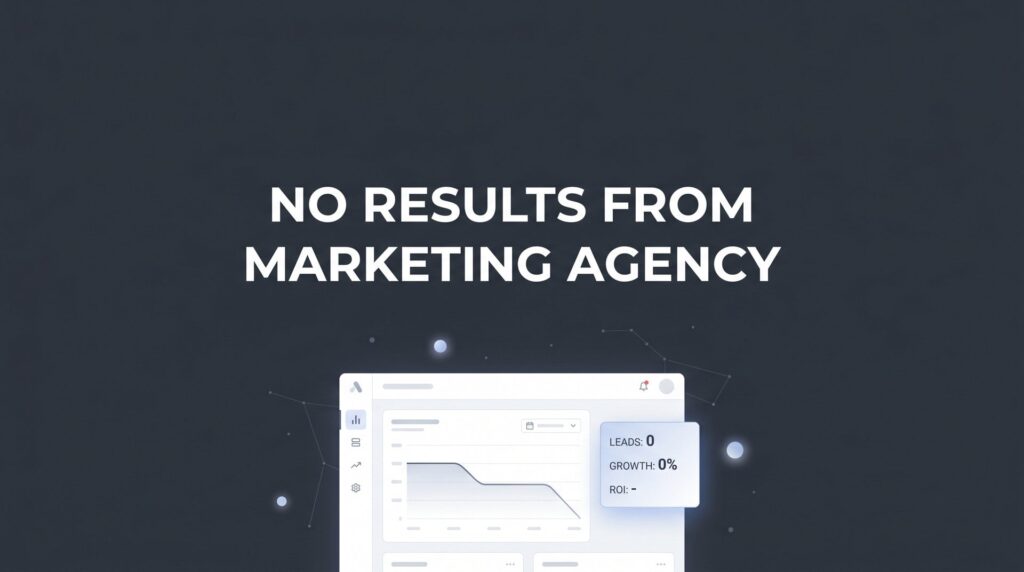
You open another monthly report from your marketing agency. Impressions are up. Clicks look solid. The graphs trend upward. Everything appears to be working—except your phone isn’t ringing, your inbox isn’t filling with inquiries, and your bank account certainly isn’t reflecting any growth. You’ve been writing checks for six months now, maybe longer, and you’re starting to wonder if you’re the problem for expecting actual customers from your marketing investment.
This isn’t just frustrating. It’s financially draining and emotionally exhausting. You second-guess every business decision. You wonder if digital marketing is just smoke and mirrors. You feel stuck between continuing to throw money at a strategy that isn’t working and starting over from scratch with no guarantee the next agency will be any different.
Here’s what you need to know: this situation is remarkably common, and it’s not because digital marketing doesn’t work. It’s because many agency relationships are built on a fundamental misalignment between what agencies measure and what business owners actually need. The good news? Once you understand why this happens, you can fix it—either by transforming your current partnership or by finding one that’s actually designed to drive revenue, not just activity.
The Silent Warning Signs You’re Being Underserved
The first red flag often hides in plain sight: your monthly reports are filled with numbers that sound impressive but feel disconnected from your actual business. Your agency celebrates 50,000 impressions and a 3.2% click-through rate while you’re sitting there thinking, “Great, but did we get any customers?” This gap between vanity metrics and revenue metrics is the clearest indicator that something’s fundamentally wrong with the relationship.
Vanity metrics—impressions, reach, engagement rates, website visits—are easy to generate and easy to report. They make agencies look busy and campaigns look successful. But here’s the thing: you can have stellar vanity metrics while your business slowly bleeds money. What matters is whether those clicks turned into calls, whether those website visits became consultations, whether any of this activity actually put money in your bank account.
Communication patterns reveal even more. Does your monthly call keep getting rescheduled? When you ask specific questions about lead quality or cost per customer, do you get clear answers or a word salad of digital marketing jargon? Pay attention to whether your agency proactively reaches out with optimization ideas or only contacts you when it’s time to renew the contract.
The “set it and forget it” approach is particularly insidious because everything appears to be running smoothly. Your campaigns are active. Money is being spent. Reports arrive on schedule. But when you dig into the details, you realize the targeting hasn’t been adjusted in months, the ad creative is identical to what launched six months ago, and nobody’s tested a new landing page or offer since the campaign started. You’re paying for ongoing management, but you’re getting autopilot.
Another warning sign: your agency can’t articulate what they’re testing or why. A healthy marketing partnership involves constant experimentation—different audiences, varied messaging, alternative offers, refined targeting. If your agency can’t tell you what they tested last month and what they learned from it, they’re not managing your campaigns. They’re babysitting them. Understanding why marketing isn’t working for your business starts with recognizing these patterns.
The most telling indicator of all? Your agency doesn’t know your numbers. They can’t tell you your average customer value, your typical sales cycle length, or what a qualified lead looks like for your business. They’re running campaigns in a vacuum, optimizing for clicks without understanding whether those clicks have any chance of becoming customers. This isn’t marketing. It’s expensive guesswork.
Five Root Causes Behind Agency Underperformance
The misaligned incentives problem runs deeper than most business owners realize. Many agencies structure their entire operation around metrics they can control rather than outcomes their clients actually care about. They optimize for click-through rates because that’s a number they can improve through better ad copy and targeting. They celebrate increased website traffic because that’s something they can directly influence. But neither of those metrics pays your rent or covers payroll.
This misalignment isn’t always malicious—it’s often structural. Agencies have limited visibility into what happens after someone clicks an ad. They don’t sit in on your sales calls. They don’t see which leads close and which ones ghost you after the first conversation. Without this feedback loop, they optimize for the metrics they can see, which may have zero correlation with the metrics that actually matter to your business.
Poor targeting and audience research creates a different kind of failure. Your agency might be technically proficient at running campaigns, but if they’re showing your ads to the wrong people, no amount of optimization will save you. This happens when agencies rely on broad demographic assumptions instead of doing the hard work of understanding your actual customer base. They target “small business owners aged 35-55” when your best customers are actually “second-generation family business owners dealing with succession planning.” That specificity makes all the difference.
The audience research problem gets worse when agencies recycle strategies that worked for other clients without adapting them to your unique market position. What worked for a SaaS company selling project management software won’t work for a local HVAC contractor. The buying cycles are different, the decision-making processes are different, and the competitive landscapes are completely different. Cookie-cutter strategies produce cookie-cutter results—which is to say, mediocre at best. If you’re dealing with poor quality leads from marketing, this is often the root cause.
Conversion infrastructure gaps kill more campaigns than bad targeting ever could. Think of it this way: even if your agency drives perfect traffic—exactly the right people, at exactly the right time, with exactly the right message—that traffic still needs somewhere productive to go. If your landing page is confusing, your contact form is broken, your phone system drops calls, or your follow-up process is nonexistent, you’re pouring water into a bucket with no bottom.
Many agencies focus exclusively on the traffic generation side of the equation because that’s their core competency. They’re not responsible for your website, your CRM, your sales process, or your follow-up systems. But here’s the problem: all of those elements determine whether your marketing investment produces revenue. An agency that generates great traffic but ignores conversion infrastructure is like a personal trainer who only focuses on cardio while ignoring strength training and nutrition. You’re getting half a solution.
The tracking and attribution breakdown compounds everything else. If your agency can’t track which campaigns produce which customers, they’re flying blind. They might be running five different campaigns, and one of them could be responsible for 80% of your actual revenue while another generates lots of clicks but zero customers. Without proper tracking, they’ll never know the difference. They’ll keep optimizing all campaigns equally, wasting your budget on strategies that fundamentally don’t work for your business.
Finally, there’s the expertise mismatch problem. Your agency might be excellent at brand awareness campaigns or social media engagement, but if what your business actually needs is direct response lead generation, their skillset doesn’t match your requirements. It’s like hiring a portrait photographer to shoot your wedding—they’re a professional photographer, but they’re not the right kind of professional for what you need.
How to Audit Your Current Agency Relationship
Start with the most important question: “Can you show me our cost per qualified lead over the last three months?” Notice the specific language here—not cost per click, not cost per website visit, but cost per qualified lead. A qualified lead is someone who actually fits your customer profile and has genuine interest in what you sell. If your agency can’t answer this question with specific numbers, that’s your first major red flag.
Follow up with: “Do you know our customer lifetime value, and how does that inform our acquisition cost targets?” This question reveals whether your agency thinks strategically about your business or just tactically about campaign metrics. An agency that understands your business knows that you can afford to spend more to acquire a customer who’ll be worth $50,000 over five years than one who’ll make a single $500 purchase. If they look confused by this question, they’re not thinking about your profitability.
Ask them to walk you through their optimization process: “What did you test last month, what did you learn, and how did that change our strategy?” A healthy agency relationship involves constant testing and learning. They should be able to tell you specifically what they tried, what the results were, and what they’re doing differently as a result. Vague answers like “we’re always optimizing” or “we monitor performance closely” are non-answers that signal they’re not actually doing the work.
Pay attention to how they respond when you push back. Ask: “Our cost per lead has increased 40% in the last two months—what’s causing that and what’s your plan to fix it?” A good agency will have a specific, data-driven answer. They’ll explain whether it’s seasonal competition, audience saturation, or platform changes, and they’ll outline concrete steps they’re taking to address it. A bad agency will deflect blame to external factors, bury you in jargon, or suggest you just need to increase your budget. Having marketing agency fees explained clearly is part of this transparency.
The jargon overload response is particularly telling. When you ask a straightforward business question and get back a response filled with terms like “algorithmic bidding optimization,” “audience segmentation matrices,” and “multi-touch attribution modeling” without any clear connection to your actual business outcomes, your agency is hiding behind complexity. Good agencies can explain complex concepts in simple terms because they actually understand what they’re doing.
Here’s what a healthy agency partnership actually looks like: Your agency knows your business well enough to have opinions about your offer, your pricing, and your sales process. They proactively suggest tests and explain why those tests matter to your bottom line. They’re transparent when something isn’t working and pivot quickly rather than letting underperforming campaigns drain your budget. They celebrate when you close a big deal and ask questions about what made that customer different so they can find more like them.
Most importantly, a good agency talks about revenue, not just metrics. Your conversations should center on questions like “How can we increase lead quality?” and “What would it take to hit your growth targets?” rather than “Look at how our click-through rate improved.” The focus should always connect back to your business outcomes, not their campaign performance in isolation.
The ROI Conversation Your Agency Should Be Having
Revenue attribution should be the foundation of every agency relationship, not an advanced topic you eventually get around to discussing. Your agency should be able to show you exactly which campaigns produced which customers and how much revenue those customers generated. This requires proper tracking infrastructure—conversion tracking, CRM integration, and closed-loop reporting that connects marketing activity to actual sales. Implementing call tracking for marketing campaigns is essential for this visibility.
Customer acquisition cost is the metric that matters most for business profitability. If you’re spending $500 to acquire a customer who’s worth $2,000 to your business, that’s a sustainable model you can scale. If you’re spending $500 to acquire a customer worth $300, you’re in a death spiral regardless of how many customers you acquire. Your agency should know these numbers and use them to make strategic decisions about budget allocation and campaign optimization.
Setting realistic timelines prevents the frustration that kills agency relationships prematurely. In the first 30 days, you should expect to see data gathering and initial optimization—your agency is learning what works in your specific market. You might see some early leads, but this is primarily a learning phase. Judging campaign success or failure at 30 days is premature for most business models.
By 60 days, you should see clear patterns emerging. Your agency should be able to tell you which audiences respond best, which messages resonate, and what your realistic cost per lead looks like in your market. You should be getting qualified leads consistently, even if the volume isn’t where you want it yet. This is when optimization really starts to pay dividends.
At 90 days, you should have enough data to make informed decisions about scaling or pivoting. Your cost per lead should be stabilizing or improving. Your lead quality should be getting better as your agency refines targeting based on which leads actually close. You should be able to project what it would look like to double your budget based on the performance patterns you’ve established.
These timelines vary by industry and campaign type. A local service business running Google Search ads might see qualified leads in week one. An e-commerce business building a new customer base through Facebook ads might need 60-90 days to gather enough data for optimization. Your agency should set expectations based on your specific situation, not generic industry standards.
Accountability structures keep everyone focused on what matters. Establish clear KPIs at the start: cost per qualified lead, lead-to-customer conversion rate, customer acquisition cost, and return on ad spend. Set up regular reporting cadences—weekly for the first month, then bi-weekly or monthly once patterns stabilize. Make sure your agency has access to closed-loop data so they can see which leads became customers.
Performance benchmarks should be specific and tied to your business goals. Instead of “increase website traffic by 50%,” your benchmark should be “achieve a cost per qualified lead of $200 or less within 90 days” or “generate 20 qualified leads per month at a customer acquisition cost below $1,000.” These benchmarks give your agency clear targets and give you objective criteria for evaluating their performance. Understanding what performance marketing is helps you set these expectations properly.
When to Stay, When to Pivot, When to Walk Away
Some agency relationships are worth saving. If your agency shows genuine willingness to adjust strategy based on results, that’s a strong indicator they’re invested in your success rather than just protecting their monthly retainer. When you raise concerns and they respond with specific action plans rather than defensive excuses, you’re dealing with a partner who can grow with your business.
Transparency about challenges is another positive sign. An agency that says “we’re seeing higher costs per lead than expected in this audience segment, so here’s what we’re testing to bring that down” is being honest and proactive. They’re treating you like a business partner who deserves to understand what’s happening with your investment. This kind of transparency builds trust and creates space for collaborative problem-solving.
Look for agencies that ask good questions about your business. When they want to understand your sales process, your typical customer objections, your competitive advantages, and your capacity to handle new leads, they’re thinking strategically about how to drive results. They’re not just running campaigns in isolation—they’re trying to understand the full customer journey so they can optimize for actual business outcomes.
Clear indicators that it’s time to find a new partner include persistent defensiveness when you raise concerns. If every conversation about underperformance turns into your agency explaining why it’s not their fault—the platform changed, your competitors increased spending, your industry is just difficult—they’re not taking ownership of results. A good agency acknowledges challenges but focuses on solutions, not excuses. Consider whether a performance based marketing agency might better align incentives with your goals.
Lack of strategic thinking reveals itself in agencies that only execute what you tell them to do. You’re paying for expertise and strategic guidance, not just campaign execution. If your agency never suggests new approaches, never questions whether your current strategy is optimal, and never brings ideas to the table, they’re order-takers, not strategic partners. You need someone who can think critically about your business and challenge assumptions when necessary.
The most damning indicator is when your agency can’t articulate a clear path to profitability. If you’re three months in and they can’t explain how your campaigns will eventually generate positive ROI, or if their plan is just “keep spending and eventually it’ll work,” you’re funding an experiment with no hypothesis. Walk away before you waste more money.
Transitioning agencies without losing momentum requires planning. First, document everything about your current campaigns—targeting parameters, ad creative that performed well, landing pages that converted, audience segments that showed promise. This data is yours, and you paid for it. Don’t let it die with the relationship. Export everything you can from your current agency’s accounts before you make the switch official.
Make sure you own your accounts and assets. Your Google Ads account, your Facebook Business Manager, your landing pages, your tracking pixels—all of these should be owned by you, with your agency having access rather than ownership. If your agency owns these assets, transitioning becomes exponentially harder. Set up new accounts under your ownership before you terminate the relationship if necessary. Seeking a marketing agency with no long term contract gives you more flexibility during transitions.
Give your new agency access to historical performance data so they can learn from what worked and what didn’t. The worst thing you can do is start completely from scratch, ignoring months of expensive learning. A good new agency will want to understand what you’ve already tried so they can build on successes and avoid repeating failures.
Building a Results-First Marketing Partnership
When evaluating potential agencies, look for a proven track record with businesses similar to yours—not just in industry, but in business model and growth stage. An agency that’s crushed it for enterprise SaaS companies might not understand the dynamics of local service businesses. An agency that specializes in e-commerce might struggle with B2B lead generation. Ask for case studies from clients who faced similar challenges and operated in similar markets.
Focus on agencies that talk about revenue, not vanity metrics. During initial conversations, pay attention to whether they ask about your customer lifetime value, your sales cycle, your capacity to handle new leads, and your profitability targets. These questions indicate they’re thinking about your business holistically, not just about campaign metrics in isolation. Learning how to hire a digital marketing agency that actually delivers results starts with knowing what questions to ask.
Before signing anything, ask these essential questions: “How do you define success for a client like me?” The answer should be specific and tied to business outcomes. If they say “increased brand awareness” or “more website traffic,” push them to connect those outputs to revenue. A good agency will say something like “success means generating qualified leads at a cost that makes your customer acquisition profitable and sustainable.”
Ask about their optimization process: “Walk me through what the first 90 days look like.” They should describe a structured approach to testing, learning, and refining based on data. Red flags include vague promises about “getting you to the top of Google” or guarantees about specific results. Good agencies set realistic expectations and explain their process clearly.
Find out how they handle underperformance: “What happens if we’re 60 days in and campaigns aren’t hitting our targets?” A trustworthy agency will have a clear process for diagnosing problems, adjusting strategy, and making data-driven decisions about whether to pivot or persevere. Be wary of agencies that promise results are just around the corner if you’ll just increase your budget or give them more time without specific reasoning. Also watch for hidden fees from marketing agencies that can erode your ROI.
The fundamental difference between agencies that report activity and agencies that drive growth comes down to focus. Activity-focused agencies celebrate how busy they are—how many ads they created, how many campaigns they launched, how many reports they generated. Growth-focused agencies celebrate business outcomes—how many qualified leads they generated, how much revenue they drove, how your customer acquisition costs improved.
Activity-focused agencies optimize for metrics that make them look good. Growth-focused agencies optimize for metrics that make your business more profitable. Activity-focused agencies want you to judge them on effort and expertise. Growth-focused agencies want you to judge them on results. The difference is everything.
Moving Forward with Clarity and Confidence
Experiencing no results from a marketing agency isn’t evidence that digital marketing doesn’t work for your business. It’s evidence that your current partnership isn’t structured to drive the outcomes you actually need. The agencies that succeed are the ones that align their success with yours—where your growth is their success metric, not just campaign activity or vanity metrics that look impressive in reports but don’t move your business forward.
You now have a framework for diagnosing what’s broken. Can your agency show you cost per qualified lead? Do they understand your customer lifetime value? Are they testing and optimizing based on real business outcomes? Do they communicate proactively and take ownership of results? These aren’t unreasonable expectations—they’re the baseline for a functional marketing partnership.
If your current agency relationship shows signs of being salvageable—transparency, willingness to adapt, genuine investment in your success—use the questions and frameworks in this article to reset expectations and refocus on what matters. If you’re seeing the red flags of defensiveness, lack of strategic thinking, and no clear path to profitability, you’re not being unreasonable for considering other options. You’re being responsible with your business resources.
The right marketing partnership transforms your business. It doesn’t just generate activity—it builds a predictable system for acquiring customers profitably. It doesn’t just report numbers—it drives revenue growth you can feel in your bank account. It doesn’t just keep campaigns running—it constantly tests, learns, and improves based on what actually works in your specific market.
Tired of spending money on marketing that doesn’t produce real revenue? We build lead systems that turn traffic into qualified leads and measurable sales growth. If you want to see what this would look like for your business, we’ll walk you through how it works and break down what’s realistic in your market.