You check your ad dashboard on Monday morning with your coffee still steaming. The numbers load slowly, and when they do, your stomach drops. $8,500 spent this month. Revenue directly attributed to those ads? $4,200. You’ve just burned through $4,300 of your marketing budget with nothing to show for it except the sinking realization that your ads aren’t working—they’re actively losing money.
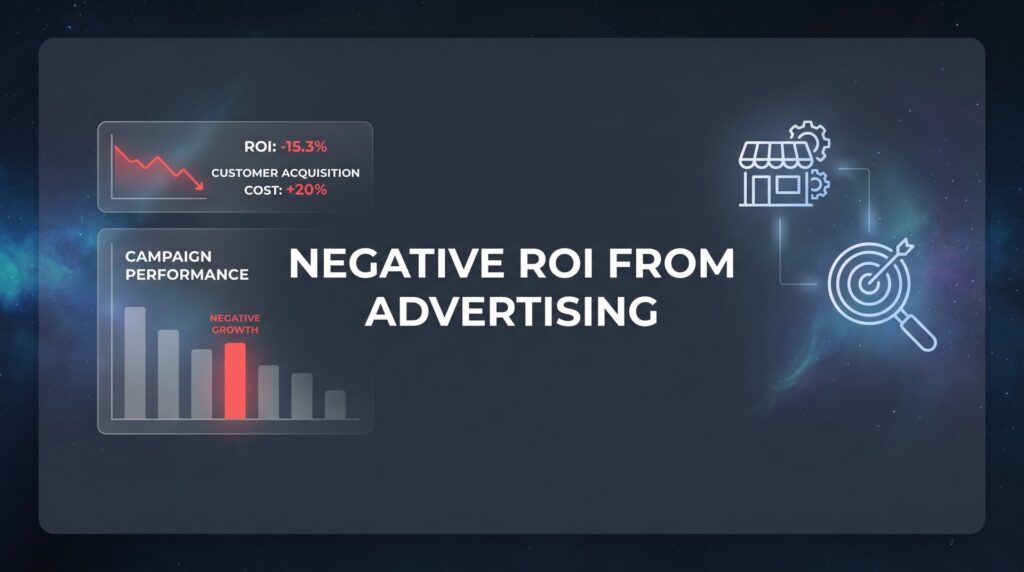
This is negative ROI from advertising, and it’s more common than most business owners want to admit. It happens when your advertising costs exceed the revenue those ads generate. Not break-even. Not “close enough.” Actually in the red, where every dollar you spend on ads takes you further from profitability instead of closer to it.
The real damage isn’t just the wasted budget. It’s the opportunity cost—what you could have done with that money if it had been invested in something that actually worked. It’s the compounding effect of bleeding cash month after month while your competitors figure out what you haven’t. And it’s the business sustainability question that keeps you up at night: how long can you keep this up before you have to pull the plug on paid advertising entirely?
Here’s what you need to understand: negative ROI isn’t a verdict on whether paid advertising can work for your business. It’s a diagnostic signal pointing to specific, fixable problems in your advertising system. This article will show you exactly why your ads are losing money and give you a clear framework for turning those campaigns profitable.
The Math Behind Advertising ROI (And When It Goes Red)
Let’s start with the formula that determines whether your advertising is making or losing money. The basic ROI calculation is straightforward: take your revenue from ads, subtract your ad spend, divide by your ad spend, then multiply by 100 to get a percentage.
The Formula: (Revenue from Ads – Ad Spend) / Ad Spend × 100
If you spent $5,000 on ads and generated $8,000 in revenue, your ROI is 60%. That’s positive—you’re making money. If you spent $5,000 and generated $3,000 in revenue, your ROI is -40%. That’s negative—you’re losing money.
But here’s where most businesses get tripped up: they forget to account for the full cost of their advertising system. Ad spend is just the money you pay to Facebook, Google, or whatever platform you’re using. The real cost includes creative production, management fees if you’re working with an agency, landing page development and hosting, CRM software, and the time your team spends managing campaigns. Understanding how to track marketing ROI properly means accounting for all these hidden expenses.
Think of it like this. You see $5,000 in ad spend and $6,000 in revenue and think you’re profitable. But you paid a designer $800 for ad creatives, your marketing manager spent 15 hours at $50/hour managing the campaign, and you’re paying $200/month for your landing page software. Your actual costs are $6,750, not $5,000. Your seemingly positive ROI just turned negative.
The severity of negative ROI matters too. A -20% ROI means you’re spending $1 to make $0.80—painful, but potentially salvageable with optimization. A -80% ROI means you’re spending $1 to make $0.20—that’s a fundamental breakdown in your advertising system that requires immediate surgery, not minor adjustments.
Understanding this distinction helps you calibrate your response. Small negative ROI might mean your targeting needs refinement or your landing page needs tweaking. Massive negative ROI usually signals deeper problems: wrong audience, wrong offer, wrong channel, or wrong business model for paid advertising entirely.
Five Root Causes Draining Your Ad Budget
Most negative ROI situations trace back to one or more of these five fundamental problems. Let’s break down each one so you can identify which is sabotaging your campaigns.
Targeting the Wrong Audience: This is the most common culprit. You’re showing your ads to people who will never buy from you, no matter how compelling your message. The mistake often looks like this: you sell premium B2B software, but you’re targeting “small business owners” as a demographic. That’s millions of people, most of whom don’t have the budget, authority, or need for what you’re selling. Effective targeting focuses on buyer-intent signals—behaviors that indicate someone is actively looking for a solution like yours, not just broad demographic categories.
Weak or Misaligned Landing Pages: You’re paying to get people to click your ad, but when they arrive at your landing page, they bounce. The page doesn’t match the ad promise, the offer isn’t clear, there’s too much friction in the conversion process, or the design looks like it was built in 2008. This is where many businesses leak the most money. They obsess over their ad creative and bidding strategy but completely neglect the conversion environment. Your landing page is where the transaction happens—if it’s broken, everything upstream is wasted effort.
Bidding Strategy Mistakes: You’re overpaying for clicks that have no chance of converting. This happens when you use automated bidding without proper conversion tracking, when you bid on broad match keywords that attract the wrong traffic, or when you compete in auctions where the cost-per-click exceeds what you can afford based on your conversion rate and profit margins. Many businesses set their bids based on what they think clicks should cost, not what they can actually afford to pay while remaining profitable. If you’re new to this, our guide on paid search advertising for beginners covers the fundamentals of smart bidding.
Ignoring the Customer Journey: You’re expecting cold traffic to buy immediately, which rarely happens outside of impulse purchases. Someone who’s never heard of your company sees your ad, clicks through, and you expect them to hand over their credit card right then. Most buying decisions—especially for complex or expensive products—require multiple touchpoints. You need to nurture cold traffic through awareness, consideration, and decision stages. Skipping straight to the sale with cold audiences is like proposing marriage on the first date.
Poor Tracking Setup: You’re making optimization decisions based on incomplete or inaccurate data. Your conversion tracking isn’t set up correctly, you’re not tracking the right events, or you’re missing attribution for significant portions of your sales. This leads to a vicious cycle: you think campaigns are performing better or worse than they actually are, you make changes based on bad data, and you end up optimizing toward the wrong outcomes. You can’t fix what you can’t measure accurately.
Warning Signs Your Campaigns Are Headed for Negative ROI
Negative ROI doesn’t happen overnight. It builds gradually, with warning signs appearing well before your campaigns fully crater. Recognizing these signals early gives you time to course-correct before you’ve burned through your entire budget.
High Click-Through Rates But Abysmal Conversion Rates: Your ads are getting clicked like crazy—2%, 3%, even 5% CTR—but almost nobody converts once they land on your page. This disconnect tells you that your ad creative is compelling but your offer, landing page, or targeting is fundamentally misaligned. You’re attracting attention from people who aren’t actually qualified buyers, or you’re making promises in your ads that your landing page doesn’t deliver on. This is a classic symptom of the low quality leads problem that plagues many advertisers.
Rising Cost-Per-Acquisition Outpacing Customer Lifetime Value: Your cost to acquire a customer keeps climbing while the value of those customers stays flat or declines. Maybe you’re paying $200 to acquire a customer who only generates $150 in profit over their lifetime with your business. The math doesn’t work, and it will never work at these economics. This often happens when you exhaust your best audience segments and start expanding into lower-quality traffic to maintain volume.
Vanity Metrics Masking Real Performance: You’re celebrating metrics that don’t actually correlate with revenue. Your impressions are up, your reach is growing, your engagement rate looks healthy—but your bank account tells a different story. These vanity metrics feel good but they don’t pay the bills. The only metrics that matter are the ones directly tied to revenue: cost per acquisition, customer lifetime value, and ultimately ROI. If you find yourself justifying poor campaign performance by pointing to “brand awareness” or “engagement,” you’re probably in trouble.
The Diagnostic Process: Finding Your Money Leaks
Before you can fix negative ROI, you need to diagnose exactly where your advertising system is breaking down. This requires a methodical audit of your entire funnel, not just surface-level metrics.
Audit Your Conversion Tracking for Accuracy Gaps: Start by verifying that your tracking is actually capturing all conversions accurately. Test your conversion events manually—fill out your own form, make a test purchase, trigger whatever action you’re optimizing for. Check that it fires correctly in your ad platform and in your analytics. Many businesses discover that their tracking has been broken for months, which means they’ve been optimizing campaigns based on incomplete data. Common issues include tracking pixels not firing on thank-you pages, conversion events not being properly attributed to the right campaigns, or duplicate tracking inflating your numbers. Implementing call tracking for marketing campaigns can help capture conversions that happen over the phone.
Analyze the Full Funnel From Impressions to Sales: Map out every step in your customer journey and identify where people are dropping off. Look at impression-to-click rate, click-to-landing-page rate (accounting for people who click but never actually land on your page), landing-page-to-conversion rate, and conversion-to-sale rate if you have a multi-step process. Each transition point is a potential leak. You might discover that your ads are performing fine but your landing page is converting at 0.5% when it should be converting at 3%. That’s your problem right there.
Benchmark Against Industry Standards to Identify Outliers: Compare your metrics against typical performance in your industry and channel. If the average conversion rate for your industry is 4% and yours is 0.8%, you know you have a conversion problem. If your cost-per-click is three times the industry average, you know you have a bidding or targeting problem. Benchmarking helps you separate “this campaign needs optimization” from “this campaign is fundamentally broken.” It also helps you set realistic expectations—if your industry typically sees 2% conversion rates and you’re getting 1.8%, you’re not that far off; you just need incremental improvements, not a complete overhaul.
Turning Negative ROI Positive: A Recovery Framework
Once you’ve diagnosed the problem, you need a systematic approach to fixing it. This isn’t about making random changes and hoping something works. It’s about implementing a structured recovery framework that addresses root causes.
Immediate Triage: Pause Bleeding Campaigns, Double Down on What Works: Your first move is to stop the bleeding. Pause any campaign or ad set that’s clearly unprofitable with no path to improvement. This might feel scary—you’re reducing your ad spend, which feels like giving up—but you’re actually preserving capital that you can reinvest in what’s working. Look for any campaigns or ad sets that are generating positive ROI, even if it’s modest, and increase budget there. Many businesses make the mistake of spreading their budget evenly across all campaigns. Concentrate your spending where you’re seeing results.
Landing Page Optimization to Capture More Value From Existing Traffic: You’re already paying for traffic. Before you spend another dollar on ads, maximize the conversion rate of the traffic you’re getting. This means ruthlessly simplifying your landing page, making your value proposition crystal clear above the fold, removing unnecessary form fields, adding social proof and trust signals, and ensuring your page loads fast on mobile devices. Even a modest improvement in conversion rate—going from 2% to 3%—can swing a campaign from negative to positive ROI without changing anything else. Our article on fixing poor lead quality from ads covers specific tactics for improving what happens after the click.
Restructure Campaigns Around Profit Margins, Not Just Lead Volume: Many businesses optimize for the wrong goal. They want more leads, more clicks, more traffic—but what they actually need is more profit. Restructure your campaigns to focus on profitability metrics. This might mean targeting smaller audiences that convert at higher rates and higher average order values. It might mean raising your prices so your margins can support higher acquisition costs. It definitely means being willing to generate fewer leads if those leads are dramatically more valuable.
Build a Measurement System That Tracks Actual Revenue Attribution: Set up proper revenue tracking that connects ad clicks to actual sales, not just form submissions or phone calls. Use CRM integration, UTM parameters, and call tracking to follow the complete customer journey from first click to closed sale. This gives you the data you need to make intelligent optimization decisions. You’ll know which campaigns, ad sets, keywords, and audiences are actually generating revenue, not just activity. This level of measurement sophistication is what separates businesses that make paid advertising work from those that keep burning money.
When to Pivot vs. When to Persist With Paid Advertising
Not every negative ROI situation is fixable. Sometimes the problem isn’t your execution—it’s the fundamental fit between your business model and paid advertising. Knowing when to pivot versus when to persist requires honest assessment of your situation.
Understanding the Learning Phase and Realistic Timelines: Most ad platforms need time to learn and optimize. If you’ve only been running campaigns for two weeks, you haven’t given the system enough data to optimize effectively. Generally, you need at least 50 conversions per campaign before the algorithm has enough signal to optimize well. This means you might need to run at a loss during the learning phase while the platform figures out who your best customers are. The question is whether you have the budget and patience to get through that learning period. Understanding what performance marketing actually entails helps set realistic expectations for this process.
Signs Your Offer or Market Fit Is the Problem: Sometimes the issue isn’t your ads—it’s that nobody wants what you’re selling at the price you’re selling it. Warning signs include: you’re getting plenty of traffic and even conversions, but people aren’t completing purchases or they’re refunding at high rates. Your messaging resonates, people are interested, but they’re not willing to pay your asking price. You’re in a market where customer acquisition costs are structurally higher than customer lifetime value, which makes paid advertising uneconomical no matter how well you execute. In these cases, you need to fix your product, pricing, or market positioning before paid advertising will work.
Calculating Your Break-Even Point and Acceptable Loss Periods: Figure out exactly how much you can afford to lose while testing and optimizing before you need to see positive ROI. If you have $10,000 to invest in proving out paid advertising, and you’re currently losing $2,000 per month, you have five months to turn things around. That’s your deadline. Use it to set aggressive milestones: month one, reduce losses to $1,500. Month two, reduce to $1,000. Month three, break even. Month four, achieve 20% positive ROI. If you’re not hitting these milestones, it’s time to seriously consider whether paid advertising is the right channel for your business right now. Exploring the best paid advertising platforms might reveal a better fit for your specific business model.
Turning Advertising Into a Profit Center, Not a Cost Center
Negative ROI from advertising isn’t a permanent condition. It’s a signal that something in your advertising system is broken—wrong audience, wrong message, wrong offer, wrong landing page, wrong tracking, or wrong expectations. The businesses that succeed with paid advertising treat it as a measurable investment with clear inputs and outputs, not a gamble where you spend money and hope for the best.
The path from negative to positive ROI requires honest diagnosis of what’s actually broken, systematic fixes that address root causes rather than symptoms, and the discipline to cut what’s not working while doubling down on what is. It means measuring what matters—revenue and profit, not clicks and impressions. And it means having realistic expectations about timelines and learning phases while also knowing when to pivot if the fundamentals aren’t there.
Your advertising should be generating predictable, profitable growth. If it’s not, you have specific, identifiable problems that can be fixed with the right expertise and execution. The question is whether you want to keep troubleshooting in the dark or get a clear diagnosis of exactly where your money is leaking and how to plug those holes.
Tired of spending money on marketing that doesn’t produce real revenue? We build lead systems that turn traffic into qualified leads and measurable sales growth. If you want to see what this would look like for your business, we’ll walk you through how it works and break down what’s realistic in your market.