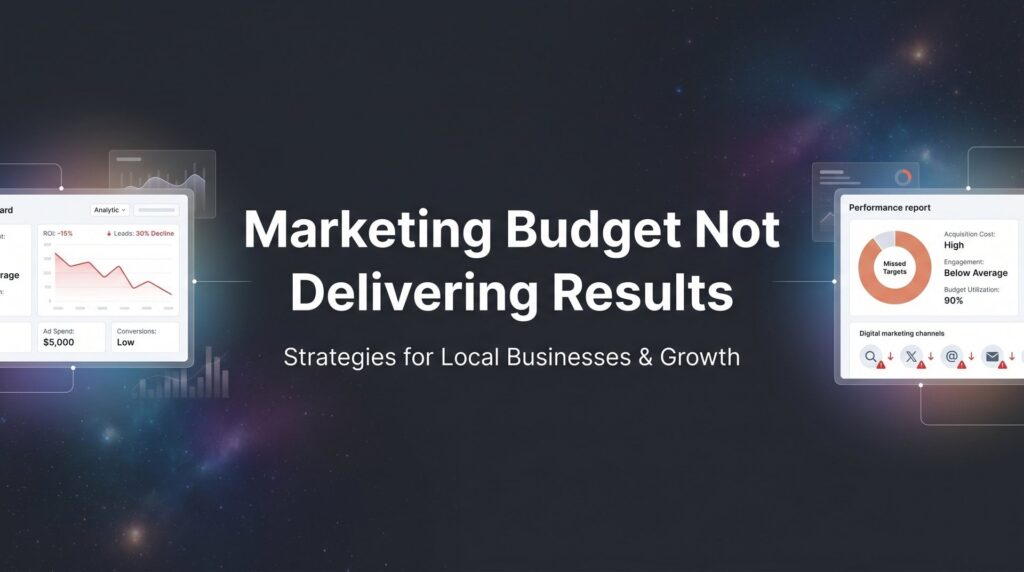
You check your bank statement and there it is again—another chunk of money gone to marketing. Facebook ads, Google campaigns, maybe some SEO work. The spend is real, the results are… questionable. You’re getting clicks, sure. Maybe some likes. But when you look at actual new customers walking through your door or filling out your contact form? The math doesn’t add up.
Here’s the uncomfortable truth: most marketing budgets leak money like a sieve. Not because business owners aren’t trying, but because they’re making predictable, fixable mistakes that quietly drain thousands of dollars every month.
This isn’t about spending more money. It’s about spending smarter. What follows is a diagnostic guide to help you identify exactly where your marketing is hemorrhaging cash and what to do about it. No vague platitudes about “engaging your audience.” Just the real problems and the real fixes.
The Hidden Leaks Draining Your Marketing Dollars
Let’s start with the money drains hiding in plain sight. The ones that feel like legitimate marketing activity but deliver almost nothing in return.
Targeting Too Broad: You’re running ads to “everyone in your city aged 25-65.” Sounds reasonable, right? It’s actually a recipe for waste. When you target everyone, you connect with no one. Your message gets diluted, your budget gets spread thin, and you end up paying to show ads to thousands of people who will never, ever become customers.
Vanity Metrics Over Conversions: High impressions feel good. Lots of likes feel validating. But neither one pays your bills. Many businesses optimize their campaigns for engagement metrics that look impressive in reports but contribute nothing to revenue. You’re essentially paying to collect digital applause instead of actual customers.
Spreading Too Thin: Facebook, Instagram, Google Ads, TikTok, LinkedIn, local directories, email campaigns. You’re trying to maintain a presence everywhere because you heard each platform matters. The reality? You don’t have the budget or bandwidth to optimize any of them properly. So they all underperform. This is one of the core reasons why marketing isn’t working for many businesses today.
Then there’s the set-it-and-forget-it trap. You launch a campaign, it performs okay initially, and you move on to other business priorities. Meanwhile, that campaign keeps running, slowly degrading in performance. Ad fatigue sets in. Competitors adjust their strategies. Market conditions shift. Your once-decent campaign becomes a money pit, but it’s still running because nobody’s actively managing it.
Here’s what makes this particularly painful: every day that campaign runs unoptimized, you’re not just wasting today’s budget. You’re also losing the revenue those marketing dollars could have generated if they’d been working properly.
The tracking problem amplifies everything. Without proper conversion tracking and attribution, you’re flying blind. You might be spending heavily on a channel that delivers zero actual customers while underfunding the one channel that’s quietly generating half your business. You literally cannot fix what you cannot measure.
Many businesses discover they’ve been optimizing campaigns based on incomplete data. They’re celebrating leads that never convert or attributing sales to the wrong source entirely. It’s like trying to navigate using a map from a different city.
Your Targeting Is Probably Wrong (Here’s How to Know)
Your campaign dashboard shows impressive numbers. Thousands of impressions. Hundreds of clicks. You’re reaching people, so targeting must be working, right?
Not quite. Reaching people and reaching the right people at the right moment are entirely different outcomes with entirely different price tags.
High Impressions, Low Engagement: Your ads are being shown thousands of times but getting minimal clicks or interaction. This signals you’re reaching people who fundamentally aren’t interested in what you offer. You’re paying to interrupt the wrong audience.
Clicks That Don’t Convert: People click your ad, land on your website, and immediately bounce. Or they browse for three seconds and leave. This indicates a targeting mismatch—you’re attracting curiosity clicks from people who were never going to become customers. Understanding what performance marketing actually means can help you shift focus from vanity clicks to revenue-generating actions.
Wrong Type of Inquiries: You’re getting leads, but they’re tire-kickers, bargain hunters, or people looking for services you don’t even offer. Your targeting is attracting interest, just not from your actual target market.
The difference between broad reach and precise targeting comes down to intent and timing. Showing your ad to a homeowner who might need plumbing services someday is expensive noise. Showing that same ad to a homeowner actively searching for “emergency plumber near me” at 10 PM on a Sunday is valuable targeting.
Run this quick targeting audit yourself. Look at your last 20 leads or inquiries. How many became paying customers? Of those that didn’t, why not? Were they outside your service area? Wrong budget range? Looking for different services? Each pattern reveals a targeting leak.
Check your demographic data. Are you actually reaching the age range, income level, and location of your best existing customers? Or are you targeting who you think your customers are versus who they actually are?
Review your ad placement reports. Where are your ads actually showing up? Sometimes broad targeting puts your ads on irrelevant websites, apps, or video content that has nothing to do with your business. You’re paying for visibility in places your ideal customers never visit.
The Conversion Gap: Traffic Without Action
Here’s a scenario that plays out thousands of times daily. Someone clicks your ad. They land on your website. They look around for maybe fifteen seconds. Then they leave, never to return. You just paid for that click, and it delivered exactly nothing.
Traffic alone means nothing. The entire point of marketing is the path from click to customer, and that path is littered with conversion killers.
Your landing page loads in five seconds. Feels fast enough to you, right? To the person who clicked your ad, five seconds is an eternity. Studies consistently show that most users abandon slow-loading pages within three seconds. Every extra second of load time hemorrhages potential customers. You’re paying to drive traffic to a page that rejects visitors before they even see your offer.
Confusing Messaging: Your ad promised a solution to a specific problem. Your landing page talks about your company history, your values, your comprehensive service offerings. The visitor can’t immediately see how you solve their problem, so they leave. The disconnect between ad promise and landing page delivery kills conversions instantly.
Weak Calls to Action: Your landing page has a “Learn More” button. Or maybe “Submit.” These vague, low-commitment CTAs don’t compel action. Compare that to “Get Your Free Quote in 60 Seconds” or “Schedule Your Consultation Today.” Specific, benefit-driven CTAs convert. Generic ones get ignored.
Then there’s the form friction. You’re asking for too much information too soon. Name, email, phone, address, company size, budget range, project timeline, how they heard about you. Each additional field drops your conversion rate. People bail because filling out your form feels like applying for a mortgage. If you’re struggling with poor quality leads from marketing, simplifying your forms while adding qualifying questions can help filter better prospects.
Mobile experience matters more than most businesses realize. Over half of your traffic likely comes from mobile devices. If your landing page isn’t genuinely mobile-optimized—not just “responsive” but actually designed for mobile—you’re losing conversions by the hundreds.
The trust gap kills conversions too. Someone clicking your ad doesn’t know you. They need quick trust signals: customer reviews, recognizable client logos, industry certifications, clear contact information. A landing page without these elements asks strangers to trust you with their information or money. Most won’t.
Every element between the click and the conversion is a potential leak. Fix the leaks, and the same traffic that’s currently delivering mediocre results suddenly starts generating actual customers.
Channel Mismatch: Are You Fishing in the Wrong Pond?
You’re running Instagram ads because everyone says Instagram is essential for business. Problem is, your ideal customers are 55-year-old homeowners who barely use Instagram. You’re spending money to reach an audience that doesn’t exist on that platform.
Channel selection isn’t about which platforms are trendy. It’s about where your actual customers spend their time and attention.
Ask yourself: when your best customers need what you offer, where do they look? If you’re a local service business, they’re probably searching Google. If you’re B2B, they might be on LinkedIn. If you’re targeting younger consumers, maybe Instagram or TikTok makes sense. But “everyone’s on social media” isn’t a strategy—it’s a recipe for wasted budget. For service-based businesses, understanding digital marketing for home services can reveal which channels actually drive qualified leads.
The trend-chasing trap is real. TikTok is hot, so businesses rush to create TikTok content without asking whether their customers are actually making purchasing decisions on TikTok. Meanwhile, their Google Ads campaigns that actually drive calls and appointments get underfunded because the budget got diverted to the shiny new platform.
Here’s a simple channel evaluation framework. For each platform you’re currently using, answer these questions: Can you directly trace revenue back to this channel? Does this channel reach people when they’re ready to buy, or just when they’re casually browsing? Is this channel delivering a cost per customer that makes sense for your business?
If you can’t answer those questions with real data, you’re guessing. And guessing is expensive.
When to Double Down: You’ve got a channel that’s consistently delivering qualified leads at a profitable cost per acquisition. Your instinct might be to maintain current spend and test new channels. Wrong move. When you find what works, pour more budget into it until you hit saturation. Maximize your winners before chasing new opportunities.
When to Test: Your current channels are optimized and performing well, but you’re ready to scale. Or you’re seeing diminishing returns and need to diversify. Testing new platforms makes sense when you have the bandwidth to properly manage them and the budget to give them a real shot—not just throw a few hundred dollars at them and hope for magic.
The biggest channel mistake? Treating all platforms the same. LinkedIn requires different content, targeting, and strategy than Facebook. Google Search demands different approaches than Google Display. Trying to run identical campaigns across different channels guarantees mediocre results everywhere.
Building a Budget That Actually Performs
Most marketing budgets are built backwards. Business owners decide they can afford $2,000 per month, divide it across a few channels, and hope for the best. That’s not a strategy. That’s a donation.
Start with clear, measurable goals tied to revenue. Not “increase brand awareness” or “grow our social following.” Those aren’t goals—they’re activities. Real goals sound like: “Generate 20 qualified leads per month at under $100 per lead” or “Achieve $10,000 in trackable revenue from paid advertising.”
When your goals are revenue-focused, every marketing dollar becomes accountable. You can calculate exactly what you’re getting for your investment and adjust accordingly.
The 70/20/10 framework gives you a smart allocation strategy. Seventy percent of your budget goes to proven channels that are already delivering results. These are your reliable revenue generators. Twenty percent goes to optimization and improvement of those existing channels—testing new ad creative, refining targeting, improving landing pages. Ten percent goes to testing new channels or strategies.
This framework prevents two common mistakes: putting all your budget into unproven experiments, or getting so comfortable with what works that you never evolve. You’re protecting your baseline revenue while still creating room for growth. Understanding the difference between performance marketing and traditional marketing helps you allocate budget toward approaches that deliver measurable ROI.
Proper tracking isn’t optional—it’s the foundation of everything. You need to know which specific ads, keywords, and campaigns are generating actual customers, not just clicks or impressions. Set up conversion tracking that follows the entire customer journey from first click to final purchase.
This means implementing proper analytics, setting up goal tracking, using UTM parameters to identify traffic sources, and potentially using call tracking for marketing campaigns if phone calls are part of your conversion process. Yes, it’s technical. Yes, it takes effort to set up correctly. But without it, you’re managing your marketing budget based on feelings instead of facts.
Review and adjust monthly, not quarterly. Markets move fast. Competitor activity changes. Seasonal factors shift. A campaign that worked brilliantly in February might be bleeding money by April. Monthly reviews let you catch problems early and capitalize on opportunities quickly.
Build buffer into your budget for testing and optimization. If you’re spending every dollar of your budget on active campaigns, you have no room to improve. Reserve 10-15% for testing new approaches, fixing what’s broken, and scaling what’s working.
When DIY Marketing Costs More Than Professional Help
You’re handling your own marketing because hiring help seems expensive. But let’s do the math on what DIY is actually costing you.
Say you’re spending $3,000 monthly on ad campaigns that deliver a 1% conversion rate. With proper optimization, that same budget could deliver a 3% conversion rate—triple the results for the same spend. Over a year, you’re leaving tens of thousands of dollars on the table. The money you’re “saving” by not hiring help is actually costing you far more in wasted ad spend and lost opportunity.
Then there’s your time. You’re spending 10-15 hours per month managing campaigns, creating ads, analyzing data, and trying to figure out why things aren’t working. As a business owner, your time has value. If those hours were spent on revenue-generating activities in your core business, what would they be worth? Often more than the cost of professional management. This is the core tradeoff when weighing digital marketing agency vs in-house marketing options.
Plateaued Results: Your campaigns performed okay initially, but now they’ve flatlined. You’re getting the same mediocre results month after month because you don’t know how to push past the plateau. This is the classic sign that you’ve hit the ceiling of DIY capabilities.
No Time for Optimization: You launched campaigns, but you never have time to review performance, test new approaches, or fix what’s broken. Your campaigns run on autopilot while performance slowly degrades. You’re paying for management you’re not actually doing.
Lack of Technical Knowledge: Conversion tracking, audience segmentation, A/B testing, attribution modeling—these aren’t just buzzwords. They’re technical skills that take time to develop. Without them, you’re managing campaigns with one hand tied behind your back. Learning how to fix your marketing conversion tracking is essential before you can accurately measure what’s working.
What should you look for in a marketing partner? Start with someone who talks about ROI before they talk about impressions or engagement. If an agency leads with how many followers they can get you or how much traffic they’ll drive, run. The right partner focuses on revenue metrics: cost per lead, customer acquisition cost, return on ad spend.
Look for transparency in reporting. You should understand exactly where your money is going and what results it’s generating. Vague reports full of vanity metrics are red flags. Clear dashboards showing leads, conversions, and revenue attribution are what you want.
Ask about their optimization process. How often do they review and adjust campaigns? What’s their approach to testing? How do they handle underperforming campaigns? The right partner has systematic processes for continuous improvement, not just “set it and forget it” campaign management.
Turning Budget Waste Into Revenue Growth
A marketing budget that isn’t delivering results isn’t a failure—it’s a diagnostic opportunity. You now know the most common leaks: targeting that’s too broad or aimed at the wrong audience, conversion paths riddled with friction, channel strategies that don’t align with where your customers actually are, and tracking systems that can’t tell you what’s working.
Pick one area to audit today. Start with targeting if you’re getting clicks but no conversions. Focus on your landing pages if you’re getting traffic but high bounce rates. Evaluate your channel mix if you’re spread thin across platforms without clear winners.
The businesses that win with marketing aren’t necessarily spending more—they’re spending smarter. They know exactly where every dollar goes and what it returns. They optimize relentlessly. They focus on revenue metrics instead of vanity numbers. They’re not afraid to kill campaigns that don’t perform and double down on what works.
You can fix this. Most budget waste comes from fixable problems, not fundamental business issues. Better targeting, optimized conversion paths, focused channel selection, and proper tracking transform the same budget that’s currently delivering mediocre results into a genuine growth engine.
Tired of spending money on marketing that doesn’t produce real revenue? We build lead systems that turn traffic into qualified leads and measurable sales growth. If you want to see what this would look like for your business, we’ll walk you through how it works and break down what’s realistic in your market.
Your marketing budget should be an investment that returns measurable growth, not an expense you tolerate. The difference between the two often comes down to identifying the leaks and fixing them systematically. Start today.