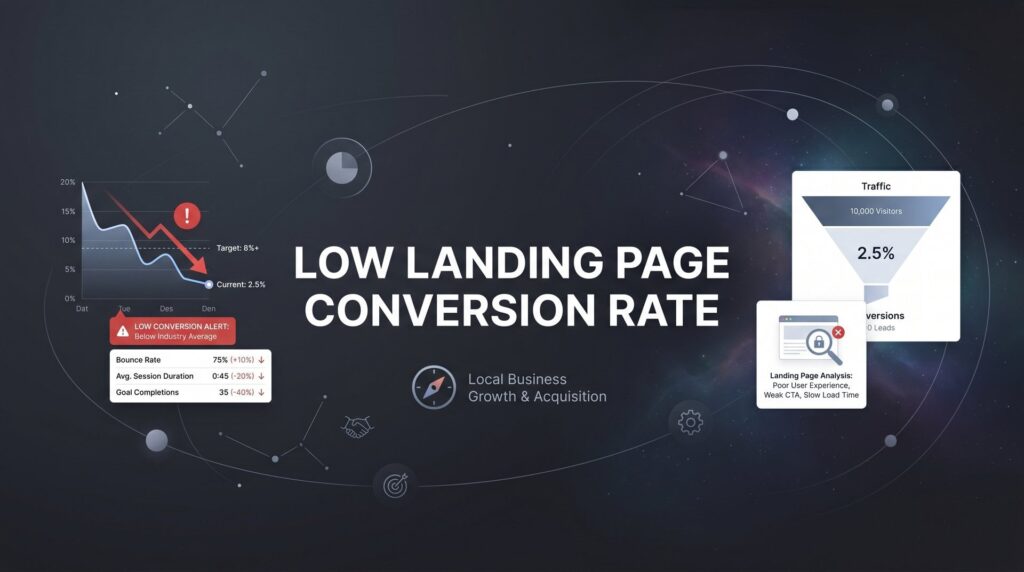
You’ve done everything right. You set up the campaign, wrote the ad, picked the keywords, and now the clicks are coming in. But then you check the numbers. Traffic is up. Leads are not. The money keeps leaving your account, and your phone isn’t ringing.
This is one of the most demoralizing experiences in digital marketing, and it happens to local business owners constantly. The problem isn’t always the ad. Often, it’s what happens the moment someone lands on your page. That gap between “clicked the ad” and “became a customer” is where your budget quietly disappears.
A low landing page conversion rate means your page isn’t turning visitors into leads or customers at a rate that justifies what you’re spending on traffic. It’s not just a vanity metric problem. It’s a profitability problem. When your conversion rate is low, every lead costs more, every sale requires more spend, and your competitors who’ve figured this out are eating your lunch.
The good news? The causes are almost always identifiable. There’s a reason your page isn’t converting, and in most cases, there are specific, fixable things you can do about it. Think of this article as your diagnostic guide: we’ll walk through what “low” actually means, what’s most likely causing the problem, and how to systematically work through a fix.
What’s Actually Considered a ‘Low’ Conversion Rate?
Before you can fix a problem, you need to know whether you actually have one. Conversion rates vary dramatically depending on your industry, your offer, your traffic source, and what you’re asking visitors to do. A rate that signals a serious problem in one business might be completely acceptable in another.
That said, there are rough guidelines worth knowing. For paid traffic landing pages, many marketers treat anything below 2-3% as underperforming, though this is a starting point for thinking, not a hard rule. A landing page asking someone to schedule a free consultation for a roofing project will naturally convert differently than one asking someone to buy a $500 product. Lower-commitment offers tend to convert higher. Higher-ticket, higher-trust offers often convert at lower rates, and that can still be profitable.
There’s also an important distinction between paid traffic landing pages and general website pages. When someone clicks a paid ad, they’ve already demonstrated intent. They searched for something, saw your ad, and chose to click. That’s a warmer visitor than someone who stumbled onto your homepage from an organic search or a social media share. Because of that intent, paid landing pages should typically convert at a higher rate than general website pages. If your paid traffic page is converting at the same rate as your “About Us” page, something is wrong with your website conversion rates.
Calculating your own conversion rate is straightforward: take the number of conversions (form fills, calls, bookings, or whatever your goal is), divide by total visitors, and multiply by 100. So if 200 people visited your landing page and 6 filled out your contact form, your conversion rate is 3%.
The more important question is whether that rate is profitable for your business. If your average customer is worth several thousand dollars and you’re paying a few dollars per click, even a 2% conversion rate might be excellent. If your margins are thin and your cost per click is high, you might need 8-10% to break even. Know your numbers before deciding whether you have a problem, and be honest about whether your expectations are calibrated to reality or to wishful thinking.
The Usual Suspects: Top Reasons Your Landing Page Isn’t Converting
Most landing page conversion problems come back to a handful of recurring issues. Once you know what to look for, they become much easier to spot.
Message Mismatch: This is the single most common cause of poor conversion rates on paid traffic campaigns, and it’s also one of the most damaging. Message mismatch happens when your ad promises one experience and your landing page delivers a completely different one. A visitor clicks an ad that says “Same-Day HVAC Repair in Philadelphia” and lands on a generic homepage about your company’s history. The connection is broken. Their brain registers a disconnect, and they leave. In the world of CRO, this is sometimes called “ad scent”—the idea that there should be a consistent thread from the ad creative through to the landing page, so the visitor feels like they’re in the right place. When that scent disappears, so does the visitor.
Slow Load Speed and Poor Mobile Experience: Google has extensively documented the relationship between mobile page load times and visitor drop-off. The longer your page takes to load, the more visitors abandon it before they ever see your offer. For local businesses, this is particularly critical because a large portion of local searches happen on smartphones, often by people who are in the middle of making a decision right now. If your landing page takes five or six seconds to load on a mobile connection, you’ve already lost a significant chunk of your traffic before they’ve read a single word. Addressing the high bounce rate problem starts with fixing load speed.
Weak or Buried Calls to Action: If a visitor can’t immediately see what you want them to do, they won’t do anything. Calls to action that are hidden below the fold, written in vague language like “Learn More” or “Submit,” or competing with three other CTAs on the same page create confusion. Confusion leads to inaction. Your landing page should have one primary goal and one primary CTA that’s impossible to miss. The button text should be specific and benefit-oriented: “Get My Free Quote,” “Schedule My Inspection,” “Call Now for Same-Day Service.” When visitors have to think about what to do next, most of them decide not to do anything at all.
Cluttered, Overwhelming Layouts: More is not better on a landing page. Navigation menus that link to other pages, multiple offers competing for attention, walls of text, and distracting design elements all pull focus away from the one thing you want the visitor to do. A good landing page is ruthlessly focused. Every element on the page should either support the conversion goal or be removed. If you wouldn’t miss it, cut it.
These issues often show up together, compounding each other. A page that loads slowly, has confusing messaging, and buries the CTA is fighting itself on multiple fronts. Fixing even one of these issues can produce a meaningful improvement. Fixing all of them often produces a dramatic one.
Trust Killers That Send Visitors Running
Even a well-structured landing page can fail if it doesn’t feel trustworthy. For local service businesses especially, trust is the currency that converts visitors into leads. People are often considering inviting you into their home or business. They want to know you’re legitimate before they hand over their phone number.
Missing Social Proof: No reviews, no testimonials, no client logos, no before-and-after photos. A landing page without social proof is a landing page asking visitors to take a leap of faith based solely on what you say about yourself. That’s a hard sell. Real reviews from real customers, even just a few well-placed ones, do more to build confidence than almost any headline you could write. If you have strong Google reviews or verified testimonials, they belong on your landing page, not buried on a separate page of your website. These are among the most impactful landing page conversion tips you can implement.
Generic Imagery and Vague Copy: Stock photos of smiling people in hard hats or generic office scenes signal inauthenticity. They make your page look like a template, not a real business. Local customers want to see real people, real work, and real evidence that you operate in their area. Vague copy that could describe any business in any city does nothing to reassure a visitor that you’re the right choice for their specific situation in their specific location. Copy that speaks directly to their problem, names their city or region, and addresses their likely objections converts far better than generic marketing language.
No Visible Contact Information or Legitimacy Signals: If your landing page doesn’t show a local phone number, a physical address, a license number, or other legitimacy markers, visitors have no way to verify you’re a real, established business. This is particularly important for trades, home services, and any business where someone is being asked to trust a stranger with something important. A visible local phone number alone can meaningfully improve conversion rates because it signals accountability. You’re not hiding. You can be reached. That matters.
The fix here isn’t complicated. Audit your landing page from the perspective of a skeptical first-time visitor. Ask yourself: if I knew nothing about this business, would I feel comfortable reaching out? If the honest answer is no, you know what to add.
The Traffic Quality Problem Nobody Talks About
Here’s a diagnosis that gets overlooked more often than it should: sometimes your landing page is fine, and your traffic is the problem.
When conversion rates are low, the instinct is to redesign the page. But if you’re sending the wrong visitors to the page, no amount of redesigning will fix the underlying issue. Poor-quality traffic is a silent conversion killer because it looks like a page problem in the data. Understanding the high cost per conversion problem often starts with examining who’s actually clicking your ads.
Poorly targeted ads, overly broad match keywords, and loosely defined audiences can flood your landing page with people who were never going to convert. They clicked because the ad was adjacent to what they were looking for, not because they were ready to buy. Your conversion rate tanks, and the page gets blamed for a problem that started in the campaign setup.
Keyword intent is a particularly important concept here. Not all searches signal the same readiness to act. Someone searching “how much does pest control cost” is in research mode. They’re gathering information, comparing options, and not yet ready to schedule a service. Someone searching “pest control near me” or “emergency pest control Philadelphia” is in decision mode. They want help now. Sending both types of searches to the same conversion-focused landing page will produce very different results, and averaging them together will make your conversion rate look worse than it actually is for your ready-to-buy visitors.
Building a strong negative keyword strategy is one of the most underutilized tools in PPC campaigns. By explicitly excluding searches that signal the wrong intent, you can dramatically improve the quality of traffic hitting your landing page without changing a single element on the page itself. If you run a premium service and people searching for “cheap” or “free” options are clicking your ads, you’re paying for traffic that was never going to convert.
Audience segmentation matters too. If you’re running display or social campaigns, broad audience targeting can bring in large volumes of visitors with low intent. Narrowing your targeting to people who match your actual customer profile, or who have already visited your site, can improve conversion rates significantly without any page changes at all.
The lesson: before you rebuild your landing page, check your traffic. Make sure the people arriving are actually the people you want to reach.
A Step-by-Step Framework to Diagnose and Fix Your Pages
Knowing the common causes is one thing. Having a systematic process to find and fix your specific problem is another. Here’s a practical order of operations for diagnosing a low-converting landing page.
Step 1: Check Message Match First. Pull up your ad and your landing page side by side. Does the headline on the page reflect what the ad promised? Is the offer consistent? Does the visual tone match? If someone had to make a split-second judgment about whether they’re in the right place, would they feel confident? If there’s any disconnect, fix this before anything else. Message mismatch is the highest-impact issue and often the fastest to resolve.
Step 2: Evaluate Load Speed and Mobile Experience. Use Google’s PageSpeed Insights (it’s free) to check how your page performs on mobile. Look at both the score and the specific recommendations. Then open your landing page on your actual phone and navigate through it as a real visitor would. Is the form easy to fill out with your thumbs? Is the CTA button large enough to tap? Does anything feel broken or slow? Fix the technical issues before testing anything else.
Step 3: Assess CTA Clarity and Page Focus. Ask someone unfamiliar with your business to look at your landing page for five seconds, then close it and tell you what the page was about and what they were supposed to do. If they can’t answer both questions clearly, you have a CTA or messaging problem. Simplify, clarify, and make the next step unmistakable. A thorough website conversion audit can help you systematically identify these friction points.
Step 4: Audit Trust Elements. Check for reviews, testimonials, contact information, local signals, and any legitimacy markers. Add what’s missing. Real photos beat stock photos. Specific claims beat vague ones.
Step 5: A/B Test One Element at a Time. Once the obvious issues are fixed, testing is how you find further improvements. The critical rule: test one thing at a time. Change the headline in version A and keep everything else identical. Run both versions simultaneously until you have statistically meaningful results. Then test the next element. When you change multiple things at once, you can’t know what actually moved the needle, and you lose the ability to learn from your tests. These are the kinds of disciplined conversion rate optimization tactics that separate guesswork from real improvement.
Step 6: Use Heatmaps and Session Recordings. Tools like Microsoft Clarity (free) and Hotjar let you see where real visitors click, how far they scroll, and where they drop off. This turns guesswork into evidence. You might discover that most visitors never scroll far enough to see your CTA, or that everyone clicks on an image that isn’t actually a link. These insights are often more valuable than any benchmark comparison.
When DIY Optimization Hits Its Limits
There’s a point where self-directed optimization stops producing results, and it’s worth being honest about when you’ve hit it.
The signs are usually clear. You’ve made multiple changes based on your best judgment. You’ve tried different headlines, adjusted the form, rewritten the copy. The conversion rate hasn’t moved meaningfully, or it improved briefly and then plateaued. You’re spending time on this that isn’t coming back, and you’re not sure what to try next.
That’s not a failure. That’s a signal that the problem requires more specialized tools, more experience with conversion patterns across many campaigns, or simply more bandwidth than a business owner running a company can reasonably dedicate to landing page optimization. Understanding conversion rate optimization services pricing can help you evaluate whether professional help makes financial sense for your situation.
A professional CRO and PPC engagement looks different from DIY tinkering. It typically starts with a comprehensive audit: ad-to-page message match, conversion tracking verification, technical performance review, and an assessment of the full funnel from click to close. From there, it moves into structured testing with proper controls, ongoing iteration based on real data, and performance reporting tied to actual revenue metrics rather than vanity numbers.
The distinction worth emphasizing: good PPC and CRO work isn’t about making your page look nicer. It’s about making it generate more revenue per dollar spent on traffic. Every improvement in conversion rate directly reduces your cost per lead and cost per acquisition. That’s not a marketing metric. That’s a business metric. Exploring proven low cost per lead strategies is often the next logical step once your landing page fundamentals are solid.
If you’ve been managing your own campaigns and landing pages and the results aren’t where they need to be, working with a team that does this every day for businesses in your situation can produce results that self-directed optimization rarely achieves.
Putting It All Together
A low landing page conversion rate is a solvable problem. It’s not a sign that digital marketing doesn’t work for your business or that you’re somehow beyond help. It’s a diagnostic signal pointing to something specific that can be identified and fixed.
Start with message match. Make sure your page delivers on exactly what your ad promised. Then evaluate the page experience: load speed, mobile usability, and CTA clarity. Check your trust signals and make sure a skeptical first-time visitor would feel confident reaching out. Finally, audit your traffic quality to confirm you’re actually sending the right people to the page in the first place.
Small improvements in conversion rate compound quickly. Moving from 2% to 4% doesn’t just double your leads. It cuts your cost per lead in half. That’s the kind of shift that changes whether a campaign is marginally profitable or genuinely transformative for your business.
Tired of spending money on marketing that doesn’t produce real revenue? Clicks Geek builds lead systems that turn traffic into qualified leads and measurable sales growth. As a Google Premier Partner agency with deep expertise in CRO and PPC management, we specialize in turning underperforming pages into lead-generating assets. If you want to see what this would look like for your business, we’ll walk you through how it works and break down what’s realistic in your market.