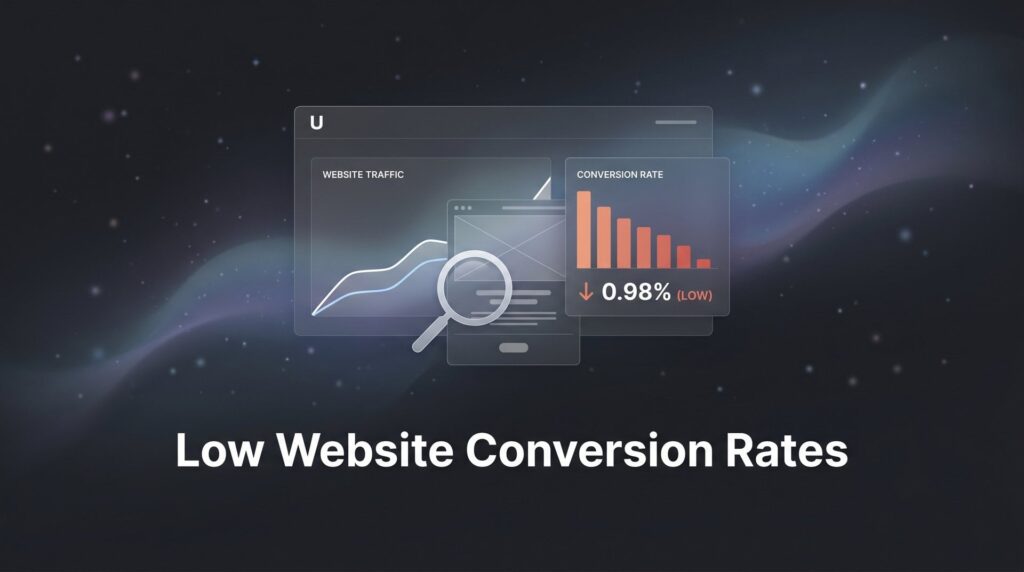
You check your analytics dashboard and see the numbers: 2,000 visitors last month. Your ad spend is climbing. Traffic looks healthy. But when you scroll down to actual sales or leads? Crickets. Maybe three inquiries. One turned into a customer.
This is the conversion rate nightmare that keeps business owners up at night. You’re doing everything the marketing gurus told you to do—running ads, posting content, driving traffic—but somewhere between the click and the cash register, something breaks. Visitors land on your site, look around for thirty seconds, and vanish into the digital void.
Here’s the good news: low website conversion rates aren’t a mystery, and they’re definitely not permanent. Most businesses face this exact problem. The difference between the ones that fix it and the ones that keep bleeding money comes down to understanding what’s actually happening on your site and making strategic changes that address the real issues, not symptoms.
Understanding What ‘Low’ Actually Means for Your Business
Before you panic about your conversion rate, let’s get clear on what we’re actually measuring. Conversion rate is simple math: take your total conversions (sales, leads, calls, whatever action matters to your business), divide by total visitors, multiply by 100. If you had 1,000 visitors and 20 conversions, that’s a 2% conversion rate.
Now here’s where it gets tricky. You’ll find articles claiming “the average e-commerce conversion rate is 2.5%” or “SaaS companies should aim for 5%.” These benchmarks are worse than useless for most local businesses—they’re actively misleading.
Think about it this way: a plumber in Dallas getting traffic from “emergency pipe repair near me” searches should convert at a dramatically different rate than someone selling custom artwork online. The intent is different. The urgency is different. The decision-making process is completely different.
A 1% conversion rate might be catastrophic if you’re selling $20 products to impulse buyers. But if you’re a commercial roofing company where each customer is worth $50,000 and requires multiple touchpoints before they’re ready to commit? A 1% conversion rate from cold traffic could be phenomenal.
The real question isn’t “Is my conversion rate low compared to some industry average?” It’s “Am I converting enough of the right visitors to make my marketing profitable?” If you’re spending $3,000 on ads to generate $2,000 in revenue, your conversion rate is too low regardless of what the website conversion rate benchmarks say. If you’re spending $3,000 to generate $15,000 in revenue, you’re doing fine even if your actual percentage looks “low.”
What matters is the quality of your traffic and whether your site is doing its job with the visitors it gets. Which brings us to the real problem most businesses face.
The Silent Killers: Why Visitors Hit Your Site and Immediately Bounce
Your website is bleeding potential customers, and in most cases, it’s happening for reasons you haven’t even considered. Let’s break down the five conversion killers that destroy more sales than bad products or high prices ever could.
Speed and Mobile Experience: Your site takes six seconds to load on mobile. You think that’s acceptable because it “works fine” on your office computer. Meanwhile, 53% of mobile visitors have already hit the back button before your hero image even renders. Page speed isn’t a nice-to-have anymore—Google’s Core Web Vitals made it a ranking factor because slow sites create terrible user experiences. If your site feels sluggish on a phone, you’re not just losing conversions, you’re losing the opportunity to convert before visitors even see your offer.
Navigation Chaos and Unclear Value: A visitor lands on your homepage and genuinely cannot figure out what you do or why they should care. Your navigation has seventeen different menu items. Your headline says something vague like “Solutions for Modern Businesses.” There’s no clear path to the information they need. Within seconds, they’re confused and gone. Your value proposition should be instantly obvious. If someone can’t understand what you offer and why it matters to them in under five seconds, your conversion rate will suffer no matter how good your actual service is.
Missing Trust Signals: You’re asking people to give you their contact information or their credit card, but your site looks like it was built in 2012 and hasn’t been updated since. There are no customer reviews visible. No credentials or certifications. No physical address or real phone number. No guarantee or clear refund policy. In an era where online scams are everywhere, trust isn’t automatic—you have to earn it. Every missing trust element is a reason for cautious visitors to go somewhere else.
Friction in Your Conversion Process: Your contact form has twelve required fields including “How did you hear about us?” and a dropdown menu for “Industry Sector.” Your checkout process requires account creation before purchase. Your phone number is buried in tiny text at the bottom of the page. Every unnecessary step, every extra field, every moment of confusion is a conversion killer. The more friction you introduce between “I’m interested” and “I’m converted,” the more people you lose along the way.
Traffic That Was Never Going to Convert: Sometimes the problem isn’t your website at all—it’s that you’re attracting the wrong visitors. If you’re a high-end B2B service provider but your ads are targeting bargain hunters looking for the cheapest option, no amount of website optimization will fix your conversion rate. If your SEO is ranking you for informational queries when you need transactional buyers, you’ll get website traffic but no conversions. Quality of traffic matters more than quantity.
The brutal truth? Most businesses have at least three of these five problems actively destroying their conversion rates right now. The question is which ones are costing you the most money.
Why Your Landing Pages Are Conversion Graveyards
Let’s talk about one of the most expensive mistakes in digital marketing: sending paid traffic to generic pages that weren’t designed to convert. You’re running Google Ads or Facebook campaigns, paying for every click, and directing that expensive traffic to your homepage or a service page that’s trying to do seventeen different things at once.
Here’s what happens: someone searches “emergency HVAC repair,” clicks your ad, and lands on your homepage with a slider showing your full range of services, a blog section, links to your about page, and a generic “Contact Us” form. They came looking for one specific thing—emergency repair—and now they have to hunt through your entire website to figure out if you even offer it and how to get help right now.
Compare that to a dedicated landing page built specifically for emergency HVAC repair. One headline that matches their search intent. One clear offer. One obvious call-to-action. No navigation menu to distract them. No competing messages. Just a focused path from “I have this problem” to “Here’s how we solve it—call now.”
The difference in conversion rates between these two approaches isn’t marginal—it’s often 3-5x or more. A homepage might convert at 1-2% because it’s serving multiple purposes. A well-designed landing page focused on one specific offer can convert at 8-12% or higher because it eliminates confusion and decision fatigue. Understanding how to optimize landing pages for conversions is essential for maximizing your ad spend.
Message match is the other critical piece most businesses miss. Your ad promises “24/7 Emergency Service with 2-Hour Response Time.” They click through and land on a page that talks about your company history and general HVAC services. That disconnect destroys trust instantly. They wonder if they clicked the wrong ad or if you’re trying to bait-and-switch them.
High-converting landing pages maintain perfect message match. The headline echoes the ad copy. The offer is exactly what was promised. The language, the urgency, the specific benefits—everything aligns. When visitors see that consistency, they trust that you understand their problem and can solve it. When they see misalignment, they bounce.
How to Actually Diagnose What’s Killing Your Conversions
Before you start changing things randomly and hoping for improvement, you need to understand what’s actually happening on your site. Guessing is expensive. Data is cheaper.
Start with your analytics and look at user flow. Where are people entering your site? Which pages do they visit next? Where do they drop off? Google Analytics 4 can show you the path visitors take and where they abandon the journey. If 80% of people land on your pricing page and immediately leave, that’s telling you something specific about either your pricing or how it’s presented.
Pay attention to bounce rate by traffic source. If your organic traffic has a 30% bounce rate but your paid traffic bounces at 70%, you have a message match problem—your ads are attracting the wrong people or making promises your landing pages don’t deliver. If mobile traffic bounces at twice the rate of desktop, you have a mobile experience problem that needs immediate attention.
Heatmaps and session recordings reveal what analytics can’t. Tools like Hotjar or Microsoft Clarity show you where people actually click, how far they scroll, and where they get stuck. You might discover that visitors are trying to click on images that aren’t clickable, or that they’re never scrolling far enough to see your call-to-action, or that they’re rage-clicking on a broken element. These behavioral insights show you exactly where the friction exists.
Before you change anything, ask yourself these questions: What action do I want visitors to take on this page? Is that action obvious and easy? What objections might prevent someone from taking that action? Are we addressing those objections clearly? What’s the one thing that would make this page more valuable to our ideal customer?
The biggest mistake is changing everything at once. You redesign your entire homepage, rewrite all your copy, add new images, and change your call-to-action. Conversions go up. Great! But you have no idea which change actually made the difference, so you can’t replicate it on other pages. Or conversions go down, and you don’t know which element to revert. If you’re not tracking marketing conversions properly, you’ll never know what’s actually working.
Systematic diagnosis means isolating variables. Test one element at a time. Understand what moves the needle before you move to the next change.
Strategic Fixes That Actually Increase Conversions
Once you know where the problems are, you can make targeted improvements that actually matter. These aren’t gimmicks or growth hacks—they’re fundamental improvements to how your site communicates value and reduces friction.
Simplify Your Calls-to-Action: Look at your most important pages and count how many different actions you’re asking visitors to take. Subscribe to the newsletter, download the guide, call now, schedule a consultation, follow us on social media, read our blog. Every additional option reduces the likelihood that visitors will take any action at all. Pick the one action that matters most for that page and make it the obvious choice. Remove or minimize everything else.
Add Strategic Urgency and Social Proof: Notice the word “strategic.” Fake countdown timers and “Only 2 spots left!” messages that reset every time someone visits your site destroy trust. Real urgency works: “We’re booking two weeks out” or “Current promotion ends Friday” or “Limited service area capacity this month.” Real social proof works: actual customer reviews, specific results you’ve achieved for named clients, credentials that matter to your audience. Place these elements near decision points—right before the form, right next to the pricing, right above the call-to-action.
Reduce Form Fields Ruthlessly: Every field you add to a form reduces completion rates. Do you really need their company size and industry and job title and how they heard about you? Or do you just need their name, email, and phone number to start the conversation? You can gather additional information later, after they’ve converted. The goal of the form is to capture the lead, not to conduct a survey. Strip it down to the absolute minimum required to follow up effectively.
Test One Element at a Time: This bears repeating because it’s where most DIY optimization fails. Change your headline and wait until you have enough traffic to see if it made a difference. Then test your call-to-action button color or copy. Then test your hero image. Sequential testing takes longer than changing everything at once, but it actually teaches you what works. For a comprehensive approach, follow a proven action plan to improve website conversion rate that builds on each successful change.
The discipline of real optimization isn’t about making your site look prettier or following design trends. It’s about systematically removing obstacles between your visitors and the action you want them to take. Every change should have a clear hypothesis: “I think this will improve conversions because…” If you can’t articulate why you’re making a change, you’re just rearranging deck chairs.
When DIY Optimization Hits Its Limit
There comes a point where you’ve picked the low-hanging fruit and your conversion rate plateaus. You’ve simplified your forms, improved your page speed, added testimonials, and cleaned up your navigation. You’re converting better than you were, but you’re still leaving money on the table and you can feel it.
This is when professional conversion rate optimization becomes worth the investment. If you’re spending $10,000 a month on advertising and converting at 2%, improving that to 3% means 50% more leads from the same ad spend. That’s an extra $5,000 in monthly results. If you’re spending $50,000 a month on traffic, even a 0.5% improvement in conversion rate can mean tens of thousands in additional revenue.
Professional CRO specialists see patterns you can’t see because you’re too close to your own business. They know which psychological triggers work for your specific industry. They understand the technical aspects of testing that ensure your results are statistically valid, not just random fluctuations. They’ve optimized hundreds of sites and know which changes typically work and which ones waste time. Investing in conversion focused marketing services can transform your results.
A comprehensive CRO audit reveals issues that tools miss. Yes, heatmaps show where people click. But an experienced optimizer understands why they’re clicking there and what that means for your conversion funnel. They can identify trust gaps, message inconsistencies, and friction points that analytics alone won’t reveal. They can design and execute multivariate tests that would take you months to set up and interpret correctly.
The ROI case is simple: if your site is getting meaningful traffic and your average customer value is significant, professional optimization pays for itself quickly. A local service business with a $2,000 average customer value only needs to convert a handful of additional customers per month to justify the investment. A high-traffic e-commerce site can see returns in days or weeks. If you’re experiencing low ROI from digital advertising, optimization is often the fastest path to profitability.
The sign that you’re ready for professional help? You’ve made the obvious improvements, you have consistent traffic, and you know that better conversion rates would dramatically impact your bottom line—but you don’t have the expertise or time to take optimization to the next level yourself.
Stop Paying for Traffic That Doesn’t Pay You Back
Low website conversion rates aren’t a permanent condition or a sign that your business model is broken. They’re a diagnostic signal telling you exactly where to focus your attention. Your site is either communicating value clearly or it’s not. It’s either making it easy for visitors to take action or it’s creating friction. It’s either building trust or raising red flags.
The businesses that win aren’t the ones with the most traffic or the biggest ad budgets. They’re the ones that convert the traffic they get into actual revenue. Small, strategic improvements compound quickly. A better headline, a simplified form, faster page speed, clearer calls-to-action—each change might only improve conversions by a fraction of a percent. But stack enough of these improvements together and you’re converting at 2x or 3x your starting rate.
Start with the obvious problems: page speed, mobile experience, trust signals, form friction. Use data to identify where visitors are dropping off. Test changes systematically. Focus on quality of traffic, not just quantity. And recognize when you’ve reached the limit of what you can accomplish on your own.
Tired of spending money on marketing that doesn’t produce real revenue? We build lead systems that turn traffic into qualified leads and measurable sales growth. If you want to see what this would look like for your business, we’ll walk you through how it works and break down what’s realistic in your market. No fluff, no fake promises—just a clear assessment of where your conversions are breaking down and what it would take to fix it.
Because at the end of the day, traffic without conversions is just an expensive vanity metric. Revenue is what matters. And if your site isn’t converting the visitors you’re already paying for, that’s the most expensive problem you’re not fixing.