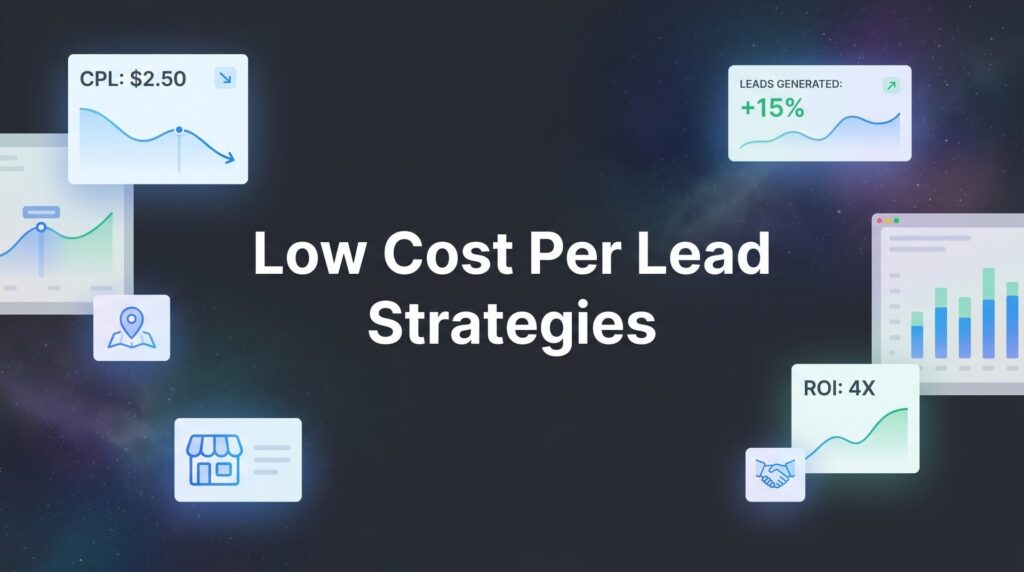
You’re spending money on ads. You’re getting clicks. But when you calculate what each lead actually costs, the number makes you wince. Here’s the uncomfortable truth: most local businesses don’t have a budget problem—they have an efficiency problem. You’re not spending too little. You’re just getting far less than you should from every dollar that leaves your account.
Cost per lead isn’t just a metric to track in your dashboard. It’s the difference between a marketing campaign that fuels growth and one that slowly drains your resources while delivering mediocre results. The businesses winning right now aren’t necessarily outspending their competition—they’re outthinking them.
What follows are seven battle-tested strategies we’ve used to drive down cost per lead across hundreds of campaigns. These aren’t theoretical concepts or wishful thinking. They’re practical approaches that address the real inefficiencies hiding in your campaigns right now. Some will deliver results within days. Others require consistent effort but compound over time.
The best part? None of these require you to slash your budget or compromise on lead quality. In fact, most will improve both your volume and the caliber of prospects entering your pipeline.
1. Tighten Your Targeting to Stop Paying for Unqualified Clicks
The Challenge It Solves
Every click you pay for that comes from someone who will never become a customer is pure waste. When you’re targeting too broadly, you’re essentially funding awareness campaigns for people outside your service area, beyond your price range, or looking for something completely different. Your budget evaporates on curiosity clicks while qualified prospects get crowded out by the noise.
The Strategy Explained
Precision targeting means drawing clear boundaries around who sees your ads. Start with geographic restrictions that match your actual service capabilities. If you only serve a 25-mile radius, don’t let your ads show to someone 50 miles away just because they searched your keyword. Layer in demographic filters, income brackets if relevant, and behavioral signals that indicate purchase intent.
The real power comes from negative keywords—terms that trigger your ads but represent the wrong intent. Someone searching “free consultation” or “DIY solution” isn’t looking to hire you. Build comprehensive negative keyword lists that eliminate these mismatches before they cost you money, which is essential for addressing low quality leads from advertising.
Implementation Steps
1. Audit your search terms report weekly to identify queries that triggered ads but produced zero conversions, then add them as negatives.
2. Set location targeting to specific zip codes or radius boundaries rather than broad city or state targeting that includes areas you don’t serve.
3. Create separate campaigns for different service tiers or product categories so you can apply distinct targeting parameters to each.
Pro Tips
Don’t just add negative keywords reactively. Research competitor terms, informational queries, and job-seeking phrases proactively. Build negative lists at the account level so they protect all campaigns simultaneously. Review location reports monthly to exclude cities or regions that consume budget without converting.
2. Fix Your Landing Pages Before Spending Another Dollar
The Challenge It Solves
You can have perfect ads and laser-focused targeting, but if your landing page fails to convert visitors, you’re just paying to send traffic into a black hole. Most businesses focus obsessively on getting clicks cheaper while ignoring the fact that their landing page converts at half the rate it should. That’s leaving money on the table in the most expensive way possible.
The Strategy Explained
Your landing page has one job: turn interested visitors into leads. Every element should support that goal or get eliminated. Strip away navigation menus that let people wander off. Remove distracting content that doesn’t directly address why they clicked. Make your form as frictionless as possible—ask only for information you absolutely need at this stage.
Mobile experience matters more than you think. If your page loads slowly or the form is difficult to complete on a phone, you’re losing leads before they even try. Test your page on actual mobile devices, not just desktop preview mode. Watch where people tap, where they hesitate, where they abandon. This directly impacts your high advertising costs and low conversions problem.
Implementation Steps
1. Create dedicated landing pages for each campaign rather than sending all traffic to your homepage or a generic contact page.
2. Reduce form fields to the absolute minimum—name, phone, email is often sufficient for initial contact.
3. Add trust signals near your form: testimonials, certifications, guarantees, or social proof that addresses the specific concern your prospect has at this moment.
Pro Tips
Use heatmapping tools to see where visitors actually click and scroll. Most abandon points are obvious once you watch real behavior. Test your page load speed using Google PageSpeed Insights and prioritize the fixes that impact mobile performance. A two-second improvement in load time can dramatically increase conversion rates.
3. Leverage Retargeting to Convert Warm Traffic at Lower Costs
The Challenge It Solves
The vast majority of people who visit your website aren’t ready to become a lead on their first visit. They’re researching, comparing, thinking. When you let them disappear without a follow-up mechanism, you’ve paid for that initial click and gotten nothing in return. Meanwhile, your competitor who stayed in front of them through retargeting gets the conversion.
The Strategy Explained
Retargeting lets you show ads specifically to people who’ve already visited your website. These are warm prospects who’ve demonstrated interest by taking action. The cost to reach them again is typically far lower than cold traffic, and the conversion rate is significantly higher because they already know who you are.
Build different retargeting segments based on behavior. Someone who visited your pricing page is more qualified than someone who only read a blog post. Someone who started filling out your form but didn’t submit deserves different messaging than someone who bounced after five seconds. Tailor your ads to where they are in the decision process—this is a core component of effective lead nurturing strategies.
Implementation Steps
1. Install retargeting pixels on your website immediately—you can’t retarget people who visited before the pixel was active, so every day you wait is lost opportunity.
2. Create audience segments for high-intent pages like pricing, services, and contact pages, then build separate campaigns targeting each segment with relevant messaging.
3. Set frequency caps so you’re staying visible without becoming annoying—showing the same ad 20 times a day creates resentment, not conversions.
Pro Tips
Exclude people who already converted from your retargeting campaigns—there’s no point spending money to advertise to existing customers unless you’re promoting something new. Use sequential messaging that evolves over time, starting with brand reinforcement and moving toward specific offers as the prospect ages in your audience.
4. Master Quality Score to Pay Less for Better Positions
The Challenge It Solves
Google Ads operates as an auction, but it’s not purely about who bids highest. Quality Score acts as a multiplier that rewards relevance and user experience. Two advertisers bidding the same amount can pay wildly different costs per click based on their Quality Scores. If yours is lagging, you’re overpaying for every single click while competitors with better scores get premium positions at lower costs.
The Strategy Explained
Quality Score is Google’s assessment of how relevant and useful your ad is to the person searching. It’s calculated based on expected click-through rate, ad relevance, and landing page experience. Improving these components directly reduces what you pay per click. Think of it as Google giving you a discount for running ads that users actually want to see—a key factor in understanding why your cost per lead is so high.
The most impactful lever is ad relevance. Your ad text should mirror the search query as closely as possible. If someone searches “emergency plumber Chicago,” your ad should say exactly that, not generic messaging about “quality plumbing services.” Landing page experience means the page you send people to actually delivers on what the ad promised, loads quickly, and works smoothly on mobile.
Implementation Steps
1. Organize your account into tightly themed ad groups with 10-20 closely related keywords per group, allowing you to write highly specific ad copy for each theme.
2. Write ad headlines that include the exact keyword phrase you’re targeting, and ensure your landing page headline matches both the keyword and ad.
3. Review your Quality Scores monthly and prioritize improving keywords with scores below 7, as these are costing you the most in unnecessary spend.
Pro Tips
Expected CTR is the hardest component to influence directly, but it improves when your ads are genuinely compelling and relevant to the search. Don’t try to game the system with clickbait—Google measures what happens after the click too. Focus on writing ads that attract qualified clicks from the right people, not maximum clicks from anyone.
5. Deploy Lead Magnets That Attract Ready-to-Buy Prospects
The Challenge It Solves
Generic “contact us” forms attract tire-kickers alongside serious prospects, making it impossible to prioritize follow-up effectively. When your only offer is “schedule a consultation,” you’re asking for a significant commitment from people who might not be ready. The result is fewer conversions and a pipeline filled with leads that never close because they weren’t qualified to begin with.
The Strategy Explained
A lead magnet is a valuable resource you offer in exchange for contact information. The key is creating offers that naturally attract people closer to a buying decision. A guide titled “How to Choose the Right [Your Service]” attracts people actively evaluating providers. A pricing calculator or ROI estimator attracts people ready to understand costs. These self-select for higher intent.
The best lead magnets solve a specific problem your ideal customer faces right before they’re ready to hire someone like you. They provide immediate value while positioning your expertise as the logical next step. Someone who downloads your “Kitchen Remodel Budget Worksheet” is clearly planning a project, not just browsing. This approach is fundamental to lead generation strategies for small business.
Implementation Steps
1. Create a lead magnet that addresses the most common question prospects ask before hiring you, packaged as a downloadable guide, checklist, or calculator.
2. Build dedicated landing pages promoting each lead magnet with clear value propositions explaining exactly what the prospect gets and why it’s useful.
3. Set up email sequences that deliver the lead magnet immediately, then nurture the relationship with additional value before making your sales pitch.
Pro Tips
Don’t overthink production value. A simple PDF checklist that’s genuinely useful outperforms a beautifully designed guide that doesn’t solve a real problem. Test different lead magnets for different stages of awareness—some prospects need education, others need comparison tools, others need proof. Segment your follow-up based on which magnet they downloaded.
6. Test Ad Creative Relentlessly to Find Your Winners
The Challenge It Solves
Most businesses write a few ads, launch their campaign, and never touch the creative again. Meanwhile, small differences in how you phrase your value proposition or structure your call-to-action can double or triple your click-through rate. When you’re not testing, you’re almost certainly running ads that underperform what’s possible, which means you’re overpaying for every click you get.
The Strategy Explained
Systematic creative testing means always having multiple ad variations running simultaneously, measuring which performs best, then creating new variations that try to beat your current winner. This isn’t random experimentation—it’s structured iteration. Test one variable at a time so you know what actually moved the needle. Maybe it’s the headline. Maybe it’s the offer. Maybe it’s how you phrase the pain point.
The goal isn’t just higher click-through rates. You want clicks from people who convert. Sometimes a more specific, qualifying ad gets fewer clicks but dramatically better lead quality. Test different angles: problem-focused versus solution-focused, feature-driven versus benefit-driven, urgency-based versus authority-based. Your market will tell you what resonates, helping you solve the high cost per lead in PPC challenge.
Implementation Steps
1. Set up responsive search ads with multiple headline and description variations, letting Google’s algorithm test combinations and identify top performers.
2. Create a testing calendar that introduces one new creative hypothesis per week, tracking performance against your current control ad.
3. Analyze winning ads to identify patterns in messaging, tone, or structure, then apply those insights to create your next round of tests.
Pro Tips
Don’t kill ads too quickly. Let them run long enough to gather statistically significant data—usually at least 100 clicks or two weeks, whichever comes first. Keep a swipe file of winning ads from your campaigns and competitors to inspire new test ideas. The biggest breakthroughs often come from testing radically different approaches, not incremental tweaks.
7. Track Everything to Eliminate Hidden Waste
The Challenge It Solves
Without proper tracking, you’re flying blind. You might know how many leads you’re getting, but you don’t know which keywords, ads, or campaigns actually produced them. This means you can’t confidently increase budget on what’s working or cut what’s failing. You end up making decisions based on gut feel rather than data, which is the most expensive way to run paid advertising.
The Strategy Explained
Comprehensive tracking means knowing exactly what happens after someone clicks your ad. Did they submit a form? Call your number? Download your lead magnet? More importantly, did they become a paying customer? Set up conversion tracking for every meaningful action, then implement attribution modeling to understand the full customer journey. Many leads touch multiple ads before converting—you need to see the whole picture.
Call tracking is non-negotiable for local businesses where phone calls drive revenue. Dynamic number insertion lets you attribute phone conversions back to specific campaigns and keywords. Form tracking should capture not just submissions but also partial completions, showing you where people get stuck. Connect your CRM to your ad platforms so you can track which leads actually closed and calculate true ROI—this is how you understand your actual lead generation cost per lead.
Implementation Steps
1. Implement conversion tracking for every lead generation mechanism on your website—forms, phone calls, chat widgets, and downloads.
2. Set up Google Analytics goals and link them to your Google Ads account so you can see the full user journey from ad click to conversion.
3. Create a weekly reporting routine where you review which campaigns, ad groups, and keywords are producing actual leads, not just clicks or impressions.
Pro Tips
Tag your campaigns with UTM parameters so you can track performance in Google Analytics even for platforms that don’t integrate directly. Set up custom dashboards that show the metrics you actually care about—cost per lead by campaign, conversion rate by landing page, lead quality by traffic source. Don’t just track volume; track quality by marking which leads became customers.
Putting It All Together
These seven strategies aren’t isolated tactics—they’re interconnected pieces of a system that compounds results when implemented together. Your tracking reveals where waste exists. Your landing pages convert the traffic your targeting brings in. Your Quality Score improvements reduce costs on the clicks your creative testing optimizes.
If you’re wondering where to start, begin with tracking. You can’t improve what you can’t measure, and proper tracking reveals exactly where your biggest opportunities hide. From there, fix your landing pages—there’s no point optimizing your ads if your pages convert poorly. Then tighten your targeting to eliminate obvious waste before you invest time in more advanced optimizations.
The businesses that win with paid advertising aren’t necessarily the ones with the biggest budgets. They’re the ones that eliminate inefficiency systematically, test relentlessly, and make decisions based on data rather than assumptions. Every percentage point you shave off your cost per lead flows directly to your bottom line or allows you to scale volume without increasing spend.
Tired of spending money on marketing that doesn’t produce real revenue? We build lead systems that turn traffic into qualified leads and measurable sales growth. If you want to see what this would look like for your business, we’ll walk you through how it works and break down what’s realistic in your market.