You’re getting clicks. You’re paying for them. And your phone isn’t ringing the way it should be.
That gap, between the traffic you’re buying and the calls you’re actually booking, is where most local service businesses quietly hemorrhage money every month. The instinct is to spend more on ads, try a different keyword strategy, or finally invest in SEO. But if the problem isn’t traffic, more traffic won’t fix it. It’ll just cost more.
Conversion rate optimization gets talked about constantly in marketing circles, usually in the context of e-commerce checkout flows and SaaS free trials. That’s not your world. Your world is a homeowner with a burst pipe at 9pm, a family whose AC quit in July, or a business owner who needs an electrician before an inspection. They found you. They’re on your page. And then something went wrong before they ever called.
This article is about what went wrong and how to fix it. Not in a “here are 47 best practices” way, but in a priority order that reflects how local service businesses actually lose leads. You’ll come away knowing whether you have a traffic problem or a conversion problem, where the real drop-off points are, and what to do first, second, and third. No jargon, no generic advice that was written for a Shopify store.
Your Conversion Rate Is the Bigger Problem Right Now
Before you spend another dollar on Google Ads or push for more organic rankings, it’s worth asking a blunt question: are visitors converting at all?
A conversion, in plain terms for a service business, is any meaningful action a visitor takes. A phone call. A form submission. A booking. That’s it. Your conversion rate is the percentage of visitors who do one of those things. If 200 people visit your plumbing page this month and 6 of them call, your conversion rate is 3%.
Here’s why that number matters more than your traffic volume right now. If your conversion rate is 3% and you double your ad spend to get 400 visitors, you get 12 calls instead of 6. You spent twice as much to get twice the calls. But if you fix your conversion rate to 6% first, you get 12 calls from the same 200 visitors, without spending another dollar.
That’s the arithmetic that most agencies don’t want to talk about because fixing your website doesn’t bill the same way as managing ad spend.
For home services, this matters even more because of how leads arrive. Between 40 and 70% of local service leads come in by phone, which means the path from your page to a ringing phone is the conversion path. Not a checkout button, not an email sequence. A phone call. Every element on your page either helps or hurts that path.
The priority order here is firm: fix conversion first, then scale traffic. The home services Google Ads CPL benchmark sits between $18 and $35. If you’re paying at the top of that range and your landing page isn’t converting well, you’re inflating your cost per booked job without any corresponding improvement in revenue. Buying more traffic into a leaky system just means a faster leak.
The good news is that conversion problems are usually fixable faster than traffic problems, and the steps to improve your website’s conversion rate are often straightforward. SEO takes 12 months or more to move. A broken phone number link can be fixed in five minutes.
Where Local Service Leads Actually Drop Off
Most drop-off problems aren’t mysterious. They’re predictable, and they tend to cluster in the same places across service businesses in every vertical.
Page load time on mobile. A homeowner searching for an emergency plumber isn’t on a desktop with fiber internet. They’re on a phone, often in a stressful situation, and they will not wait. If your page takes more than a few seconds to load on a mobile connection, a significant share of visitors leave before they see anything you’ve built. This is a conversion problem before it’s an SEO problem.
Phone number placement. Your phone number needs to be the first thing a visitor can act on, visible without scrolling on any device. If a homeowner has to hunt for how to contact you, most won’t. They’ll go back to the search results and call whoever is next on the list.
Contact form friction. A form with eight required fields is not a conversion tool. It’s a filter. Name, phone number, and what they need is enough to qualify a lead. Anything beyond that costs you completions.
Missing trust signals. No license number visible. No review count. No photos of your actual team. Homeowners are deciding whether to let a stranger into their home. Generic stock photos and a tagline about “quality service” don’t help them make that decision.
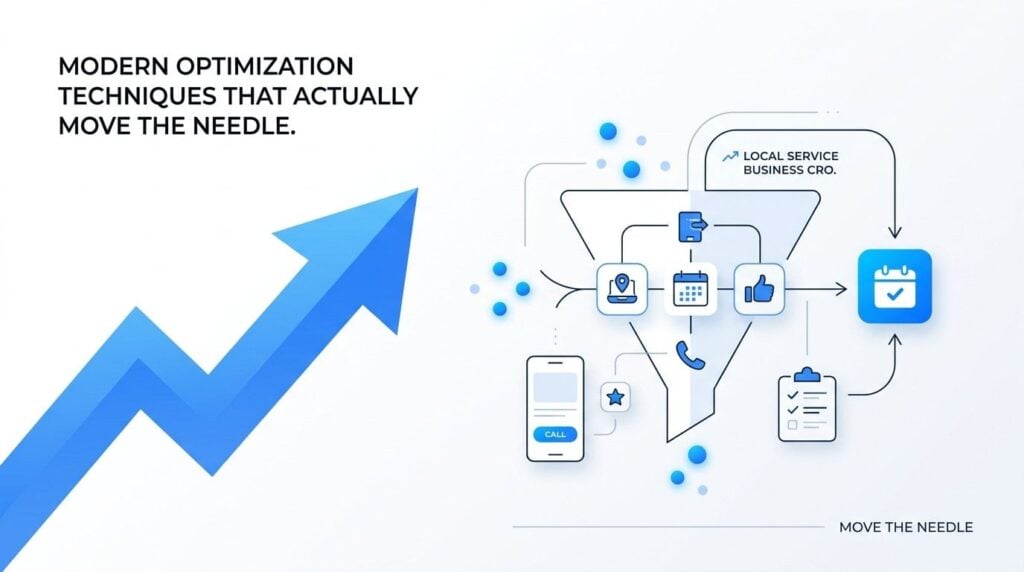
Beyond the page itself, there’s a structural problem that costs local service businesses a lot of money: sending paid traffic to a homepage. A homepage is designed to introduce your business. A landing page is designed to convert a specific visitor with a specific need. When you send someone who searched “emergency HVAC repair near me” to a page that talks about all six of your service lines and has three different CTAs, you’re asking them to do work they didn’t come to do. Dedicated landing pages built around a single service and a single action consistently outperform homepages for paid traffic.
There’s also a conversion surface that most businesses underestimate: your Google Business Profile. Roughly 42% of local clicks go to Map Pack results, which means your GBP listing is often the first real interaction a potential customer has with your business. An incomplete profile, thin review counts, missing service categories, or outdated hours can lose leads before they ever reach your website. Your GBP is a conversion page. Treat it like one.
The Trust Signals That Get Skeptical Homeowners to Call
Design doesn’t close the deal for service businesses. Trust does.
Think about what a homeowner is actually deciding when they land on your page. They’re not comparing features or evaluating a subscription tier. They’re deciding whether to let someone they’ve never met into their home, often when something is broken and they’re already stressed. The conversion lever in that moment isn’t a clever headline. It’s evidence that you’re legitimate, competent, and safe.
License numbers and insurance statements belong on your landing pages, not buried in an “About” page. A visible license number does something a testimonial can’t: it’s verifiable. It signals that you’re operating above board and that you’re not afraid to be checked. For trades like electrical, plumbing, and HVAC, where licensing is a genuine consumer protection issue, this detail does real conversion work.
Named technicians and real photos of your actual team convert better than stock photography. When someone can see the face of the person who might show up at their door, the decision to call gets easier. This sounds simple because it is. Most businesses skip it because it takes effort to photograph your crew and write a two-sentence bio for each tech. That gap is an advantage you can take.
Reviews need to be visible without scrolling on mobile. A star rating, a review count, and one or two specific excerpts placed near your primary call to action do more work than a testimonials page buried three clicks deep in your navigation. The specificity of a review matters too. “Great service” is forgettable. “They showed up within two hours on a Sunday and had our heat back on before dinner” is a conversion asset.
Response time is a conversion factor, not just a customer service feature. For emergency services, the business that answers fastest wins. That’s not an opinion, it’s how emergency calls work. Click-to-call buttons, prominently stated response time guarantees (“We answer 24/7, no voicemail”), and live chat for non-emergency inquiries all reduce the friction between “I need help” and “I’m calling you.” If your competitor answers and you don’t, the lead is gone regardless of how good your website looks.
Interestingly, some of the sharpest thinking on trust signals and conversion flows comes from outside the service industry entirely. Nonprofits like charity: water and the ASPCA have pressure-tested these same principles under extreme budget constraints, and the conversion optimization strategies nonprofits use translate almost perfectly to local service businesses trying to turn website visitors into booked jobs.
How to Test What’s Working Without Losing Three Months
A/B testing sounds like it requires a data science team and enterprise software. For a local service business, it doesn’t.
The core discipline is simple: change one thing at a time, run it long enough to see a real difference, and decide based on what you see. Testing a headline variant against your current headline. Testing a phone-number-first layout against a form-first layout. Testing a specific CTA (“Get a Free Estimate Today”) against a generic one (“Contact Us”). One variable, one test, one decision.
Where businesses go wrong is testing everything at once, or running a test for a week and calling it. If you change your headline, your button color, and your form layout simultaneously, you won’t know what caused any change in your conversion rate. And a week of data from a local service business with moderate traffic isn’t enough to trust. Several weeks per test is a more realistic window for meaningful results.
Heatmaps and session recordings are the diagnostic tools that tell you what analytics can’t. Google Analytics tells you that visitors left. A session recording shows you why. If visitors are clicking on your logo expecting it to navigate somewhere, that’s a friction point. If they’re rage-clicking a phone number that isn’t linked as a tap-to-call, that’s a specific fix with a measurable impact. Tools in this category exist at a range of price points, and for a service business running paid traffic, the investment in a few months of session recording data is usually worth it.
The mindset shift that makes CRO work for service businesses is treating it as ongoing diagnosis rather than a one-time project. You run a test, you learn something, you implement the winner, and you find the next thing to test. That cycle compounds over time in ways that a single website redesign never does.
Speed, Mobile, and the Technical Details That Actually Lose Calls
Page speed is a conversion issue. The SEO angle gets most of the attention, but the conversion impact is just as real. A page that takes more than three seconds to load on a mobile connection loses a meaningful share of visitors before they see your headline, your phone number, or your reviews. For a service business where a single booked job can be worth several hundred to several thousand dollars, that’s not a rounding error.
Mobile-first design for service businesses has specific requirements that generic web design advice misses. Your phone number must be formatted as a tappable link, not just text on a screen. Your primary CTA must be visible without scrolling on a phone screen. Your forms must work cleanly on a small touch screen without requiring pinch-to-zoom. Most local service business websites fail at least one of these. Check yours right now on your own phone, not in a browser’s mobile preview mode.
Form friction deserves its own conversation because it’s one of the most common and most avoidable conversion killers. Every additional required field in a contact form reduces the percentage of people who complete it. The question to ask about each field is: do I actually need this to qualify the lead, or am I asking for it because it would be convenient to have? Name, phone number, and what service they need is sufficient for most home service businesses. Address, preferred appointment time, and budget can be collected during the intake call. Asking for all of it upfront costs you leads from people who were ready to call but weren’t ready to fill out a questionnaire.
One more technical detail that often gets skipped: make sure your click-to-call tracking is set up correctly in GA4. If your phone calls aren’t being tracked as conversions, you’re making decisions about your landing pages without seeing the most important conversion action on them. GA4 is the current standard; if you’re still looking at Universal Analytics data, that platform is deprecated and you need to migrate your tracking setup.
What CRO Actually Looks Like When It’s Working
Conversion rate optimization isn’t a project you complete. It’s a discipline you build into how you run your marketing.
Seasonal demand shifts create new conversion challenges. An HVAC company‘s busiest conversion surface in January is different from its busiest in July. New service offerings need their own landing pages, not a paragraph added to an existing page. Competitor moves, new review platforms, and changes in how Google displays local results all affect where leads drop off. Businesses that review their conversion data monthly catch these problems before they become expensive. Businesses that review it quarterly are usually chasing a problem that’s already cost them real money.
The connection between conversion rate and cost per lead is direct and worth internalizing. If you’re paying at the high end of the $18-35 Google Ads CPL benchmark for home services, improving your landing page conversion rate brings that number down without changing your ad spend. You’re not spending less. You’re getting more booked jobs from the same budget. That’s the actual value of CRO, and it compounds as you layer in improvements over time.
One discipline that separates businesses doing CRO well from those going through the motions: orienting your reporting around outcomes, not activity. Session duration, bounce rate, and page views tell you something, but they don’t tell you whether your marketing is working. Booked jobs and cost per booked job are the numbers that matter. If your reporting doesn’t connect traffic and conversion data to actual revenue, you’re navigating without a destination.
For HVAC businesses dealing with lead quality issues, this deeper look at HVAC conversion rate problems breaks down the vertical-specific patterns. Plumbing businesses can find similar detail in the services section of the Clicks Geek site.
Putting It All Together: Where to Start This Week
CRO is one more thing to manage on top of running a service business. That’s real, and it’s worth acknowledging. But here’s the reframe: every dollar you’re already spending on ads and SEO works harder when your conversion rate improves. You’re not adding a new expense. You’re getting more out of what you’re already paying for.
The path forward is diagnostic, not overwhelming. Start with the basics this week: pull up your website on your phone and check whether your phone number is tappable, whether your CTA is visible without scrolling, and how long the page takes to load on a mobile connection. Those three checks will tell you whether you have obvious technical problems that are costing you calls right now.
Then look at your trust signals. License number visible? Real photos of your team? Reviews placed near your CTA rather than on a separate page? Fix what’s missing before you run a single test.
Then test. One thing at a time, with enough patience to see real results.
Clicks Geek has been running this process since 2015, across more than 10,000 campaigns in 298 industries, with over $100M in managed spend. We’re a Google Premier Partner, and the reason that credential matters here is that we see conversion data across a range of local service verticals that most agencies never touch. We know what actually moves the needle, and we know what looks good in a report but doesn’t book jobs.
If you want to see what this would look like for your business, we’ll walk through your current setup, show you where leads are likely dropping off, and tell you what’s realistic in your market. No pitch deck, no pressure. Just a straight conversation about what’s working and what isn’t.