You’ve probably already spent money on Google Ads. Maybe Angi leads too. And at some point someone told you Facebook could work for pest control, so you boosted a post or ran a quick campaign, got a handful of clicks, zero calls, and wrote the whole thing off.
That experience is common. It is also almost always a setup problem, not a platform problem.
Google catches homeowners mid-crisis. The wasp nest appeared this morning, the mouse ran across the kitchen floor last night, and they are actively searching for someone to fix it right now. That intent is real and valuable, and Google Ads is the right tool to capture it. But Facebook does something different. It reaches homeowners before the panic, while they are scrolling on a Tuesday evening with no immediate pest problem, and it plants your name in their head so that when the problem does arrive, or when they decide they are tired of dealing with ants every spring, they call you instead of whoever shows up first in a search.
That is a different buyer. And that buyer, the one who signs up for a quarterly plan or books a mosquito control package before the season starts, is often worth significantly more to your business than the one-time emergency caller.
The pest control owners who tried Facebook and got nothing almost always made the same mistakes: broad targeting, generic creative, no specific offer, and no tracking tied to actual booked jobs. This article walks through what a properly built Facebook campaign looks like in this vertical, from audience setup to seasonal timing to the tracking layer that tells you whether it is actually working.
The platform is not broken. The setup just has to match how pest control customers actually make decisions.
Why Pest Control Is a Surprisingly Good Fit for Facebook Advertising
Most pest control owners think of their business as purely reactive. Someone has a problem, they search for help, you show up. That is true for a meaningful portion of your calls. But it is not the whole picture, and the part it misses is where Facebook actually earns its place in the channel mix.
Pest control has two distinct buyer modes. The first is emergency: active infestation, immediate need, Google search, first available credible option wins. The second is preventive: the homeowner who wants quarterly service so they never have to deal with roaches again, or who books mosquito control before the season starts, or who schedules a termite inspection after a neighbor mentions they found damage. That second group is not searching right now. They are interruptible. And Facebook, built around reaching people who are not actively looking for anything, is exactly the right tool to reach them.
The preventive buyer also tends to be more profitable. A customer on an annual pest plan generates recurring, predictable revenue. A one-time treatment does not. When you build a Facebook campaign to sell recurring service contracts instead of single calls, the math on customer acquisition cost changes substantially because the lifetime value you are working against is much higher.
The targeting fit is also real. Pest control is a homeowner product. Renters do not call pest control companies; their landlord does. Facebook’s ability to filter by homeownership status, household type, suburban geography, and income tier means you can build an audience that actually looks like your customer base rather than spraying impressions at everyone in a metro area. Layer in seasonal timing, which we will cover shortly, and you have a targeting setup that matches how pest control demand actually moves through the year.
The competitive situation is worth noting too. In Google Ads, pest control companies compete against Terminix, Orkin, and Rentokil with national budgets, plus Angi and Thumbtack driving up auction prices. Facebook is comparatively less saturated in this vertical. Most local pest control companies are either absent entirely or running occasional boosted posts with no real strategy behind them. That gap will not stay open indefinitely, but right now the cost to reach a qualified homeowner on Facebook is often lower than what you would pay in a crowded Google auction.
Building an Audience That Reflects Your Actual Service Area
The single biggest mistake pest control companies make on Facebook is targeting too broadly. A metro-wide campaign sounds efficient until you realize you are paying for leads forty miles from your nearest truck. Pest control is hyper-local by nature. Drive time limits your same-day coverage area, and a lead you cannot serve within a reasonable window is a lead that converts poorly or not at all.
Start with geography as your hard constraint. A 15-20 mile radius around your primary service area is a reasonable starting point for most operations. If you serve multiple zip codes but not all of them, exclude the ones you cannot realistically cover. This feels obvious but most campaign setups skip it, and it is one of the fastest ways to waste budget.
Within that geography, layer in audience signals that reflect your actual customers. Homeownership is the most important filter in this vertical. Household income tiers matter if your service pricing is above the market average or if you are selling termite treatments that run into the thousands. Family households with children tend to be more motivated buyers for mosquito control and general pest prevention than single-person households.
Your existing customer list is one of your most valuable targeting assets. Upload a clean list of 500 or more past customers and build a lookalike audience from it. Meta will find people who share behavioral and demographic characteristics with the homeowners who already hired you. In home services, lookalike audiences built from real customer data consistently outperform cold interest-based targeting because the algorithm is matching on actual buyer patterns rather than inferred interests.
Seasonal timing is the targeting lever most pest control Facebook campaigns ignore entirely. Termite swarm season peaks from March through May across most of the US. That is the window when homeowners are most likely to notice swarmers, find wing piles near windowsills, and suddenly become very interested in an inspection. Running termite-specific creative and increasing budget during that window is not complicated, but it requires planning in advance rather than reacting after the season has started.
Mosquito control campaigns belong in late spring through summer. Rodent exclusion messaging fits October through December as temperatures drop and mice start looking for warm entry points. Running the same creative year-round and expecting consistent results ignores the seasonal reality of what drives pest control demand. Shift your budget and your messaging with the calendar and you will get better results from the same total spend.
What Your Ads Actually Need to Say
Pest control creative has one real job: make the viewer feel the discomfort of having a pest problem and immediately believe you are the credible local solution. That is it. Everything else is secondary.
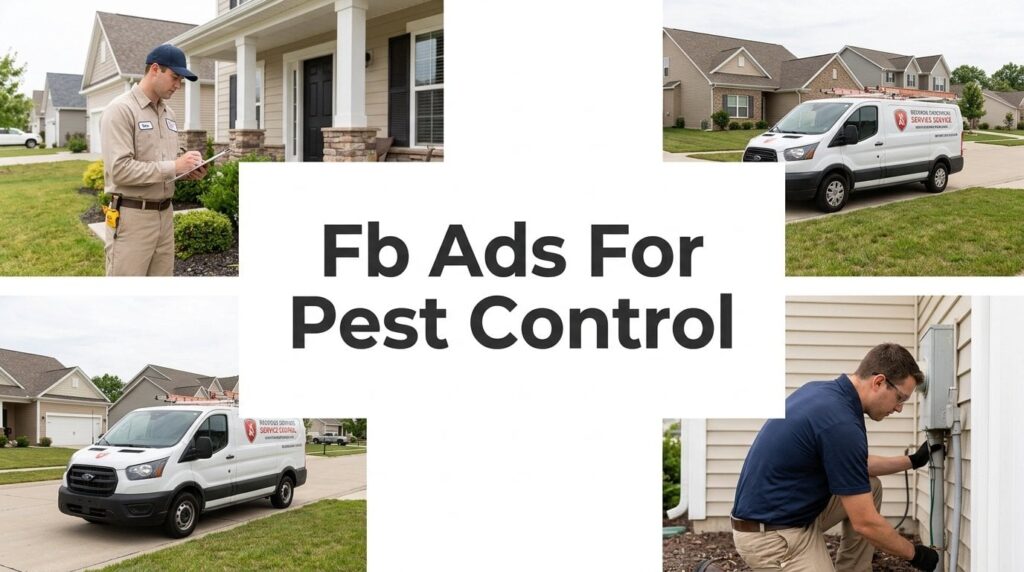
The creative formats that work in home services are not the polished ones. Before-and-after photos of actual treatments, short video walkthroughs of a technician doing an inspection, photos of real crew members in uniform with your company name visible, these outperform stock imagery consistently. The reason is trust. A homeowner is deciding whether to let a stranger into their house. Seeing a real person in a branded uniform signals something that a generic pest graphic does not.
State-level applicator licensing is a trust signal worth putting in your ad copy and your landing page. Most homeowners do not know it exists, which means mentioning it differentiates you from unlicensed operators and signals professionalism. Background-checked technicians, bonded and insured, licensed in your state: these details matter to the person deciding who gets access to their home.
The offer structure matters more than the headline. A specific, low-friction offer converts better than a vague call to action. “Free inspection for new customers” is better than “Contact us today.” A fixed monthly price for a quarterly service plan gives the homeowner a concrete decision to make. Mosquito control packages with a clear seasonal price point work better than generic mosquito messaging because the viewer knows exactly what they are considering. Vague offers produce vague responses.
What kills the click is predictable. Headlines that sound like every other pest control ad in existence (“We Get Rid of Pests Fast!”) produce nothing because they give the viewer no reason to stop scrolling. No local signal in the copy is a close second: if your ad could be running in any city in the country, it does not feel relevant to someone in your specific market. Mentioning your city or service area by name, even briefly, increases relevance significantly.
The landing page has to match the ad. If your ad promotes a free termite inspection, the landing page needs to be about the free termite inspection with a clear form or phone number above the fold. Dropping someone on your homepage and expecting them to navigate to the right offer is a reliable way to lose the conversion. The ad and the page need to match in offer, location, and tone, or the work you did to get the click is wasted.
How to Structure the Campaign Without Burning the First 90 Days
For pest control, Lead Generation campaigns using Facebook’s native lead forms are usually the right starting point. A homeowner scrolling at 9pm on their phone is not going to navigate to your website, wait for it to load, and fill out a five-field contact form. The native lead form captures name, phone number, and service interest without the viewer ever leaving the app. Friction is lower, completion rates are higher, and on mobile it is a meaningfully better experience than a website redirect.
The trade-off is lead quality. Because the barrier to submit is lower, some lead form submissions will be lower intent than someone who navigated to your website and filled out a form there. The fix is speed. A pest control lead that gets a call-back within five minutes converts at a substantially higher rate than one that sits for two hours. If your follow-up process is not set up to respond that quickly, either fix the process before you launch or start with a website conversion campaign instead where the higher friction self-selects for more motivated prospects.
Budget expectations need to be honest. The home services Facebook CPL benchmark is $10-25. A well-built pest control campaign should land in that range, but the first 30-60 days are the algorithm’s learning phase. Meta needs conversion data to optimize its delivery, and pulling budget before it has enough signal is the most common reason campaigns fail before they had a real chance. Cutting a campaign after two weeks because the CPL looks high is not a fair test. It is judging the learning phase.
Retargeting is where pest control Facebook campaigns often make their money back. Website visitors who did not fill out a form, people who watched more than half of a video ad, and past lead form openers who never booked an appointment are all warm audiences. Running a separate retargeting campaign to these groups with a different offer or a short testimonial-style video typically produces lower CPLs than cold traffic because the audience already has some familiarity with your company. Set up the retargeting layer from day one, even if the audiences start small. They build over time.
On campaign structure: keep cold traffic and retargeting in separate campaigns so you can see the performance of each clearly. Mixing them together obscures what is actually working and makes budget allocation decisions harder than they need to be.
Tracking That Connects Ad Spend to Booked Jobs
If you cannot see which ads are producing booked jobs, you are making budget decisions based on incomplete information. This is where a lot of pest control Facebook campaigns quietly fail: the ads are running, leads are coming in, but nobody has connected the dots between which campaign produced which revenue.
The Meta Pixel alone is no longer sufficient. Browser privacy changes have made pixel-only tracking unreliable. You need the Conversions API (CAPI) running alongside the pixel to capture conversion events that the browser-side pixel misses. Without it, Meta’s algorithm is optimizing on partial data, which means it is not finding the right people as efficiently as it could. This is a technical setup item but it is not optional in 2026 if you want the campaign to perform well over time.
For pest control specifically, the conversion events that matter are: phone call from the landing page, lead form submission, and booked appointment if your scheduling software or CRM can pass that event back to Meta. Tracking clicks and page visits tells you about traffic. It tells you nothing about revenue. Set up a dedicated call tracking number for your Facebook campaigns so you can tie phone leads back to specific ads and know what you are actually paying per call.
The monthly review should look at three numbers together: CPL trend over time, lead-to-booked-job rate, and cost per booked job. CPL alone is misleading. Facebook leads, because they are interruption-based rather than search-intent-based, often have a lower close rate than Google leads. A $15 CPL that closes at 20% is more expensive per booked job than a $30 CPL that closes at 40%. Factor in your close rate before deciding whether a campaign is working or not.
If your cost per booked job is within a range you can sustain given your average job value and customer lifetime value, the campaign is working. If it is not, the review process tells you where to look: creative performance, audience quality, offer relevance, or follow-up speed. Each of those has a fix. You just need the data to know which one to address first.
Honest Expectations: What Facebook Can and Cannot Do for Pest Control
Facebook is not a replacement for Google Ads or local SEO in pest control. It is a complement. Google captures demand that already exists. Someone searching “termite treatment near me” is ready to buy. Facebook reaches people who have not searched yet, which means you are creating demand rather than capturing it. The businesses that tend to win in this vertical are running both channels and understanding which one serves which buyer stage.
Facebook makes the most sense for pest control companies that have a few things in place. A recurring service offer to sell, because the lifetime value math works better when you are acquiring customers for annual plans rather than one-time treatments. A fast lead follow-up process, because interruption-based leads go cold faster than search leads. And enough budget to fund the learning phase without pulling the plug at week three because the results are not there yet.
If your business model is primarily reactive one-time treatments, the economics are harder. The customer lifetime value is lower, which means your acceptable cost per acquisition is lower, which means the margin for error in campaign performance is smaller. That does not mean Facebook cannot work, but it means the offer structure and targeting need to be tighter.
The ramp timeline is real. Expect 30-60 days before the algorithm has enough data to optimize well, and 90 days before you have enough information to make confident decisions about scaling or adjusting. Two weeks is not a test. It is the learning phase. Set those expectations internally before the campaign launches so you are not making reactive decisions based on early data that does not yet mean much.
Putting It All Together
Facebook works for pest control when it is built to reach the right homeowners, with a specific offer tied to a real service, tracked all the way to booked jobs, and given enough time for the algorithm to find its footing. None of those conditions are complicated. They are just less common than they should be.
The platform is not magic and it is not broken. It is a tool that rewards specificity: specific geography, specific seasonal timing, specific offers, and specific tracking. Termite swarm season in the spring. Mosquito control through the summer. Rodent exclusion as fall comes in. Recurring service plans as the offer worth building campaigns around. These are the details that separate a pest control Facebook campaign that produces revenue from one that produces clicks and confusion.
The businesses that figure this out now have an advantage over competitors who are still treating Facebook as a place to boost posts and hope for the best. That advantage is real, and it compounds over time as your customer lists grow and your lookalike audiences improve.
At Clicks Geek, we are a Meta Business Partner with over a decade of experience running lead generation campaigns for local service businesses across 298 industry verticals. We have managed more than $100 million in ad spend and built campaigns for pest control companies that needed more than clicks. We needed booked jobs.
If you want to see what this would look like for your pest control business, we will walk you through what a properly built campaign looks like in your market, what realistic CPLs and timelines look like, and what needs to be in place before you spend a dollar. No pressure, no pitch deck. Just a straight conversation about what is actually worth doing.