You’ve heard it a hundred times: Facebook ads are a game-changer for local businesses. So you took the plunge. You set up a campaign, wrote some copy, picked an audience, and started spending. Weeks later, you’re staring at a dashboard full of impressions and clicks while your phone stays quiet and your revenue stays flat.
Sound familiar? You’re not alone, and you’re not imagining it. The gap between “Facebook ads can work” and “Facebook ads are working for my business” is enormous, and it’s filled with targeting mistakes, broken funnels, wrong objectives, and measurement blind spots that nobody warned you about.
This isn’t a motivational piece telling you to trust the process. It’s a diagnostic guide. We’re going to break down exactly why Facebook ad ROI tanks for so many local businesses, what the real culprits are, and what you can actually do to fix them. At Clicks Geek, a Google Premier Partner agency focused on profitable growth for local businesses, we’ve seen these patterns repeat across dozens of industries. The good news: most of these problems are fixable once you know where to look.
Measuring the Right Thing: Why Most Business Owners Have ROI All Wrong
Before you can fix low ROI on Facebook ads, you need to make sure you’re measuring ROI correctly in the first place. This sounds obvious, but it’s where a surprising number of business owners go wrong from the start.
ROI in the context of Facebook advertising isn’t about how many people saw your ad, liked your post, or even clicked through to your website. It’s a straightforward calculation: revenue generated minus total costs (ad spend plus any management fees), divided by those total costs. If you spent $1,000 on ads and generated $1,500 in revenue, your ROI is 50%. If you generated $800, you’re losing money regardless of how impressive your reach numbers look.
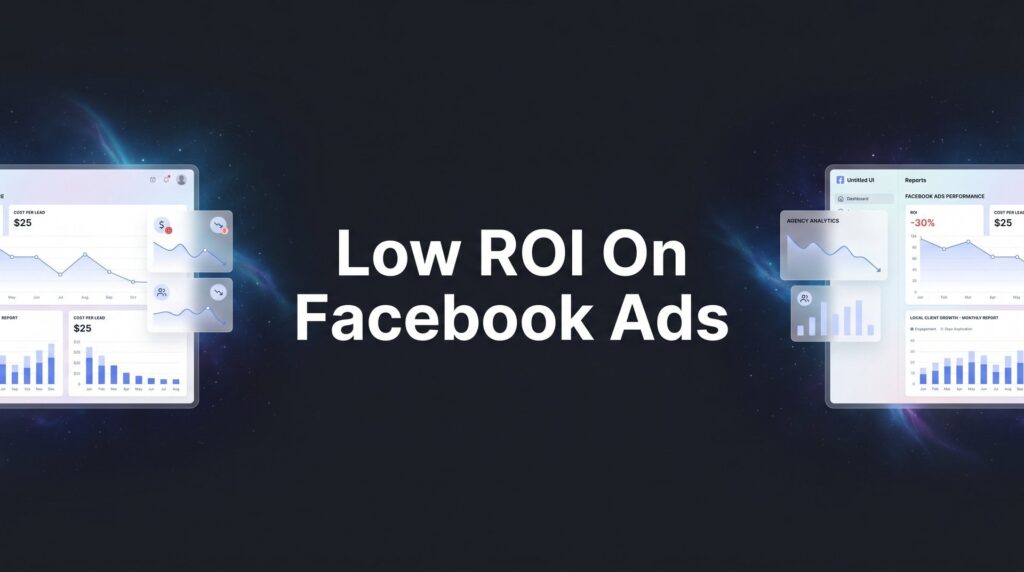
The problem is that most Facebook dashboards default to showing you vanity metrics: reach, impressions, post engagement, link clicks. These numbers feel good because they’re usually large. But they don’t tell you whether the campaign is making you money. The metrics that actually matter are cost per lead, cost per acquisition, and ideally, customer lifetime value relative to what you spent to acquire that customer.
Cost Per Lead (CPL): How much are you paying for each person who raises their hand and expresses interest? This is your first real signal of campaign health.
Cost Per Acquisition (CPA): How much does it cost to turn a lead into a paying customer? This accounts for your close rate and gives you a truer picture of ad profitability.
Customer Lifetime Value (CLV): For many local service businesses, a single customer is worth far more than their first transaction. An HVAC customer who books a service call might come back for annual maintenance, emergency repairs, and system replacements over a decade. If you’re only measuring first-sale revenue against ad spend, you may be dramatically undervaluing what your campaigns are actually producing.
Here’s a nuance worth sitting with: many business owners think they have a Facebook ads problem when they actually have a measurement problem. Since Apple’s iOS 14.5 privacy changes reduced the accuracy of pixel-based tracking, a meaningful portion of conversions simply don’t get attributed to the campaigns that drove them. If your tracking setup is broken or incomplete, you might be writing off campaigns that are quietly working while doubling down on ones that aren’t. Our Facebook ads optimization guide covers how to address these attribution gaps in more detail.
The 6 Most Common Reasons Your Facebook Ad ROI Is Tanking
Once your measurement is solid, you can start diagnosing the actual performance problems. In our experience, low ROI on Facebook ads almost always traces back to one or more of these six issues.
Poor Audience Targeting: Casting too wide a net is one of the fastest ways to burn through budget. Facebook’s interest-based targeting is broad by nature, and many local businesses make the mistake of targeting massive audiences that include people who will never realistically become customers. On the flip side, over-narrowing your audience can starve the algorithm of data. For local businesses especially, geo-targeting precision matters enormously. A plumber serving one metro area doesn’t need to reach the entire state.
Weak or Mismatched Creative: Your ad creative needs to speak directly to a pain point your ideal customer is actively experiencing. Generic stock photos and vague copy that could apply to any business in any industry won’t stop anyone’s scroll. Ad fatigue is also real. Running the same creative for months causes performance to steadily decay as your audience becomes desensitized to it. Refreshing creative regularly isn’t optional; it’s maintenance.
Sending Traffic to a Bad Landing Page: The ad gets the click. Then the landing page loses the customer. This is one of the most common and costly leaks in any Facebook funnel, and we’ll go deeper on this in the next section because it deserves its own conversation.
Wrong Campaign Objective: This one is underappreciated and critically important. When you choose a campaign objective in Meta Ads Manager, you’re telling Facebook’s algorithm what kind of person to find. Choose “Traffic” and the algorithm finds people who click on things. Choose “Engagement” and it finds people who like and comment. Choose “Leads” or “Conversions” and it finds people who take action. If you’re running a Traffic campaign but your actual goal is booked appointments, you’re paying for the wrong behavior at scale. The algorithm is doing exactly what you asked; you just asked for the wrong thing.
No Retargeting Strategy: Most people who see your ad for the first time aren’t ready to buy. That’s not a failure; it’s human psychology. The businesses that see strong ROI from Facebook ads typically aren’t relying on cold audiences alone. They’re running structured funnels where cold traffic gets introduced to the brand, warm audiences (website visitors, video viewers, engagement) get retargeted with more specific offers, and past customers get nurtured for repeat business and referrals.
Insufficient Budget or Patience: Meta’s own documentation indicates that ad sets generally need around 50 conversion events per week to exit the learning phase and optimize effectively. If you’re spreading a modest budget across five ad sets targeting different audiences, none of them may accumulate enough data to learn. Understanding Facebook ads agency cost structures can help you budget more effectively and avoid spreading resources too thin.
Your Landing Page Is Probably the Biggest Leak in Your Funnel
Most business owners spend the majority of their time obsessing over the ad itself: the headline, the image, the copy, the audience. Meanwhile, the landing page, where the money is actually won or lost, gets an afterthought treatment. This is backwards.
Think of it this way: your ad is a door. Your landing page is the room behind it. You can build the most compelling door in the world, but if the room is a mess, nobody’s staying.
Several landing page problems consistently kill Facebook ad conversions. Slow load times are near the top of the list. Mobile users especially will abandon a page that takes more than a few seconds to load, and the majority of Facebook traffic is mobile. If your page isn’t loading fast, you’re paying for clicks that evaporate before the page even appears.
Sending ad traffic to your homepage is another common mistake. Your homepage is designed for multiple audiences with multiple goals. A campaign landing page should have one audience, one message, and one call to action. When someone clicks an ad promising a free HVAC inspection and lands on a generic homepage with no mention of that offer, the disconnect breaks trust immediately.
Here are the elements that separate high-converting landing pages from ones that leak money:
Message Match: The headline and primary message on your landing page should directly reflect what the ad promised. If the ad says “Free Roof Inspection This Week,” the landing page headline should echo that offer immediately.
Single, Clear CTA: One action. Book a call, fill out a form, or click to call. Not all three. Not a navigation menu with six options. One clear next step.
Trust Signals Above the Fold: Reviews, star ratings, certifications, years in business, and recognizable logos all reduce the psychological friction of taking action. Visitors need a reason to believe you before they’ll hand over their contact information.
Click-to-Call for Mobile: For local service businesses, a phone number that dials automatically when tapped on mobile is one of the highest-converting elements you can add. Don’t make people copy and paste a number.
Fast Load Speed: This isn’t negotiable. Use tools like Google PageSpeed Insights to benchmark your page. If it’s slow, fix it before spending another dollar on ads driving traffic to it.
Conversion rate optimization at the landing page level is often where the biggest ROI improvements come from. You can double the conversion rate of a landing page without changing a single thing about your ad spend, which effectively cuts your cost per lead in half. Learning how to optimize Facebook ads alongside your landing pages creates the kind of compounding leverage that changes campaign economics entirely.
Is Facebook Even the Right Platform for Your Business Right Now?
Here’s an honest question that most agencies won’t ask you: are Facebook ads actually the right channel for your specific business and offer at this moment?
Facebook advertising operates on an interruption model. Users aren’t searching for your service; they’re scrolling through content about other things entirely, and your ad appears in the middle of that. This is fundamentally different from search advertising, where someone types “emergency plumber near me” and your ad appears at the exact moment of intent.
For local service businesses in categories like plumbing, HVAC, roofing, electrical, and similar trades, search-based platforms often deliver stronger immediate ROI because the demand already exists. The customer knows they have a problem and they’re actively looking for a solution. Capturing that intent with a Google Ads campaign is often more efficient than trying to generate it through social interruption.
This doesn’t mean Facebook ads have no role for local service businesses. They can be highly effective for retargeting people who’ve already visited your website, building brand awareness in a specific geographic area, promoting seasonal offers to warm audiences, and nurturing leads who didn’t convert the first time. But using Facebook as your primary demand-generation channel for emergency or high-urgency services is often a harder path than starting with search.
A useful framework for deciding where Facebook ads fit in your strategy involves three questions. First, what is your average customer value? High-value customers with strong lifetime revenue justify more patient, multi-touchpoint funnels. Second, how long is your sales cycle? Shorter cycles with impulse-friendly offers tend to work better on social. Even niche local businesses like hardscaping companies can see strong results when the offer and audience alignment are right. Third, does your ideal customer need to be educated before they’ll buy, or do they already understand the problem and just need to find the right provider?
Knowing the honest answer to these questions doesn’t mean abandoning Facebook. It means using it strategically rather than treating it as a one-size-fits-all lead generation machine.
A Practical Framework to Turn Your Facebook Ad ROI Around
If you’ve identified the problems, here’s a structured approach to fixing them. This isn’t about overhauling everything at once. It’s about working through the funnel systematically so you know exactly what’s driving improvement.
Step 1: Audit Your Tracking. Nothing else matters if your data is unreliable. Start by verifying that your Meta Pixel is installed correctly and firing on the right pages. More importantly, implement the Conversions API (CAPI), which sends conversion data directly from your server to Meta rather than relying solely on browser-based tracking. Since iOS 14.5 reduced cookie-based tracking accuracy, CAPI has become the foundation of reliable Facebook attribution. Define what a conversion means for your business, whether that’s a form submission, a phone call, a booked appointment, or a purchase, and make sure that event is being tracked and reported accurately before you make any campaign decisions based on the data.
Step 2: Restructure Your Campaigns Around a Funnel. Replace disconnected one-off campaigns with a simple three-layer structure. The first layer targets cold audiences through prospecting, people who match your ideal customer profile but haven’t interacted with your business yet. The second layer retargets warm audiences, including website visitors, video viewers, and people who’ve engaged with your content. The third layer targets customer lookalikes and past customers for repeat business or referrals. Our guide on setting up Facebook ads with a step-by-step approach walks through this funnel structure in detail, and the principles apply to local businesses as well.
Step 3: Test Systematically, Not Randomly. Creative testing is essential, but it needs to be controlled. Change one variable at a time: the headline, the image, the offer, or the CTA. Running tests where multiple elements change simultaneously makes it impossible to know what actually moved the needle. Give campaigns enough budget and time to generate meaningful data before drawing conclusions. Make decisions based on cost-per-lead trends rather than early impressions or gut feeling. And when something works, scale it deliberately rather than immediately inflating budgets, which can disrupt the learning phase all over again.
Knowing When to Stop Tweaking and Get Expert Help
There’s a point where DIY Facebook ads management stops being a learning experience and starts being an expensive hobby. Some signs that you’ve crossed that line: you’re spending hours each week adjusting campaigns without seeing consistent improvement, your results swing dramatically from month to month with no clear explanation, or you’re working with an agency that sends you reports full of impressions and engagement numbers while your actual lead volume stays flat.
If any of those describe your situation, the issue isn’t effort. It’s the absence of a system that connects ad spend to real business outcomes.
When evaluating whether to bring in outside expertise, look for a few specific things. Transparency matters more than promises. You should know exactly how much of your budget goes to ad spend versus management fees, and your partner should be able to explain every decision in plain language. Focus on leads and revenue, not vanity metrics, is non-negotiable. Any agency worth working with should be measuring success the same way you do: in customers and revenue, not reach and likes.
CRO expertise is also worth prioritizing. An agency that only optimizes the ad and ignores the landing page is leaving the most valuable improvements on the table. And cross-channel knowledge matters because, as we discussed, Facebook isn’t always the right primary channel. A good partner will tell you honestly when Google Ads, local SEO, or a different approach would serve your business better than doubling down on a platform that isn’t the right fit for your offer.
At Clicks Geek, this is the lens we bring to every local business we work with. The goal isn’t to run ads for the sake of running ads. It’s to build a lead system that generates profitable, measurable growth, and to be accountable to that outcome.
Putting It All Together
Low ROI on Facebook ads is rarely the platform’s fault. It’s almost always a combination of measurement gaps, targeting mistakes, weak post-click experiences, and strategic mismatches that are entirely diagnosable and fixable with the right approach.
Start with your tracking. If you can’t measure it accurately, you can’t improve it. Then work through your funnel from the top down: audience, creative, objective, landing page, and follow-up sequence. Be honest about whether Facebook is the right primary channel for your specific business and offer, or whether it’s better suited as a retargeting and nurturing layer on top of search-based demand capture.
The businesses that see strong, consistent returns from paid social aren’t doing anything magical. They’re measuring the right things, testing systematically, and treating the full funnel as a system rather than a collection of disconnected parts.
Tired of spending money on marketing that doesn’t produce real revenue? We build lead systems that turn traffic into qualified leads and measurable sales growth. If you want to see what this would look like for your business, we’ll walk you through how it works and break down what’s realistic in your market. No hard sell, no vague promises. Just an honest look at where your funnel is leaking and what it would take to fix it.