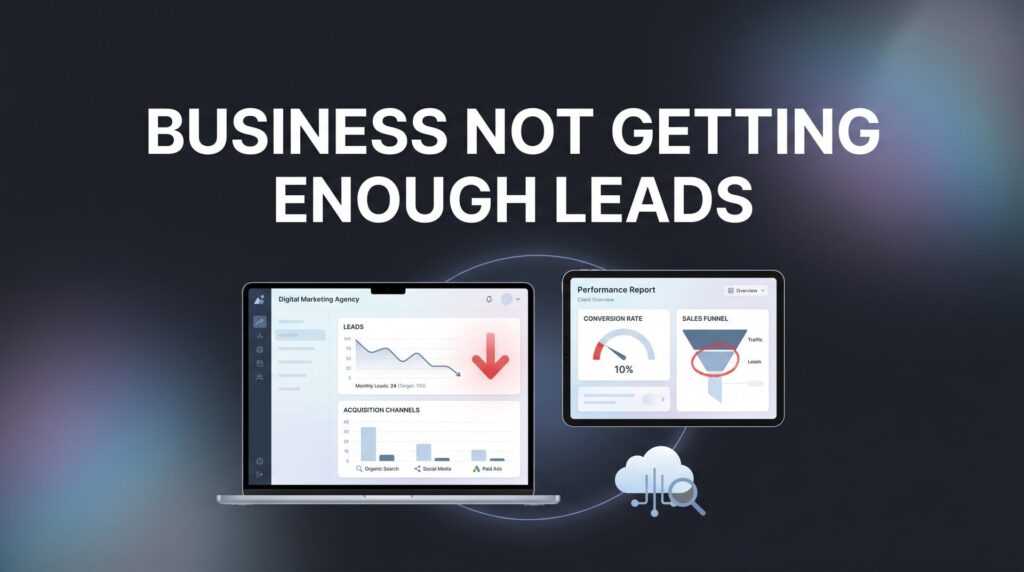
You’re putting in the hours, your service is solid, and yet the phone isn’t ringing like it should. If your business isn’t getting enough leads, you’re not alone—but you also don’t have to accept it as normal.
The truth is, most lead generation problems stem from a handful of fixable issues: unclear targeting, weak messaging, broken conversion paths, or simply being invisible where your customers are actually looking. This guide cuts through the noise and gives you a practical, step-by-step system to diagnose exactly why leads aren’t flowing and what to do about it.
We’re not talking about vague advice like “post more on social media.” We’re talking about concrete actions that drive measurable results—the same strategies that help local businesses go from wondering where their next customer will come from to having a predictable stream of qualified leads.
By the end of this guide, you’ll have a clear action plan to transform your lead generation from a frustrating guessing game into a reliable growth engine. Let’s get started.
Step 1: Audit Your Current Lead Sources to Find the Gaps
Before you can fix your lead problem, you need to understand exactly where you stand right now. Think of this like checking your bank account before creating a budget—you can’t make smart decisions without knowing the current state of affairs.
Start by listing every single channel that’s currently generating leads for your business. This includes website contact forms, phone calls, walk-ins, referrals, social media messages, paid advertising, email inquiries—everything. Don’t skip the obvious ones or the channels you “think” aren’t working. Write them all down.
Next, track the lead volume and quality from each source over the past 90 days. How many leads came from Google searches versus Facebook? How many phone calls originated from your website versus your Google Business Profile? If you don’t have this data readily available, start tracking it now and review again in 30 days.
Here’s where it gets interesting: identify which sources are completely dead or severely underperforming. Maybe your website gets decent traffic but zero form submissions. Maybe you’re paying for directory listings that haven’t sent a single lead in months. These are your gaps—the places where money or effort is being wasted.
For any paid channels, calculate your cost per lead. Take your total ad spend and divide it by the number of leads generated. If you’re spending $500 on Google Ads and getting 10 leads, that’s $50 per lead. Now compare that to your average customer value. If your average sale is $200 and it costs you $50 to get a lead that converts 50% of the time, you’re spending $100 to make $200—that’s profitable. If your numbers don’t work out that cleanly, you’ve found a problem worth fixing. Understanding why marketing isn’t working for your business often starts with this exact analysis.
Success indicator: You have a clear picture of where leads come from, which channels are profitable, and where the holes are in your current system. This clarity is your foundation for everything that follows.
Step 2: Define Your Ideal Customer Profile with Precision
Most businesses think they know their ideal customer, but when pressed for details, they offer vague descriptions like “small business owners” or “homeowners in their 40s.” That’s not nearly specific enough to drive effective marketing.
Move beyond basic demographics to understand the actual pain points and buying triggers that make someone reach out to you. What specific problem are they facing that makes them pick up the phone today instead of next month? What frustration finally pushes them from “I should look into this” to “I need to solve this now”?
Let’s say you run an HVAC company. Your ideal customer isn’t just “homeowners.” It’s homeowners whose AC just broke during a heat wave, or who are tired of sky-high energy bills, or who are selling their house and need repairs to pass inspection. Each of these scenarios represents a different pain point and requires different messaging.
Map out where your ideal customers spend their time both online and offline. Are they searching Google when their problem hits? Are they in local Facebook groups asking for recommendations? Do they trust word-of-mouth referrals from neighbors more than online reviews? Understanding their behavior patterns tells you exactly where to show up.
Create a one-paragraph description of your perfect lead that your whole team can use as a reference. It should be specific enough that anyone on your staff could read it and immediately recognize that customer when they call. For example: “A homeowner in the 35-55 age range who owns a 15+ year old home in our service area, is experiencing an urgent problem with their HVAC system, values quality over price, and is ready to make a decision within 48 hours.” This clarity is essential when you’re struggling with not enough qualified leads in your pipeline.
Success indicator: You can describe your ideal customer in specific, actionable terms that directly inform your marketing decisions. When you write an ad or create a landing page, you know exactly who you’re talking to and what they need to hear.
Step 3: Optimize Your Website for Lead Capture
Your website might be getting traffic, but if it’s not converting visitors into leads, it’s just an expensive digital brochure. Let’s fix that.
First, ensure your contact information is visible on every single page. That means your phone number should appear in the header, footer, and ideally in a sticky element that follows users as they scroll. Don’t make people hunt for how to reach you—that’s a conversion killer.
Add compelling calls-to-action above the fold on your key pages. “Above the fold” means visible without scrolling. Your homepage, service pages, and about page should all have a clear next step for visitors: “Call Now for a Free Quote,” “Schedule Your Free Consultation,” or “Get Your Custom Estimate.” Make these buttons stand out visually—use contrasting colors that catch the eye.
Now let’s talk about forms. If your contact form asks for 12 fields of information, you’re losing leads. Simplify ruthlessly. For most local businesses, you only need name, phone number, email, and maybe a brief message field. Every additional field you add decreases the likelihood someone will complete the form. Ask yourself: do you really need their company size, budget range, and project timeline before you even speak to them? Probably not. If your website isn’t generating leads, form friction is often the culprit.
Here’s a critical step many businesses skip: actually test your forms and phone tracking to confirm they work. Fill out your own contact form and see if you receive it. Call your business number from a cell phone and make sure it rings through. Check that your voicemail system is set up and not full. It sounds basic, but you’d be shocked how many businesses have broken contact forms or phone systems they don’t even know about.
Add trust signals near your conversion points. When someone is about to fill out a form or pick up the phone, they’re making a decision about whether to trust you. Help them over that hurdle by placing customer reviews, certifications, industry awards, or guarantees right next to your contact forms and phone numbers. These social proof elements reduce hesitation and increase conversions.
Success indicator: Your website has clear, working conversion paths on every page, forms are simple and functional, and trust signals are strategically placed to overcome buyer hesitation.
Step 4: Fix Your Local Search Visibility
If your business isn’t showing up when people in your area search for your services, you’re invisible to a massive pool of high-intent prospects. Local search optimization is non-negotiable for service businesses.
Start by claiming and fully optimizing your Google Business Profile. This is the single most important piece of local search real estate you own. Make sure every field is completed: accurate business name, address, phone number, website, hours of operation, service areas, and business categories. Add high-quality photos of your work, your team, and your location. Businesses with complete profiles and photos typically appear more credible and get more clicks than sparse listings.
Ensure NAP consistency across all online directories. NAP stands for Name, Address, Phone number, and these three pieces of information must be identical everywhere they appear online—your website, Google Business Profile, Yelp, Facebook, industry directories, everywhere. Inconsistencies confuse search engines and can hurt your local rankings. If your website says “123 Main Street” but your Google listing says “123 Main St.,” fix that.
Target location-specific keywords on your website pages. Don’t just say “plumbing services“—say “plumbing services in Austin, Texas” or “emergency plumber serving downtown Denver.” Create dedicated service pages for each area you serve if you cover multiple cities or neighborhoods. Search engines need these geographic signals to understand where you operate and who to show your business to. This is a core component of effective lead generation for local businesses.
Actively request and respond to customer reviews. After completing a job, send a simple follow-up message asking satisfied customers to leave a review on Google. Make it easy by including a direct link. Then—and this is crucial—respond to every review, both positive and negative. Thank people for positive feedback and address concerns professionally in negative reviews. This shows prospects that you’re engaged and care about customer satisfaction.
Success indicator: Your business appears in the local map pack (the top three results with map pins) when someone in your area searches for your main services. You have a steady stream of recent reviews and a complete, optimized Google Business Profile.
Step 5: Launch Targeted Paid Advertising for Immediate Results
Organic visibility takes time to build. If your business needs leads now, paid advertising is your fastest path to results—but only if you do it right.
Start with Google Ads targeting high-intent keywords. These are search terms that indicate someone is actively looking for your service right now: “emergency locksmith near me,” “roof repair Denver,” “personal injury lawyer consultation.” These searchers aren’t browsing—they’re ready to hire someone. That’s why they convert at higher rates than broader awareness campaigns.
Before you spend a single dollar, set up proper conversion tracking. You need to know which ads and keywords are actually generating leads, not just clicks. Install Google’s conversion tracking code on your website to track form submissions, and set up call tracking numbers so you can attribute phone calls to specific campaigns. Without this data, you’re flying blind. Many businesses wonder why their ads aren’t converting to sales—and the answer usually starts with missing conversion data.
Create dedicated landing pages for each ad campaign—never send paid traffic to your homepage. If someone searches “AC repair Phoenix” and clicks your ad, they should land on a page specifically about AC repair in Phoenix, not your general homepage with navigation to 15 different services. The more aligned your landing page is with the search intent, the higher your conversion rate will be.
Set a realistic daily budget and monitor your cost per lead weekly. Start with a budget you can sustain for at least 90 days—that’s how long it typically takes to gather enough data to optimize effectively. Check your campaigns weekly to see which keywords are generating leads at an acceptable cost and which are wasting money. Pause underperforming keywords and increase budget on winners.
Success indicator: You have campaigns running with trackable, measurable lead generation. You know exactly how much you’re spending, how many leads you’re getting, and what your cost per lead is for each campaign.
Step 6: Build a Follow-Up System That Converts Inquiries to Customers
Here’s a harsh truth: many businesses aren’t actually suffering from a lead generation problem—they’re suffering from a lead follow-up problem. You might be getting enough leads; you’re just not converting them.
Respond to all leads within five minutes during business hours. Speed matters enormously. When someone fills out a contact form or calls your business, they’re often reaching out to multiple companies. The first business to respond professionally typically has a significant advantage. Set up notifications on your phone so you know immediately when a lead comes in.
Create a simple follow-up sequence for leads who don’t respond immediately. Not everyone answers on the first attempt. Your sequence might look like this: immediate phone call, follow-up text message within an hour, email within 24 hours, second phone call at 48 hours, final email at one week. Document this sequence and make sure everyone on your team follows it consistently. When leads aren’t turning into sales, a broken follow-up process is often the hidden cause.
Use a CRM or even a simple spreadsheet to track every lead and their status. You need a system that shows you which leads you’ve contacted, when you last reached out, what they said, and what the next step is. This doesn’t have to be fancy—a Google Sheet with columns for name, phone, email, source, status, and notes works fine for small businesses. The key is having one central place where nothing falls through the cracks.
Set reminders for follow-up so no lead gets forgotten. If a prospect says “call me back next week,” put a reminder in your calendar. If someone requested a quote and you sent it, set a reminder to follow up in three days. Consistent follow-up is what separates businesses that convert 20% of leads from those that convert 50%.
Success indicator: You have a documented process that ensures every lead gets multiple touchpoints, response times are tracked, and no inquiry goes unanswered. Your team knows exactly what to do when a lead comes in.
Step 7: Measure, Analyze, and Double Down on What Works
Data-driven decisions separate struggling businesses from thriving ones. Once you’ve implemented the previous steps, it’s time to measure what’s actually working and invest more heavily there.
Track lead-to-customer conversion rates for each source. It’s not enough to know that Google Ads sent you 50 leads last month—you need to know how many of those 50 became paying customers. Maybe Google Ads has a 30% conversion rate while Facebook leads convert at 10%. That information completely changes how you should allocate your budget.
Calculate true ROI by comparing revenue generated to marketing spend. If you spent $2,000 on Google Ads and those leads generated $15,000 in revenue, that’s a 7.5x return. If you spent $500 on a directory listing and got zero customers, that’s a 0x return. This analysis tells you exactly where to cut spending and where to increase it. Addressing poor quality leads from marketing requires this same level of source-by-source analysis.
Identify your top-performing channel and increase investment there first. Many businesses make the mistake of spreading their budget evenly across multiple channels or constantly chasing new tactics. Instead, find what’s working and do more of it. If Google Ads is generating profitable leads, increase your daily budget before experimenting with LinkedIn ads or direct mail.
Cut or fix channels that consistently underperform after 90 days of data. Give new channels a fair test—90 days is usually enough to gather meaningful data—but don’t throw good money after bad. If a particular ad platform or marketing tactic isn’t generating leads at an acceptable cost after three months of optimization attempts, pause it and reallocate that budget to proven winners.
Success indicator: You make data-driven decisions about where to invest your marketing budget. You can confidently explain which channels drive the most revenue and why, and your marketing spend is concentrated on activities with proven ROI.
Putting It All Together: Your 30-Day Action Plan
The businesses that consistently generate leads aren’t lucky—they’re systematic. They’ve implemented the exact framework you just learned and they execute it consistently.
Here’s your quick-start checklist to transform your lead generation over the next 30 days:
Week 1: Complete your lead source audit. Document every channel, track volume and quality, calculate cost per lead for paid sources. This gives you your baseline.
Week 2: Define your ideal customer profile in writing and audit your website. Test every form and phone number to ensure they work. Add clear calls-to-action above the fold on key pages. Simplify your contact forms to essential fields only.
Week 3: Optimize your Google Business Profile with complete information, photos, and start requesting reviews. Ensure NAP consistency across all directories. Launch your first targeted Google Ads campaign with proper conversion tracking and dedicated landing pages.
Week 4: Implement your five-minute response rule and create your documented follow-up sequence. Set up your lead tracking system. Begin measuring conversion rates by source.
Start with Step 1 today, and work through this process methodically. Each step builds on the previous one, creating a complete lead generation system that turns your marketing from a cost center into a predictable revenue driver.
The difference between businesses that struggle for leads and those with full pipelines isn’t talent or luck—it’s having a proven system and the discipline to execute it. You now have the system. The execution part is up to you.
Tired of spending money on marketing that doesn’t produce real revenue? We build lead systems that turn traffic into qualified leads and measurable sales growth. If you want to see what this would look like for your business, we’ll walk you through how it works and break down what’s realistic in your market.