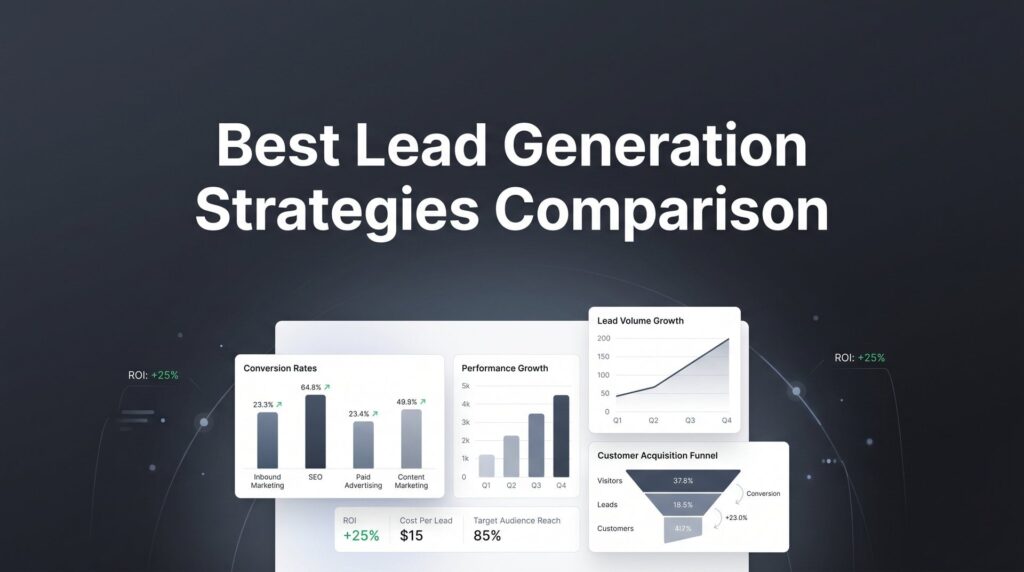
Not all lead generation strategies are created equal. For local business owners, choosing the wrong one can mean months of wasted budget and a phone that never rings. The challenge isn’t a shortage of options — it’s the opposite. PPC, SEO, social media ads, referral programs, content marketing, email outreach, strategic partnerships — every marketing guru has a favorite, and they all swear theirs is the best.
Here’s the honest truth: the best strategy depends on your budget, your timeline, your industry, and your growth goals. What fills the pipeline for a personal injury law firm won’t necessarily work for a carpet cleaning company. A strategy that delivers fast results in a small market might drain your budget in a competitive metro area.
This guide cuts through the noise. We’re breaking down seven proven lead generation strategies side by side, examining how each one works, what it costs, how quickly it delivers results, and which types of local businesses benefit most. Think of it as a head-to-head comparison rather than a sales pitch for any single approach.
By the end, you’ll have a clear picture of where to invest your marketing dollars for the highest return based on where your business actually stands right now. No fluff. No theory. Just a direct, honest comparison so you can make a smart decision and stop guessing.
1. Pay-Per-Click Advertising
The Challenge It Solves
Most lead generation strategies take months to gain traction. If your pipeline is dry right now and you need qualified calls coming in this week, waiting for SEO to kick in isn’t a viable plan. PPC solves the urgency problem. It puts your business in front of people who are actively searching for exactly what you offer, at the exact moment they’re ready to hire someone.
The Strategy Explained
Google Ads operates on a pay-per-click auction model. You bid on specific keywords, and your ad appears when someone in your target area searches for those terms. The critical advantage here is intent. Someone searching “emergency plumber near me” or “divorce attorney in [city]” is not browsing — they’re ready to make a decision.
For local service businesses, this high-intent traffic is incredibly valuable. You’re not interrupting someone’s scroll with an ad for a service they weren’t thinking about. You’re showing up at the exact moment they’re looking for you. Combine this with a well-optimized landing page and strong call tracking, and PPC becomes a highly measurable, controllable lead machine. Businesses looking to understand the full picture should explore profitable Google Ads strategies that maximize return on every dollar spent.
Implementation Steps
1. Define your core service keywords and geographic targeting radius before touching the campaign settings.
2. Build dedicated landing pages for each service category rather than sending traffic to your homepage.
3. Set up conversion tracking so you know which keywords and ads are producing actual leads, not just clicks.
4. Start with a focused campaign structure, monitor search term reports weekly, and add negative keywords to eliminate wasted spend.
5. Continuously test ad copy and landing page elements to improve your cost per lead over time.
Pro Tips
Bid on competitor brand terms cautiously — they can produce leads but often at higher cost. Focus your budget on transactional keywords with “near me,” “in [city],” or “cost of” modifiers. These signal someone who’s further along in the buying decision. If you’re running Google Ads without a Google Premier Partner agency reviewing your account, you’re likely leaving significant efficiency on the table.
Best For: Home services, legal, medical, financial services, and any local business that needs leads quickly or operates in a competitive market.
Timeline to Results: Days to weeks.
Cost Profile: Higher upfront cost per lead, but highly scalable and measurable.
2. Local SEO and Google Business Profile
The Challenge It Solves
PPC stops the moment you stop paying. Local SEO solves the sustainability problem. Businesses that rank consistently in the local map pack and organic results enjoy a steady stream of inbound leads without paying for every click. The challenge is that it takes time and consistent effort to build — but the long-term economics are hard to beat. Understanding the tradeoffs between these two channels is essential, and our breakdown of local SEO vs PPC for lead generation dives deeper into that comparison.
The Strategy Explained
Your Google Business Profile is the engine behind local map pack rankings. Google’s algorithm evaluates three primary factors: proximity to the searcher, relevance to the search query, and prominence (driven by reviews, citations, and overall online authority). A fully optimized GBP combined with consistent review generation and local citation building can push you to the top of local results for your most valuable keywords.
Beyond the map pack, on-page SEO and locally-targeted content help your website rank in organic results. This creates a compounding effect over time. Each new review, each new citation, each new optimized page adds to your authority, and that authority doesn’t disappear when you pause your marketing spend.
Implementation Steps
1. Claim and fully complete your Google Business Profile including service categories, business description, service areas, and photos.
2. Build a systematic process for requesting reviews from every satisfied customer immediately after the job is complete.
3. Ensure your name, address, and phone number (NAP) are consistent across all online directories and citation sources.
4. Create location-specific service pages on your website targeting the cities and neighborhoods you serve.
5. Respond to every review, positive or negative, to signal active engagement to both Google and potential customers.
Pro Tips
Don’t underestimate the power of Google Business Profile posts. Regularly publishing updates, offers, and service highlights signals an active business and can improve visibility. Also, pay close attention to your “Questions and Answers” section — seed it with common questions your customers ask, and you control the narrative before a competitor or stranger does.
Best For: Any local business with a physical location or defined service area, particularly those in markets where competitors haven’t invested heavily in SEO.
Timeline to Results: 3-6 months for meaningful traction, 6-12 months for strong competitive positioning.
Cost Profile: Lower ongoing cost per lead as rankings mature, but requires consistent investment in optimization and review generation.
3. Social Media Advertising
The Challenge It Solves
Some of your best potential customers don’t know they need you yet. They haven’t searched Google because the problem hasn’t fully registered, or they don’t know a solution exists. Social media advertising solves the awareness problem by reaching people based on who they are rather than what they just searched.
The Strategy Explained
Facebook and Instagram ads operate on an interruption model rather than a search-based intent model. This is a fundamental difference that changes how you approach the strategy. Because you’re reaching people who weren’t actively looking for you, the quality of your creative and the strength of your offer carry far more weight than they do in PPC.
The targeting capabilities are genuinely powerful for local businesses. You can reach homeowners in specific zip codes, people who recently moved, individuals in specific income brackets, or users who have engaged with competitor pages. When paired with a compelling offer and a retargeting strategy, social ads can generate leads at competitive cost-per-acquisition rates, especially for services with broader appeal. To get the most from this channel, it helps to study Facebook lead ads best practices before launching your first campaign.
Implementation Steps
1. Define your audience segments clearly before building any ads — think about demographics, behaviors, and life events that signal someone might need your service.
2. Lead with a strong offer or hook in your creative, since you have about two seconds to stop someone’s scroll.
3. Use Meta’s lead form ads for lower-friction conversions, or drive traffic to a dedicated landing page for higher-quality leads.
4. Set up a retargeting campaign to re-engage people who visited your website or interacted with your content but didn’t convert.
5. Test multiple creative formats including video, carousel, and static images to identify what resonates with your specific audience.
Pro Tips
Social media leads tend to be earlier in the buying cycle than PPC leads, so your follow-up speed and process matters enormously. A lead that doesn’t get a response within a few hours often goes cold. Build your follow-up sequence before you launch the campaign, not after. Also, video creative consistently outperforms static images for service businesses — even a simple 30-second “here’s what we do and why it matters” clip can dramatically improve your cost per lead.
Best For: Home improvement, beauty and wellness, fitness, real estate, and service businesses with visually demonstrable results.
Timeline to Results: 1-3 weeks to optimize campaigns, leads can start immediately.
Cost Profile: Moderate cost per lead, highly variable based on audience competition and creative quality.
4. Referral and Review Programs
The Challenge It Solves
Word-of-mouth has always been the most trusted form of marketing. The problem is that most businesses leave it entirely to chance. A customer loves your work, intends to tell their neighbors, and then life gets busy and it never happens. Referral and review programs solve the passivity problem by building a system around something that was already working organically.
The Strategy Explained
Referral marketing is widely considered one of the lowest-cost acquisition channels available to local businesses because it leverages relationships that already exist. A referred customer arrives pre-sold on your credibility. They convert faster, negotiate less, and often become loyal long-term customers themselves. For businesses looking to understand the full spectrum of acquisition costs, a deep dive into cost per lead in marketing provides valuable context for benchmarking referral performance against paid channels.
A structured referral program removes the awkwardness and inconsistency from the process. Rather than hoping a happy customer mentions you to a friend, you make it easy and rewarding for them to do so. Similarly, a systematic review generation process turns satisfied customers into a growing body of social proof that influences every future prospect who searches for you online.
Implementation Steps
1. Identify your “referral moment” — the point in the customer experience when satisfaction is highest — and make that the trigger for your ask.
2. Create a simple, clear incentive structure for referrals that feels generous without eroding your margins (service credits, gift cards, or charitable donations on their behalf all work well).
3. Build a follow-up sequence that automatically sends a review request via text or email within 24 hours of job completion.
4. Make it easy by sending direct links to your Google review page rather than asking customers to find you themselves.
5. Track referral sources in your CRM so you know which customers are your most valuable advocates and can nurture those relationships.
Pro Tips
Don’t just ask for reviews — make it a natural part of your service wrap-up conversation. Train your team to say something like: “If we did a great job today, it would mean a lot to us if you shared that on Google. Here’s a link.” The personal ask dramatically increases follow-through compared to an automated message alone. Combine both for best results.
Best For: Any local service business with repeat customers or strong community ties. Particularly powerful for contractors, healthcare providers, personal services, and real estate.
Timeline to Results: 2-4 weeks to see initial referrals, compounding growth over months.
Cost Profile: Very low cost per lead — often the lowest of any channel when the program is running well.
5. Content Marketing and Educational Lead Magnets
The Challenge It Solves
Not every prospect is ready to buy today. Some are in research mode, comparing options, or trying to understand what their problem actually costs to fix. If your only strategy is to capture people who are ready to call right now, you’re missing a large portion of your potential market. Content marketing solves the early-stage prospect problem by building authority and trust before the buying decision is made.
The Strategy Explained
Content marketing supports your SEO efforts by creating indexable pages that target informational search queries. When someone searches “how much does a roof replacement cost in [city]” and finds a detailed, helpful guide on your website, you’ve just introduced your business to a warm prospect at zero cost per click. That same piece of content builds credibility and positions you as the expert in your market.
Lead magnets take this a step further by converting readers into email subscribers. A downloadable checklist, a free estimate guide, or a comparison tool gives prospects a reason to share their contact information before they’re ready to call. Businesses that want to explore this approach further can review the best lead magnet creation services to find resources that streamline the process. This creates a nurture pipeline of people who are interested but not yet ready, giving you the opportunity to stay top of mind until they are.
Implementation Steps
1. Research the questions your customers ask most frequently before hiring you, and build content that answers each one in depth.
2. Create a simple lead magnet relevant to your service — a cost guide, a checklist, or a “questions to ask before hiring a [service provider]” resource.
3. Build a simple opt-in landing page for your lead magnet and connect it to your email marketing platform.
4. Publish content consistently — even two or three well-researched blog posts per month will compound meaningfully over 12 months.
5. Promote your content through social media and your email list to accelerate its reach beyond organic search alone.
Pro Tips
Focus on specificity over volume. One highly detailed, genuinely useful guide on a specific topic will outperform ten thin blog posts every time, both in search rankings and in the trust it builds with readers. Local businesses often underestimate how much authority a single well-researched piece can generate in their market, especially when competitors aren’t producing content at all.
Best For: Service businesses with longer sales cycles, higher ticket services, or complex buying decisions. Legal, financial, medical, home improvement, and B2B-adjacent local businesses benefit most.
Timeline to Results: 4-9 months for organic traction, faster if paired with paid promotion.
Cost Profile: Low to moderate cost depending on whether you produce content in-house or outsource it.
6. Email Marketing and Lead Nurturing
The Challenge It Solves
Most prospects don’t convert on their first interaction with your business. They get busy, they’re comparing options, or the timing simply isn’t right. Without a follow-up system, those warm leads go cold and often end up hiring a competitor. Email marketing solves the timing problem by keeping your business visible and relevant until the prospect is ready to move forward.
The Strategy Explained
Email marketing is consistently cited by marketing professionals as one of the highest-ROI channels available, largely because the audience is already warm and the delivery cost is minimal compared to paid advertising. When someone opts into your list, they’ve already expressed interest. The job of your email sequence is to deepen that relationship, demonstrate expertise, and make it easy for them to take the next step when the timing is right.
For local businesses, this looks like a combination of automated drip sequences for new leads and regular broadcast emails for seasonal promotions, maintenance reminders, or re-engagement campaigns. A former customer who used you for HVAC service three years ago is a warm prospect for a tune-up or replacement. An email at the right time of year can reactivate that relationship at a fraction of the cost of acquiring a new customer. If you’re building this system from scratch, our guide on lead nurturing campaign setup walks through the entire process step by step.
Implementation Steps
1. Set up an email marketing platform and segment your list by lead source, service interest, and customer status (prospect vs. past customer).
2. Build a 3-5 email welcome sequence for new leads that introduces your business, shares social proof, and presents a clear next step.
3. Create a re-engagement campaign for past customers timed around seasonal service needs or annual maintenance windows.
4. Send a regular newsletter or value-driven email at least once per month to stay top of mind without being promotional every time.
5. Track open rates, click rates, and conversions to identify which messages resonate and refine your approach over time.
Pro Tips
Subject lines determine whether your email gets opened at all. Write subject lines that create curiosity or speak directly to a specific concern rather than generic promotional language. “Before you turn on your AC this summer, read this” will outperform “Summer HVAC Special” almost every time. Keep your emails short, direct, and focused on one action per message.
Best For: Any local business with an existing customer base or an active lead list. Particularly effective for businesses with repeat purchase cycles or seasonal demand patterns.
Timeline to Results: Immediate for existing lists, 2-4 weeks for new sequences to build traction.
Cost Profile: Very low cost per contact, making it one of the most cost-efficient channels for warm audiences.
7. Strategic Partnerships and Local Networking
The Challenge It Solves
Every marketing channel discussed so far involves some level of ongoing spend. Strategic partnerships solve the budget problem entirely by creating lead flow through relationships rather than advertising. The challenge is that most small business owners treat networking as a passive activity — attending events, handing out cards, and hoping something comes of it. Done strategically, it’s an entirely different animal.
The Strategy Explained
The core idea is simple: identify businesses that serve the same customer you serve but don’t compete with you directly, then build formal referral relationships with them. A residential plumber and a general contractor share the same homeowner customer. A family law attorney and a financial advisor often work with clients going through the same life transition. When these relationships are structured with clear reciprocity and consistent follow-through, they can generate a reliable stream of warm leads at zero advertising cost.
Strategic partnerships are widely underutilized by local businesses, which makes them a genuine competitive advantage for those willing to invest the relationship-building time upfront. A single strong partnership with a well-connected complementary business can deliver more leads per month than a modest paid advertising campaign, and it keeps delivering without ongoing spend. Businesses that want to pair this organic approach with scalable systems should also explore how to scale lead generation as their pipeline grows.
Implementation Steps
1. Map out the customer journey around your service and identify which other businesses your customers hire before, during, or after they hire you.
2. Make a list of five to ten specific businesses in your area that serve your ideal customer and don’t compete with you directly.
3. Reach out with a clear, value-first proposition — offer to refer your customers to them before asking for anything in return.
4. Formalize the relationship with a simple agreement on how referrals will be tracked and acknowledged, whether through a finder’s fee, reciprocal referrals, or co-marketing.
5. Check in with partners monthly to share referral updates and look for ways to deepen the relationship over time.
Pro Tips
The biggest mistake businesses make with partnerships is going in with a “what can I get” mindset. Lead with generosity. Send them referrals before you’ve received any. Introduce them to your network. When your partners see that you’re actively invested in their success, the reciprocity follows naturally and the relationship becomes durable. One strong partner who trusts you completely is worth more than ten casual connections who barely remember your name.
Best For: Service businesses in tight-knit local communities, businesses with strong existing networks, and any business looking to diversify lead sources without increasing ad spend.
Timeline to Results: 1-3 months to establish meaningful partnerships, ongoing compounding growth thereafter.
Cost Profile: Near-zero direct cost, investment is primarily time and relationship capital.
Pulling It All Together: Your Lead Generation Action Plan
Here’s the honest takeaway from this comparison: no single strategy wins across every situation. The businesses that consistently fill their pipelines aren’t betting everything on one channel. They’re combining fast-result tactics with compounding long-term strategies.
If your pipeline is empty right now and you need leads this month, start with PPC advertising. It’s the fastest path to high-intent, qualified traffic. Pair it with social media ads if your budget allows and your service has visual appeal.
While those paid channels are running, build the foundation for long-term cost reduction. Invest in your Google Business Profile and local SEO. Build your review generation process. Start producing content that answers the questions your best customers ask. These efforts compound over time and progressively lower your cost per lead as organic visibility grows.
Referral programs, email nurturing, and strategic partnerships are the multipliers. They take the customers and leads you’re already generating and turn them into a self-sustaining referral engine that keeps producing even when you scale back ad spend.
The right mix for your business depends on your budget, your market competitiveness, and how quickly you need results. Businesses in highly competitive local markets, like legal or home services, typically benefit most from leading with PPC while building SEO in parallel. Less competitive markets may find that SEO and referrals alone can drive substantial growth.
Tired of spending money on marketing that doesn’t produce real revenue? We build lead systems that turn traffic into qualified leads and measurable sales growth. If you want to see what this would look like for your business, we’ll walk you through how it works and break down what’s realistic in your market.