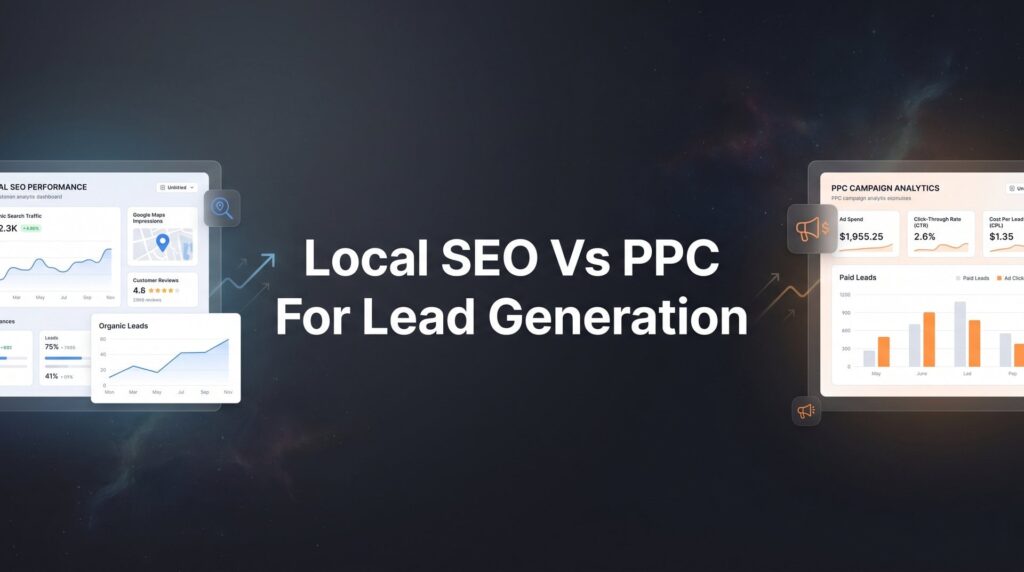
Every local business owner eventually hits the same wall: you need more leads, you have a marketing budget, and you’re staring down two very different paths. Do you invest in local SEO to build organic visibility over time, or do you pour money into PPC advertising for immediate results? The pressure to pick one and commit can feel overwhelming, especially when every dollar counts.
Here’s the truth: the question isn’t really “which one is better?” It’s “which one is right for my business, right now, given my goals and resources?” Local SEO builds a compounding organic presence that pays dividends for years. PPC delivers qualified traffic from day one, with complete control over spend and targeting. Both are powerful. Both have trade-offs.
The smartest local businesses treat this as a strategic deployment decision, not a binary choice. They know when to lean into paid search, when to invest in organic growth, and how to use both channels together to dominate their local market.
Whether you run a plumbing company, a law firm, a dental practice, or a home services business, the seven strategies below will give you a clear, practical framework for making this decision with confidence. No guesswork. No wasted budget. Just a roadmap for putting your marketing dollars where they’ll generate the highest return.
1. Audit Your Sales Timeline to Pick the Right Channel First
The Challenge It Solves
Many business owners choose a marketing channel based on what they’ve heard works, rather than what their business actually needs right now. A new business with no cash reserves and empty pipelines has completely different lead generation requirements than an established company investing in long-term growth. Picking the wrong channel for your timeline is one of the most expensive mistakes in local marketing.
The Strategy Explained
Start by asking yourself one honest question: how long can your business survive without new leads? If the answer is “not long,” PPC needs to be your first move. Google Ads and local search ads can be live within hours, driving calls and form submissions before the week is out.
Local SEO, by contrast, is widely acknowledged across the digital marketing industry to take roughly three to six months before delivering meaningful results. That’s not a flaw; it’s simply how organic authority is built. Google needs time to index your content, assess your local signals, and determine where you belong in the Local Pack.
The smart play for most businesses is to use PPC as a bridge. Launch paid campaigns immediately to generate leads while your SEO foundation is being built in the background. As your organic rankings mature, you’ll have real revenue coming in rather than waiting and hoping. If you’re looking for a structured approach, our guide on how to build a lead generation system for local businesses walks through this process step by step.
Implementation Steps
1. Define your lead runway: how many months of operating capital do you have without new leads coming in?
2. If your runway is under three months, allocate the majority of your initial budget to PPC and begin SEO groundwork simultaneously.
3. Set a calendar reminder at the three-month and six-month marks to evaluate your organic ranking progress and begin adjusting budget allocation accordingly.
Pro Tips
Don’t wait until your PPC budget feels comfortable before starting SEO. The earlier you plant the organic seed, the sooner it pays off. Think of it as two investments running in parallel: one for right now, one for twelve months from now. The businesses that start both early consistently outperform those that sequence them.
2. Analyze Your Local Competitive Landscape Before Spending a Dollar
The Challenge It Solves
Jumping into either channel without understanding your competitive environment is like entering a poker game without knowing the stakes. Some local markets have an open Local Pack that a well-optimized Google Business Profile can crack within months. Others are dominated by established players with years of reviews and authoritative backlinks. Similarly, some PPC auctions are highly competitive and expensive, while others offer surprisingly affordable cost-per-click opportunities.
The Strategy Explained
Before committing budget to either channel, do a proper competitive audit of both. For local SEO, search your primary service keywords in your city and study who’s occupying the Local Pack. Look at their review counts, review recency, website authority, and how thoroughly their Google Business Profile is optimized. If the top three spots are held by businesses with thousands of reviews and highly authoritative websites, you’re looking at a long SEO runway.
For PPC, use Google Keyword Planner to check estimated cost-per-click for your target keywords. High CPCs signal heavy competition but also confirm strong commercial intent. Sometimes a market with fierce PPC competition has a surprisingly weak organic presence, making SEO the smarter long-term bet. Our breakdown of lead generation tools for local services covers several platforms that can help you research these competitive dynamics efficiently.
Implementation Steps
1. Search your top five service keywords in Google from your target city and document who appears in the Local Pack and paid ads for each.
2. Use Google Keyword Planner to pull CPC estimates for your target keywords and identify which terms are expensive versus affordable.
3. Score each channel opportunity: if Local Pack competition is low, prioritize SEO investment; if PPC CPCs are reasonable, start there for immediate lead flow.
Pro Tips
Pay attention to who is running ads consistently over time, not just who appears today. Businesses that maintain PPC campaigns month after month are typically profitable doing so, which tells you those keywords convert well. That’s valuable intelligence for both your paid and organic strategy.
3. Calculate Your True Cost-Per-Lead for Both Channels
The Challenge It Solves
Most business owners compare SEO and PPC on surface-level costs without accounting for the full picture. They see PPC ad spend and assume it’s expensive, or they hear “SEO is free” and underestimate the real investment required. Without an honest 12-month cost comparison, you can’t make a rational allocation decision. You end up choosing based on gut feeling rather than math.
The Strategy Explained
Build a true cost-per-lead model for both channels. For PPC, the calculation is relatively straightforward: total ad spend plus management fees divided by the number of leads generated. But don’t forget to factor in landing page development and ongoing optimization costs.
For local SEO, the math is less obvious but equally important. Add up monthly agency or consultant fees, content creation costs, link building investments, and technical SEO work. Then estimate how many months it will take to rank competitively and how many leads you realistically expect at that point. Spread your total SEO investment across those months to get a true cost-per-lead figure.
The interesting dynamic is that PPC cost-per-lead often starts higher but remains relatively stable over time. SEO cost-per-lead typically starts high because you’re paying for work before results arrive, then drops significantly as rankings and traffic compound. Understanding this curve is critical for making smart budget decisions. For a real-world example of how this plays out, our guide on local SEO for appliance repair illustrates the timeline and investment required to build organic authority in a competitive home services niche.
Implementation Steps
1. Build a simple spreadsheet with two columns: PPC 12-month projection and SEO 12-month projection, listing all costs and estimated lead volumes by month.
2. Identify the crossover point where SEO cost-per-lead becomes lower than PPC, and use that as a milestone for budget reallocation.
3. Revisit and update this model every quarter with actual data rather than projections.
Pro Tips
Factor in lead quality, not just lead volume. Many businesses find that organic leads from local SEO convert at a higher rate because searchers who find you organically often have higher trust in your business. A slightly higher volume of lower-quality leads can actually cost you more in sales effort than fewer, better-qualified leads.
4. Match Each Channel to the Right Stage of the Buyer Journey
The Challenge It Solves
Treating all search queries as equal is a common and costly mistake. Someone searching “emergency plumber near me” is in a completely different mental state than someone searching “how to fix a leaking pipe.” Sending the wrong message to the wrong buyer at the wrong moment wastes ad spend and misses organic opportunities. Aligning your channels to buyer intent dramatically improves conversion efficiency across the board.
The Strategy Explained
Think of the buyer journey in two broad phases: the research phase and the decision phase. PPC excels at capturing decision-phase searches, the high-intent queries where someone is ready to call, book, or buy right now. These searches often include words like “near me,” “cost,” “emergency,” “same day,” or the name of a specific service. Bidding on these terms with a compelling ad and a strong landing page puts you directly in front of buyers at the moment of maximum intent.
Local SEO, meanwhile, is particularly powerful for research-phase queries and trust-building content. Blog posts answering common questions, service pages explaining your process, and a well-optimized Google Business Profile with strong reviews all work together to build credibility before a buyer ever makes a decision. You can see this content-driven approach in action with strategies like SEO for window cleaning, where educational content captures research-phase searchers and converts them into customers over time.
Implementation Steps
1. List your top 20 target keywords and categorize each as either “high intent / ready to buy” or “research phase / trust building.”
2. Assign high-intent keywords to PPC campaigns with dedicated landing pages optimized for conversion.
3. Assign research-phase keywords to your SEO content calendar, creating blog posts, FAQs, and service pages that answer buyer questions and build authority.
Pro Tips
Don’t neglect your Google Business Profile for decision-phase searches. The Local Pack appears prominently for “near me” and location-based queries, and a well-optimized profile with strong reviews can capture high-intent clicks without any ad spend. Think of it as free real estate at the bottom of the funnel.
5. Use PPC Data to Supercharge Your Local SEO Keyword Strategy
The Challenge It Solves
One of the biggest SEO mistakes local businesses make is building their content strategy around keyword volume rather than keyword conversion. High-traffic keywords don’t always generate leads. You can spend months ranking for a term that drives plenty of visitors but produces almost no calls or form submissions. PPC solves this problem by giving you fast, reliable conversion data before you commit to a long-term SEO investment.
The Strategy Explained
Here’s where the two channels create a genuinely powerful feedback loop. When you run PPC campaigns, Google Ads shows you exactly which search terms triggered clicks and, when conversion tracking is set up properly, which terms actually produced leads. This is conversion intelligence that would take SEO months to accumulate organically.
Use your PPC search term reports as a keyword research goldmine. Identify which terms are generating actual phone calls and form submissions, not just clicks. Those proven converters become the foundation of your local SEO content strategy. You’re no longer guessing which keywords your audience uses when they’re ready to buy; your ad data tells you directly. Industries like SEO for general contractors benefit enormously from this approach because the range of service keywords is so broad that PPC data helps prioritize which terms deserve organic investment first.
This approach also helps you avoid wasting SEO resources on keywords that look attractive on paper but underperform in practice. It’s a smarter, more efficient way to build organic content that actually drives revenue.
Implementation Steps
1. Set up conversion tracking in Google Ads to capture phone calls, form submissions, and any other lead actions on your site.
2. After 60 to 90 days of running PPC, pull your search terms report and filter for terms with the highest conversion rates, not just the highest click volume.
3. Build your SEO content calendar around those proven converters: create dedicated service pages, location pages, and blog content targeting each high-converting term.
Pro Tips
Pay special attention to long-tail search terms in your PPC data. These specific, multi-word phrases often have lower search volume but exceptional conversion rates because they signal very specific buyer intent. Ranking organically for a handful of these terms can generate a steady stream of highly qualified leads at virtually no ongoing cost.
6. Dominate the SERP by Owning Both Paid and Organic Real Estate
The Challenge It Solves
When a competitor appears in both the paid ads and the Local Pack for the same search, they’re not just getting more clicks; they’re signaling authority and trustworthiness to every searcher on the page. Businesses that only occupy one position are leaving visibility on the table and handing their competitors a psychological advantage. For your most valuable keywords, settling for one position is settling for less than you could own.
The Strategy Explained
The goal for your highest-value keywords is to appear in as many positions on the search results page as possible simultaneously. That means running paid ads at the top of the page, appearing in the Local Pack through your Google Business Profile, and ranking organically in the standard blue-link results below. When you occupy multiple positions for the same search, you dominate the visual real estate and make it significantly harder for competitors to capture that click.
This dual presence also serves a trust function. Searchers who see your business in both paid and organic results often perceive you as a more established, credible option. It reinforces that you’re a serious player in your market, not just a business that bought a single ad. Industries like family law attorneys and cosmetic dentists see particularly strong results from this dual-presence strategy because trust is a critical factor in the buyer’s decision.
This is exactly the kind of integrated approach that Clicks Geek builds for local businesses: coordinated campaigns across paid and organic channels that compound each other’s impact rather than operating in isolation.
Implementation Steps
1. Identify your top five to ten highest-value keywords, the ones most likely to generate qualified leads and revenue.
2. For each keyword, audit your current presence: are you appearing in paid ads? The Local Pack? Organic results? Document the gaps.
3. Build a plan to close those gaps systematically, prioritizing paid ads for immediate coverage while building organic authority over time.
Pro Tips
Even when you rank well organically, don’t automatically pause PPC for that keyword. Owning both positions reinforces your authority and gives you a safety net if your organic ranking fluctuates. Reserve PPC pauses for keywords where your organic position is consistently strong and your ad spend isn’t generating incremental leads beyond what organic already captures.
7. Build a Phased Budget Allocation That Shifts Over Time
The Challenge It Solves
Static budget allocation is one of the most common and costly mistakes in local marketing. Businesses either go all-in on PPC forever, paying for every lead indefinitely, or they invest in SEO too early without the cash flow to sustain the wait. Neither extreme is optimal. The businesses that win long-term treat their marketing budget as a living plan that evolves as their channels mature.
The Strategy Explained
A phased budget approach starts PPC-heavy and gradually shifts investment toward SEO as organic rankings build momentum. In the early months, PPC does the heavy lifting: generating leads, funding operations, and producing the keyword conversion data that informs your SEO strategy. Meanwhile, a smaller portion of the budget goes toward SEO groundwork: optimizing your Google Business Profile, building foundational content, and earning early backlinks.
As your organic rankings improve and your Local Pack presence strengthens, the cost-per-lead from SEO begins to drop. At that point, you can start reallocating a portion of your PPC budget toward accelerating SEO growth, whether that means more content, more aggressive link building, or expanding into new keyword clusters. The same phased approach works across verticals, from SEO for car detailing businesses to home services companies scaling into multiple service areas. Over time, the balance shifts until SEO is carrying a significant portion of your lead volume at a lower cost-per-lead than paid search alone could achieve.
This isn’t about abandoning PPC. It’s about building a system where both channels are working together efficiently, with budget allocated based on performance rather than habit.
Implementation Steps
1. Define three budget phases: months one through three (PPC-heavy, SEO groundwork), months four through nine (balanced investment as organic gains traction), and month ten onward (SEO-led with strategic PPC support).
2. Set clear ranking and lead volume milestones that trigger each budget shift rather than moving on a fixed calendar regardless of results.
3. Review your cost-per-lead from each channel quarterly and reallocate budget toward whichever channel is delivering the better return at that moment in time.
Pro Tips
Never reduce PPC to zero, even when SEO is performing well. Algorithm updates, seasonal demand spikes, and competitive shifts can all affect organic rankings without warning. Maintaining an active PPC presence gives you an immediate lever to pull if your organic traffic takes a hit. Think of it as insurance that also generates leads.
Putting It All Together: Your Local Lead Generation Roadmap
The local SEO vs PPC debate has no universal winner. What it does have is a clear strategic answer for every individual business: understand your timeline, know your market, do the math, and deploy each channel where it performs best.
Start with a timeline audit to determine how urgently you need leads. Then analyze your competitive landscape to find where the real opportunity lives. Build an honest cost-per-lead model for both channels and match each one to the right stage of the buyer journey. Let your PPC data guide your SEO keyword strategy, aim to dominate multiple positions for your most valuable searches, and build a phased budget that evolves as your organic presence matures.
The businesses generating the most leads aren’t picking sides. They’re building integrated systems where PPC and local SEO reinforce each other, creating a lead generation engine that grows stronger and more cost-efficient over time.
Tired of spending money on marketing that doesn’t produce real revenue? We build lead systems that turn traffic into qualified leads and measurable sales growth. If you want to see what this would look like for your business, we’ll walk you through how it works and break down what’s realistic in your market. As a Google Premier Partner agency, Clicks Geek knows how to make every marketing dollar count across both channels.