You’re running ads. The clicks are coming in. Your dashboard shows impressions in the thousands, and your click-through rate looks respectable. But at the end of the month, when you sit down and ask yourself how many actual customer inquiries those ads generated, the answer is… murky.
This is one of the most common frustrations for local business owners who invest in digital marketing. Clicks feel like progress, but clicks don’t pay the bills. What you really need to know is how much it costs you to get a potential customer to raise their hand and say, “Yes, I’m interested.”
That’s exactly what cost per lead tells you. It’s the metric that cuts through the noise of vanity numbers and connects your ad spend directly to real business results. If you’re running any kind of paid advertising or lead generation campaign and you’re not tracking CPL, you’re essentially flying blind with your budget.
In this article, we’ll break down how cost per lead works, how to calculate it, what factors push it up or down, how to benchmark your numbers against your own business model, and five practical ways to bring it down without sacrificing the quality of the leads you’re getting.
The Simple Formula Behind Every Smart Marketing Budget
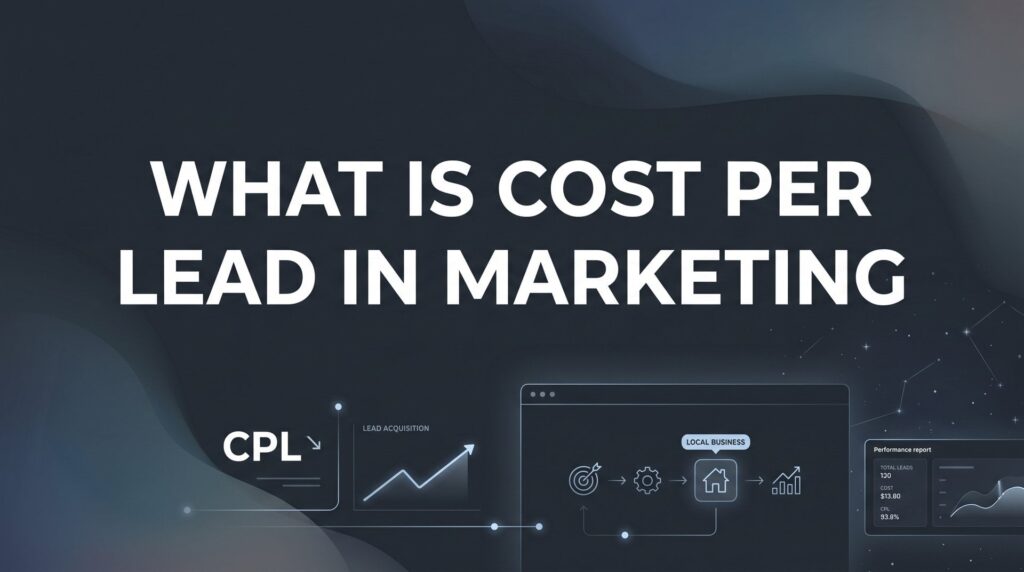
Cost per lead is about as straightforward as marketing metrics get. The formula is this: take your total marketing spend for a given period, divide it by the number of leads generated during that same period, and you have your CPL.
The formula: Total Marketing Spend / Number of Leads = Cost Per Lead
To make this concrete, imagine you spend $2,000 on Google Ads in a given month and those campaigns generate 40 leads. Your CPL is $50. That’s a hypothetical illustration, but it shows how cleanly the math works. You know exactly what each potential customer inquiry cost you.
Simple, right? But here’s why this number is so powerful compared to the metrics most business owners focus on.
Impressions tell you how many times your ad was displayed. Clicks tell you how many people visited your site. Click-through rate tells you what percentage of people who saw your ad actually clicked. These numbers can all look great while your lead generation quietly underperforms. A campaign can generate thousands of clicks and still produce almost no leads if the targeting is off or the landing page isn’t converting.
CPL bypasses all of that noise. It ties your spend directly to the thing that actually matters: the moment a real person expresses genuine interest in your business by filling out a form, calling your number, or booking an appointment. That’s a lead. Everything before it is just traffic.
This is why CPL belongs at the center of how you evaluate any marketing campaign. It doesn’t care how many people saw your ad or how cheap your clicks were. It only cares about one question: how much did you pay to get someone into your pipeline? Understanding how to track marketing ROI effectively starts with getting this foundational metric right.
Once you start measuring CPL consistently, you’ll start making better decisions. You’ll know which campaigns are actually producing and which ones are burning money on traffic that goes nowhere. You’ll have a real number to optimize toward instead of chasing metrics that feel good but don’t connect to revenue.
CPL vs. CPC, CPA, and ROAS: Where This Metric Fits
Marketing has no shortage of acronyms, and it’s easy to lose track of which metric is actually telling you what. Understanding where CPL sits relative to other common metrics helps clarify why it deserves its own focused attention.
Cost Per Click (CPC) measures how much you pay each time someone clicks on your ad. It’s an early-funnel metric. A low CPC sounds like a win, but it only means your ad is generating cheap traffic. If that traffic lands on a weak page and bounces without converting, your CPC means nothing. You could have a $0.50 CPC and a $300 CPL if your conversion rate is poor enough.
Cost Per Acquisition (CPA) sits at the other end of the funnel. It measures how much you paid to acquire an actual paying customer, not just a lead. CPA is the ultimate profitability metric, but it requires knowing your close rate and revenue data, which takes longer to calculate and varies by sales cycle. For businesses with longer sales processes, waiting for CPA data before optimizing can mean weeks or months of wasted spend. If you’re struggling with this metric, understanding the high cost per conversion problem can help you diagnose what’s going wrong.
Return on Ad Spend (ROAS) measures revenue generated per dollar spent on advertising. It’s powerful for e-commerce but harder to track in service businesses where a lead goes through a sales conversation before becoming a customer.
CPL lives in the middle of this funnel. It’s more meaningful than CPC because it measures an actual action, not just a visit. It’s faster to calculate than CPA because you don’t have to wait for deals to close. For local service businesses, contractors, law firms, healthcare providers, and anyone else selling through conversations rather than shopping carts, CPL is often the most actionable daily metric available.
There’s one important caveat: CPL should never be evaluated in isolation. A $30 CPL looks great until you discover those leads are people who have no real intent to buy. Lead quality matters just as much as lead cost. A campaign that generates 50 low-quality leads at $30 each is far less valuable than one that generates 15 qualified, ready-to-buy prospects at $80 each.
This is why smart marketers track CPL alongside lead quality indicators: contact rate, qualification rate, and ultimately close rate. CPL tells you the cost of entry into your pipeline. Lead quality tells you what those leads are actually worth once they’re in it. If you’re finding that your leads are not qualified enough, that’s a separate problem worth solving alongside CPL optimization.
What Actually Drives Your Cost Per Lead Up or Down
CPL isn’t a fixed number. It shifts based on a combination of factors, some external and some entirely within your control. Knowing what moves it helps you make smarter decisions about where to invest and where to optimize.
Industry competitiveness is one of the biggest external forces. Legal services, financial advising, and insurance tend to carry much higher CPLs than, say, a local landscaping company, simply because the competition for those keywords and audiences is intense. More advertisers bidding on the same audience drives up costs across the board. This isn’t something you can change, but it sets the baseline you’re working within. For example, firms investing in digital marketing for law firms routinely see CPLs several times higher than other industries.
Geographic targeting plays a similar role. Advertising in a dense metro market typically costs more per lead than advertising in a smaller city or suburban area. More competition, higher population, and more advertisers fighting for the same eyeballs all push costs up.
Ad platform choice matters too. Google Ads tends to capture high-intent searchers who are actively looking for what you offer, which often translates to better lead quality but higher costs. Facebook and Instagram ads reach people based on interests and demographics rather than active search intent, which can produce lower CPLs but sometimes at the cost of lead quality. SEO-generated leads often carry the lowest effective CPL over time, but they require upfront investment and take longer to produce results.
Landing page quality is where many business owners leave money on the table without realizing it. You can have perfectly targeted ads with compelling copy, and still have a high CPL if your landing page isn’t converting. Slow load times, confusing layouts, weak headlines, and unclear calls to action all cause visitors to bounce before they become leads. The ad gets the click; the landing page earns the lead. If your conversion rate on the landing page is low, every other element of your campaign has to work harder to compensate.
Offer strength and targeting precision round out the picture. Broad targeting generates more clicks at lower cost, but those clicks often come from people who aren’t a great fit. Tight, well-defined targeting costs more per click but tends to produce leads that are more qualified and more likely to convert. A strong, specific offer, whether it’s a free estimate, a consultation, or a limited-time promotion, also directly improves conversion rates and brings CPL down. If you feel like you’re paying too much per lead, these factors are the first place to look.
Benchmarking CPL: Building Your Own Standard
One of the most common questions business owners ask is: “What’s a good cost per lead?” The honest answer is that there’s no universal number. A “good” CPL is entirely relative to your industry, your average transaction value, and your close rate.
Consider two businesses. A personal injury attorney might find a $300 CPL completely reasonable, because a single signed case can be worth tens of thousands of dollars. A residential carpet cleaner with an average job value of $200 would be out of business at that same CPL. The number only means something in context.
Here’s a practical framework for calculating your own acceptable CPL. Start with your average job or client value. Then factor in your close rate, meaning the percentage of leads you actually convert into paying customers. From there, work backward to find your maximum tolerable CPL. Learning how to calculate marketing ROI gives you the full picture of whether your CPL is sustainable.
As a hypothetical illustration: if your average job is worth $5,000 and you close one out of every five leads, each lead is theoretically worth $1,000 to your business in revenue. If your profit margin on that job is 40%, each lead is worth about $400 in gross profit. That gives you a ceiling. As long as your CPL stays meaningfully below that ceiling, your campaigns are generating positive returns.
This kind of thinking transforms CPL from an abstract number into a business decision framework. Instead of asking “is $80 a good CPL?”, you’re asking “does $80 per lead make sense given what each lead is worth to my business?” That’s a much more useful question.
One critical warning: don’t chase the lowest possible CPL without accounting for lead quality. Campaigns that generate cheap leads by casting a wide net often attract people who have no real intent to buy, who are just browsing, or who are completely outside your service area. Those leads waste your time, inflate your close rate calculations, and give you a false sense of campaign performance. Cheap leads that never convert are, paradoxically, the most expensive leads of all. This is a core reason why many businesses find their marketing campaigns are not generating revenue despite seemingly healthy CPL numbers.
Five Proven Ways to Lower Your Cost Per Lead Without Sacrificing Quality
Once you understand what’s driving your CPL, you can start pulling the right levers to bring it down. These aren’t shortcuts or hacks. They’re fundamentals that compound over time when applied consistently.
1. Fix your landing page first. Before you touch your ad targeting or budget, look at where your traffic is landing. A landing page with a low conversion rate is the most common hidden culprit behind high CPL. Improve your headline so it immediately matches what the visitor searched for or clicked on. Make your call to action obvious and specific. Remove distractions. Speed up your load time, especially on mobile, since a significant portion of local search traffic comes from phones. Often, improving the landing page alone produces a dramatic reduction in CPL without changing anything about the ad itself.
2. Tighten your targeting. Broad targeting feels efficient because it generates volume, but volume without relevance is just noise. Use negative keywords in your Google Ads campaigns to filter out searches that aren’t relevant to your business. If you’re a plumber in Denver, you don’t want to pay for clicks from people searching in Colorado Springs or people looking for DIY plumbing tutorials. Tighten your geographic radius, refine your demographic targeting, and use audience segmentation to focus your spend on the people most likely to convert. A detailed guide on improving ad campaign performance can walk you through these optimizations step by step.
3. Test your ad creative consistently. Ad copy that resonates with your audience produces higher click-through rates and, more importantly, attracts the right kind of clicks. Test different headlines, different value propositions, and different calls to action. Small changes in how you frame your offer can meaningfully shift both your click costs and your conversion rates. The goal isn’t just more clicks; it’s more clicks from people who are genuinely ready to reach out.
4. Build proper tracking and attribution. You cannot optimize what you cannot measure. If you don’t know which campaigns, keywords, or channels are generating your best leads, you’re making budget decisions in the dark. Set up conversion tracking for every lead source: form submissions, phone calls, and chat inquiries. Use UTM parameters to track which campaigns are driving results. A solid marketing dashboard and reporting setup makes this process far more manageable. Then do something most advertisers don’t: regularly review the data and act on it. Double down on what’s working and cut what isn’t.
5. Align your offer with your audience’s intent. A generic “Contact Us” button converts far worse than a specific, low-friction offer like “Get a Free Estimate” or “Book a 15-Minute Consultation.” When your offer matches what someone is actively looking for, the barrier to becoming a lead drops significantly. Think about what your ideal customer needs to feel confident enough to reach out, and make that the centerpiece of your landing page and ad copy.
Putting It All Together: Making CPL Work for Your Business
Cost per lead is not a destination. It’s a compass. It points you toward smarter budget decisions, better campaign structure, and a clearer understanding of what your marketing is actually producing. But like any compass, it only works if you’re paying attention to it.
If you’re not currently tracking CPL, start today. It doesn’t require complex software. It requires knowing how much you spent and how many leads that spend produced. From there, you can build the kind of data-driven picture that makes every future marketing decision more confident and more profitable.
Pair your CPL data with lead quality analysis. Ask your team which leads are actually converting. Look at which campaigns are producing customers, not just inquiries. The combination of cost efficiency and lead quality is where the real optimization happens.
At Clicks Geek, this is exactly how we approach every campaign we manage. As a Google Premier Partner agency with deep expertise in conversion rate optimization, we don’t just drive traffic. We obsess over the metrics that connect spend to revenue, and CPL is one of the most important tools in that process. We work with local businesses to build lead generation systems that are designed around profitability, not just activity.
Tired of spending money on marketing that doesn’t produce real revenue? We build lead systems that turn traffic into qualified leads and measurable sales growth. If you want to see what this would look like for your business, we’ll walk you through how it works and break down what’s realistic in your market.