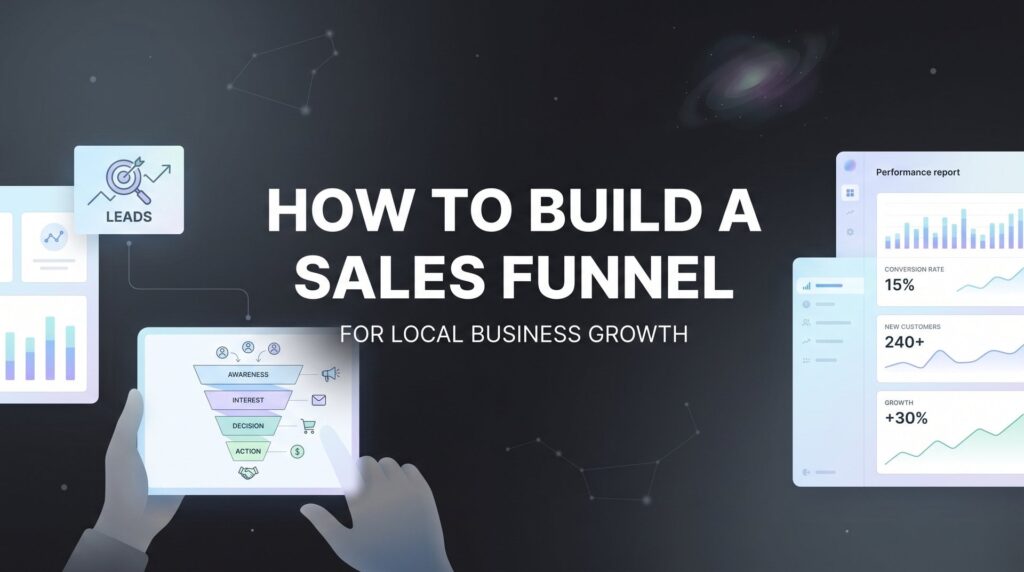
Most local business owners hear “sales funnel” and immediately picture something complicated: software dashboards, email sequences, and marketing jargon that feels miles away from their day-to-day reality. Here’s the truth: you already have a sales funnel. Every time someone finds your business online, calls your office, or walks through your door, they’re moving through stages of awareness, consideration, and decision.
The problem? Most local businesses leave this process completely to chance. They run ads without a landing page strategy, collect leads without a follow-up system, and wonder why their marketing dollars aren’t translating into booked jobs or signed contracts.
A well-built sales funnel eliminates that guesswork. It maps out the exact journey from stranger to paying customer and puts intentional touchpoints at every stage so fewer people fall through the cracks. Think of it like a leaky bucket: if you keep pouring water in without fixing the holes, you’ll never fill it up. Building a proper funnel means finding those holes and sealing them, one by one.
For local businesses specifically, the funnel looks different than what you’d build for an e-commerce store or a software company. Your conversion event isn’t an online purchase. It’s a phone call. A form submission. A booked appointment. That distinction matters enormously when you’re deciding how to structure each stage.
In this guide, we’ll walk you through exactly how to build a sales funnel from scratch, designed specifically for local businesses that need real leads, real phone calls, and real revenue. No fluff, no theory-only advice. Just the practical steps you can start implementing this week to turn more of your marketing spend into profitable customers.
We’ll cover everything from defining who you’re actually trying to reach, to building a landing page that converts, to setting up the follow-up system that closes deals after the initial inquiry. By the end, you’ll have a clear picture of what your funnel needs to look like and where your current setup might be leaking revenue.
Step 1: Define Your Ideal Customer and Their Buying Journey
Before you build anything, you need to get crystal clear on who you’re building it for. This sounds obvious, but it’s the step most local businesses skip entirely, and it’s the reason their marketing feels generic and their ads attract the wrong people.
Start by identifying your most profitable customer type. Not your most common customer. Your most profitable one. Think about the jobs or clients that generate the best margins, the fewest headaches, and the highest likelihood of referrals. Those are the people your funnel should be engineered to attract high quality leads like them.
Once you’ve identified that customer type, map out the journey they typically take before hiring you. Ask yourself:
How do they discover you? Are they searching Google for a specific service? Seeing an ad on Facebook? Getting referred by a neighbor? The answer tells you where to focus your traffic efforts.
What questions do they ask before committing? Do they want to know your pricing upfront? Are they comparing multiple providers? Do they need reassurance about your credentials or experience? These questions become the content of your funnel.
What makes them choose you over a competitor? Speed of response? A specific guarantee? A free estimate? Identifying your decision triggers helps you craft offers that actually convert.
What makes them hesitate? Price concerns? Uncertainty about whether they really need the service? Past bad experiences with other providers? Understanding objections lets you address them proactively in your messaging.
From this exercise, build a simple customer avatar. It doesn’t need to be a 10-page document. A clear paragraph describing who this person is, what problem they’re trying to solve, what they’re afraid of, and what would make them say yes is enough to guide every decision you make about your funnel.
The most common pitfall here is building a funnel for “everyone.” When you try to speak to everyone, you end up resonating with no one. A roofing company that speaks directly to homeowners dealing with storm damage will always outperform one that just says “we do all types of roofing.” Specificity builds trust, and trust drives conversions. If you’re curious how this applies to paid search, see how PPC for roofing companies leverages this kind of targeting.
You’ll know you’ve nailed this step when you can describe your ideal customer’s problem and buying process in two or three sentences without hesitation. That clarity becomes the foundation for everything that follows.
Step 2: Create a High-Converting Landing Page
Your homepage is not a landing page. This is one of the most important distinctions in digital marketing, and ignoring it is one of the most expensive mistakes local businesses make.
Your homepage is designed to introduce your entire business. It has navigation menus, multiple service pages, links to your blog, and a dozen different things competing for attention. A landing page does exactly one thing: it presents a single offer to a specific audience and asks them to take one specific action. That focus is what makes it convert.
When someone clicks on your ad or organic search result and lands on your homepage, they’re overwhelmed with choices. When they land on a dedicated page built around the exact thing they searched for, everything clicks into place. The message matches what they were looking for, and the path forward is obvious. If you need help choosing the right tool, check out the best landing page builders for conversions to get started.
Here’s what every high-converting local business landing page needs:
A headline that speaks to the pain point: Don’t lead with your company name. Lead with the problem you solve or the outcome you deliver. “Leaking Roof? Get a Free Inspection Before the Next Storm Hits” will outperform “Welcome to ABC Roofing” every single time.
A clear, specific offer: What exactly are you offering, and why should they care right now? Make it concrete and make it easy to say yes to.
Social proof: Reviews, star ratings, the number of customers served, before-and-after photos, or logos of recognizable clients. Local businesses especially benefit from reviews that mention specific neighborhoods or situations your prospects can relate to.
A single call-to-action: One button, one form, one phone number. Not three options. Not a menu of services. One next step. Every additional choice you give someone reduces the likelihood they’ll take any action at all.
Mobile-first design: The majority of local searches happen on mobile devices. If your landing page loads slowly, has tiny text, or requires pinching and zooming, you’re losing leads before they even read your offer. A dedicated mobile ad optimization service can help you stop losing leads on small screens. Test your page on a phone before you launch anything.
Use the language your customers actually use, not industry jargon. If your customers call it a “broken AC,” don’t write “HVAC system malfunction.” Mirror their words back to them and they’ll feel like you understand their problem better than anyone else.
Your success indicator for this step: your landing page has one clear CTA and loads in under three seconds on a mobile device. If it doesn’t, fix that before spending a single dollar on traffic.
Step 3: Drive Targeted Traffic to the Top of Your Funnel
You can have the best landing page in your market, but if no one sees it, it doesn’t matter. This is where traffic strategy comes in, and for local businesses, choosing the right traffic source is just as important as the volume you drive.
The key concept here is intent. Not all traffic is created equal. Someone who searches “emergency plumber near me at 11pm” is in a completely different buying mindset than someone scrolling Instagram who sees an ad for a plumbing service. Both can become customers, but they require different approaches and different expectations around conversion rates.
Google Ads captures high-intent, “I need this right now” traffic. When someone is actively searching for what you offer, showing up at the top of the results page with a relevant ad and a strong landing page is one of the most direct paths to a phone call or form submission. For local businesses selling services with immediate demand, PPC advertising for small business is often the highest-ROI starting point.
Facebook and Instagram Ads work better for awareness and retargeting. They’re powerful for reaching people who might need your service in the future, or for re-engaging people who visited your landing page but didn’t convert. Social ads tend to require more nurturing before someone takes action, but they can build your pipeline significantly over time.
SEO is the long game. Ranking organically for local search terms takes time, but the traffic it generates is highly qualified and costs nothing per click once you’ve earned the ranking. It’s worth investing in alongside paid channels, not instead of them.
Before you spend a dollar on any traffic source, set up proper tracking. Install conversion tracking in Google Ads or your ad platform of choice. Set up UTM parameters on your URLs so you know exactly which campaign, ad, and keyword is driving each lead. Using call tracking for ad campaigns is especially important for local businesses where phone calls are the primary conversion event.
The most common and costly mistake at this stage: sending paid traffic to your homepage instead of a dedicated landing page. When your ad promises a free estimate and the click lands someone on a page full of navigation links and general company information, most people bounce. You’ve paid for that click and gotten nothing in return.
Start with one traffic channel. Prove that it generates a positive return. Then expand to a second channel. Trying to run Google Ads, Facebook Ads, and an SEO campaign simultaneously with a limited budget spreads resources too thin and makes it nearly impossible to diagnose what’s working.
Your success indicator: at least one traffic source is actively sending qualified visitors to your landing page, and you have tracking in place to measure what happens when they arrive.
Step 4: Capture Leads With an Irresistible Offer
Getting traffic to your landing page is only half the battle. The other half is convincing that visitor to take action. And the difference between a weak call-to-action and a strong one can dramatically change how many of those visitors become leads.
Compare these two CTAs for a home services business: “Contact Us” versus “Get Your Free Roof Inspection Before Winter.” The first is vague and puts the burden on the prospect to figure out why they should reach out. The second is specific, valuable, and time-sensitive. It gives someone a clear reason to act now.
Strong offers for local businesses typically share a few characteristics. They’re low-risk for the prospect, meaning there’s no large financial commitment required to take the first step. They deliver immediate value, like a free estimate, consultation, or inspection. And they’re specific enough that the prospect knows exactly what they’re getting. Building a qualified lead generation system around these principles ensures you’re capturing the right prospects, not just any traffic.
Think about what you can offer that removes the barrier to that first interaction. A free first visit. A complimentary audit. A downloadable guide that answers the questions your prospects are already asking. The goal is to make saying yes feel easy.
For lead capture mechanics, local businesses generally have a few options:
Phone calls: For many local services, a phone call is still the highest-converting lead type. Make your phone number prominent, use call tracking numbers so you can measure performance, and make sure someone answers or calls back quickly.
Form submissions: Keep your forms short. Ask for the minimum information you need to follow up: name, phone number, and maybe one qualifying question. Every additional field you add reduces the number of people who complete it. If your form abandonment rate is too high, trimming unnecessary fields is usually the fastest fix. You can gather more information during the actual conversation.
Chat widgets and booking tools: Some customers prefer to avoid phone calls entirely. Offering a live chat option or an online booking tool can capture leads who would otherwise leave without making contact.
Match your lead capture method to how your customers prefer to communicate. A service targeting older homeowners may get more phone calls. A service targeting busy professionals might see more form fills or chat interactions. When in doubt, offer multiple options but make one of them the primary, featured CTA.
Your success indicator: your offer is specific, valuable, and low-risk for the prospect. A stranger who lands on your page should immediately understand what they’re getting and why it’s worth their time to claim it.
Step 5: Build a Follow-Up System That Closes the Deal
Here’s where most local businesses lose the most money. Not in generating leads. In failing to follow up on them.
Think about how many leads you’ve received in the past year that went cold because no one followed up quickly enough, or consistently enough. For higher-ticket local services, most prospects don’t make a decision on the first contact. They’re comparing options, waiting for a spouse to weigh in, or simply getting distracted by life. A systematic follow-up process is what keeps you in the conversation until they’re ready to say yes.
Speed-to-lead is one of the most well-documented concepts in sales. The faster you respond to a new inquiry, the higher your likelihood of converting that lead. When someone submits a form or calls and doesn’t reach anyone, they move on to the next option. Responding within minutes, not hours, is a competitive advantage that most local businesses simply don’t have.
Set up your follow-up cadence so it happens automatically, not depending on whether someone remembers to check their inbox. Learning how to set up a lead nurturing campaign is one of the most impactful things you can do at this stage. A basic sequence looks like this:
Immediate response: The moment a lead comes in, they receive an automated text or email confirming you received their inquiry and letting them know when to expect a call. This alone sets you apart from competitors who respond hours later.
Same-day follow-up: A personal call or personalized message within the first few hours. This is where you qualify the lead and move toward scheduling an appointment or estimate.
Two-day check-in: If you haven’t connected yet, send a brief follow-up message referencing their original inquiry. Keep it short and focused on being helpful, not pushy.
Weekly nurture: For leads that haven’t converted, a simple weekly or bi-weekly touchpoint, whether that’s a helpful tip, a seasonal offer, or a simple check-in, keeps you top of mind until they’re ready.
Tools like CRM software, email automation platforms, and SMS marketing tools make this process manageable even for small teams. You don’t need an enterprise system. You need a consistent process that ensures no lead gets forgotten.
The biggest revenue leak for local businesses isn’t a bad landing page or the wrong traffic source. It’s spending money to generate leads and then having no system to follow up on them. Fixing this single issue often produces more revenue than any other change in the funnel.
Your success indicator: every lead that enters your funnel gets contacted within minutes of their inquiry and receives at least three to five follow-up touchpoints before being marked as inactive.
Step 6: Track, Measure, and Optimize Every Stage
A sales funnel isn’t something you build once and forget. It’s a system you build, measure, and continuously improve. The businesses that get the best long-term results from their funnels are the ones that treat optimization as an ongoing habit, not a one-time project.
Start by identifying the key metrics at each stage of your funnel:
Top of funnel: Traffic volume, cost per click, and click-through rate on your ads. These tell you whether your targeting and ad creative are attracting the right people.
Middle of funnel: Landing page conversion rate (the percentage of visitors who take your desired action) and cost per lead. These tell you whether your landing page and offer are resonating.
Bottom of funnel: Lead-to-appointment rate, appointment-to-close rate, and cost per acquired customer. These tell you whether your follow-up process and sales conversation are converting leads into paying customers.
Tracking these numbers gives you the ability to identify your funnel’s weakest link. That’s where your optimization efforts should be concentrated first, because that’s where improvement delivers the highest return. If your landing page is converting well but your close rate is low, the problem isn’t your ads. If your ads have a strong click-through rate but your landing page conversion rate is poor, that’s where to focus. For a deeper dive into diagnosing and fixing these issues, our guide on website conversion rate optimization walks through the process step by step.
Set up proper attribution so you know which marketing channels and campaigns are producing which customers. Without this, you’re making budget decisions based on gut feel rather than data, and that’s an expensive way to operate.
When you’re ready to optimize a specific element, use A/B testing. Change one thing at a time: the headline, the offer, the CTA button color, the form length. Run both versions simultaneously, let the data accumulate, and let the results guide your decision. Changing multiple things at once makes it impossible to know what actually caused the improvement.
This is where conversion rate optimization (CRO) becomes one of the highest-leverage activities in your marketing. Even modest improvements in conversion rate at each stage compound into meaningful revenue gains over time. A landing page that converts slightly better, combined with a follow-up sequence that closes a few more leads, adds up quickly across hundreds of inquiries per year. Partnering with a sales funnel optimization agency can accelerate this process if you want expert eyes on every stage.
Create a simple dashboard or spreadsheet that tracks your key metrics at each funnel stage and make it a habit to review it weekly. You don’t need complex software to do this. A consistent review process is what separates businesses that improve from those that stay stuck.
Your success indicator: you have a tracking system in place and you can answer, at any given moment, where your leads are coming from, what percentage are converting, and where the biggest drop-off in your funnel is occurring.
Putting It All Together: Your Funnel Launch Checklist
Building a sales funnel doesn’t have to be overwhelming. Here’s a quick-reference summary of everything you’ve just covered:
1. Define your ideal customer and map their buying journey, including their pain points, objections, and decision triggers.
2. Build a dedicated landing page with a single offer, a clear headline, social proof, and one call-to-action that loads fast on mobile.
3. Choose one traffic source, set up proper tracking before spending money, and send all paid traffic to your landing page, not your homepage.
4. Create a specific, low-risk offer that makes it easy for prospects to take the first step, and keep your lead capture form short.
5. Set up an automated follow-up sequence that responds immediately, follows up consistently, and nurtures leads until they’re ready to buy.
6. Track your key metrics at every funnel stage, identify your weakest link, and test one improvement at a time.
The most important thing to remember: a basic funnel that’s live and running today will always outperform a perfect funnel that’s still in the planning stage. Start simple. Get something in market. Then use real data to make it better.
Audit your current customer journey against these six steps. Where are people falling through the cracks? Where is your follow-up inconsistent? Where are you sending traffic without a clear conversion path? Those gaps are where your next revenue opportunity is hiding.
Tired of spending money on marketing that doesn’t produce real revenue? Clicks Geek builds lead systems that turn traffic into qualified leads and measurable sales growth. If you want to see what this would look like for your business, we’ll walk you through how it works and break down what’s realistic in your market.