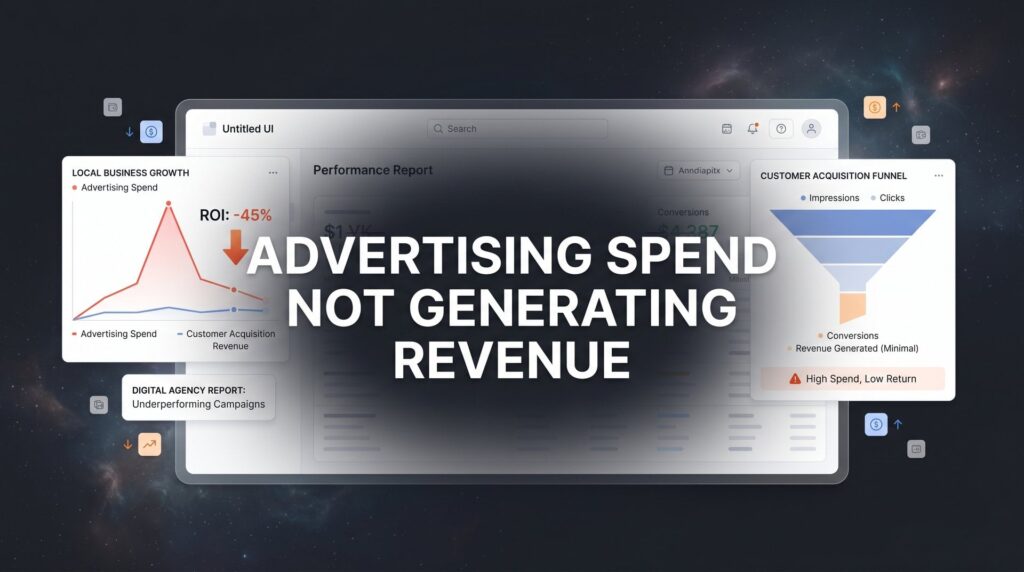
You’re spending money on ads every month. The clicks are rolling in. But when you check your bank account, the revenue just isn’t there.
If your advertising spend is not generating revenue, you’re not alone — and you’re not stuck. Most local business owners assume the problem is their ad platform or their budget size. In reality, the disconnect between ad spend and revenue almost always traces back to fixable gaps in strategy, tracking, targeting, or conversion process.
Here’s what makes this frustrating: the ads might technically be “working” by platform metrics. Impressions are up. Clicks are coming in. Your agency sends a report full of green arrows. But none of that matters if those clicks aren’t turning into paying customers.
The good news is that each of these gaps has a clear solution. Whether you’re running Google Ads, Facebook Ads, or both, the seven strategies below address the most common reasons ad budgets bleed money without producing real business results. Work through them systematically, and you’ll stop funding clicks that go nowhere and start turning your ad dollars into actual revenue.
1. Install Airtight Conversion Tracking Before Spending Another Dollar
The Challenge It Solves
Without proper tracking, you’re essentially flying blind. You might know how many clicks your ads generated, but you have no idea which specific campaigns, keywords, or audiences are producing actual customers versus just burning through budget. This is the foundational problem that makes every other optimization effort unreliable.
The Strategy Explained
Conversion tracking isn’t just flipping a switch in Google Ads. It means building a complete attribution system that connects the dots from the first ad click all the way to a closed sale. That includes call tracking with dynamic number insertion so you know which ad drove each phone call, form submission tracking tied to your CRM, and ideally, offline conversion imports that tell your ad platform which leads actually became paying customers.
When your tracking is airtight, you stop optimizing for cheap clicks and start optimizing for revenue. The platform’s algorithm also becomes dramatically more effective because it’s learning from real business outcomes rather than surface-level engagement signals.
Implementation Steps
1. Audit your current conversion tracking setup and identify every gap — calls, forms, chat, and purchases all need to be tracked as separate conversion actions.
2. Implement call tracking software (such as CallRail or a similar tool) with dynamic number insertion on your landing pages so every call is attributed to the correct campaign and keyword.
3. Set up form tracking through Google Tag Manager and verify that conversion data is flowing accurately into your ad platform before increasing any spend.
4. Where possible, import offline conversions so the platform understands which leads actually closed into revenue, not just which ones submitted a form.
Pro Tips
Don’t trust default tracking. Manually test every conversion action yourself before relying on the data. Submit a test form, make a test call, and confirm it registers as a conversion in your platform. Many businesses discover their tracking was broken for months, which means their optimization decisions were built on bad data the entire time.
2. Ruthlessly Audit Your Keyword and Audience Targeting
The Challenge It Solves
One of the most common reasons ad spend doesn’t generate revenue is that a significant portion of your budget is reaching people who were never going to buy. In Google Ads, broad match keywords and poorly maintained negative keyword lists frequently result in ads showing for irrelevant searches. In Facebook and Instagram campaigns, overly broad audience targeting means you’re paying to reach people with no real interest in what you sell.
The Strategy Explained
Targeting audits aren’t a one-time task. They’re an ongoing discipline. Start by pulling your search terms report in Google Ads and reading through every query that triggered your ads. You’ll often find searches that have nothing to do with your business, and each one represents money spent on someone who was never your customer.
On the audience side, review your geographic targeting carefully. Local businesses frequently discover their ads are showing to people outside their service area. Tightening your radius, adjusting bid modifiers by location, and excluding demographics that don’t convert are all quick wins that immediately improve the quality of your traffic. For a deeper look at why clicks aren’t becoming customers, our guide on why ads are not converting walks through the most common culprits.
Implementation Steps
1. Pull your search terms report for the past 30-90 days and flag every irrelevant query. Add those terms to your negative keyword list immediately.
2. Review your match types. If you’re running broad match keywords without strong negative keyword coverage, consider shifting to phrase or exact match until your negatives are fully built out.
3. Audit your geographic targeting and confirm your ads are only showing in areas you actually serve. Check location reports to see if any regions are consuming budget without converting.
4. For social campaigns, review audience overlap and exclude existing customers, employees, and audiences that have historically shown low purchase intent.
Pro Tips
Build your negative keyword list proactively, not just reactively. Research common irrelevant searches in your industry before launching campaigns, and add those negatives from day one. This prevents wasted spend from accumulating in the first place rather than cleaning it up after the fact.
3. Fix Your Landing Pages to Actually Convert Traffic Into Leads
The Challenge It Solves
Sending paid traffic to your homepage is one of the most expensive mistakes in digital advertising. Your homepage is designed for general visitors. Paid traffic needs a focused, purpose-built experience that matches the specific ad that brought someone there. When there’s a disconnect between your ad message and the page a visitor lands on, trust evaporates and people leave without converting.
The Strategy Explained
Dedicated landing pages built around a single offer and a single call to action consistently outperform general website pages for paid traffic. The principle of message match is straightforward: if your ad says “Free Roof Inspection for Homeowners in Dallas,” your landing page should say almost exactly the same thing above the fold. Visitors should feel like they’re in the right place the moment they arrive.
Beyond message match, page speed matters enormously. Mobile users especially will abandon a page that takes more than a few seconds to load. Trust signals like reviews, certifications, photos of real work, and clear contact information reduce friction and give hesitant visitors a reason to take action. Improving your Quality Score in Google Ads also depends heavily on landing page relevance and experience.
Implementation Steps
1. Audit your current landing pages and check whether the headline matches the ad copy that sends traffic there. If they don’t align, rewrite the headline to reflect the specific offer or search intent.
2. Test your page load speed on mobile using Google’s PageSpeed Insights tool and address any critical issues flagged in the results.
3. Simplify your conversion path. Remove navigation menus, reduce distractions, and make sure there is one clear primary CTA above the fold — a phone number, a form, or a booking button.
4. Add trust signals: customer reviews, star ratings, before-and-after photos, certifications, or any third-party validation that builds credibility quickly.
Pro Tips
Run A/B tests on your headline and CTA button copy before making sweeping design changes. Sometimes a single word change on a headline produces a meaningful lift in conversions. Start with the elements that have the highest impact on first impressions, then work your way down the page.
4. Restructure Your Budget Around What Actually Produces Revenue
The Challenge It Solves
Many businesses spread their ad budget evenly across campaigns, ad groups, or channels without ever questioning whether that allocation reflects actual performance. The result is that underperforming campaigns continue consuming budget while the campaigns that actually drive revenue are held back by arbitrary spending caps.
The Strategy Explained
Performance-based budget allocation is one of the highest-leverage moves in PPC management. Once your tracking is solid (which is why Strategy 1 comes first), you can identify with confidence which campaigns are generating revenue and which are simply generating activity. Pausing or dramatically reducing spend on underperformers frees up budget to scale what’s working.
This isn’t about cutting your total ad spend. It’s about making every dollar work harder by concentrating resources on the campaigns, keywords, and audiences that have demonstrated they can produce paying customers. If you suspect you’re spending too much on advertising without proportional returns, a structured budget audit is the fastest way to diagnose the problem. Think of it as pruning a garden — you’re not cutting back the whole thing, you’re removing what’s taking up space without producing fruit.
Implementation Steps
1. Pull a campaign performance report segmented by revenue or lead quality (not just cost per click or click-through rate) and rank your campaigns from highest to lowest ROI.
2. Identify any campaigns that have spent meaningful budget over the past 60-90 days without producing qualified leads or revenue. Pause or significantly reduce their budgets.
3. Reallocate the freed-up budget to your top-performing campaigns and monitor performance closely over the next two to four weeks.
4. Establish a regular budget review cadence — at minimum monthly — so allocation stays aligned with current performance data rather than historical assumptions.
Pro Tips
Be careful not to confuse “low spend” with “low performance.” Sometimes a campaign hasn’t had enough budget to generate statistically meaningful data. Give campaigns a fair testing period before making final decisions, but don’t let sentiment or sunk cost keep you funding campaigns that consistently underperform.
5. Close the Gap Between Lead Generation and Lead Follow-Up
The Challenge It Solves
Here’s a scenario that plays out constantly: someone searches for a local service, clicks your ad, fills out your form, and waits. Hours pass. Maybe a day. By the time someone from your business follows up, that prospect has already called three competitors and hired one of them. Your ad generated a lead. Your follow-up process lost the sale.
The Strategy Explained
Speed-to-lead is widely recognized in sales and marketing as one of the most critical factors in lead conversion. The window between when a prospect submits a form or places a call and when they’re ready to commit is often very short, especially for local service businesses where the need is immediate. Contacting a lead within minutes of their inquiry is dramatically more effective than following up hours later.
The solution isn’t just working faster. It’s building systems that make fast follow-up automatic. CRM automation, instant lead notification to your phone, templated response sequences, and clear ownership of who handles new leads are all components of a follow-up process that doesn’t let revenue slip through the cracks. If your digital marketing is not generating sales, a broken follow-up process is often the hidden culprit.
Implementation Steps
1. Map your current lead follow-up process from the moment a form is submitted or a call comes in. Identify every delay point and who is responsible for each step.
2. Set up instant lead notifications via SMS and email so the right person on your team knows the moment a new lead comes in, regardless of where they are.
3. Implement a CRM (if you don’t have one) and configure automated follow-up sequences: an immediate confirmation email to the lead, followed by a personal call within five minutes during business hours.
4. Create after-hours protocols. If leads come in outside business hours, have an automated response that sets expectations and triggers a follow-up first thing the next morning.
Pro Tips
Track your actual average response time as a metric. Many business owners assume their team is following up quickly until they measure it and discover the reality. Making response time a visible, tracked number creates accountability and drives improvement without requiring constant management oversight.
6. Stop Ignoring Lead Quality — Not All Leads Are Created Equal
The Challenge It Solves
Chasing the lowest cost per lead is a trap. A campaign that delivers leads at half the price of another campaign looks like a winner on paper — until you discover that those cheap leads never actually buy. Optimizing for lead volume without accounting for lead quality is one of the primary reasons advertising spend fails to generate revenue even when the raw numbers look decent.
The Strategy Explained
Shifting your optimization focus from cost per lead to revenue per lead requires connecting your ad platform data to your actual sales outcomes. This is where offline conversion tracking (introduced in Strategy 1) becomes especially powerful. When you can tell your ad platform which leads became paying customers and what they were worth, the algorithm can start finding more people who match that profile rather than simply finding people who are cheap to acquire. Understanding performance based marketing can help you reframe how you evaluate campaign success around real revenue outcomes.
On the targeting side, this means prioritizing high-intent signals. In Google Ads, that often means tighter keyword match types focused on transactional queries. In social campaigns, it means testing lead qualification questions in your forms or using landing page copy that naturally filters out low-quality prospects before they even submit.
Implementation Steps
1. Review your last 90 days of leads and categorize them by outcome: closed, lost, unqualified, or no response. Identify patterns in where your best customers are coming from.
2. Add qualifying questions to your lead forms that help filter out prospects who aren’t a fit — budget range, project timeline, service area, or any other factor that predicts purchase intent.
3. Import closed-won customer data back into your ad platforms as high-value conversion events so the algorithm learns to find more people like your best customers.
4. Adjust your bidding strategy to prioritize conversion value rather than conversion volume, especially if you have enough data to support value-based bidding.
Pro Tips
Talk to your sales team or whoever handles inbound leads. They often know immediately which lead sources produce serious buyers versus tire-kickers. That qualitative insight is invaluable for refining your targeting strategy and should directly inform which campaigns you scale and which you pull back.
7. Demand Transparent Reporting From Your Agency (Or Yourself)
The Challenge It Solves
Vanity metrics are comfortable. Impressions went up. Click-through rate improved. Cost per click went down. These numbers can look great in a monthly report while your actual revenue stays flat. If you or your agency are measuring success by metrics that don’t connect to business outcomes, you’ll keep making decisions that optimize for the wrong things.
The Strategy Explained
Revenue-tied reporting replaces the question “How did our ads perform?” with “How much did our ads make us?” The core metrics that matter are cost per qualified lead, cost per acquisition, and return on ad spend calculated against actual closed revenue — not just leads generated.
If you’re working with an agency, this level of reporting should be non-negotiable. A good agency will want you to see exactly where your money is going because their value is demonstrated through real results, not activity reports. If your current reporting doesn’t include revenue attribution or lead quality breakdowns, that’s a conversation worth having immediately. Our breakdown of profitable Google Ads strategies covers how to structure campaigns around revenue metrics from the start.
If you’re managing your own campaigns, build a simple dashboard that tracks the metrics that actually matter to your business. Connect your ad platform data to your CRM so you can follow each lead from first click to closed sale.
Implementation Steps
1. Define the two or three metrics that directly reflect business outcomes for your specific situation — typically cost per qualified lead, cost per acquisition, and return on ad spend tied to revenue.
2. Audit your current reporting setup and identify which metrics are vanity metrics versus revenue indicators. Remove or deprioritize anything that doesn’t connect to business results.
3. Request (or build) a monthly report template that leads with revenue-tied metrics and provides clear campaign-level breakdowns so you can see which specific efforts are driving results.
4. Schedule a regular review meeting — monthly at minimum — where reporting data is used to make concrete decisions about budget allocation, targeting adjustments, and creative changes.
Pro Tips
Ask your agency one simple question: “Which specific campaigns produced paying customers last month, and what did each one cost us?” If they can answer that clearly and confidently, you have a solid reporting foundation. If they pivot to impressions and click-through rates, you have a gap that needs to be addressed before you spend another dollar.
Turning Your Ad Spend Into a Revenue Engine
These seven strategies aren’t independent fixes. They’re a system. Tracking comes first because everything else depends on accurate data. Targeting and landing pages come next because they determine whether your traffic has any chance of converting. Budget restructuring follows because it’s only worth scaling what’s already working. Lead follow-up and quality focus ensure that the leads you generate actually turn into revenue. And transparent reporting keeps the entire system honest and continuously improving.
The most practical way to approach this is sequentially. Start with your tracking setup and verify it’s airtight. Then audit your targeting and landing pages. Once those foundations are solid, shift your attention to budget allocation and lead quality. Build your follow-up systems in parallel, and make revenue-tied reporting the standard from day one.
Most businesses that struggle with advertising spend not generating revenue aren’t failing because their market is too competitive or their budget is too small. They’re failing because one or more of these gaps exist and haven’t been addressed systematically.
Tired of spending money on marketing that doesn’t produce real revenue? We build lead systems that turn traffic into qualified leads and measurable sales growth. If you want to see what this would look like for your business, we’ll walk you through how it works and break down what’s realistic in your market.