You open your Google Ads dashboard on a Monday morning, coffee in hand, ready for good news. The numbers look busy: hundreds of clicks, a solid click-through rate, and a campaign that appears to be running just fine. Then you check your leads. Nothing. Maybe one inquiry that went nowhere. Your phone didn’t ring. Your inbox stayed quiet. And yet, somehow, you spent a few hundred dollars over the weekend.
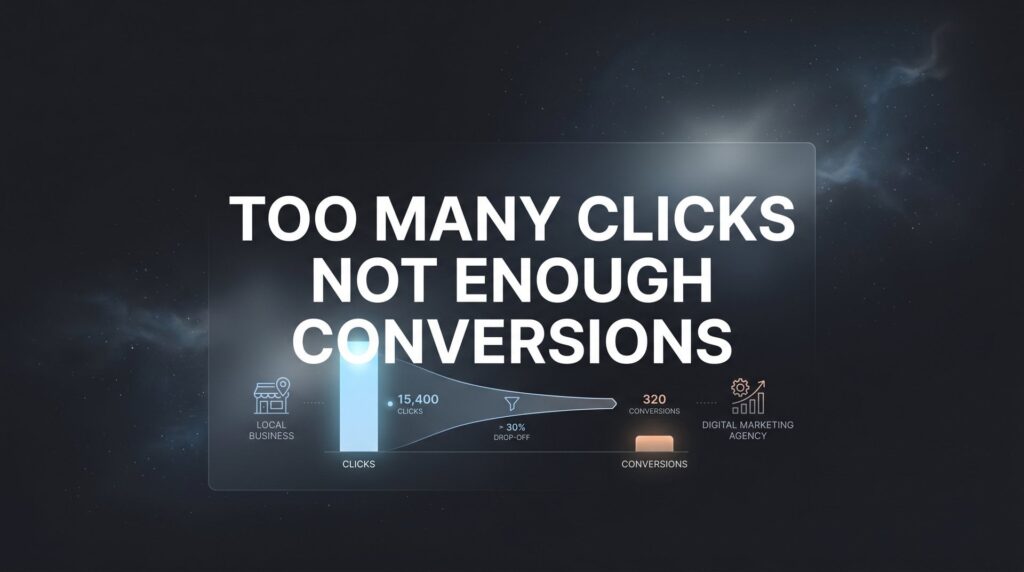
Sound familiar? You’re not alone, and you’re not imagining it. The “too many clicks not enough conversions” problem is one of the most expensive and demoralizing experiences in paid advertising. It’s the digital equivalent of filling a store with foot traffic and watching every single person walk out without buying anything.
Here’s the critical insight most businesses miss: the problem almost never lies in your ability to attract clicks. Google is very good at spending your budget and generating traffic. The real problem lives in everything that happens after the click. The targeting, the landing page, the offer, the trust signals, the tracking setup. Get those wrong, and you can pour thousands of dollars into a campaign that produces nothing but a growing sense of frustration.
This article breaks down exactly why clicks fail to convert into customers, and what you can do about each root cause. Whether you’re running ads yourself or trying to hold an agency accountable, understanding these mechanics will change how you look at your campaigns.
The Expensive Illusion of a Busy Dashboard
There’s a psychological trap built into every ad platform dashboard: it rewards you with numbers. Lots of them. Impressions, clicks, click-through rates, average position, quality scores. The dashboard is always busy, always showing activity, and it’s very easy to mistake that activity for results.
But there’s a fundamental difference between vanity metrics and revenue metrics. Vanity metrics tell you your ads are being seen and clicked. Revenue metrics tell you whether those clicks are producing customers. The first category includes impressions, clicks, and CTR. The second includes conversions, cost per acquisition, and return on ad spend. Many business owners spend their time staring at the first category while the second category quietly tells a very different story.
The gap between these two categories often comes down to traffic quality. Not all clicks are equal. When your targeting is too broad, your ads show up for searches that have nothing to do with your actual offer. Broad match keywords are a common culprit here. A roofing company bidding on “roof” as a broad match keyword might show ads to people searching for “roof rack for SUV,” “roof of the mouth anatomy,” or “how to install roof shingles yourself.” Every one of those clicks costs real money. None of them produce a roofing customer.
Then there’s the issue of bot traffic and accidental clicks. These are less dramatic than they sound, but they do exist. Mobile ads in particular can generate accidental taps from users who were trying to scroll past. These inflate your click count and your spend without contributing a single lead.
This is where the concept of qualified traffic becomes everything for local businesses. Qualified traffic means people who are actively looking for what you sell, in your service area, with the intent to actually hire or buy. Raw traffic just means people clicked. For a business spending real money on ads, the distinction between the two is the difference between a profitable campaign and a budget that evaporates. If you’re struggling with this exact issue, understanding why your traffic isn’t converting is the essential first step.
Before you optimize anything else, you need to ask one honest question: are the people clicking on my ads actually likely to become my customers? If you can’t answer that with confidence, the rest of your campaign is built on sand.
Five Hidden Reasons Your Clicks Aren’t Turning Into Customers
Once you accept that traffic quality matters more than traffic volume, the next step is diagnosing exactly why your qualified traffic isn’t converting. Most campaigns that suffer from the clicks-without-conversions problem have one or more of these root causes at play.
Keyword-to-intent mismatch: Google categorizes search queries by intent, and the framework matters enormously for conversion rates. Informational queries are searches where someone wants to learn something. “What causes a leaky roof” or “how much does HVAC service cost” are informational. Navigational queries are when someone is looking for a specific website or brand. Transactional queries are where the money lives: “emergency roof repair near me” or “HVAC technician in Phoenix.” When your ads target informational searches, you’re paying to educate people who aren’t ready to buy. They click, they read, they leave. Conversion rates on informational traffic are naturally low, and no amount of landing page optimization will fully compensate for the wrong intent at the top of the funnel.
Landing page disconnect: Your ad is a promise. Your landing page is where you keep it, or break it. When someone clicks an ad for “emergency plumber in Chicago” and lands on a generic homepage with a slider, a navigation menu with twelve options, and a contact form buried below the fold, the experience creates friction. The visitor’s brain is asking “is this the right place?” and your page is making it hard to answer yes. Slow load times amplify this problem significantly. A page that takes more than a few seconds to load on mobile loses a substantial portion of its visitors before they ever see your offer. This is a core reason why website visitors leave empty-handed despite strong ad performance.
Targeting too broadly: Geographic targeting mistakes are surprisingly common, especially for local businesses. Campaigns set to “presence or interest” rather than “presence only” will show your ads to people who are merely interested in your area but don’t actually live or work there. Similarly, device-level targeting that ignores mobile behavior, or demographic targeting that includes age groups unlikely to need your service, sends budget in directions that will never produce customers.
Weak or missing calls to action: People need to be told what to do next, clearly and specifically. “Learn more” is not a call to action for a service business. “Call now for a free estimate” is. The specificity of your CTA directly affects whether a visitor takes the next step or bounces.
Absent trust signals: For most local service businesses, the person clicking your ad has never heard of you. They need immediate reassurance that you’re legitimate, experienced, and trustworthy. Reviews, star ratings, certifications, years in business, and photos of real work all serve this function. Without them, even a well-targeted, well-written ad sends traffic to a page that doesn’t close the deal.
Your Landing Page Is Leaking Money
If the campaign structure is the engine, the landing page is where the rubber meets the road. It’s also where most of the money leaks out. The good news is that landing page problems are fixable, often without touching your ad campaigns at all.
A high-converting landing page for a local service business has a clear anatomy. It starts with a headline that directly matches the ad that brought the visitor there. If your ad says “Fast Roof Repair in Denver,” your headline should reinforce that exact message, not pivot to a generic “Welcome to ABC Roofing.” This principle is called message match, and Google’s own Quality Score system rewards it because it reflects a better user experience.
Below the headline, the page should present a single, clear offer. Not three service options, not a menu of everything you do. One specific offer with specific benefits. The call to action should be prominent, repeated, and specific. Phone number at the top in large text. A form that asks for only the information you actually need. Typically, name, phone, and a brief description of the issue is enough to qualify a lead. Every additional form field reduces the likelihood of completion.
Social proof belongs above the fold. Real reviews with real names, star ratings, and if possible, photos of completed work. These aren’t decorative. They’re doing the job of a referral, which is the most powerful conversion tool in local business marketing.
Now, the common mistakes. The most expensive one is linking your ads to your homepage. Homepages are designed to serve many audiences and many purposes. Landing pages are designed to convert one specific visitor with one specific intent. They are not interchangeable. A visitor who clicks an ad for “emergency HVAC repair” and lands on a homepage with a blog, a careers section, and a photo gallery of your team picnic is going to leave. If your advertising isn’t working, this is often the hidden culprit.
This is where conversion rate optimization comes in. CRO is the discipline of testing changes to your landing page to improve the percentage of visitors who take action. Testing a different headline, changing the color or copy of your CTA button, shortening your form, or adding a trust badge can each produce meaningful improvements. You don’t need massive traffic to start testing. You need a systematic approach and the patience to let tests run long enough to produce reliable data.
Campaign Structure Fixes That Stop Wasted Spend Immediately
While landing page work is often where the biggest conversion gains live, campaign structure fixes are where you stop the bleeding on wasted spend. Some of these changes can produce noticeable improvements almost immediately after implementation.
Negative keywords: This is the single most underused tool in most small business PPC campaigns. Negative keywords tell Google which searches should not trigger your ads. For a local service business, this typically means adding terms like “free,” “DIY,” “how to,” “jobs,” “salary,” “course,” and “certification” to your negative keyword list. Google’s own documentation confirms that negative keywords prevent ads from showing for irrelevant searches. For many campaigns, a thorough negative keyword audit produces an immediate reduction in wasted spend and an improvement in cost per conversion, simply by stopping the flow of traffic that was never going to convert.
Ad group segmentation: Tightly themed ad groups are a foundational best practice that many DIY campaigns skip. When one ad group contains dozens of loosely related keywords, the ad copy can’t speak specifically to any of them. A tighter structure, where each ad group contains a small cluster of closely related keywords, allows you to write ad copy that directly addresses what the searcher typed. This improves relevance, improves Quality Score, and improves conversion rates because the experience feels more tailored. If you’re finding the whole process overwhelming, this guide on how to simplify Google Ads management breaks it down into manageable steps.
Match type strategy: Broad match keywords cast a wide net. Phrase match and exact match are more precise. Many campaigns that struggle with irrelevant clicks are running too many broad match keywords without the negative keyword infrastructure to compensate. Shifting toward more specific match types, at least for your highest-value keywords, concentrates your budget on searches that are more likely to reflect genuine buyer intent.
Bid strategy and dayparting: Smart bidding strategies like Target CPA or Maximize Conversions require accurate conversion data to function well. Without it, Google’s algorithm is optimizing toward the wrong signals. Dayparting, which means adjusting bids based on time of day or day of week, allows you to concentrate spend during the hours when your target customers are most likely to be searching and most likely to convert. A plumber’s emergency service might convert well at 11pm on a Sunday. A B2B consulting firm probably doesn’t. Geo-targeting adjustments work similarly, letting you bid more aggressively in your highest-converting zip codes and pull back in areas that consistently underperform.
Tracking What Actually Matters
Here’s a hard truth: if you don’t have conversion tracking set up correctly, you don’t actually know whether your campaigns are working. You’re flying blind, optimizing based on clicks and impressions while the data that would tell you what’s producing customers simply doesn’t exist.
Many local businesses have this problem without realizing it. Google Ads conversion tracking might be installed, but it’s only counting form submissions, not phone calls. Or it’s counting every page visit as a micro-conversion, which inflates the numbers without reflecting actual leads. The result is a dashboard that looks healthy while the business owner wonders why the phone isn’t ringing. Learning how to track marketing conversions properly is one of the highest-leverage improvements you can make.
Proper conversion tracking for a local service business covers several touchpoints. Google Ads conversion tracking should be set up to fire when a form is actually submitted, not just when the contact page is viewed. Call tracking, whether through Google’s native call extensions or a dedicated call tracking platform, should attribute phone calls back to specific campaigns and keywords. If you’re using live chat or a booking widget, those interactions should be tracked as well.
Google Analytics goal setup adds another layer, allowing you to see conversion paths and identify which traffic sources are producing leads across all your channels, not just paid search. When this data is connected back to Google Ads, Smart Bidding strategies can actually function as intended, because the algorithm now knows which clicks are producing customers rather than just which clicks are happening.
The compounding effect of accurate tracking is significant. Once you know which specific keywords, ads, and targeting combinations are producing paying customers, you have a feedback loop that drives continuous improvement. You scale budget toward what works, cut what doesn’t, and each optimization cycle produces better results than the last. Without tracking, that loop never closes.
When DIY Campaigns Stop Making Sense
There’s a certain point in every business owner’s PPC journey where the honest question becomes: is my time and budget better spent managing this myself, or bringing in someone who does this every day?
The warning signs are fairly consistent. Your cost per click keeps rising while your conversions stay flat or decline. You can look at your dashboard and see that something isn’t working, but you can’t pinpoint exactly what. You’re spending more time trying to figure out Google Ads than you’re spending running your actual business. Or, perhaps most telling, you’ve made changes based on what seemed logical and the results didn’t improve. If your paid advertising isn’t working despite your best efforts, it may be time for a professional recovery plan.
A results-focused PPC agency approaches campaigns differently than a business owner managing ads as a secondary responsibility. The difference isn’t just technical knowledge, though that matters. It’s the combination of granular keyword research, ongoing ad copy testing, proactive negative keyword management, landing page optimization, and transparent reporting tied to actual revenue metrics rather than vanity metrics. A good agency doesn’t celebrate a high CTR. They celebrate a lower cost per acquisition and a higher return on ad spend. This is especially critical if you’re paying too much per lead and need to bring acquisition costs back in line.
At Clicks Geek, this is exactly how we operate. As a Google Premier Partner agency, we work specifically with local businesses who are tired of watching their ad budgets produce clicks without customers. The work isn’t glamorous. It’s systematic. Keyword audits, match type refinement, landing page CRO, call tracking setup, and continuous testing. But the output is campaigns that produce qualified leads and measurable revenue, not just a busy dashboard.
Putting It All Together
Clicks are not the goal. They never were. Clicks are simply the first step in a process that should end with a customer calling your business, submitting a form, or booking an appointment. Every element between the click and that conversion is an opportunity to either earn the lead or lose it.
The businesses that win at paid advertising are the ones who obsess over what happens after the click. They match their ads to the right search intent. They build landing pages that speak directly to the visitor’s need and make it easy to take action. They use negative keywords to stop paying for traffic that will never convert. They track every form submission, every phone call, and every lead back to the specific keyword and ad that produced it. And they use that data to continuously improve.
If you’ve been running ads and watching the clicks pile up without the revenue to match, the answer isn’t to spend more. It’s to spend smarter. Start by auditing your current campaigns against the principles in this article. Check your keyword intent alignment. Visit your landing page as if you were a first-time visitor and ask yourself honestly whether you’d call that business. Verify that your conversion tracking is capturing real leads, not just page views.
And if what you find is a tangle of issues that are hard to prioritize or fix without deep platform expertise, that’s exactly what we’re here for. If you want to see what this would look like for your specific business, we’ll walk you through a free Google Ads audit, show you exactly where your budget is leaking, and map out what a properly structured campaign would look like in your market. No fluff, no vanity metrics. Just a clear picture of what’s working, what isn’t, and what it would take to change it.