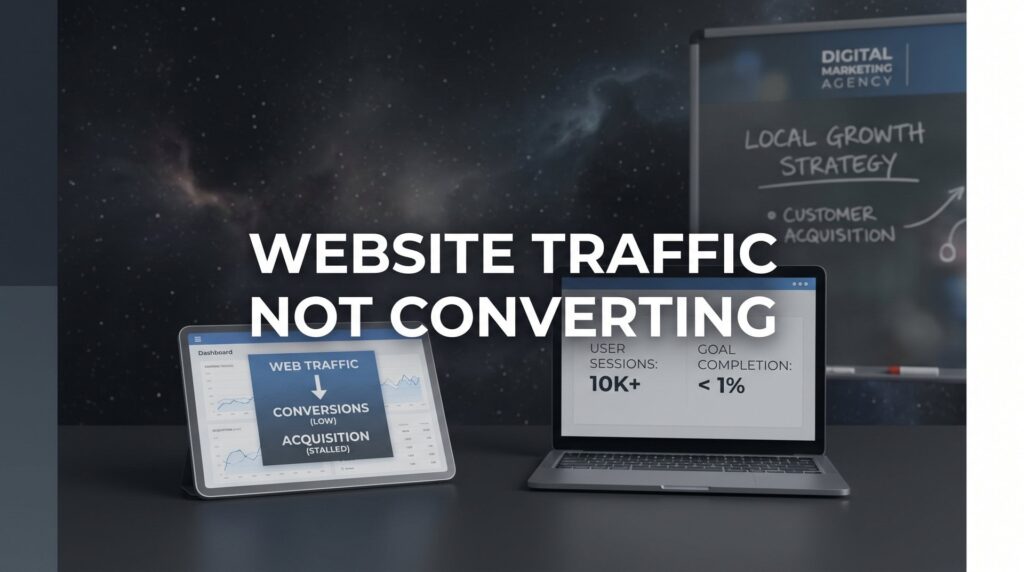
You check your analytics dashboard and see the numbers: 5,000 visitors last month. Your heart lifts for a second—until you remember that your phone barely rang and only three people filled out your contact form. The math doesn’t add up. You’re paying for ads, investing in SEO, posting on social media, and the traffic is there. But those visitors are doing absolutely nothing except inflating your pageview count.
This is one of the most frustrating scenarios in digital marketing. You’ve solved half the equation—getting people to your website—but the other half remains broken. Your visitors arrive, look around for a few seconds, and leave without taking any meaningful action. No calls, no form fills, no purchases. Just empty visits that cost you money and deliver nothing in return.
Here’s the good news: high traffic with low conversions is almost always fixable. The problem isn’t that your business is fundamentally flawed or that your market doesn’t exist. Usually, it’s a handful of specific, identifiable issues creating what we call “conversion leaks”—points where qualified visitors slip through your funnel without converting. We’re going to diagnose exactly why your traffic isn’t converting and give you a clear path to fixing it.
The Real Numbers Behind Your Traffic Problem
Before we dig into solutions, let’s establish what “good” actually looks like. Conversion rate is the percentage of visitors who take your desired action—whether that’s filling out a form, making a purchase, or picking up the phone. This number tells you how effectively your website turns casual browsers into actual leads or customers.
Industry benchmarks vary significantly depending on what you’re selling and how you’re selling it. Lead generation sites for professional services often see conversion rates between 2-5%. E-commerce sites typically convert at lower rates, sometimes 1-3%, because the barrier to entry is higher—you’re asking for money, not just contact information. If you’re converting below these ranges, you’ve got work to do.
But here’s what most businesses miss: conversion rate only matters in the context of traffic quality. You could have a 10% conversion rate and still fail if you’re attracting the wrong visitors. Think of it this way—would you rather have 1,000 visitors converting at 5% or 100 highly qualified visitors converting at 20%? The second scenario gives you 20 conversions while the first gives you 50, but the quality of those conversions matters enormously.
This is where the concept of conversion leaks becomes critical. Your website is essentially a sales funnel with multiple stages: visitors land on a page, they navigate to learn more, they evaluate your offer, and finally they take action. At each stage, some percentage of visitors drop off. When too many people leak out at any particular stage, your overall conversion rate tanks.
The key to fixing your conversion problem is identifying exactly where these leaks occur. Is it the moment people land on your page? Are they exploring multiple pages but never reaching your contact form? Do they get to the form but abandon it halfway through? Each scenario points to a different underlying problem, and each requires a different solution.
When Your Traffic Comes From the Wrong Places
Let’s start with the most common culprit: you’re attracting visitors who were never going to convert in the first place. This happens more often than you’d think, and it’s particularly common with businesses new to digital marketing.
Picture someone searching “what is conversion rate optimization” versus someone searching “hire CRO agency Chicago.” The first person is learning, researching, trying to understand a concept. The second person is ready to buy. Both searches might bring traffic to a CRO agency’s website, but only one represents a genuine business opportunity. If your traffic skews heavily toward informational searchers, your conversion rate will suffer no matter how good your website is.
This keyword misalignment problem shows up constantly in organic search strategies. Businesses target broad, high-volume keywords because they want traffic, but those keywords attract researchers instead of buyers. You rank for “digital marketing tips” when you should be ranking for “digital marketing agency for contractors.” The traffic numbers look impressive, but the business results don’t materialize.
Paid advertising amplifies this problem when targeting is too broad. You set up a Google Ads campaign targeting anyone interested in your industry, and suddenly you’re paying for clicks from students doing homework, competitors researching you, and job seekers looking for employment. Your click costs are real, but these visitors were never potential customers. Understanding low quality website traffic patterns helps you identify and fix these targeting issues.
Social media traffic presents its own unique challenge. Someone scrolling Instagram or Facebook is in a fundamentally different mindset than someone actively searching Google for a solution to their problem. Social traffic can absolutely convert, but it typically requires a different approach—more education, more trust-building, a softer ask. If you’re treating social media visitors the same as search visitors, you’re probably watching them bounce.
The solution starts with traffic source analysis. Break down your conversions by channel in Google Analytics. You’ll often discover that organic search converts at 4%, paid search at 6%, but social media at 0.5%. This tells you where to focus your optimization efforts and which traffic sources might need different landing pages or offers altogether.
Your Landing Pages Are Sabotaging Your Success
Even perfectly qualified visitors will abandon your site if the landing page experience is broken. And make no mistake—many landing pages are fundamentally broken in ways that business owners don’t even realize.
Page load speed is the first killer. Visitors expect your page to load in under three seconds. Every additional second of delay correlates with higher bounce rates and lower conversions. When someone clicks your ad or search result and stares at a blank screen for five seconds, they hit the back button before your page even loads. You’re paying for traffic that never sees your content.
This problem is particularly severe on mobile devices, which now account for the majority of web traffic for most businesses. Your site might load quickly on your office desktop with high-speed internet, but that same site could be agonizingly slow on a phone over a cellular connection. If you haven’t tested your mobile load speed recently, you’re probably losing conversions without knowing it.
Beyond speed, layout and clarity matter enormously. Visitors make snap judgments about your site within seconds of landing. If they can’t immediately understand what you offer and why it matters to them, they leave. This happens when your headline is vague, your value proposition is buried, or your page is cluttered with competing messages. A landing page not converting visitors often suffers from these fundamental clarity issues.
Think about the last time you landed on a website and felt confused about what the company actually does. Maybe the homepage featured abstract imagery and buzzwords but never clearly stated their core service. Maybe you had to hunt through multiple pages to understand their pricing or process. That confusion creates friction, and friction kills conversions.
Your call-to-action placement and design also plays a critical role. If visitors have to scroll to find your contact form or if your “Get Started” button blends into the background, you’re creating unnecessary barriers. The path to conversion should be obvious and effortless. Every extra click or scroll you require increases the chance that visitors will abandon the process.
Mobile experience deserves special attention because it’s where many businesses fail spectacularly. Your desktop site might be beautiful, but if form fields are too small to tap accurately on a phone, if text is too tiny to read without zooming, or if your navigation menu doesn’t work properly on mobile, you’re losing conversions. Test your entire conversion path on an actual phone, not just in desktop browser’s mobile preview mode.
Nobody Trusts a Website That Doesn’t Prove Itself
Visitors arrive at your site with natural skepticism. They don’t know you, they’ve probably been burned by bad businesses before, and they’re protective of their time and money. Your job is to overcome that skepticism quickly, or they’ll take their business elsewhere.
Social proof is your most powerful trust-building tool. When visitors see that other people have worked with you and had positive experiences, their anxiety drops. Reviews, testimonials, case studies, client logos—these elements signal that you’re legitimate and capable. Without them, your site feels empty and unproven.
Many businesses make the mistake of burying their social proof or treating it as an afterthought. Your testimonials shouldn’t be hidden on a separate page that nobody visits. They should be integrated throughout your site, particularly on pages where visitors are making decisions. Put client reviews near your contact form. Feature case study results on your service pages. Make trust-building a central part of your content strategy.
Your value proposition clarity also impacts trust. If visitors can’t quickly understand what you do, how you do it, and why you’re different from competitors, they assume you’re generic or inexperienced. This happens constantly with service businesses that describe their work in vague terms: “We provide innovative solutions” or “We’re a full-service agency.” These phrases mean nothing and build zero trust.
Instead, be specific and concrete. “We run Google Ads campaigns for HVAC companies and generate qualified leads at $40-60 each” tells visitors exactly what you do and sets clear expectations. Specificity builds credibility because it demonstrates expertise and confidence. If you’re wondering why you’re not getting customers online, weak value propositions are often the culprit.
Professional design matters more than many businesses want to admit. An outdated website with poor typography, stock photos from 2010, and clunky navigation creates immediate doubt about your capabilities. If you can’t maintain a modern website, visitors wonder whether you can deliver on your promises. This doesn’t mean you need an expensive redesign every year, but your site should look current and professional.
Trust badges and security indicators also play a role, particularly for e-commerce or sites collecting sensitive information. Display security certificates, payment processor logos, industry association memberships, and any relevant credentials. These small elements reduce anxiety at critical conversion moments.
You’re Asking for Too Much, Too Soon
One of the most common conversion killers is the mismatch between what you’re asking for and what visitors are ready to give. You want a phone call and a signed contract. They want to browse anonymously and learn more. This disconnect creates friction that stops conversions cold.
Think about the visitor’s journey. Someone who just discovered your business five minutes ago isn’t ready to commit to a sales call. They don’t know if you’re credible, if your services match their needs, or if your pricing is in their budget. Asking them to schedule a consultation as their only option is asking them to jump several steps in the decision-making process.
This is why offer laddering matters. Give visitors multiple conversion options that match different readiness levels. Someone early in their research might download a guide or subscribe to your email list. Someone further along might request a quote or pricing information. Someone ready to buy might schedule a call or make a purchase. Each option captures a different segment of your traffic.
Your calls-to-action themselves might also be the problem. Generic phrases like “Submit” or “Contact Us” don’t compel action. They’re passive and uninspiring. Compare that to specific, benefit-focused CTAs: “Get Your Free Marketing Audit” or “See Pricing for Your Industry.” The second approach tells visitors exactly what happens next and why it benefits them.
Form length and complexity also dramatically impact completion rates. Every field you add to a form reduces the percentage of people who complete it. If you’re asking for company size, annual revenue, project timeline, and detailed requirements before someone can download a simple PDF, you’re creating unnecessary friction. Learn how to fix customers not filling out forms by streamlining your lead capture process.
Pricing transparency is another frequent sticking point. Many service businesses hide their pricing, forcing visitors to schedule calls just to learn if they can afford the service. This approach filters out price-conscious buyers, but it also frustrates qualified prospects who want to self-educate before engaging. Consider offering pricing ranges or starting points to help visitors self-qualify.
How to Diagnose Your Specific Conversion Problem
Everything we’ve covered so far represents potential issues, but your business has specific problems that require specific solutions. The key is systematic diagnosis rather than random changes.
Start with your analytics data. Google Analytics shows you exactly where visitors enter your site, which pages they view, how long they stay, and where they exit. Set up goal tracking for your key conversion actions—form submissions, phone clicks, purchases—and analyze the paths people take before converting versus those who bounce.
Look for patterns in your data. Do visitors who land on your homepage convert better than those landing on blog posts? Does traffic from Google Ads convert at higher rates than organic search? Do mobile visitors abandon at higher rates than desktop users? Each pattern reveals something about where your conversion problems exist. Our guide on website traffic but no conversions walks through a complete diagnostic framework.
Heat mapping and session recording tools take this analysis deeper by showing you what visitors actually do on your pages. Heat maps reveal where people click, how far they scroll, and which elements attract attention. Session recordings let you watch individual visitor journeys, seeing exactly where they get confused, frustrated, or distracted.
These tools often reveal surprising insights. You might discover that visitors never scroll far enough to see your call-to-action. Or that they repeatedly click on an image that isn’t actually a link, suggesting confusion about your navigation. Or that they fill out half your form before abandoning it at a specific question. Each insight points to a specific fix.
Once you’ve identified potential problems, implement changes systematically through A/B testing. This means creating two versions of a page—one with your current design and one with a specific change—and splitting traffic between them to see which performs better. Test one variable at a time: headline, CTA button color, form length, page layout.
A/B testing prevents you from making changes based on hunches or best practices that might not apply to your specific audience. What works for other businesses might not work for you. Testing gives you data-driven answers about what actually improves your website conversion rate.
Build a testing roadmap based on potential impact and ease of implementation. Start with high-impact, easy-to-test changes like headline variations or CTA button text. Move to more complex tests like page layout redesigns or offer changes once you’ve exhausted the quick wins. Consistent, systematic testing compounds over time into significant conversion rate improvements.
Turning Your Traffic Into Actual Revenue
Website traffic not converting is frustrating, but it’s also solvable. The businesses that succeed are those that treat conversion optimization as an ongoing process rather than a one-time fix. You diagnose problems, implement solutions, measure results, and iterate.
Most businesses don’t have one catastrophic flaw destroying their conversions. Instead, they have multiple small issues—slow mobile load times, buried CTAs, weak trust signals, misaligned traffic sources—that collectively create poor results. Fix these systematically, and your conversion rate climbs steadily.
Start with the diagnostic steps we’ve outlined. Analyze your traffic sources to understand quality issues. Test your mobile experience to identify speed and usability problems. Review your landing pages for clarity and trust signals. Evaluate your offers and CTAs to ensure they match visitor readiness. Each improvement compounds with the others.
Remember that conversion optimization isn’t about tricking visitors into taking action. It’s about removing barriers, building trust, and making it easy for qualified prospects to take the next logical step. When you align your website experience with visitor needs and expectations, conversions follow naturally.
Tired of spending money on marketing that doesn’t produce real revenue? We build lead systems that turn traffic into qualified leads and measurable sales growth. If you want to see what this would look like for your business, we’ll walk you through how it works and break down what’s realistic in your market.