You’ve been there. You write a check for a newspaper ad, a radio spot, or a billboard on the highway, and then you wait. Maybe the phone rings more that week, maybe it doesn’t. You have no way of knowing whether that $1,500 produced a single customer or just made your business name slightly more familiar to people stuck in traffic. That’s not a marketing strategy. That’s a hope strategy.
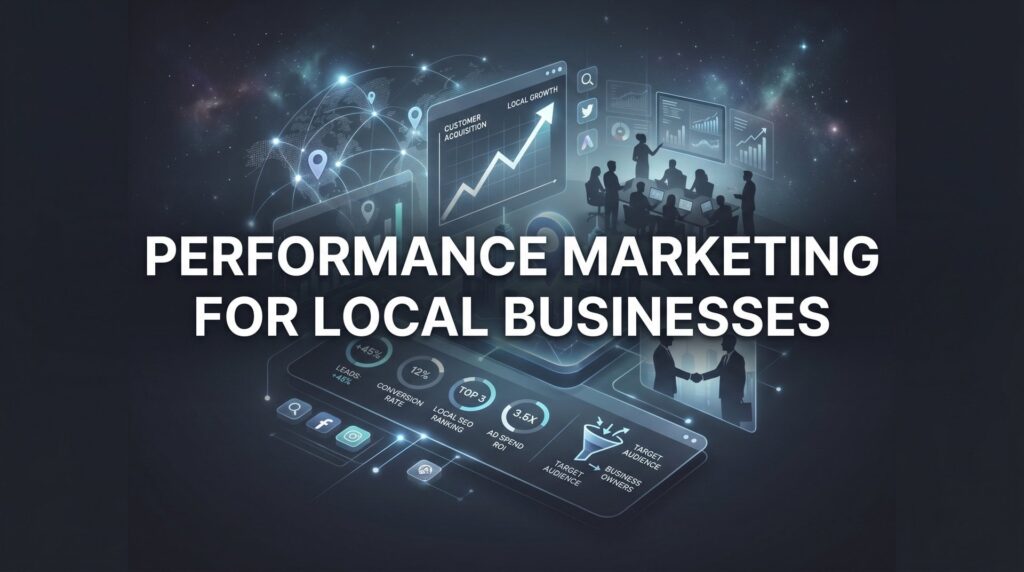
Performance marketing flips the entire equation. Instead of paying for exposure and crossing your fingers, you define a specific outcome you want — a phone call, a form submission, a booked appointment — and you only pay when that outcome actually happens. Every dollar is tracked. Every result is measurable. And if the numbers don’t add up, you adjust or stop spending. No guesswork, no wasted budget disappearing into the ether.
For local businesses, this shift matters more than almost anything else in marketing right now. You’re not a national brand with a seven-figure budget to absorb inefficiency. Every dollar you spend needs to work harder. Performance marketing for local businesses has become the great equalizer: a model that lets a two-person plumbing company compete directly with a regional chain, not by outspending them, but by out-targeting them and tracking results with precision they often lack internally.
This article breaks down exactly how performance marketing works, which channels consistently deliver results for local companies, how to track what’s actually happening with your spend, and the mistakes that drain budgets without producing a single paying customer. By the end, you’ll have a clear picture of what a real performance marketing engine looks like and how to build one for your business.
Why the Old Marketing Playbook No Longer Works
Traditional advertising was built around one core assumption: if enough people see your message, some of them will eventually buy. That logic made sense when your only options were print, radio, and TV. You bought reach and hoped conversion followed. The problem is that local businesses were always the worst fit for this model.
A billboard costs the same whether 50,000 cars drive past it or zero of those drivers ever call you. A newspaper ad runs regardless of whether your phone rings once. You’re paying for eyeballs, not customers. And for a local business with a tight budget and a real need to connect with people who are actively ready to buy, that’s a fundamentally broken deal.
Performance marketing is built on a completely different premise. You define the action that matters to your business, and you only pay when someone takes it. That’s the core shift. Instead of funding exposure, you’re funding outcomes. If you’re new to this concept, our guide on what performance based marketing is breaks down the fundamentals in detail.
Understanding the pricing models helps clarify how this plays out in practice. The three most common structures you’ll encounter are:
Cost-Per-Click (CPC): You pay each time someone clicks your ad. This is the standard model for Google Search Ads and Meta Ads. You’re not paying for impressions or reach — only for the moment someone actively engages. CPC works well when your website or landing page is optimized to convert that traffic into a lead.
Cost-Per-Lead (CPL): You pay only when someone submits a form, makes a call, or takes a defined action that qualifies them as a potential customer. Google’s Local Services Ads operate on this model, charging you per verified lead rather than per click. For service businesses like HVAC, roofing, or legal services, CPL is often the clearest way to understand your marketing cost relative to your sales pipeline. Understanding cost per lead in marketing is essential for evaluating whether your campaigns are truly profitable.
Cost-Per-Acquisition (CPA): You pay only when a lead becomes a paying customer. This is the most direct connection between marketing spend and revenue, though it requires robust tracking to implement accurately. CPA is the gold standard for performance marketing accountability, and it’s the benchmark sophisticated local advertisers work toward over time.
The reason these models matter for local businesses specifically is budget control. When you know your cost per lead and your close rate, you can calculate almost exactly what your next 10 customers will cost you before you spend a single dollar. That kind of predictability is something traditional advertising never offered and never will.
The Channels That Actually Move the Needle Locally
Not every digital marketing channel is built equally for local businesses. Some are high-intent, meaning the people you reach are actively searching for what you offer right now. Others are better for building awareness or staying top of mind over time. Knowing which channel to use and when is what separates efficient performance marketing from expensive experimentation.
Google Search Ads and Local Services Ads: If you run a service business, Google Search is almost certainly your highest-priority channel. When someone types “emergency plumber near me” or “best dentist in [your city]” into Google, they are not browsing. They are ready to hire someone. That intent is rare and valuable, and Google Search Ads put you directly in front of those people at the exact moment they’re making a decision.
Local Services Ads (LSAs) take this a step further. They appear above traditional search results, carry a Google Guarantee badge, and charge you per lead rather than per click. For trades, legal, medical, and home service businesses, LSAs are one of the most efficient performance marketing tools available. You pay when someone calls or messages you through the ad, not just for showing up in the results.
Facebook and Instagram Ads: Social ads don’t have the same immediate purchase intent as search. Someone scrolling Instagram on a Tuesday evening isn’t necessarily looking for a roofer. But that doesn’t make social ads irrelevant for local businesses. They excel in specific scenarios: retargeting people who visited your website but didn’t convert, running seasonal promotions to a local audience, and building awareness during slow periods so you’re top of mind when the need arises. For a deeper comparison, our article on local SEO vs paid ads for customer acquisition explores when each approach makes the most sense.
For service businesses with longer consideration cycles — think remodeling contractors, financial advisors, or cosmetic dental practices — Facebook and Instagram ads are effective for nurturing an audience over time. The targeting capabilities let you reach people in specific zip codes, age ranges, and interest categories with a level of precision that a local radio spot simply can’t match.
Google Maps and Local SEO: This is the organic performance channel that many local businesses underestimate. Ranking in Google’s “map pack” — the three local listings that appear prominently in search results — drives consistent, high-intent traffic without a cost-per-click attached to it. Once you rank, the traffic is effectively free.
Local SEO involves optimizing your Google Business Profile, building consistent citations across directories, earning genuine reviews, and creating locally relevant website content. It takes longer to build than paid ads, but the compounding effect is significant. A business that ranks well in the map pack for its core services generates leads month after month without an ongoing ad spend attached to each one. Think of it as building an asset rather than renting visibility.
The smartest local performance marketing strategies combine all three: paid search for immediate, high-intent leads; social ads for retargeting and seasonal reach; and local SEO for long-term organic compounding. Our guide on building a multi-channel marketing strategy for local businesses walks through how to integrate these channels into a cohesive system.
Tracking Every Dollar: The Metrics That Actually Matter
Here’s a scenario that plays out constantly with local business owners: an agency sends a monthly report full of impressive-sounding numbers. Impressions are up. Clicks increased. Website traffic is growing. And yet the phone isn’t ringing any more than it was before. The metrics look great. The business isn’t growing. That disconnect is what happens when you track the wrong things.
Performance marketing for local businesses lives or dies on four core metrics:
Cost Per Lead (CPL): How much did you spend to generate each inquiry? If you spent $500 on ads and received 10 leads, your CPL is $50. Whether that’s acceptable depends entirely on what a new customer is worth to your business. A $50 CPL is a bargain for a remodeling contractor with a $15,000 average job. It might not work for a business with thin margins.
Cost Per Acquisition (CPA): How much does it cost to turn a lead into a paying customer? If you close 1 in 4 leads, your CPA is four times your CPL. This is the number that connects marketing spend directly to revenue, and it’s the metric that sophisticated business owners focus on above everything else.
Conversion Rate: What percentage of people who click your ad (or visit your page) actually take the desired action? A low conversion rate tells you the problem isn’t your ad — it’s what happens after the click. This is where CRO becomes critical, which we’ll cover next.
Return on Ad Spend (ROAS): For every dollar you put into advertising, how many dollars come back in revenue? A ROAS of 4:1 means $4 in revenue for every $1 spent. This is the clearest measure of whether your performance marketing is actually performing.
None of these metrics are possible without proper tracking infrastructure. Call tracking for ad campaigns assigns unique phone numbers to different campaigns so you can see exactly which ad drove which call. Form tracking captures which source a lead came from before they submitted your contact form. Attribution connects the dots between a click and a closed sale.
Without this infrastructure, you’re making budget decisions based on incomplete information. You might be pouring money into a campaign that looks active but generates zero actual customers, while underinvesting in a channel that’s quietly driving your best leads. For a complete walkthrough on setting this up, see our guide on tracking marketing results for small business.
Watch for these red flags that signal wasted spend: high impressions paired with very low click-through rates (your ad isn’t resonating), strong click volume but no calls or form fills (your landing page is failing), or leads coming in but none converting to sales (a lead quality or sales process problem). Each pattern points to a different fix, but you can only diagnose them if you’re tracking properly.
Turning Clicks Into Customers: The Conversion Problem Most Businesses Ignore
You can have the best-performing Google ad in your market, and it still won’t matter if the experience after the click doesn’t convert. This is the part of performance marketing that local businesses most commonly overlook. They invest in traffic and then wonder why leads aren’t coming in, when the real problem is sitting on their website or landing page the whole time.
Think about what happens when someone searches “emergency AC repair” at 2pm on a hot afternoon and clicks your ad. They land on your website. If that page loads slowly, looks broken on mobile, or doesn’t immediately tell them you’re available and easy to reach, they’re gone in seconds. They’re clicking back to the results and calling your competitor. You paid for that click. You got nothing from it. Our step-by-step guide on how to improve ad campaign performance covers exactly how to diagnose and fix these conversion leaks.
High-impact CRO tactics for local businesses don’t require massive redesigns. The fundamentals are:
Mobile speed: Most local searches happen on phones. A page that takes more than a few seconds to load loses a significant portion of visitors before they even see your offer. Fast, clean, and mobile-first is non-negotiable.
Click-to-call buttons: Make it effortless to contact you. Your phone number should be prominent, tappable on mobile, and visible without scrolling. Removing friction from the contact process directly increases conversions.
Trust signals: Reviews, certifications, years in business, and any relevant badges (Google Guaranteed, BBB accreditation, industry licenses) reduce the hesitation a visitor feels before reaching out. Local businesses earn trust through social proof, and your landing page should display it prominently.
Simple, focused lead forms: If you need a form, keep it short. Name, phone number, and a brief description of the service needed is usually enough to qualify a lead. Every additional field you add reduces the number of people who complete it.
The compounding math here is worth understanding clearly. If your current landing page converts 3% of visitors into leads, improving that to 6% doubles your lead volume without changing your ad budget at all. You’re not spending more to get more. You’re getting more from what you’re already spending. That’s why CRO is one of the highest-leverage investments in performance marketing, and why agencies that focus only on traffic generation without addressing conversion are leaving real money on the table for their clients.
The Performance Marketing Mistakes That Drain Budgets Silently
Performance marketing done well is one of the most efficient ways a local business can grow. Performance marketing done poorly is an expensive lesson. These are the mistakes that show up most often, and understanding them in advance saves you real money.
Chasing vanity metrics: Impressions, reach, and click volume are easy to report on and easy to inflate. An agency can make a campaign look incredibly active while generating zero qualified leads. The only metrics that matter for a local business are the ones connected to revenue: cost per lead, cost per acquisition, and ROAS. If your monthly report doesn’t include these, ask why. If you don’t get a clear answer, that’s a problem.
Ignoring lead quality: A flood of leads sounds great until you realize most of them are the wrong fit. Low-quality leads — people who aren’t in your service area, aren’t ready to buy, or are shopping for prices you can’t compete on — waste your team’s time and distort your metrics. Good performance marketing optimizes for lead quality, not just lead volume. This often means tightening targeting, adjusting ad copy to pre-qualify prospects, and being willing to accept fewer leads in exchange for better ones.
Neglecting the sales process: Marketing can deliver a qualified lead to your door. What happens after that is on you. If calls go unanswered, response times are slow, or your follow-up process is inconsistent, even the best performance marketing campaign can’t save your conversion rate. Before scaling ad spend, make sure your business is operationally ready to handle the leads you’re generating.
DIYing complex campaigns without the expertise: Performance marketing requires ongoing optimization: bid adjustments, audience refinement, ad copy testing, landing page iteration, and constant analysis of what’s working and what isn’t. Most local business owners are already running a business full time. Trying to manage sophisticated ad campaigns on top of that typically results in set-it-and-forget-it campaigns that bleed money quietly for months. Many businesses find that the real cost of online marketing is actually lower when managed by specialists who prevent wasted spend.
Skipping the testing phase: No campaign is perfect from day one. The best-performing ads, audiences, and landing pages emerge through structured testing over time. Businesses that expect immediate perfection often pull the plug on campaigns before they’ve had enough data to optimize properly. Give campaigns enough runway to generate meaningful data, then make decisions based on evidence rather than impatience.
Building a Performance Marketing Engine That Scales With Your Business
The most effective approach to performance marketing for local businesses isn’t to launch every channel simultaneously and hope something sticks. It’s to build systematically, validate at each stage, and scale what’s working.
Start with one high-intent channel. For most local service businesses, that means Google Search Ads or Local Services Ads. These channels reach people who are actively searching for what you offer right now, which means faster feedback and a clearer signal on whether your offer, targeting, and landing page are working. Our breakdown of the best ROI digital marketing channels can help you determine which starting point makes the most sense for your industry. Get your tracking right from day one: call tracking, form tracking, and proper attribution set up before you spend a significant budget.
Once you have a baseline cost per lead and conversion rate you’re comfortable with, layer in additional channels. Local SEO builds compounding organic traffic over time. Google Ads remarketing recaptures visitors who didn’t convert on the first visit. Each layer adds reach without abandoning the performance accountability that makes the model work.
At some point, the question of whether to manage this in-house or work with a specialized agency becomes unavoidable. The honest answer is that performance marketing done well is a full-time job. Campaign optimization, bid strategy, creative testing, landing page iteration, and reporting require consistent attention and expertise that most business owners simply don’t have available. A qualified agency partner handles all of that while you focus on running your business.
When evaluating an agency, the signals that matter are: transparent reporting that shows actual leads and revenue, not just traffic and impressions; real-time access to your campaign data; a clear explanation of their optimization process; and verifiable credentials like Google Premier Partner status, which indicates the agency meets Google’s performance and certification standards. Be cautious of agencies that are vague about results or reluctant to show you the raw data behind their reports.
A practical benchmark for evaluating whether your performance marketing is working: give any new campaign or strategy 90 days of consistent execution before drawing conclusions. In the first 30 days, you’re gathering data. In days 31 to 60, you’re making optimizations based on that data. By day 90, you should have a clear picture of your cost per lead, cost per acquisition, and whether the channel is profitable at your current spend level. If the numbers work, scale. If they don’t, diagnose before you give up — often the fix is a landing page change or a targeting adjustment, not a fundamental problem with the channel itself.
Putting It All Together: Your Next Move
Performance marketing gives local businesses something that traditional advertising never could: accountability. You know what you spent, you know what it produced, and you can make intelligent decisions about where to put the next dollar. That’s not a small thing. For a business operating on a real budget with real stakes, it’s the difference between marketing that grows your company and marketing that just costs money.
The core principles are straightforward. Track everything from day one. Focus on conversions, not clicks. Prioritize lead quality over lead volume. Build your performance engine systematically, starting with high-intent channels and layering in additional reach as you validate what works. And be honest about whether you have the time and expertise to manage it at the level it requires, or whether a specialized partner would deliver better results faster.
The businesses that win with performance marketing aren’t necessarily the ones with the biggest budgets. They’re the ones who are most disciplined about measuring results, most willing to optimize based on data, and most focused on connecting every marketing dollar to actual revenue.
Tired of spending money on marketing that doesn’t produce real revenue? Clicks Geek builds lead systems that turn traffic into qualified leads and measurable sales growth. As a Google Premier Partner agency, we specialize in performance marketing for local businesses and hold ourselves accountable to your bottom line, not vanity metrics. If you want to see what this would look like for your business, we’ll walk you through exactly how it works and break down what’s realistic in your market.