You’re running ads on Google. They’re performing well—decent click-through rates, leads coming in. But you notice something: your competitor seems to be everywhere. You see their brand on Facebook, their articles ranking in search results, their remarketing ads following you around the web. Meanwhile, you’re pouring your entire budget into one channel and wondering why growth has plateaued.
Here’s what’s happening: your customers aren’t living on a single platform. They’re bouncing between Google searches during their lunch break, scrolling Instagram before bed, checking email throughout the day, and researching reviews across multiple sites before making a decision. When you only show up in one of those places, you’re missing the other seven touchpoints that influence their final choice.
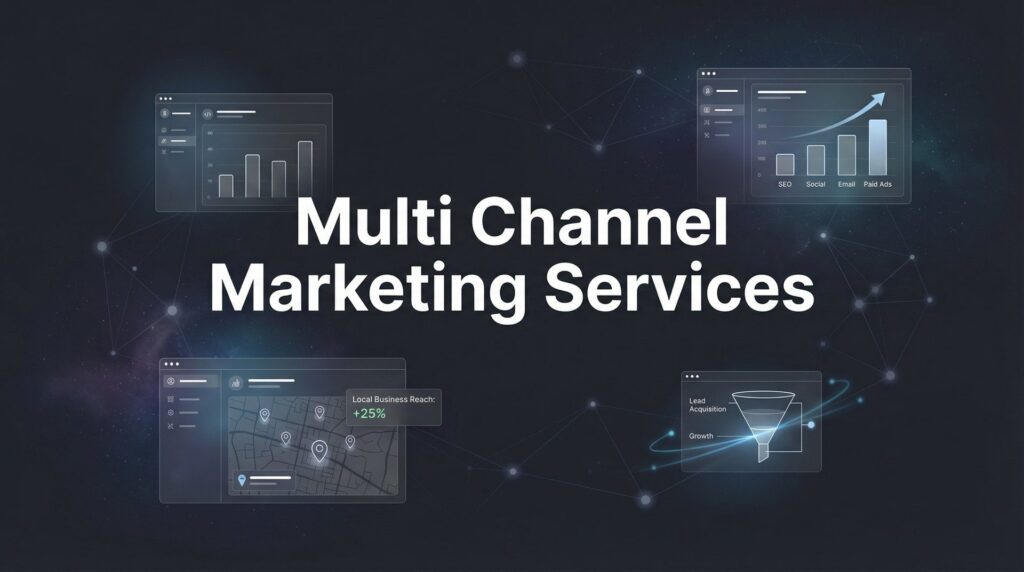
Multi channel marketing services solve this problem by creating a coordinated presence across the platforms where your customers actually spend their time. This isn’t about randomly posting everywhere or spreading your budget too thin. It’s about strategic integration—making sure that when a potential customer searches for your service, sees your ad, visits your website, and encounters your brand on social media, they experience a cohesive message that builds trust and drives action.
In this guide, we’ll break down what multi channel marketing actually means beyond the buzzwords, why it consistently outperforms single-channel approaches for local businesses, and how to build a practical strategy that drives measurable revenue growth instead of just burning through your marketing budget.
Breaking Down the Multi Channel Approach (And Why Single-Channel Falls Short)
Multi channel marketing services coordinate campaigns across multiple platforms—PPC advertising, SEO, social media, email marketing, and display advertising—all working toward unified business goals. The key word is “coordinated.” This isn’t about randomly being active on five platforms. It’s about creating a strategic ecosystem where each channel reinforces the others.
Think of it like this: someone searching “emergency plumber near me” on Google at 2 AM has completely different intent than someone scrolling Facebook on Sunday morning. Multi channel marketing recognizes these different mindsets and meets customers where they are with the right message at the right time.
Single-channel marketing falls short because of a fundamental reality: prospects rarely convert on first contact. A business owner might see your Google ad today, but they’re not ready to commit to a $5,000 service package based on one click. They’ll visit your website, compare you to competitors, read reviews, see your retargeting ads over the next week, and maybe—if everything aligns—they’ll finally reach out. If you’re only running Google Ads, you’ve paid for that initial click but have no way to stay in front of them during the consideration phase.
The customer journey fragmentation problem gets worse every year. Your potential customers are using an average of three to four devices throughout their day. They might research on mobile during their commute, compare options on desktop at work, and make the final decision on a tablet at home. Single-channel strategies lose these prospects in the gaps between devices and platforms. Understanding how to build a comprehensive multi channel marketing strategy becomes essential for capturing these fragmented journeys.
It’s worth distinguishing multi channel from omnichannel marketing, terms that often get confused. Multi channel means having presence on multiple platforms—you’re running Google Ads, posting on Facebook, sending emails, and maintaining your website. Omnichannel takes it further by ensuring seamless integration between those platforms. In an omnichannel approach, a customer could start a conversation on your website chat, continue it via email, and complete their purchase in-store with the sales rep already knowing their entire history. Multi channel is the foundation; omnichannel is the advanced execution.
For most local service businesses, mastering multi channel marketing is the practical first step. You need coordinated presence across the platforms that matter to your customers before worrying about perfect integration between every touchpoint.
The Revenue Impact: Why Businesses Using Multiple Channels Outperform
Multi channel strategies create a compounding effect that single-channel approaches simply cannot match. Here’s how it works in practice: someone sees your Facebook ad about bathroom remodeling. They don’t click—they’re not ready yet. Two days later, they search “bathroom remodeling contractors near me” and your Google Ad appears. Now your brand looks familiar. They click through, browse your site, but don’t convert. That evening, they see your Instagram post showcasing a recent project. The next day, your remarketing ad appears while they’re reading news online. By the time they receive your email newsletter with a customer success story, you’re no longer a random contractor—you’re the remodeling company they keep seeing everywhere.
This repeated exposure builds trust faster than any single touchpoint could achieve. Your prospect starts to perceive you as the established, dominant player in your market simply because you’re present across multiple channels. Meanwhile, your competitor who only runs Google Ads is just another option in a sea of search results.
The risk mitigation factor is equally important but often overlooked. Relying entirely on one marketing channel means algorithm changes or platform issues can devastate your lead flow overnight. Google updates its search algorithm regularly. Facebook adjusts its ad delivery system constantly. If 100% of your leads come from one source, you’re one platform change away from a crisis.
Businesses using multi channel strategies spread this risk. When Google Ads costs spike in your industry, your SEO traffic provides a buffer. When organic reach drops on social media, your email list keeps delivering. When one channel underperforms, others compensate. This approach aligns with performance marketing principles that focus on measurable results across multiple touchpoints. This isn’t just theoretical—it’s the difference between stable growth and feast-or-famine revenue cycles.
The attribution reality reinforces why multi channel presence is essential. Customers typically interact with multiple touchpoints before converting. They might see your ad, search your brand name, read your blog post, check your reviews, see a retargeting ad, and then finally call. If you’re only tracking last-click attribution, you’d credit that phone call entirely to whatever channel they used last—probably your website or a direct search. But the truth is that all those earlier touchpoints played crucial roles in building the trust that led to that call.
Companies that understand this dynamic invest in the full customer journey, not just the final click. They recognize that brand awareness channels and consideration-stage content aren’t “wasting budget”—they’re essential components of a system that converts prospects into customers.
Core Channels That Drive Results for Local Businesses
Let’s break down the channels that actually move the needle for local service businesses, starting with where most companies see immediate impact.
PPC Advertising (Google Ads and Bing): This is your immediate visibility play. When someone searches “emergency HVAC repair” or “personal injury lawyer near me,” they have high intent and need a solution now. PPC puts you at the top of those search results within hours of launching your campaign. For service businesses that need leads today—not six months from now—paid search is non-negotiable. The key is understanding that PPC works best as part of a larger strategy. Yes, you’ll get immediate leads, but the cost per click keeps rising. That’s where the other channels come in to reduce your overall cost per acquisition.
SEO and Content Marketing: Think of SEO as the long-term play that compounds over time. When you rank organically for “best roofing company in [city]” or “how to choose a financial advisor,” you’re capturing leads without paying for each click. The challenge is that SEO takes time—typically three to six months before you see meaningful results, and longer for competitive terms. But here’s why it matters: once you rank, that traffic keeps coming without ongoing ad spend. Your cost per lead from organic search decreases month after month as your content gains authority. For local businesses, this means creating content that answers the questions your customers are actually asking, optimizing your Google Business Profile, and building local citations that signal relevance to search engines. Home service companies in particular benefit from understanding digital marketing strategies tailored to their industry.
Social Media Advertising and Organic Presence: Social platforms serve a different purpose than search. People scrolling Facebook or Instagram aren’t actively looking for your service—they’re in discovery mode. This makes social ideal for brand awareness and reaching customers before they even realize they need your solution. A homeowner might not be actively searching for kitchen remodeling services, but when they see your before-and-after transformation photos on Instagram, suddenly they’re thinking about their outdated kitchen. Social advertising also powers remarketing—staying in front of website visitors who didn’t convert on their first visit. The organic side of social builds community and trust. When prospects research your company, your active social presence signals legitimacy and engagement.
Email Marketing and Remarketing: Most leads aren’t ready to buy immediately. Email marketing nurtures these prospects over weeks or months, staying top-of-mind until they’re ready to make a decision. For a roofing company, this might mean sending seasonal maintenance tips, storm preparation guides, and customer success stories to homeowners who downloaded a roof inspection checklist but haven’t requested a quote yet. Facebook remarketing ads work similarly through display ads—following website visitors around the web with relevant messages based on what pages they viewed. Someone who spent time on your “bathroom remodeling” page but didn’t fill out your contact form will see ads showcasing your bathroom projects, not your kitchen work.
The power comes from integration. Your PPC ads drive traffic to content optimized for SEO. Your social media posts promote your valuable blog articles. Your email campaigns feature your best organic content. Your remarketing ads remind prospects about the service they researched on your site. Each channel feeds the others, creating a marketing ecosystem where the whole exceeds the sum of its parts.
Building Your Multi Channel Strategy: A Practical Framework
Start by mapping your customer journey—not the journey you wish they took, but the actual path your customers follow. Interview recent clients and ask them how they found you. What did they search for? What made them choose you over competitors? How many times did they visit your website before contacting you? This research reveals which channels actually matter for your business instead of guessing based on industry trends.
For a local service business, the journey might look like this: a homeowner notices water damage and searches “water damage restoration near me” on their phone. They click three different Google Ads, quickly scan the websites, and leave. Later that day, they search for reviews and comparison articles. Over the next few days, they see remarketing ads from the companies they visited. They finally call the company that had the best reviews, the most professional website, and kept showing up in their Facebook feed with helpful content about preventing mold.
Once you understand this journey, prioritize channels based on your business model and resources. Service businesses needing immediate leads typically start with PPC for quick wins while building SEO for long-term sustainability. If your average customer value is high and your sales cycle is long—like for kitchen remodeling or legal services—invest heavily in remarketing and email nurturing because prospects need multiple touchpoints over weeks or months. Businesses focused on conversion-focused marketing understand this balance between immediate results and long-term relationship building.
Create consistent messaging across channels while adapting to each platform’s expectations. Your core value proposition stays the same, but how you communicate it changes. A Google Ad needs to be direct and benefit-focused: “Emergency Plumbing Repair – 24/7 Service – Call Now.” That same message on Instagram becomes a visual story: a before-and-after photo of a burst pipe repair with a caption about being available when disaster strikes. Your email newsletter might share a customer story about how you saved their home from flooding. Same core message, different formats.
The biggest mistake businesses make is trying to launch everything at once. You’ll spread yourself too thin and execute poorly across all channels. Instead, phase your approach. Month one might focus on getting PPC and website optimization right. Month two adds remarketing to capture people who visited but didn’t convert. Month three introduces SEO content creation. Month four layers in social advertising. This staged approach lets you master each channel before adding the next, building a solid foundation instead of a shaky house of cards.
Budget allocation follows the 70-20-10 rule as a starting framework: 70% to proven channels that are currently driving results, 20% to promising channels you’re scaling up, and 10% to experimental channels you’re testing. For most local businesses, this means the majority of budget goes to PPC and SEO, with smaller allocations to social and email until you prove they drive ROI for your specific business.
Measuring What Matters: Attribution and ROI Across Channels
Here’s the attribution challenge that trips up most businesses: last-click attribution dramatically undervalues awareness channels while overvaluing bottom-funnel tactics. If someone sees your Facebook ad, reads your blog post, gets remarketed to three times, and then searches your brand name before calling, last-click attribution credits 100% of that conversion to the brand search. Your Facebook ads, content, and remarketing get zero credit despite playing crucial roles in the conversion.
This is why businesses often cut awareness channels thinking they “don’t work” when in reality, those channels were driving all the branded searches and direct traffic that appeared to convert on their own. Many companies discover they’re not tracking marketing conversions properly, which leads to poor budget decisions.
Practical tracking starts with proper implementation. Use UTM parameters on every link in your ads, emails, and social posts. This tags your traffic so you can see exactly which campaigns drive which results. Implement call tracking for marketing campaigns with unique phone numbers for different channels—one number for Google Ads, another for Facebook, another on your organic listings. This reveals which channels drive phone calls, not just form submissions.
CRM integration takes tracking further by connecting marketing touchpoints to actual revenue. When a lead converts to a customer, you can trace back through every interaction they had with your brand. This reveals patterns: maybe customers who engage with your email content before requesting a quote have 40% higher lifetime value than those who convert immediately from a Google Ad. That insight changes how you allocate budget.
Multi-touch attribution models attempt to assign credit across all touchpoints in the customer journey. A linear model gives equal credit to every interaction. A time-decay model gives more credit to recent touchpoints. A position-based model emphasizes the first and last touchpoints while still crediting middle interactions. These models aren’t perfect, but they’re far more accurate than last-click attribution for understanding how channels work together.
Focus on the metrics that actually matter for business growth. Cost per acquisition tells you how much you’re spending to get a customer. Customer lifetime value shows whether those customers are profitable long-term. Return on ad spend measures revenue generated per dollar spent. Track these metrics by channel, but also look at the overall system performance. Your Facebook ads might have a higher initial CPA than Google Ads, but if Facebook customers have 50% higher lifetime value, Facebook is actually the more profitable channel.
The goal isn’t perfect attribution—that’s impossible in a multi-device, multi-platform world. The goal is directional accuracy that lets you make smarter budget decisions. When you understand that prospects typically interact with five to eight touchpoints before converting, you stop expecting every channel to show immediate ROI and start evaluating how channels work together to drive profitable growth.
When to Partner with a Multi Channel Marketing Agency
You’ve outgrown DIY marketing when you’re spending more time managing campaigns than running your actual business. If you’re up at 11 PM adjusting Google Ads bids, writing social media posts, trying to figure out why your SEO rankings dropped, and responding to emails about your latest campaign performance, you’re not operating as a business owner—you’re operating as an overworked marketing coordinator.
Inconsistent results signal another red flag. Your Google Ads perform well one month and tank the next. Your social media gets engagement sometimes but crickets other times. Your SEO traffic fluctuates without clear reason. This inconsistency usually stems from reactive management—you’re putting out fires instead of executing a strategic plan. If you’re wondering why marketing isn’t working for your business, the answer often lies in this lack of systematic approach. An experienced agency brings systematic processes that deliver more predictable results.
The growth plateau is perhaps the clearest sign you need expert help. You’ve maxed out what you can achieve with your current knowledge and resources. You’re running ads, posting content, sending emails, but revenue has flatlined. Breaking through that ceiling requires advanced strategies, better optimization, and often a complete reimagining of your marketing approach—exactly what specialized agencies do daily.
What should you look for in a multi channel marketing partner? Start with a proven track record in your industry or with similar business models. An agency that’s driven results for local service businesses understands the unique challenges you face—long sales cycles, local competition, the importance of reputation management, and the need for qualified leads over raw traffic volume.
Transparent reporting is non-negotiable. You should understand exactly where your money is going and what results you’re getting. Avoid agencies that hide behind vanity metrics like impressions or clicks without connecting those numbers to actual business outcomes. The right partner shows you cost per lead, conversion rates, customer acquisition costs, and return on investment in clear, understandable terms.
CRO expertise separates great agencies from mediocre ones. Driving traffic is only half the equation—converting that traffic into leads and customers is where real value gets created. An agency with conversion rate optimization experience doesn’t just send you more visitors; they systematically improve how many of those visitors become paying customers. This might mean A/B testing your landing pages, optimizing your lead capture forms, improving your website speed, or refining your offer positioning. Addressing poor quality leads from marketing is another area where experienced agencies excel.
Industry understanding matters more than most businesses realize. An agency that works with local service businesses knows that phone calls matter more than form submissions for emergency services. They understand that review management impacts conversion rates. They recognize that local SEO requires different tactics than national SEO. They’ve seen what works and what wastes money in your specific market.
The advantage of integrated services becomes obvious once you’ve dealt with multiple vendors. When you have one company running your Google Ads, another handling your SEO, a third managing your social media, and a fourth building your website, nobody owns the overall results. The PPC team blames the website for poor conversion rates. The SEO team says the PPC campaigns are bidding on the wrong keywords. The social media manager claims they’re driving awareness but can’t prove it leads to sales. Everyone points fingers while your marketing budget evaporates.
One team coordinating all channels eliminates this finger-pointing while enabling real optimization. They can see that prospects who engage with your content before clicking an ad convert at higher rates, so they create more content. They notice that remarketing ads work better when they match the blog topics prospects read, so they align messaging. They identify that leads from organic search have higher lifetime value than paid search leads, so they shift budget accordingly. This holistic optimization is impossible when channels operate in silos.
Putting It All Together
Multi channel marketing services aren’t about being everywhere—they’re about being in the right places with the right message at the right time. The local business owner we talked about at the beginning wasn’t failing because they lacked ambition or budget. They were failing because they were fighting a multi-front war with a single weapon while competitors deployed coordinated campaigns across every battlefield that mattered.
The key takeaway is this: coordinated multi channel campaigns create a compounding effect that single-channel approaches simply cannot match. When your Google Ads drive traffic to SEO-optimized content, which captures emails for nurturing campaigns, which feed remarketing audiences for social ads, which drive branded searches that convert at higher rates—that’s when marketing transforms from an expense into a growth engine.
Your customers are already using multiple channels. They’re searching Google, scrolling social media, checking email, and bouncing between devices throughout their day. The question isn’t whether to meet them across these touchpoints—it’s whether you’ll do it strategically or let competitors own those crucial moments when purchase decisions get made.
Start by evaluating your current marketing mix honestly. Are you over-invested in one channel while ignoring others where your customers spend time? Are your channels working together or operating in isolation? Are you measuring the full customer journey or just crediting the last click? These questions reveal whether you’re truly executing multi channel marketing or just checking boxes on multiple platforms.
Tired of spending money on marketing that doesn’t produce real revenue? We build lead systems that turn traffic into qualified leads and measurable sales growth. If you want to see what this would look like for your business, we’ll walk you through how it works and break down what’s realistic in your market.
Want More Leads for Your Business?
Most agencies chase clicks, impressions, and “traffic.” Clicks Geek builds lead systems. We uncover where prospects are dropping off, where your budget is being wasted, and which channels will actually produce ROI for your business, then we build and manage the strategy for you.