You check your marketing dashboard and see the numbers climbing. Website traffic is up 40% this month. Your Facebook ads are getting thousands of impressions. Google Analytics shows people are clicking through to your site. Everything looks like it’s working.
Then you check your bank account.
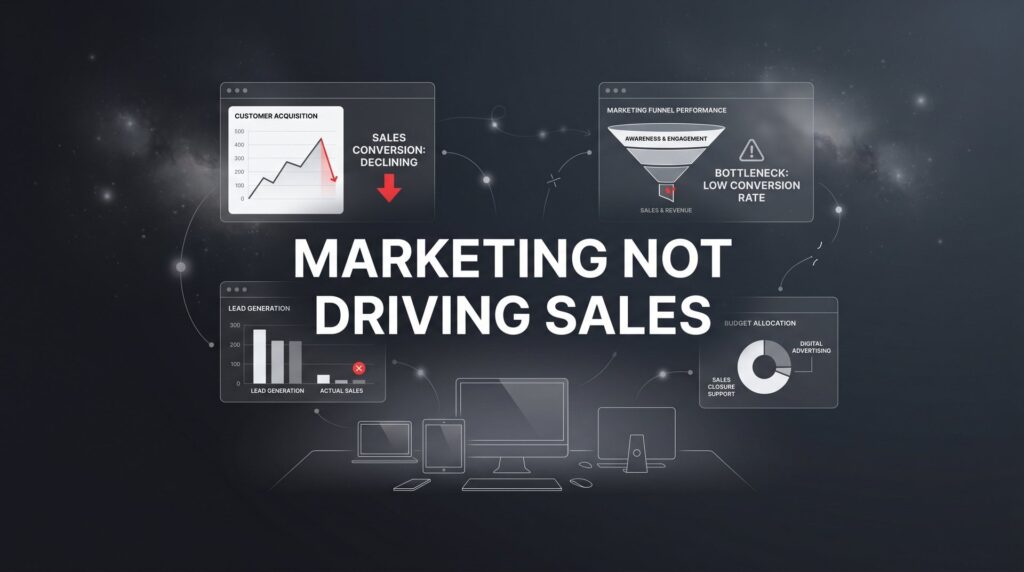
The revenue hasn’t budged. Despite all that activity, despite all those clicks and visits and impressions, you’re not seeing more sales. You’re spending money to generate noise, not customers. And the frustrating part? You can’t quite pinpoint where the breakdown is happening.
This disconnect between marketing activity and actual sales is one of the most common—and most expensive—problems local businesses face. The good news? It’s almost always fixable once you know what to look for. This article will help you diagnose exactly where your marketing is failing to convert and what you can do about it.
The Traffic Trap: When Vanity Metrics Mask Real Problems
Here’s the uncomfortable truth: most marketing metrics are designed to make you feel good, not to tell you whether you’re making money.
Activity metrics—clicks, impressions, reach, page views—are easy to measure and satisfying to watch climb. They create the illusion of progress. Your marketing agency sends you a monthly report showing that your ad impressions increased by 5,000 and your click-through rate improved by half a percentage point. It feels like success.
But these numbers don’t pay your bills.
Revenue metrics tell a completely different story. Cost per acquisition, customer lifetime value, return on ad spend, actual sales attributed to specific campaigns—these are the numbers that matter. And for many businesses, these numbers reveal that all that impressive-looking traffic isn’t actually converting into paying customers.
The warning signs are usually obvious once you know what to look for. You’re getting plenty of form submissions, but they’re from tire-kickers and information gatherers, not serious buyers. Your phone is ringing more, but the calls are questions about your hours or services you don’t offer. Your email list is growing, but nobody’s buying.
This is the traffic trap. You’re generating activity without intent. Movement without momentum. And every month, you’re spending money to attract people who were never going to become customers in the first place.
The shift from activity-focused marketing to revenue-focused marketing starts with asking a different question. Not “How many people saw my ad?” but “How many people who saw my ad actually bought something, and was that profitable?” Once you start measuring what actually matters, the real problems become visible.
Five Hidden Disconnects Between Your Marketing and Your Sales
The gap between marketing activity and sales results usually comes down to one of five fundamental disconnects. Let’s break them down.
Disconnect #1: You’re targeting the wrong audience. Your ads might be reaching thousands of people, but if those people don’t have purchase intent, the traffic is worthless. A local HVAC company running ads about “energy efficiency tips” will attract homeowners interested in DIY solutions, not people ready to hire a professional. A restaurant promoting “healthy eating advice” will get clicks from diet enthusiasts, not people looking for a place to eat tonight. The traffic looks good on paper, but these visitors were never going to convert because they’re in research mode, not buying mode.
Disconnect #2: Your messaging attracts browsers instead of buyers. There’s a huge difference between content that educates and content that converts. Educational content attracts a broad audience interested in learning. Sales-focused content attracts a narrow audience ready to make a decision. Many businesses accidentally optimize for the wrong one. They create content designed to be interesting and shareable, then wonder why all those engaged readers never become paying customers. The messaging doesn’t filter for purchase intent.
Disconnect #3: The handoff between marketing and sales is broken. Someone clicks your ad, lands on your website, fills out a form… and then what? If there’s a delay in follow-up, if the sales conversation doesn’t acknowledge what the person was looking at, if the offer they receive doesn’t match what the ad promised—the momentum dies. Many businesses treat marketing and sales as separate functions. Marketing generates leads, then tosses them over the wall to sales. Understanding the difference between marketing qualified leads vs sales qualified leads can help bridge this gap.
Disconnect #4: Your offers don’t match customer readiness. Someone who just discovered your business needs a different offer than someone who’s been researching for weeks. But most marketing treats everyone the same. You’re pushing for the sale when people aren’t ready, or you’re nurturing people who are already prepared to buy. A visitor landing on your homepage for the first time probably isn’t ready to “Schedule a Free Consultation Today.” They need to understand what you do first. Meanwhile, someone who’s visited your pricing page three times this week doesn’t need another educational blog post—they need a clear path to purchase.
Disconnect #5: Attribution gaps hide which channels actually drive revenue. You’re running Google Ads, Facebook campaigns, SEO efforts, and email marketing simultaneously. Sales are happening, but you can’t definitively say which channel is responsible. So you keep funding everything equally, including the channels that are generating activity but not revenue. Without clear attribution, you’re flying blind. You might be doubling down on the marketing that makes you feel good while starving the channels that actually convert.
Most businesses have at least two of these disconnects active at any given time. The combination creates a situation where marketing looks successful on the surface while sales remain stagnant underneath.
The Conversion Breakdown: Where Leads Go to Die
Let’s say you’ve fixed the targeting and messaging issues. You’re now attracting the right people with purchase intent. They click your ad, ready to take action. And then your website kills the momentum.
This is where many marketing dollars go to die: in the gap between click and conversion.
Landing page failures are the silent killers of marketing ROI. A page that takes more than three seconds to load loses a significant portion of visitors before they even see your offer. A confusing layout makes people work to figure out what you’re selling. Weak calls-to-action fail to create urgency or clarity about the next step. Each of these friction points sheds potential customers. If your ads are not converting to sales, the landing page is often the culprit.
Picture this: Someone searches for “emergency plumber near me” at 11 PM because their basement is flooding. They click your ad. Your landing page loads slowly because it’s image-heavy. When it finally appears, the main headline says “Quality Plumbing Services Since 1995” instead of “24/7 Emergency Service—We’ll Be There in 30 Minutes.” The phone number isn’t immediately visible. There’s a contact form, but it asks for unnecessary information like “How did you hear about us?” By the time they’ve processed all this, they’ve already clicked back and called your competitor.
That’s a conversion breakdown. The marketing did its job—it put a ready-to-buy customer in front of you. But the landing experience created too much friction.
Follow-up gaps are equally destructive. Someone fills out your contact form on Tuesday afternoon. Your automated confirmation email arrives immediately. But then… silence. No phone call until Thursday morning. By that time, the person has already contacted three other companies and probably made a decision. The lead went cold not because they weren’t interested, but because you didn’t strike while the momentum was hot.
Many businesses don’t realize how much friction exists in their buying process until they actually walk through it themselves. Try this: go through your own customer journey as if you were a stranger. Click your ads. Fill out your forms. See how long it takes to get a response. Notice where you feel confused or frustrated. Every point of friction is a place where potential customers are quietly abandoning the process.
Building a Revenue-First Marketing System
Fixing individual problems helps, but sustainable results require a fundamental shift in how you think about marketing. You need to move from campaign-focused thinking to customer journey optimization.
Campaign-focused thinking asks: “How can I get more clicks on this ad?” Customer journey optimization asks: “What does someone need to experience from first awareness to final purchase, and how can I remove every unnecessary barrier along that path?”
This shift changes everything. Instead of celebrating traffic increases, you start measuring the percentage of visitors who take meaningful actions. Instead of running isolated campaigns, you build connected experiences that guide people from curiosity to commitment. Instead of treating marketing as a lead generation machine, you treat it as a revenue system.
Revenue-first marketing requires aligning your KPIs with actual sales outcomes. This means tracking marketing conversions properly—metrics that directly correlate with money: cost per acquisition, conversion rate by traffic source, customer lifetime value, return on ad spend. When these become your primary metrics, you immediately see which marketing efforts are profitable and which are just generating activity.
The most effective businesses create feedback loops between marketing data and sales results. Your sales team should be telling your marketing team which leads actually close and why. Your marketing team should be adjusting targeting and messaging based on which campaigns produce the highest-quality customers. This isn’t complicated—it’s just a regular conversation where both teams share what they’re seeing.
Think of your marketing and sales process as a single system, not separate departments. The ad, the landing page, the follow-up email, the sales call—they’re all part of one continuous experience. When you optimize the entire system instead of individual pieces, conversion rates improve dramatically.
Quick Wins: Immediate Fixes to Start Converting More Leads
While building a revenue-first system takes time, there are immediate actions you can take this week to start converting more of your existing traffic.
Audit your highest-traffic pages for conversion barriers. Pull up Google Analytics and identify the pages that get the most visitors. Then visit each page and ask: Is it immediately clear what I’m supposed to do next? Is the call-to-action visible without scrolling? Does this page answer the question that brought people here? If someone wanted to buy right now, could they easily figure out how? Fix the obvious friction points first—slow load times, missing contact information, unclear next steps.
Implement lead scoring to prioritize sales-ready prospects. Not all leads are created equal. Someone who visits your pricing page three times and downloads a case study is more sales-ready than someone who read one blog post. Set up simple lead scoring based on behavior: high-intent actions (pricing page visits, demo requests, comparison page views) get higher scores. Focus your immediate follow-up energy on high-score leads while nurturing lower-score leads with automated email sequences. If you’re struggling with poor quality leads from marketing, lead scoring is essential.
Test offer positioning to match buyer intent stages. Create different offers for different stages of readiness. For cold traffic (people who just discovered you): offer educational content or low-commitment resources. For warm traffic (people researching solutions): offer comparison guides or case studies. For hot traffic (people ready to buy): offer consultations, quotes, or direct purchase options. Match the ask to the relationship stage, and you’ll see conversion rates improve immediately.
These aren’t revolutionary changes. They’re practical adjustments that acknowledge a simple truth: different people need different things at different times. When you stop treating all traffic the same way, more of it converts.
When to Bring in Conversion Specialists
There’s a point where DIY optimization hits its limits. You’ve fixed the obvious problems, implemented best practices, and made incremental improvements. But you’re still not seeing the conversion rates you need to make your marketing profitable.
This is when professional conversion rate optimization becomes worth the investment.
The signs are usually clear. You’re spending significant money on traffic but can’t get conversion rates above a certain threshold. You’ve tested different headlines and CTAs without meaningful improvement. You know there’s a problem but can’t identify exactly where the breakdown is happening. Your marketing generates leads, but the quality is inconsistent—some months you get great customers, other months you get tire-kickers, and you can’t figure out why. Understanding what performance marketing is can help you evaluate whether your current approach is truly results-focused.
Professional conversion optimization isn’t about making your website prettier or adding more features. It’s about systematic diagnosis and testing. Specialists use data to identify exactly where people are dropping off in your funnel, then run controlled experiments to fix those specific problems. They map the entire customer journey from ad click to purchase, looking for friction points you might not even realize exist.
The difference between tactical fixes and strategic overhaul comes down to scope. Tactical fixes address individual problems: a slow landing page, a confusing form, a weak call-to-action. Strategic overhaul rebuilds the entire system: realigning targeting with purchase intent, restructuring the customer journey, integrating marketing and sales processes, implementing proper attribution tracking. Implementing call tracking for marketing campaigns is often part of this strategic approach.
You need tactical fixes when you have specific, identifiable problems. You need strategic overhaul when you’re generating plenty of activity but can’t figure out why it’s not converting to sales. If you’ve already tried the obvious solutions and conversion rates are still disappointing, the problem is probably systemic rather than superficial.
Turning Marketing Activity Into Actual Revenue
Marketing that doesn’t drive sales isn’t a mystery—it’s a solvable problem. But solving it requires honest diagnosis and strategic action, not just more traffic.
The key disconnects to look for: Are you targeting people with actual purchase intent, or just people who find your content interesting? Does your messaging filter for buyers, or does it attract browsers? Is there friction in your landing pages or follow-up process that’s killing momentum? Are you measuring activity metrics or revenue metrics? Is there clear attribution showing which marketing efforts actually produce sales?
Most businesses discover they’re celebrating the wrong wins. They’re optimizing for clicks when they should be optimizing for customers. They’re proud of traffic growth while ignoring conversion rates. They’re running campaigns in isolation instead of building connected customer journeys.
The shift to revenue-focused marketing doesn’t require a complete overhaul overnight. Start by identifying your biggest leak—the place where the most potential customers are falling out of your funnel. Fix that first. Then move to the next problem. Each improvement compounds.
Tired of spending money on marketing that doesn’t produce real revenue? We build lead systems that turn traffic into qualified leads and measurable sales growth. If you want to see what this would look like for your business, we’ll walk you through how it works and break down what’s realistic in your market.
Because at the end of the day, marketing should do one thing: make you money. If it’s not doing that, it’s time to figure out why—and fix it.