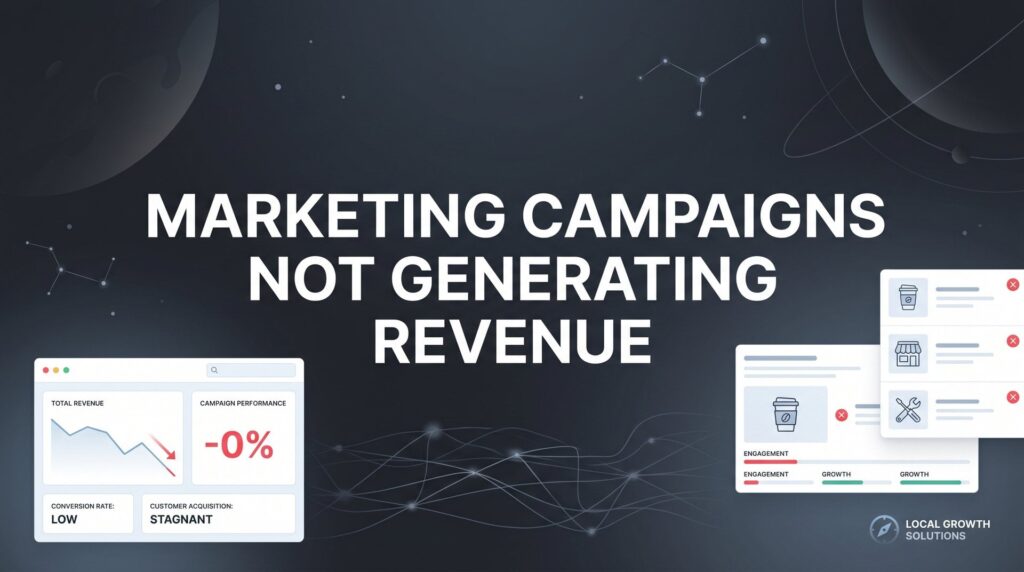
You check your ad dashboard. The numbers look good. Clicks are up. Impressions are climbing. Your social posts are getting likes. But when you check your bank account? Nothing has changed.
This is the reality for countless local business owners right now. They’re spending real money on marketing that feels productive—campaigns are running, content is posting, the activity looks legitimate. But the revenue? It’s not moving.
The problem isn’t that marketing doesn’t work. The problem is that most marketing campaigns are optimized for the wrong outcomes. They’re built to generate activity, not revenue. And that gap between what you’re measuring and what actually matters to your business is costing you thousands of dollars every month.
This article will help you diagnose exactly where your marketing-to-revenue pipeline is breaking down. We’ll identify the specific leaks draining your ROI, show you what high-performing campaigns actually look like, and give you a clear path to turn marketing spend into measurable business growth.
The Revenue Gap: Why Traffic and Engagement Don’t Equal Sales
Here’s the uncomfortable truth: most marketing metrics are designed to make you feel good, not to make you money.
Impressions tell you how many people saw your ad. Clicks tell you how many people were curious enough to visit your site. Engagement tells you who liked your post. But none of these metrics tell you whether anyone actually bought something.
This disconnect creates what we call the revenue gap—the space between marketing activity and actual business results. You can have thousands of website visitors and still make zero sales. You can generate hundreds of leads and still have an empty sales pipeline. The activity exists, but the outcomes don’t.
Many businesses fall into this trap because they’re optimizing for the wrong KPIs. They celebrate when traffic goes up. They get excited about lower cost-per-clicks. They track engagement rates and follower counts. And all of these metrics can improve while revenue stays completely flat.
The reason this happens is simple: these are vanity metrics. They measure visibility and interest, but they don’t measure purchase intent or buying behavior. A click from someone who will never buy costs the same as a click from someone ready to spend money. Your dashboard doesn’t know the difference.
Think of it like running a retail store. You could count how many people walk past your storefront (impressions), how many people stop to look in the window (clicks), and how many people wave at you through the glass (engagement). But none of that matters if nobody walks in and buys something.
The revenue gap exists because most marketing campaigns are built backwards. They start with tactics—run ads, post content, send emails—without first defining what a successful outcome looks like in revenue terms. So you end up with campaigns that generate activity without generating income. Understanding why marketing campaigns fail is the first step toward fixing this fundamental problem.
This creates a dangerous cycle. You see the activity metrics improving, so you assume the marketing is working. You keep investing. The numbers keep climbing. But your bank account tells a different story. By the time you realize the campaigns aren’t producing revenue, you’ve already spent months and thousands of dollars chasing the wrong goals.
The businesses that actually generate revenue from marketing do something fundamentally different: they work backwards from the sale. They start by defining what a valuable customer looks like, what that customer is worth, and what it costs to acquire them. Then they build campaigns designed to produce those specific outcomes.
Everything else is just noise.
Five Hidden Leaks Draining Your Marketing ROI
When marketing campaigns fail to generate revenue, the problem usually isn’t the platform or the budget. It’s one of five specific leaks in your system. Each one quietly drains your ROI while making your campaigns look like they’re working.
Leak #1: Targeting the Wrong Audience
Your ads might be reaching thousands of people who will never become customers. This happens when targeting is based on demographics or interests rather than purchase intent. You’re paying to show your plumbing services to homeowners who rent. You’re advertising your premium service to people searching for budget options. You’re reaching people in the awareness stage when your offer requires someone ready to buy.
The clicks look good. The traffic is real. But you’re fundamentally talking to people who don’t have the problem you solve, don’t have the budget you require, or aren’t in a position to make a purchase decision. Every dollar spent reaching the wrong audience is a dollar that will never generate revenue.
Leak #2: Weak or Misaligned Offers
Your messaging might be completely disconnected from what actually motivates your customers to buy. This happens when you focus on features instead of outcomes, when you lead with what you do instead of what the customer gets, or when your offer doesn’t match the stage of awareness your audience is in.
Someone searching for emergency HVAC repair doesn’t want to read about your company history. Someone comparing software solutions doesn’t care about your newest features—they want to know if you solve their specific problem better than the alternatives. When your message doesn’t align with buyer intent, people click and leave. They were curious, but you didn’t give them a reason to take action. This is a core reason behind marketing campaigns not driving sales despite healthy traffic numbers.
Leak #3: Broken Conversion Paths
Your landing pages, forms, and checkout processes might be actively preventing people from becoming customers. This is one of the most expensive leaks because you’ve already paid to get someone interested—and then you lose them at the last step.
Forms that ask for too much information. Landing pages that don’t match the ad promise. Checkout processes that require account creation. Unclear next steps. Slow page load times. Mobile experiences that don’t work. Each friction point costs you conversions. You’re spending money to drive traffic to a broken sales process.
Leak #4: Poor Lead Qualification
You might be generating volume without quality. Your campaigns produce leads, but those leads aren’t actually viable customers. They’re tire-kickers, information gatherers, students doing research, or people who will never have the budget for what you offer.
This leak is particularly dangerous because it looks like success. Your lead count goes up. Your cost-per-lead goes down. But when your sales team follows up, nothing converts. You’re paying to generate leads that waste everyone’s time. The marketing dashboard says you’re winning, but the revenue says otherwise. If this sounds familiar, you may be dealing with poor quality leads from marketing that need strategic filtering.
Leak #5: Lack of Follow-Up Systems
Your campaigns might be generating legitimate interest, but you’re losing potential customers because nobody follows up effectively. The lead comes in, sits in a spreadsheet, and goes cold before anyone reaches out. Or the follow-up happens, but it’s generic, poorly timed, or gives up after one attempt.
Many businesses spend thousands getting someone to raise their hand—and then treat that lead like it doesn’t matter. No immediate response. No nurture sequence. No system to keep the conversation going. The person who was interested last week has moved on to your competitor by the time you get around to calling them.
Each of these leaks operates independently, but they often exist together. You might be targeting the wrong audience AND have a broken landing page. You might generate good leads but have no follow-up system. The combination of multiple leaks is why campaigns can look busy while producing zero revenue.
The Conversion Problem Most Businesses Ignore
Here’s a scenario that plays out constantly: a business is spending $3,000 a month on ads, getting 300 clicks, and converting 3 of those clicks into customers. That’s a 1% conversion rate. They assume the problem is traffic volume, so they increase their budget to $6,000, get 600 clicks, and convert 6 customers.
They doubled their revenue—but they also doubled their costs. The math still doesn’t work. They’re stuck in the same place, just at a higher spend level.
The real opportunity was never about more traffic. If they had fixed their conversion rate first—getting it from 1% to 3%—they would have converted 9 customers at the original $3,000 budget. Triple the revenue without spending another dollar.
This is the conversion problem most businesses ignore. They focus on driving more traffic instead of converting the traffic they already have. They throw money at the top of the funnel while the bottom of the funnel is leaking like a sieve. When your ad campaigns are not converting, more traffic just means more wasted spend.
Conversion rate optimization is often the missing piece between spending and earning. Small improvements create exponential revenue changes. Moving from 2% to 4% doesn’t just double your conversions—it cuts your customer acquisition cost in half. That same ad spend suddenly produces twice the revenue.
But most businesses never look at conversion rates because they’re too focused on traffic metrics. They know how many clicks they got. They don’t know how many of those clicks should have converted but didn’t. They don’t know what percentage of their landing page visitors leave without taking action. They don’t track where in the process people drop off.
Here are the signs your landing pages and sales funnels are underperforming: your bounce rate is above 60%, meaning most visitors leave immediately. Your average time on page is under 30 seconds, meaning people aren’t reading your offer. Your form abandonment rate is high, meaning people start to convert but don’t finish. Your mobile conversion rate is significantly lower than desktop, meaning your mobile experience is broken.
Each of these signals represents lost revenue. You paid to get someone to that page. They were interested enough to click. But something about your conversion path made them leave instead of buy.
The businesses that actually generate revenue from marketing obsess over conversion rates. They test headlines. They optimize page layouts. They reduce form fields. They improve load times. They make the path from click to customer as smooth as possible. Because they understand that traffic is expensive and conversions are profitable.
Building a Revenue-First Marketing Strategy
The shift from activity-based marketing to outcome-based marketing requires a fundamental change in how you think about campaigns. Instead of asking “How many clicks did we get?” you start asking “How much revenue did we generate?”
This means working backwards from the sale. Before you launch a campaign, you define what success looks like in revenue terms. If you need to generate $50,000 in new revenue, and your average customer is worth $5,000, you need 10 new customers. If your close rate is 20%, you need 50 qualified leads. If your landing page converts at 5%, you need 1,000 targeted clicks.
Now you have a clear target. You know exactly what the campaign needs to produce. You can calculate whether the math works before you spend a dollar. And you can track performance against actual business outcomes instead of vanity metrics. This approach is the foundation of performance marketing—where every dollar spent is tied to measurable results.
Revenue-first marketing also means aligning campaigns with the customer journey and purchase intent. Someone searching “emergency plumber near me” is in a different stage than someone reading “how to fix a leaky faucet.” The first person is ready to buy right now. The second person is gathering information and might not need help for months.
Your campaigns need to match where people are in their buying journey. High-intent searches get direct response ads with clear calls to action. Low-intent audiences get educational content designed to build awareness. You don’t waste direct response budget on people who aren’t ready to buy, and you don’t miss opportunities to capture people who are.
This requires proper tracking to connect marketing spend to actual revenue. You need to know which campaigns produced which customers and how much those customers are worth. You need attribution systems that show the path from first click to final sale. You need to track not just conversions, but revenue per conversion.
Most businesses track conversions and stop there. They know they got 20 leads this month. They don’t know that 15 of those leads came from one campaign and 5 came from another. They don’t know that the 15 leads were low-quality and none converted, while 3 of the 5 leads became customers worth $15,000 total.
Without revenue tracking, you can’t make intelligent decisions. You might cut the campaign that’s actually producing revenue because it generates fewer leads. You might double down on the campaign that produces volume but zero value. You’re flying blind.
Setting up proper tracking means implementing conversion tracking that captures not just the lead, but the outcome. It means using CRM systems that connect marketing sources to closed deals. It means building reports that show revenue by campaign, not just clicks by campaign. Learn how to fix your marketing conversion tracking to stop making decisions based on incomplete data.
When you can see the complete picture—from ad spend to clicks to leads to customers to revenue—you can optimize for what actually matters. You can kill campaigns that look good but don’t produce income. You can scale campaigns that generate real returns. You can make decisions based on profitability instead of activity.
When to Audit Your Campaigns (And What to Look For)
There are specific warning signs that indicate your campaigns need a professional review. If you’re experiencing any of these, you’re likely leaving significant revenue on the table.
Your cost per lead is increasing while lead quality is decreasing. This suggests your targeting has drifted or your audience is fatigued. You’re reaching more people, but the wrong people. Your campaigns are generating activity without generating value.
Your conversion rates have plateaued or declined. What used to work isn’t working anymore. This could mean your landing pages are outdated, your offer isn’t competitive, or your messaging no longer resonates with your market. Something in your conversion path needs fixing.
You’re getting leads but they’re not converting to customers. Your sales team is following up, but nothing closes. This indicates a lead quality problem—your campaigns are attracting people who aren’t actually viable buyers. Your targeting criteria need adjustment.
You can’t clearly connect marketing spend to revenue outcomes. You know what you’re spending, but you don’t know what you’re earning. You can’t tell which campaigns are profitable and which are burning money. You’re making decisions based on incomplete information. Implementing proper attribution tracking for marketing campaigns solves this visibility problem.
When you audit campaigns, examine these key areas: ad targeting parameters to ensure you’re reaching the right audience, landing page performance to identify conversion barriers, lead quality metrics to verify you’re attracting viable buyers, and attribution systems to confirm you’re tracking the complete customer journey.
Look at your targeting first. Review who your ads are actually reaching versus who you intended to reach. Check if your audience definitions have drifted over time. Verify that your geographic, demographic, and behavioral targeting still aligns with your ideal customer profile.
Examine your landing page performance next. Check bounce rates, time on page, scroll depth, and form abandonment rates. Identify where people are dropping off. Test your pages on mobile devices. Verify that your page speed is acceptable and your forms are working correctly.
Assess lead quality by tracking what happens after the lead comes in. How many leads become qualified opportunities? What percentage convert to customers? Is there a pattern in which campaigns produce better leads? Your CRM data will reveal whether you have a volume problem or a quality problem.
Review your attribution setup to ensure you’re connecting marketing activity to business outcomes. Can you trace each customer back to their original source? Do you know which campaigns produced which revenue? Are you tracking the complete customer journey or just the first click?
Sometimes the value of an outside perspective becomes clear when internal efforts plateau. You’ve tried adjusting your targeting. You’ve tested new ad copy. You’ve tweaked your landing pages. But nothing moves the needle. This often means the problem is structural—something fundamental about your approach needs to change, and you’re too close to see it.
Turning Things Around: Your Next Steps
Start by diagnosing where your biggest leak exists. Pull your campaign data for the last 90 days. Calculate your conversion rate at each stage: clicks to landing page visitors, visitors to leads, leads to qualified opportunities, opportunities to customers.
Whichever stage has the lowest conversion rate is where you’re losing the most money. That’s where you focus first.
If your click-through rate is terrible, your targeting or ad creative needs work. If your landing page conversion rate is below 3%, your page is broken. If your lead-to-opportunity rate is low, you have a qualification problem. If your opportunity-to-customer rate is weak, your sales process or offer needs improvement.
Fix the biggest leak first. Don’t try to optimize everything at once. If 70% of your traffic bounces from your landing page, that’s your priority. Improving that one metric will have more impact than tweaking ad copy or adjusting bids.
Prioritize fixes based on potential impact. A 1% improvement in landing page conversion rate might generate 10 additional customers per month. A 10% improvement in click-through rate might generate 2 additional customers. Work on landing pages first. Consider implementing marketing automation tools to systematize your follow-up and prevent leads from going cold.
For businesses where the problems are complex or the stakes are high, bringing in specialized help accelerates results significantly. An experienced agency can identify issues you’ve been blind to, implement fixes you didn’t know were possible, and compress months of trial-and-error into weeks of strategic execution.
The difference between DIY marketing and professional execution often comes down to pattern recognition. An agency that’s optimized hundreds of campaigns knows what works. They’ve seen your exact problem before. They know the solution. What would take you three months of testing, they can implement in three weeks.
Putting It All Together
Marketing campaigns not generating revenue isn’t a sign to stop marketing. It’s a signal to market smarter. The gap between spending and earning isn’t about effort or budget—it’s about strategy, execution, and optimization.
The businesses that generate real revenue from marketing do three things consistently: they optimize for outcomes instead of activity, they align campaigns with actual buyer intent, and they continuously improve conversion rates instead of just driving more traffic.
They track what matters. They fix what’s broken. They scale what works. And they’re ruthless about cutting campaigns that look busy but don’t produce income.
If you’ve been watching your marketing budget disappear while revenue stays flat, you now know why. The problem isn’t that marketing doesn’t work—it’s that your campaigns are optimized for the wrong outcomes. The traffic exists. The interest exists. But somewhere between the click and the sale, your system is leaking money.
The path forward requires intentional strategy, proper tracking, and continuous optimization. It means shifting focus from vanity metrics to revenue metrics. It means building conversion paths that actually convert. It means treating every dollar of ad spend as an investment that should produce measurable returns.
Tired of spending money on marketing that doesn’t produce real revenue? We build lead systems that turn traffic into qualified leads and measurable sales growth. If you want to see what this would look like for your business, we’ll walk you through how it works and break down what’s realistic in your market.
The difference between campaigns that generate activity and campaigns that generate revenue is strategy. Get the strategy right, and the revenue follows.