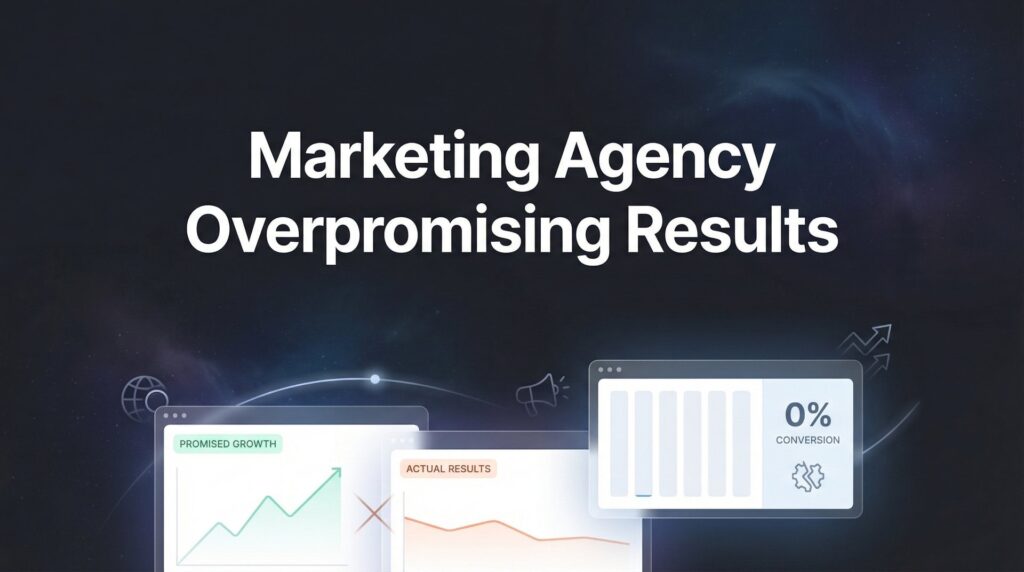
You’re sitting across from a marketing agency representative who’s confidently explaining how they’ll get your business to page 1 of Google in 30 days. They’re throwing around numbers—”guaranteed 300% ROI,” “minimum 50 qualified leads per month,” “top 3 rankings for all your keywords.” It sounds incredible. You’re excited. You sign the contract, wire the first payment, and wait for the magic to happen.
Three months later, your rankings haven’t budged. The “qualified leads” turned out to be spam form submissions. The agency keeps telling you to “give it more time” while your marketing budget evaporates. You’re not alone in this experience.
Overpromising has become so endemic in the marketing industry that it’s practically a business model. Agencies desperate for clients make bold guarantees they know they can’t keep, banking on the fact that most business owners don’t understand the technical realities of digital marketing. The result? Small businesses collectively waste billions on marketing services that deliver nothing but excuses and vague reports.
The frustrating part is that effective marketing absolutely exists. Real agencies produce real results every day. But when you’ve been burned by empty promises, it becomes nearly impossible to distinguish between legitimate partners and skilled salespeople. This guide exists to change that. We’re going to break down exactly what unrealistic marketing promises look like, why agencies make them, and most importantly—how to spot the red flags before you waste a single dollar.
The Anatomy of an Unrealistic Marketing Promise
Let’s start with the most common overpromises you’ll hear from agencies that are more interested in your signature than your success. These aren’t just optimistic projections—they’re technically impossible guarantees that reveal an agency’s either incompetent or dishonest.
Guaranteed Page 1 Rankings: Any agency promising specific Google rankings is either lying or fundamentally misunderstands how search engines work. Google’s algorithm uses over 200 ranking factors and changes constantly. Your competition isn’t sitting still. Market conditions shift. Even if an agency does everything perfectly, they cannot guarantee where Google will decide to rank your pages.
Specific Lead Numbers Without Context: “We’ll generate 50 qualified leads per month” sounds concrete and measurable. But what makes a lead qualified? What’s the conversion rate assumption? What’s the traffic volume required? Legitimate agencies discuss lead generation in terms of ranges based on your specific market, not arbitrary numbers pulled from thin air. Understanding the difference between poor quality leads from marketing and genuine prospects is essential before evaluating any agency’s promises.
Exact ROI Percentages: “300% ROI guaranteed” is marketing theater. ROI depends on your profit margins, sales process, conversion rates, average transaction value, and dozens of other variables specific to your business. An agency can’t guarantee ROI without deeply understanding your entire business model—and even then, market conditions introduce variables no one can control.
Overnight Results: Marketing that produces sustainable business growth takes time. SEO requires months of consistent effort before significant organic traffic improvements appear. PPC campaigns need testing and optimization cycles. Content marketing builds authority gradually. Any promise of immediate, dramatic results is a red flag that the agency doesn’t understand the mechanics of what they’re selling.
Here’s the crucial distinction: confident projections based on data are completely different from empty guarantees with no backing. A legitimate agency might say, “Based on businesses similar to yours in this market, we typically see a 20-30% increase in qualified traffic within the first six months, assuming consistent implementation and normal market conditions.” That’s honest. What’s dishonest is “We guarantee you’ll be number one for ‘personal injury lawyer’ in 90 days.”
The difference comes down to specificity about methodology and honesty about variables. Real agencies explain what they’ll do, why it should work based on evidence, and what factors could affect outcomes. Overpromising agencies skip straight to the outcome without explaining the path or acknowledging that paths sometimes have obstacles.
Why Agencies Make Promises They Can’t Keep
Understanding why agencies overpromise helps you recognize the behavior when you see it. It’s rarely about malicious intent—though that exists too. More often, it’s about business desperation, lack of expertise, or short-term thinking that prioritizes closing deals over delivering results.
Market Saturation Breeds Desperation: The digital marketing industry has extremely low barriers to entry. Anyone can hang out a shingle and call themselves a marketing agency. This saturation creates intense competition for clients, and some agencies respond by making increasingly bold promises to stand out. When ten agencies are pitching the same prospect, the one promising the biggest results often wins—even if those promises are fiction.
Think about it from the agency’s perspective. They’re competing against dozens of other firms, many of which are also overpromising. If they take the honest route and say “We can probably improve your rankings over 6-12 months with consistent effort,” they lose to the competitor promising “Page 1 in 30 days guaranteed.” The market actually punishes honesty in the short term, which creates pressure to inflate claims just to compete.
Lack of Real Expertise: Many agencies making impossible promises genuinely don’t know they’re impossible. They’ve never actually executed successful campaigns, so they don’t understand the timeline, effort, and variables involved. They’ve learned marketing from YouTube videos and blog posts, not from years of hands-on experience managing real client accounts.
These agencies make up for their lack of knowledge with boldness. They can’t explain their methodology in detail because they don’t have one. They can’t show you case studies because they don’t have successful ones. So instead, they lean heavily on confidence and guarantees, hoping you’ll mistake certainty for competence. This is a common reason why marketing isn’t working for many businesses—they’ve partnered with agencies that lack genuine expertise.
Short-Term Thinking Wins Over Long-Term Reputation: Some agencies operate on a churn-and-burn model. They know they can’t deliver on their promises, but they also know they can collect several months of fees before the client realizes nothing’s working. By the time you cancel, they’ve already moved on to the next victim.
This business model actually works for them in the short term. They win the contract with bold promises, collect payments for 3-6 months while producing mediocre work and vague reports, then move on when you finally cancel. They’re not building a reputation for results—they’re building a sales machine that constantly needs new clients because they can’t retain the old ones.
Red Flags That Signal an Overpromising Agency
Now that you understand what unrealistic promises look like and why agencies make them, let’s talk about how to spot these red flags before you sign anything. These warning signs appear consistently across agencies that overpromise and underdeliver.
Vague Methodology, Specific Outcome Guarantees: This is the biggest red flag. When you ask “How will you achieve these results?” and get answers like “We use proprietary strategies” or “Our proven system” without actual specifics, run. Legitimate agencies can explain exactly what they’ll do: “We’ll conduct keyword research targeting commercial intent terms with monthly search volume between X and Y, create optimized content targeting those terms, build authoritative backlinks through outreach to industry publications, and optimize your technical SEO foundation.”
If an agency can’t explain HOW they’ll deliver results but confidently promises WHAT results you’ll get, they’re either hiding their lack of knowledge or deliberately keeping you in the dark. Either way, it’s a terrible foundation for a business relationship.
No Case Studies or References With Context: Every legitimate agency has success stories. But notice the difference between real case studies and vague claims. A real case study names the client (or at least the industry), explains the starting point, details the strategy implemented, and shows the results with context. “We helped a regional HVAC company increase qualified leads by 40% over eight months through a combination of local SEO optimization and targeted PPC campaigns” tells you something useful.
Compare that to “We’ve helped hundreds of businesses achieve amazing results” with no specifics. Or worse, the agency gets defensive when you ask for references: “Our clients value their privacy” or “We can’t share that information due to NDAs.” While some clients do require confidentiality, an agency should have at least some case studies or references they can share. If they don’t, it’s because they don’t have successful clients to reference.
Pressure Tactics Without Substance: “This special pricing is only available if you sign today” or “We only take on three new clients per month and our spots fill up fast.” These urgency tactics are designed to prevent you from thinking critically or getting second opinions. Legitimate agencies want you to make an informed decision because they know informed clients who understand the strategy are better partners who stick around longer.
Pressure tactics appear when an agency knows their offer doesn’t hold up to scrutiny. They need you to sign quickly, before you have time to research their claims or talk to their past clients. The urgency is artificial—if their service is truly valuable, it will still be valuable next week. Understanding hidden fees from marketing agencies is another critical step before signing any contract under pressure.
No Discussion of Your Specific Business: Here’s a simple test: In your initial conversations with the agency, are they asking more questions or making more statements? A good agency needs to understand your business model, target market, competitive landscape, current marketing efforts, budget constraints, and business goals before they can make any meaningful recommendations.
If an agency is making promises about what they can achieve for you before they’ve asked these questions, they’re not basing those promises on your reality—they’re reciting a sales script. They’re promising the same results to every prospect regardless of individual circumstances. That’s not marketing strategy; it’s marketing theater.
Contracts With Long Lock-Ins and Vague Deliverables: Be extremely wary of contracts that lock you in for 12+ months but don’t specify exactly what you’ll receive. “Ongoing SEO services” could mean anything from comprehensive strategy implementation to someone spending 20 minutes per month submitting your site to directories. If the contract doesn’t detail specific deliverables, timelines, and reporting standards, the agency is giving themselves maximum flexibility to underdeliver. Many businesses are now seeking a marketing agency with no long term contract to avoid being trapped in underperforming relationships.
What Realistic Marketing Expectations Actually Look Like
After all this talk about what’s unrealistic, let’s establish what you should actually expect from legitimate marketing services. Understanding realistic timelines and outcomes protects you from overpromises while helping you recognize agencies that know what they’re doing.
SEO Timelines Are Measured in Months, Not Weeks: Organic search optimization is a long-term strategy. For most businesses, you’re looking at 4-6 months before you see meaningful traffic increases, and 8-12 months before SEO becomes a significant lead generation channel. This isn’t because agencies are slow—it’s because Google needs time to crawl your site, index your content, evaluate your authority, and determine how you rank relative to competition.
Variables that affect this timeline include your starting point (brand new website vs. established domain), your competitive landscape (local service business vs. national e-commerce), and your budget allocation (how much content and link building can you afford). An honest agency discusses these variables upfront and sets expectations based on your specific situation.
PPC Shows Faster Results But Requires Optimization: Pay-per-click advertising can generate traffic immediately—that part is true. But generating traffic and generating profitable conversions are completely different things. Most PPC campaigns need 60-90 days of testing and optimization before they become consistently profitable. You’re testing ad copy, landing pages, targeting parameters, and bid strategies.
A realistic PPC promise sounds like: “We’ll launch your campaigns in week one. You’ll start seeing traffic immediately, but expect the first month to be a learning period where we’re gathering data and testing variables. By month two, we should have enough data to optimize toward profitability. By month three, we’re aiming for consistent positive ROI.” That’s honest. “We’ll generate 50 leads at $20 each starting day one” is not. Understanding what performance marketing actually means helps you evaluate whether an agency’s promises align with reality.
Ranges and Variables, Not Guarantees: Notice how legitimate agencies talk about outcomes. They use ranges: “typically see a 20-30% increase” rather than “guaranteed 50% increase.” They acknowledge variables: “assuming normal market conditions and consistent implementation” rather than unconditional promises. They discuss what affects outcomes: “Results depend on your competitive landscape, budget allocation, and how quickly we can implement changes.”
This isn’t hedging or lack of confidence—it’s honesty about how marketing actually works. There are too many variables outside any agency’s control to make absolute guarantees. Algorithm changes, competitor actions, market shifts, seasonal fluctuations, and your own business operations all affect results. Good agencies acknowledge this reality rather than pretending they can control everything.
Results Tied to Your Specific Context: Your market matters. A personal injury attorney in New York City faces completely different competitive dynamics than one in rural Montana. Your budget matters—$2,000 per month buys different capabilities than $20,000 per month. Your business model matters—lead generation for a service business operates differently than e-commerce sales.
Agencies that understand this don’t give you generic promises. They research your specific market, analyze your competition, evaluate your current position, and then explain what’s achievable given your unique circumstances. If an agency promises you the same results they promise everyone else, they’re not doing actual marketing strategy—they’re selling a one-size-fits-all package that probably fits no one well.
Questions to Ask Before Signing with Any Marketing Agency
Armed with knowledge about realistic expectations and red flags, here are the specific questions you should ask every agency you’re considering. Their answers will tell you everything you need to know about whether they’re legitimate partners or smooth-talking salespeople.
What Specific Metrics Will You Track and How Often Will You Report? This question reveals whether an agency focuses on vanity metrics or business outcomes. A good answer includes metrics that actually matter to your business: qualified leads, conversion rates, cost per acquisition, revenue attribution. A bad answer focuses on metrics that don’t directly impact your bottom line: social media followers, website traffic without conversion context, rankings for keywords that don’t generate business. Implementing call tracking for marketing campaigns is one way legitimate agencies prove their results with hard data.
Also pay attention to reporting frequency and accessibility. Monthly reports are standard, but you should have access to real-time data through shared dashboards. If an agency is reluctant to give you direct access to your own data, ask yourself why. Usually it’s because they don’t want you seeing the actual performance until they’ve had time to spin it in their monthly report.
Can You Show Me Results From Businesses Similar to Mine? This question tests whether the agency has relevant experience and successful case studies. Notice what they show you. Are the examples actually similar to your business in size, industry, and market? Or are they showing you results from completely different contexts that don’t apply to your situation?
Also notice whether they can explain the strategy behind those results. Anyone can show you a graph that goes up. The question is whether they can explain why it went up, what they did to make it happen, and how those same principles apply to your business. If they can’t articulate the strategy, they probably got lucky rather than executing a repeatable process.
What Happens If We Don’t Hit Projected Targets? This is where you separate agencies that stand behind their work from those that just want your money. A good agency has a clear answer: “We review performance monthly. If we’re not hitting targets, we analyze why, adjust strategy, and communicate the changes clearly. If we determine the issue is on our end, we work to fix it. If it’s a market reality we didn’t anticipate, we reset expectations honestly.”
A bad answer involves deflection: blaming you, making excuses, or hiding behind contract terms that prevent you from leaving. If an agency’s response to underperformance is “You’re locked in for 12 months regardless,” that tells you they know they might underdeliver and they’re protecting themselves rather than committing to your success. A performance based marketing agency ties their compensation to results, which naturally aligns their incentives with yours.
How Do You Determine What’s Achievable for My Specific Business? This question gets to the heart of whether an agency does actual strategy or just sells packages. A legitimate answer involves research: “We analyze your competitive landscape, review your current digital presence, research keyword opportunities in your market, evaluate your conversion funnel, and consider your budget allocation. Based on that analysis, we project what’s realistically achievable.”
If the answer is vague—”We use our proven system that works for everyone”—you’re talking to a package seller, not a strategist. Marketing that produces real results is customized to your specific situation. One-size-fits-all approaches rarely fit anyone well.
Finding a Partner Who Delivers Instead of Just Promises
At this point, you know what unrealistic promises look like, why agencies make them, and what questions to ask. But let’s talk about the positive indicators—what does a legitimate marketing partner actually look like?
They Ask More Questions Than They Answer: In your initial conversations, a good agency is primarily in listening mode. They’re asking about your business model, target customers, competitive challenges, past marketing efforts, budget constraints, and growth goals. They’re not pitching you their services—they’re diagnosing your situation so they can determine if and how they can help.
This might feel less exciting than an agency that immediately starts promising results. But it’s infinitely more valuable. An agency that understands your business can create strategy that actually works. An agency that’s just trying to close a deal will tell you what you want to hear regardless of whether it’s true. Learning how to hire a digital marketing agency that prioritizes discovery over sales pitches is crucial for long-term success.
Transparency Markers You Can Verify: Look for concrete signs of transparency. Do they offer to share access to your analytics and campaign data? Do they explain their reporting structure clearly? Are they willing to put performance expectations in writing? Do they have clear processes for communication and strategy reviews?
Transparency also means honest conversations about challenges. Every marketing campaign faces obstacles—algorithm changes, competitive actions, seasonal fluctuations, testing periods that don’t work out. Agencies that pretend everything will be smooth sailing are either inexperienced or dishonest. Agencies that acknowledge potential challenges and explain how they’ll handle them are being realistic. Understanding marketing agency fees explained in detail is another transparency marker that separates legitimate agencies from those hiding costs.
Performance-Focused Partnerships Over Transactions: The best agency relationships are partnerships, not vendor transactions. A transactional relationship is “We pay you X, you deliver Y.” A partnership is “We’re working together toward your business growth, and we’ll adjust strategy based on what the data tells us works.”
You can feel the difference in how agencies talk about the relationship. Transactional agencies focus on their deliverables: “We’ll post X times per week, create Y blog posts, build Z backlinks.” Partnership agencies focus on your outcomes: “Our goal is to increase your qualified lead volume by X% while maintaining or improving lead quality. We’ll use these tactics to get there, but if the data shows something isn’t working, we’ll adjust.”
Partnerships also involve accountability on both sides. Yes, the agency needs to execute well. But you also need to respond to leads promptly, have a functional sales process, and implement recommended changes to your website or business operations. Good agencies acknowledge this mutual responsibility rather than pretending they can overcome any obstacle on your end.
The Bottom Line on Agency Promises
Overpromising isn’t just annoying—it’s a symptom of an agency that either doesn’t know what they’re doing or doesn’t respect your intelligence. Possibly both. The agencies making impossible guarantees are the same ones that will spend your budget ineffectively, produce vague reports that hide poor performance, and ultimately waste months of your time and thousands of your dollars.
The frustrating reality is that effective marketing absolutely exists. Real agencies produce real, measurable business growth for their clients every single day. But when the industry is flooded with smooth talkers making empty promises, it becomes nearly impossible to distinguish between legitimate partners and skilled salespeople—until it’s too late and you’ve already signed the contract.
That’s why understanding these red flags matters so much. You don’t need to become a marketing expert to protect yourself. You just need to recognize the difference between confident projections based on strategy and empty guarantees based on nothing. You need to know what questions to ask and what answers should concern you. You need to understand what realistic timelines and expectations actually look like.
The best marketing partnerships are built on realistic expectations, transparent communication, and a genuine understanding of your business goals. They’re built on agencies that ask questions before making promises, that explain their methodology clearly, that acknowledge variables and challenges, and that focus on your actual business outcomes rather than vanity metrics.
When you find an agency that operates this way, hold onto them. They’re worth their weight in gold because they’re focused on actually delivering results rather than just promising them. And in an industry where overpromising has become the norm, that kind of honesty and competence is increasingly rare.
If you’re tired of spending money on marketing that doesn’t produce real revenue, it’s time to work with a team that focuses on performance over promises. We build lead systems that turn traffic into qualified leads and measurable sales growth. If you want to see what this would look like for your business, we’ll walk you through how it works and break down what’s realistic in your market—no impossible guarantees, just honest strategy based on your specific situation.
Want More Leads for Your Business?
Most agencies chase clicks, impressions, and “traffic.” Clicks Geek builds lead systems. We uncover where prospects are dropping off, where your budget is being wasted, and which channels will actually produce ROI for your business, then we build and manage the strategy for you.