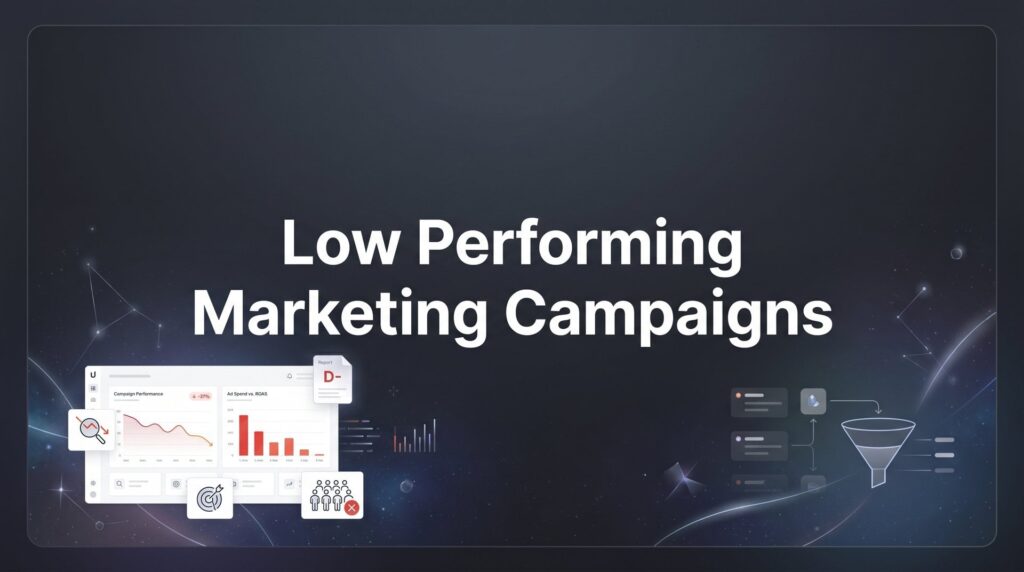
You’re spending money on marketing, but the results just aren’t there. Clicks trickle in, leads are scarce, and the revenue you expected feels like a mirage that keeps moving further away the closer you get. If that sounds familiar, you’re not alone. Many local business owners find themselves staring at low performing marketing campaigns, wondering where things went wrong and whether to pull the plug entirely.
Here’s the thing: most underperforming campaigns don’t need to be scrapped. They need a diagnosis.
The two most common mistakes business owners make are reacting too fast or not reacting at all. Some kill a campaign after two weeks because the phone isn’t ringing. Others keep feeding budget into a broken system, hoping volume will eventually produce results. Neither approach works. What does work is a structured, step-by-step process that identifies exactly where the campaign is breaking down, then applies targeted fixes to those specific breakpoints.
Think of it like a leaking pipe. You don’t replace the entire plumbing system when one joint is loose. You find the leak, fix it, and then test the pressure. Marketing campaigns work the same way. There’s almost always a specific stage in the funnel where performance falls apart, and once you locate it, the path forward becomes much clearer.
This guide walks you through a proven 6-step turnaround plan for low performing marketing campaigns. Whether you’re running Google Ads, Facebook Ads, or a broader digital strategy, these steps apply. We’ll cover how to audit your data, tighten your targeting, sharpen your creative, fix your landing pages, restructure your budget, and build a tracking system that actually tells you what’s working.
No guesswork. No vague advice. Just a clear action plan you can start using this week.
Step 1: Audit Your Campaign Data Before Touching Anything
The single biggest mistake marketers and business owners make when campaigns underperform is making changes based on gut instinct rather than data. You see low leads, assume the ads are bad, rewrite everything, and suddenly you’ve introduced three new variables at once. Now you have no idea what actually moved the needle. Resist that urge.
Before you change a single headline, budget line, or audience setting, pull your data and read it carefully. You need to understand where in the funnel the campaign is breaking down. There are three distinct stages where performance can collapse, and each one points to a different fix.
Awareness stage (impressions): If your ads aren’t getting seen, the problem is likely your budget, bidding strategy, or targeting settings. You can’t convert traffic you’re not generating.
Engagement stage (clicks and CTR): If impressions are healthy but clicks are low, your ad creative, messaging, or offer isn’t compelling enough to earn the click. People are seeing your ads and scrolling past.
Conversion stage (leads and sales): If you’re getting clicks but no conversions, the problem is almost certainly your landing page, your offer, or a mismatch between what the ad promises and what the page delivers.
To do this properly, build a simple diagnostic spreadsheet. Pull the following metrics for your campaign over the last 30 to 90 days: click-through rate (CTR), conversion rate, cost per lead or cost per acquisition, impression share, quality score (for Google Ads), and return on ad spend (ROAS) if you’re tracking revenue. Then compare each metric against your baseline goals and general industry benchmarks for your sector.
You don’t need perfect benchmark data to do this. Even comparing current performance to your own historical data, or to a clearly defined goal, will reveal which stage is underperforming. Learning how to track marketing ROI effectively makes this diagnostic process far more reliable.
For Google Ads specifically, quality score is a useful diagnostic signal. A low quality score in Google Ads often indicates that your keywords, ads, and landing pages are misaligned, which affects both your ad rank and your cost per click.
Success indicator for this step: You can articulate exactly where the campaign is breaking down. Not “it’s not working,” but “our CTR is strong, but our landing page conversion rate is below 1%, so the problem is post-click.” That specificity is what makes every subsequent fix more targeted and more effective.
Step 2: Tighten Your Targeting and Audience Settings
The most common reason campaigns fail isn’t bad creative or a weak offer. It’s that the ads are reaching the wrong people entirely. You could have the most compelling ad in the world, but if it’s showing up in front of people who have no interest in or need for what you’re selling, it will never perform.
For Google Ads campaigns, start with your search term report. This is one of the most valuable and most overlooked tools in the platform. The search term report shows you the actual queries that triggered your ads, and in many unoptimized campaigns, a meaningful portion of that spend is going to irrelevant searches. Go through the report line by line and ask: would someone searching this phrase actually buy from me? If the answer is no, add it as a negative keyword immediately.
Negative keyword management isn’t a one-time task. It’s an ongoing practice. Build a negative keyword list and review your search term report at least weekly in the early stages of a campaign turnaround. When your ad campaigns are not reaching your target audience, this is often the first place to look.
For social media ad campaigns on Facebook or Instagram, the audit looks different. Review your audience demographics: age, gender, location, income range if applicable. Look at your interest-based targeting and ask whether those interests genuinely correlate with purchase intent for your specific offer. Lookalike audiences can be powerful, but only if the source audience they’re modeled on is high quality. If your customer list is small or outdated, your lookalike audience may be drifting far from your actual buyers.
Geographic targeting is a particularly common problem for local businesses. Many local service businesses set their geographic radius too wide, paying for clicks from people who are unlikely to drive across town for a service they can get locally. Others go too narrow and miss profitable neighboring areas. Pull a geographic performance report and look at which locations are actually converting, then adjust your targeting and bid modifiers accordingly.
One practical principle that saves a lot of budget: start narrow and expand, rather than starting broad and trying to restrict. When you launch broad, you spend money learning what doesn’t work. When you launch narrow with a well-defined audience and expand based on performance data, you preserve budget while building a clearer picture of who actually converts.
Common pitfall to avoid: Don’t assume your ideal customer matches who’s actually clicking your ads. The data often reveals a gap. Let performance data, not assumptions, define your audience over time.
Step 3: Rewrite Your Ad Creative and Messaging
Once you’ve confirmed your targeting is reaching the right people, look at the ads themselves. The diagnostic signal here is CTR. If your impressions are healthy and your targeting is solid, but people aren’t clicking, the ad creative is the problem. Your message isn’t resonating enough to earn the action.
A useful framework for evaluating any ad is the headline-offer-CTA structure. Each element needs to pull its weight independently.
Headline: Does it immediately speak to a problem your customer actually has, or does it lead with your company name and a generic tagline? Most local business ads fail at the headline stage. “ABC Plumbing — Serving the Metro Area Since 1998” tells the reader nothing about why they should care right now.
Offer: Is there a clear, specific reason to act? A compelling offer doesn’t have to be a discount. It can be speed (“Same-day service”), certainty (“Licensed and insured”), or convenience (“Book online in 60 seconds”). The offer should directly address the thing your customer is most anxious about when searching for a service like yours.
CTA: Is the call to action specific and action-oriented? “Learn More” is weak. “Get a Free Quote Today” or “Call Now for Same-Day Availability” creates urgency and tells the reader exactly what to do next.
When testing new creative, change one element at a time. If you rewrite the headline, keep the offer and CTA the same. If you change the offer, keep the headline. This is the core principle of A/B testing, and it’s the only way to know which specific change drove the improvement. Run each test long enough to collect meaningful data before declaring a winner. Pulling the plug after three days doesn’t give you reliable signal. For a deeper dive into structuring campaigns that convert, check out this guide on building profitable PPC campaigns.
Also account for ad fatigue. Even a high-performing ad will see declining results over time as the same audience sees it repeatedly. Most platforms show diminishing returns on creative that hasn’t been refreshed in several weeks. Build a refresh schedule into your campaign management routine rather than waiting for performance to drop before acting.
Success indicator for this step: CTR improves within one to two weeks of launching new creative. That’s a clear sign your messaging is connecting better with your audience.
Step 4: Fix Your Landing Pages, Where Most Conversions Actually Die
You’ve tightened your targeting, improved your ads, and clicks are coming in. But the leads still aren’t converting. This is the most frustrating scenario in digital marketing, and it almost always traces back to the landing page.
The most common landing page problem is what conversion rate experts call the disconnect problem. Your ad makes a specific promise, and your landing page delivers something different. A user clicks an ad for “emergency HVAC repair in Phoenix” and lands on your homepage, which talks about your full range of services, your company history, and a contact form buried three scrolls down. The user doesn’t connect the dots. They leave. This disconnect is one of the top reasons marketing campaigns are not driving sales.
Message match is the fix. The headline on your landing page should mirror the language in your ad. The offer should be the same. The CTA should be consistent. When a visitor lands on your page and immediately sees that it matches what they were promised in the ad, trust goes up and friction goes down.
Beyond message match, there are three technical factors that quietly kill conversions for many local business campaigns.
Page speed: If your landing page takes more than a few seconds to load on mobile, a significant portion of your traffic will leave before seeing a single word. Use Google’s PageSpeed Insights to check your load time and follow the recommendations. This is often a quick win.
Mobile responsiveness: Most local service searches happen on mobile devices. If your landing page isn’t optimized for mobile, with large tap targets, readable text, and a click-to-call button prominently placed, you’re losing conversions from your most valuable traffic source.
Form length: Every additional field in a contact form reduces the likelihood that someone will complete it. For most local businesses, a name, phone number, and one qualifying question is enough to start the conversation. You can gather more information once you’ve made contact.
Trust signals matter enormously for local businesses. Reviews and star ratings, professional certifications, a local phone number, a physical address, and photos of real work or real team members all reduce the anxiety a visitor feels before submitting their information to a stranger. These elements don’t require a redesign. They can be added to an existing page quickly.
Finally, apply the one-page-one-goal rule. Every landing page should have a single, clear conversion action. Not a contact form AND a newsletter signup AND a link to your blog. One action. Everything else is a distraction that dilutes your conversion rate.
Step 5: Restructure Your Budget and Bidding Strategy
Here’s a counterintuitive truth about low performing marketing campaigns: adding more budget to a broken campaign doesn’t fix it. It amplifies the problem. If your cost per lead is too high because your targeting is off or your landing page isn’t converting, spending more money will produce more of the same disappointing results at a higher cost. Fix the campaign first. Then scale the budget.
Start by looking at performance by ad group or campaign segment. In almost every account, performance is uneven. Some ad groups are generating leads at an efficient cost. Others are burning budget with little to show for it. Identify your top performers and your worst performers, then shift budget allocation toward what’s working. Implementing proven marketing budget waste solutions can meaningfully improve overall campaign efficiency without changing anything else.
Bidding strategy is another area where many campaigns go wrong. Automated bidding strategies like Target CPA or Target ROAS can be powerful, but they require sufficient conversion data to function well. If your campaign doesn’t have enough conversions in the lookback window, automated bidding can actually hurt performance by making poor decisions with limited information. In early-stage or low-volume campaigns, manual CPC bidding often gives you more control while you build up data.
Daily budget settings also matter more than most people realize. Setting a budget that’s too low relative to your cost per click means your ads stop showing partway through the day, creating inconsistent data and missed opportunities during peak search hours. Set budgets that allow the campaign to run fully through your highest-converting time windows.
Speaking of time windows, dayparting is an underused tactic for local businesses. Review your performance data by hour and day of week. You’ll often find that conversions cluster in specific time periods. Scheduling your ads to show more heavily during those windows, and reducing bids or pausing during low-conversion periods, stretches your budget further. If you’re seeing a negative ROI from advertising, budget restructuring combined with dayparting is often the fastest path to profitability.
Common pitfall: Competing on broad, high-volume keywords with expensive CPCs when more specific, high-intent terms are available at lower cost. For local service businesses especially, longer-tail, location-specific keywords often convert better and cost less than generic head terms.
Step 6: Build a Tracking System That Catches Problems Early
Here’s something that surprises many business owners: a campaign can appear to underperform simply because the tracking is broken. If your conversion tracking isn’t firing correctly, you might be generating leads and not seeing them reflected in your data. You’d be making optimization decisions based on incomplete or inaccurate information, which can lead to cutting campaigns that are actually working.
Before drawing any conclusions from performance data, verify that your tracking is set up correctly. Check that Google Analytics is installed and receiving data. Confirm that your Google Ads conversion actions are firing on the correct thank-you pages or form submission events. If you’re running campaigns that generate phone calls, make sure call tracking is in place so those conversions are being attributed to the right campaigns and keywords. This guide on how to track marketing conversions walks through the full setup process.
This verification step is not glamorous, but it’s foundational. Agencies that audit new client accounts frequently discover misconfigured or missing conversion tracking. When tracking is fixed, the campaign often looks very different, sometimes better, sometimes worse, but always more accurate.
Once your tracking is confirmed, establish a regular review cadence. A weekly check of your key metrics is the right rhythm for most local business campaigns. During that review, look at CTR trends, conversion rate, cost per lead, and impression share. A well-configured marketing dashboard and reporting system makes these weekly reviews far more efficient. Set action thresholds for yourself: if cost per lead rises above a certain number for two consecutive weeks, that triggers a targeting or creative review. If CTR drops below a benchmark, that triggers a creative refresh.
Apply the 80/20 principle to your optimization work. Most of the performance improvement in any campaign comes from a small number of high-impact changes. Focus your time on the levers that move the biggest numbers: audience targeting, landing page conversion rate, and offer clarity. Don’t get lost in micro-optimizations before the major variables are dialed in.
One final note on patience: optimization takes time. Changes to bidding strategies, creative, or targeting need a reasonable window to generate enough data before you can evaluate them fairly. The optimization treadmill, where you make changes every few days and never let anything settle, is one of the most common ways campaigns stay broken. Make a change, give it time, measure it, then decide.
Success indicator for this step: You have a repeatable weekly review process with defined metrics and action thresholds. You catch performance dips early, before they become expensive problems.
Your 6-Step Turnaround Checklist
Low performing marketing campaigns are fixable. The key is a systematic approach, not guesswork, and not panic. Here’s a quick-reference summary of everything covered in this guide:
Step 1: Audit your data first. Identify exactly which stage of the funnel is underperforming: awareness, engagement, or conversion. Build a diagnostic spreadsheet before making any changes.
Step 2: Fix your targeting. Review search term reports and add negative keywords for PPC. Audit audience demographics and geographic settings for social ads. Start narrow and expand based on data.
Step 3: Sharpen your creative. Use the headline-offer-CTA framework. Write to your customer’s pain points, not your product features. A/B test one element at a time and build a refresh schedule for ad creative.
Step 4: Optimize your landing pages. Ensure message match between your ad and your page. Improve page speed, mobile experience, and form length. Add trust signals and enforce the one-page-one-goal rule.
Step 5: Restructure your budget. Shift spend toward proven performers. Review your bidding strategy against your data volume. Use dayparting to concentrate budget during high-converting windows.
Step 6: Fix your tracking and build a review cadence. Verify all conversion tracking is firing correctly. Establish weekly reviews with defined action thresholds. Apply the 80/20 rule to your optimization priorities.
Start with Step 1 this week. Pull your campaign data, build the diagnostic spreadsheet, and identify where the breakdown is happening. That single exercise will make every other step faster and more effective.
If you’d rather not work through this alone, Clicks Geek is a Google Premier Partner agency with deep expertise in PPC campaign management and conversion rate optimization. We’ve helped local businesses diagnose exactly these kinds of issues and turn campaigns around. If you want to see what this would look like for your business, we’ll walk you through how it works and break down what’s realistic in your market.