You refresh your ad dashboard for the third time today. The numbers look good on the surface: 12,000 impressions this week, 340 clicks, and your daily budget is being spent in full. But your phone isn’t ringing. Your inquiry form sits empty. The sales you expected haven’t materialized.
This is the silent frustration that keeps business owners up at night. You’re spending real money on advertising that reaches thousands of people, yet somehow it’s missing the only people who matter: the ones ready to buy what you’re selling.
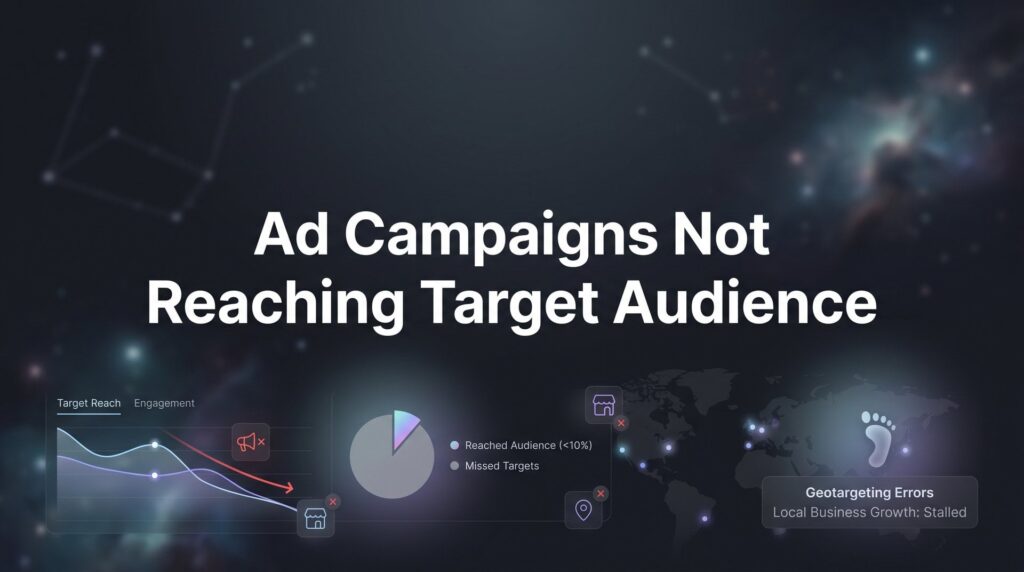
Here’s what most local businesses don’t realize: this problem has nothing to do with the quality of your product or service. Your business isn’t the issue. The problem is that your ads are being shown to the wrong eyeballs, and every impression wasted on someone who will never become a customer is money you’ll never get back. The good news? Once you understand why your ad campaigns are not reaching your target audience, the fixes are straightforward and the results can be dramatic.
The Hidden Culprits Behind Missed Audiences
The first mistake happens before your ad ever goes live: you cast too wide a net. It sounds counterintuitive because more reach feels like it should mean more customers, but that’s exactly how budgets evaporate without producing results.
Geographic targeting is where many local businesses bleed money. You set your location radius to 25 miles because you want to capture everyone in the area, but half that radius includes towns where nobody knows your business exists and wouldn’t drive to you anyway. Or you target “United States” because the platform suggests it, and suddenly you’re paying for clicks from people three states away who will never walk through your door.
Demographic settings create another layer of waste. Platforms like Facebook default to showing your ads to everyone 18-65+ unless you actively restrict it. If you sell premium services that appeal to established professionals aged 35-55, why are you paying to reach college students and retirees? Each irrelevant impression chips away at your budget without moving the needle.
Interest-based targeting sounds sophisticated until you realize how broad these categories actually are. Someone who liked a page about “home improvement” five years ago gets lumped into that interest category forever, even if they’re now renting an apartment and have zero plans to renovate. The platform sees a match and serves your ad, but the person seeing it couldn’t be less interested in what you’re offering.
Then there’s the algorithm problem. Google and Facebook use machine learning to optimize your campaigns, but they optimize toward the wrong signals if you don’t set them up correctly. If your conversion tracking isn’t configured properly, the algorithm might optimize for clicks instead of actual customers. It learns to find people who click on things, not people who buy things. You get lots of activity and zero revenue.
Audience fatigue accelerates this problem, especially in smaller markets. When your targeting is too narrow or your budget too aggressive for your market size, the same people see your ads over and over. They develop ad blindness. They scroll past without even registering what you’re selling. Your frequency metric climbs while your performance tanks, and you’re paying more to reach people who are actively tuning you out.
Diagnosing Your Targeting Problem: A Quick Audit
The data already knows your targeting is broken. You just need to look at the right reports to see it screaming at you.
Start with your audience breakdown by demographics. In Google Ads, check the “Demographics” tab under any campaign. In Facebook Ads Manager, look at “Breakdown” options for age, gender, and location. What you’re looking for is the gap between who’s seeing your ads and who’s actually converting.
Let’s say you run a financial planning service targeting business owners. You check your age breakdown and discover that 60% of your ad spend is going to the 18-24 age range, but 90% of your actual leads come from people 45-64. That’s not a creative problem or an offer problem. That’s a targeting problem draining your budget on people who aren’t in your market.
Click-through rate by segment reveals another critical insight. If one demographic group has a 0.5% CTR while another has a 3.2% CTR, the platform is showing your ads to people who don’t care. High impressions with low engagement means you’re paying for visibility among the wrong crowd.
The most telling metric is cost per acquisition by audience segment. Pull a report that shows how much you’re spending to acquire a customer from different age groups, locations, or interest categories. You might discover you’re spending $200 to acquire a customer from one segment and $45 from another. That $200 segment is killing your overall performance, and you’re funding it with budget that could be scaling the $45 segment.
Geographic performance data often reveals shocking waste. A local service business might find they’re spending 30% of their budget on clicks from a neighboring city where they don’t even operate, simply because the location targeting wasn’t configured with enough precision. Or they’re paying for mobile clicks from people passing through their area on the highway who will never return.
Look at your conversion rate by traffic source and placement. Are your ads converting at 8% on Google Search but 0.5% on the Display Network? That’s the platform spending your money on cheap, low-intent placements instead of high-intent search traffic. Are Facebook feed ads converting while Stories ads produce nothing? The placement settings are working against you.
Platform-Specific Targeting Mistakes That Drain Budgets
Google Ads and Facebook operate on completely different targeting logic, and the mistakes that kill performance on each platform are equally different.
On Google Ads, keyword match types are where most local businesses destroy their own campaigns. You bid on “plumber near me” thinking you’ll capture high-intent searches, but you used Broad Match, so Google is also showing your ads for “plumber salary,” “plumber school,” and “plumber memes.” None of those searchers want to hire you, but you’re paying for every click.
The lack of a proper negative keyword list compounds this. Without systematically excluding irrelevant searches, your campaign bleeds budget on informational queries, job searches, DIY tutorials, and competitor research. Someone searching “how to fix a leaky faucet yourself” doesn’t need your plumbing service, but if you haven’t added “how to,” “DIY,” and “yourself” as negative keywords, you’re paying to show up for that search.
Location targeting in Google Ads has a hidden default that catches businesses off guard. The “People in or regularly in your targeted locations” setting sounds reasonable until you realize “regularly in” means someone who commutes through your area might see your ads even though they live 40 miles away and would never use your local service. Switch to “People in your targeted locations” for most local businesses.
On Facebook and Instagram, interest targeting creates an illusion of precision that rarely delivers. You stack interests thinking you’re narrowing to your perfect customer—”Small Business Owners” AND “Marketing” AND “Entrepreneurship”—but Facebook’s interest categories are notoriously unreliable. Someone who liked an entrepreneurship meme page three years ago gets categorized as interested in entrepreneurship forever, even if they’re now working a 9-to-5 job.
Lookalike audiences sound like a targeting silver bullet, but the quality depends entirely on your source audience. If you create a lookalike based on your website visitors, but 70% of your website traffic is junk (people who bounced in three seconds, accidental clicks, bot traffic), Facebook builds a lookalike audience of more junk traffic. You need to build lookalikes from your customer list or high-value converters, not from all website visitors.
Placement settings on Meta platforms default to “Automatic Placements,” which means Facebook will show your ads wherever it can get the cheapest impressions. This often means your budget gets dumped into low-performing placements like Audience Network (random apps and websites) or Instagram Stories when your actual customers are on Facebook Feed. Manual placement selection gives you control over where your money goes.
Building an Audience That Actually Converts
The businesses that win with paid advertising don’t target based on assumptions. They target based on data about who actually buys from them.
Start by analyzing your existing customer base. Pull your customer records from the last 12 months and look for patterns. What age range dominates? What geographic areas produce the most revenue? What industries or job titles show up repeatedly if you’re B2B? This isn’t about creating a fictional persona with a name and a backstory. This is about identifying the actual characteristics of people who hand you money.
One local HVAC company discovered through this analysis that 80% of their revenue came from homeowners aged 45-65 in specific zip codes with median home values above $400,000. They had been targeting everyone within 20 miles aged 25-65. When they tightened their targeting to match their actual customer profile, their cost per lead dropped by 60% because they stopped paying for clicks from apartment renters and younger homeowners who were just price shopping.
Layer your audience targeting strategies without strangling your reach. The goal isn’t to create the narrowest possible audience. It’s to exclude the people who demonstrably don’t convert while keeping your audience large enough for the algorithm to optimize effectively. On Facebook, aim for an audience size of at least 50,000-100,000 for most local campaigns. On Google, make sure you’re not restricting yourself so much that you can’t spend your budget.
First-party data is your most powerful targeting asset. Upload your customer email list to both Google and Facebook to create custom audiences. These platforms can match your customer emails to user accounts and show ads specifically to people who have already bought from you (for retention campaigns) or create lookalike audiences of people who share characteristics with your buyers.
Website visitor audiences should be segmented by behavior, not treated as one blob. Create separate audiences for people who visited your pricing page, people who spent more than two minutes on your site, people who viewed multiple pages, and people who abandoned a form. These segments have different levels of intent and should be targeted with different messages and budgets.
For local businesses, radius targeting needs precision. Don’t just draw a circle on a map. Look at drive time, not distance. Someone 15 miles away in heavy traffic might be less likely to use your service than someone 25 miles away with a straight highway shot. Use actual town and zip code targeting when possible instead of radius targeting to avoid spillover into areas that don’t convert.
Testing and Refining Your Way to the Right Audience
Finding your perfect audience isn’t a one-time setup. It’s an ongoing process of testing, measuring, and eliminating what doesn’t work.
Set up proper A/B tests for audience segments, not just ad creative. Most businesses test different images or headlines, but they show those variations to the same poorly-targeted audience. Instead, test the same ad against different audience segments. Run your offer to a broad 25-mile radius versus a tight 10-mile radius. Target 25-45 year-olds versus 45-65 year-olds. See which segment produces better results at lower cost.
The iterative exclusion method is how you systematically remove waste. Start with reasonably broad targeting, let the campaign run for a week or two, then analyze performance by segment. Identify the demographics, locations, or placements producing zero conversions or abnormally high costs. Exclude them. Wait another week, analyze again, exclude more waste. Repeat until you’ve carved away everything that doesn’t work.
This approach works because you’re making decisions based on actual performance data rather than guesses. You might assume your service appeals to younger demographics, but the data might reveal that everyone under 35 clicks but never converts. Exclude them and redirect that budget to the segments that actually produce customers.
Know when to scale winning audiences versus when to refresh. If you’ve found an audience segment that converts at $50 per customer and you’re currently spending $500 per day on it, scaling to $1,000 per day might drop your efficiency because you’re reaching beyond the core high-intent group. The platform starts showing your ads to more marginal prospects to spend the increased budget. Test scaling gradually—increase by 20-30% and watch what happens to your cost per acquisition.
Audience refresh becomes necessary when performance degrades over time despite no changes to your campaign. This happens because you’ve saturated your audience—everyone in that segment has now seen your ad multiple times, and you’re hitting diminishing returns. When this happens, either expand your targeting to reach new people or create new creative to re-engage the existing audience with a fresh message.
Platform learning periods matter more than most businesses realize. When you make significant changes to targeting, the algorithm needs time to relearn and optimize. Give any major targeting change at least 7-14 days before judging results. Making daily tweaks prevents the algorithm from ever stabilizing and finding the right people within your new parameters.
Turning Targeting Fixes Into Sustainable Growth
Fixing your targeting once isn’t enough. Campaigns drift over time, and what worked last quarter might be bleeding money this quarter if you’re not paying attention.
Create a targeting review cadence that prevents drift. Every two weeks, check your audience performance reports. Look for segments that have started underperforming. Look for new negative keywords that need to be added based on recent search terms. Look for geographic areas where costs have increased without a corresponding increase in conversions. This 30-minute review catches problems before they drain thousands of dollars.
Align your ad messaging with your refined audience segments. Once you know exactly who you’re targeting, your ads should speak directly to their specific situation. If your data shows that homeowners aged 50-65 in affluent zip codes are your sweet spot, your ad copy should address their concerns and desires, not speak in generic terms that try to appeal to everyone. Relevance scores improve when your targeting and messaging are perfectly matched.
Seasonal adjustments matter for local businesses. A landscaping company might find that their target audience shifts throughout the year—spring cleanup appeals to a different demographic than fall leaf removal or winter snow plowing. Your targeting should flex with these seasonal changes rather than running the same settings year-round.
There comes a point where professional PPC management makes sense for ongoing optimization. If you’re spending $3,000+ per month on ads, the cost of management is justified by the waste it prevents and the performance improvements it delivers. An experienced PPC manager catches targeting drift before it costs you money, implements sophisticated testing strategies you don’t have time for, and stays current on platform changes that affect targeting effectiveness.
The businesses that win with paid advertising long-term treat targeting as a core competency, not a set-it-and-forget-it task. They understand that reaching the right audience is more valuable than reaching a large audience, and they’re willing to invest the time and expertise required to keep their targeting sharp.
Putting It All Together
Your ad campaigns are not reaching your target audience because the platforms are designed to spend your budget, not to find your customers. That’s your job, and it requires active management, constant refinement, and a willingness to exclude the majority of people to focus your budget on the minority who actually matter.
The diagnostic steps are straightforward: analyze who’s currently seeing your ads versus who’s actually converting, identify the segments draining your budget without producing results, and systematically exclude the waste. The fixes are equally clear: tighten your geographic targeting to match where your real customers live, align your demographic settings with your actual buyer profile, build audiences from first-party data instead of platform interest categories, and test different segments against each other to find what works.
This isn’t about spending more money on advertising. Most businesses would see better results spending half their current budget on the right audience than spending their full budget on everyone. It’s about precision, not reach.
The difference between ad campaigns that waste money and ad campaigns that generate profitable growth comes down to targeting discipline. Every dollar you spend showing your ad to someone who will never buy is a dollar you can’t spend reaching someone who will. When you fix your targeting, everything else gets easier—your creative performs better because it’s reaching people who care, your landing pages convert higher because the traffic is qualified, and your cost per customer drops because you’re not funding dead-end clicks anymore.
Tired of spending money on marketing that doesn’t produce real revenue? We build lead systems that turn traffic into qualified leads and measurable sales growth. If you want to see what this would look like for your business, we’ll walk you through how it works and break down what’s realistic in your market.