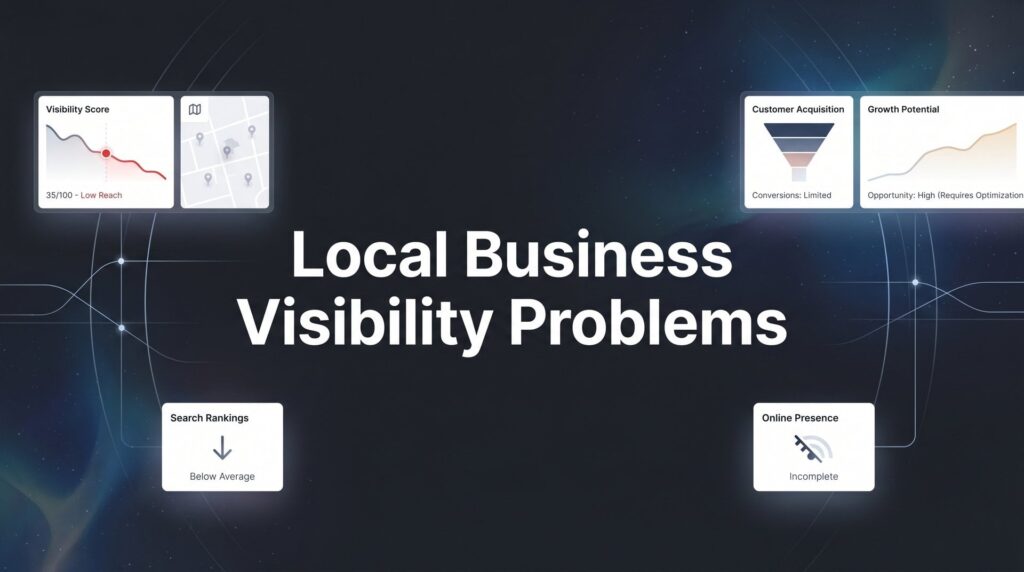
You run a great business. Your customers love you, your work speaks for itself, and you’ve built something worth being proud of. But somehow, a competitor down the street with half your skill and a fraction of your reputation keeps showing up first when people search for what you offer. They’re getting the calls. They’re booking the appointments. And you’re left wondering what they know that you don’t.
The answer almost always comes down to visibility. Not quality, not pricing, not even reputation. Visibility.
Here’s the hard truth: it doesn’t matter how good your business is if potential customers can’t find you at the moment they’re actively looking for your service. A person searching “emergency tire repair near me” or “dermatologist accepting new patients” isn’t browsing casually. They’re ready to act. If you’re not showing up in that moment, you don’t lose to a competitor. You simply don’t exist to that customer.
What makes local business visibility problems particularly frustrating is that they rarely stem from a single mistake. More often, they’re a cluster of digital blind spots that quietly compound over time. A slightly outdated Google Business Profile here. An inconsistent address listing on a directory there. A website that loads slowly on mobile. None of these feels catastrophic on its own, but together they push you further down the rankings while your competitors climb.
This article is designed to work as a diagnostic guide. By the time you finish reading, you’ll have a clear picture of what’s likely holding your business back, why it’s costing you real revenue, and what you can actually do to fix it. Let’s start at the foundation.
The Invisible Storefront: What Local Visibility Actually Means in 2026
Local visibility isn’t just about having a website. It’s about appearing where your potential customers are actively searching, at the exact moment they need what you offer. That means Google Search results, Google Maps, the Local Pack (the three businesses that appear in a map box at the top of local search results), social media discovery, and industry-specific directories.
The way people find local businesses has shifted dramatically over the past decade. Word-of-mouth still matters, and foot traffic hasn’t disappeared entirely. But the majority of local purchase decisions now begin with an online search. Someone needs a pediatric dentist, a transmission repair shop, or an urgent care clinic. Their first move is to pick up their phone and search. What they find in the next thirty seconds shapes everything that follows.
The Local Pack is where this battle is most intense. When someone searches “auto detailing near me” or “urgent care open now,” Google typically shows three businesses prominently before any organic website results. Those three spots capture the vast majority of clicks. Businesses outside those positions are, for practical purposes, invisible to a large portion of searchers. Competing for those spots is not optional if you want consistent customer acquisition for your small business.
This is where many business owners misunderstand the problem. They assume that because they have a website, they have visibility. But having a website and being visible are two very different things. A website that isn’t optimized for local keywords, doesn’t load well on mobile, and isn’t connected to a complete Google Business Profile might as well not exist from a search engine’s perspective.
Visibility problems also include factors most business owners have never heard of: NAP consistency (the alignment of your Name, Address, and Phone number across every online listing), local authority signals like backlinks from community organizations, and structured data markup that helps search engines understand and categorize your business. Understanding the difference between local SEO vs PPC for lead generation is also critical for deciding where to invest your efforts first. These aren’t technical luxuries. They’re foundational signals that determine whether Google trusts your business enough to show it to searchers.
Understanding visibility as a multi-channel, multi-signal ecosystem is the first step toward fixing it. Once you see the full picture, the path forward becomes much clearer.
Five Root Causes That Keep Local Businesses Hidden
Most local businesses struggling with visibility share a predictable set of problems. These aren’t exotic or obscure. They’re common, fixable, and more impactful than most owners realize.
An unclaimed or poorly optimized Google Business Profile: This is the single most common visibility killer. Your Google Business Profile is what powers your appearance in Google Maps and the Local Pack. If it’s unclaimed, incomplete, or stale, you’re handing those prime positions to competitors. Missing business categories, no photos, outdated hours, zero reviews, and an empty description are all signals to Google that your business isn’t worth surfacing. A fully optimized profile, by contrast, tells Google exactly who you are, what you offer, and why searchers should trust you.
Website performance and mobile experience: If your website loads slowly on a mobile device, Google notices. The majority of local searches happen on smartphones, and Google’s ranking algorithm heavily weighs mobile performance. Beyond speed, many local business websites lack location-specific content. A plumber in Pittsburgh whose website never mentions Pittsburgh, the neighborhoods they serve, or the specific services they offer in that market is leaving enormous ranking potential on the table. Structured data markup, which is code that helps search engines understand your business type, location, and services, is another commonly missing element that can meaningfully impact how and where you rank.
NAP inconsistencies across directories: Your business name, address, and phone number need to match exactly across every platform where you’re listed: Yelp, the Better Business Bureau, industry-specific directories, local chamber of commerce websites, and anywhere else your business appears online. Even small discrepancies, like “St.” versus “Street” or an old phone number that was never updated, create confusion for search engines. When Google can’t confidently verify your location and contact information, it’s less likely to rank you prominently in local results. If your local business is struggling to grow, inconsistent directory listings are one of the first things to investigate.
A weak or nonexistent review presence: Reviews are both a trust signal for potential customers and a ranking factor for Google. A business with no recent reviews, or worse, no reviews at all, looks dormant regardless of how active it actually is. Review recency matters too. A handful of reviews from two years ago carries far less weight than a steady stream of fresh feedback. Many businesses lose visibility simply because they’ve never built a systematic process for asking satisfied customers to leave a review.
No local content strategy: Search engines reward businesses that consistently publish relevant, location-specific content. Blog posts answering common local questions, service pages targeting specific neighborhoods, and FAQ content that addresses what your customers are actually searching are all signals of authority and relevance. Businesses that treat their website as a static digital brochure miss the opportunity to build the kind of content presence that earns higher rankings over time.
The Ripple Effect: How Visibility Problems Drain Revenue
Here’s what makes local business visibility problems particularly damaging: they compound. Every day you’re not visible, a competitor is capturing those high-intent searches. They’re building review momentum, accumulating clicks, and earning the kind of local authority that makes them progressively harder to displace. The gap doesn’t stay the same size. It grows.
Think about what an invisible local business actually loses in concrete terms. Missed phone calls from people who needed your service and called the first business they found. Appointment bookings that went to a competitor’s online scheduler because yours wasn’t showing up. Service slots sitting empty while your staff is available and ready. These aren’t abstract losses. They’re real revenue that left your business and went somewhere else. Understanding how to generate more qualified leads online starts with recognizing just how much opportunity slips through the cracks when visibility is broken.
The emotional toll matters too. Many business owners who struggle with visibility eventually conclude that “marketing doesn’t work for my type of business.” That’s rarely true. What’s actually happening is that their marketing foundation has gaps that prevent any strategy from performing well. Running ads to a website that doesn’t convert, or optimizing content for a Google Business Profile that’s incomplete, produces frustrating results not because marketing doesn’t work, but because the foundational visibility problems haven’t been addressed. This is one of the most common forms of wasted marketing spend in small business.
Different industries experience these losses in distinct ways. Consider a tire shop. A significant portion of their business comes from emergency searches: someone who just got a flat tire or noticed unusual wear before a long drive. Those searches are immediate, high-intent, and highly local. If the tire shop isn’t showing up in the Local Pack for those searches, that customer calls whoever does appear. The tire shop doesn’t get a second chance.
A dermatology practice faces a different version of the same problem. Patients searching “dermatologist near me accepting new patients” are often in the early stages of a decision that could become a long-term patient relationship. If that practice doesn’t appear prominently in local results, it misses not just one appointment but potentially years of recurring visits and referrals.
An urgent care facility has perhaps the highest stakes of all. Patients searching during peak illness hours need immediate answers. If the facility’s Google Business Profile shows incorrect hours, or if it doesn’t appear in Maps results for the surrounding neighborhoods, patients go elsewhere. And because urgent care decisions are often made once in a moment of need, there’s rarely an opportunity to recapture that patient later.
Visibility problems, in every case, translate directly into lost revenue that compounds silently over time.
DIY Diagnosis: How to Audit Your Own Local Visibility
Before investing in any solution, it helps to understand exactly where your visibility stands right now. A basic self-audit takes less than an hour and can reveal a surprising amount about what’s working and what isn’t.
Start with the simplest test: search your own business name in Google. Does your Google Business Profile appear on the right side of the results? Is the information accurate? Are your hours current, your photos present, and your reviews visible? Then search your primary service plus your city: “HVAC repair [city name]” or “family dentist [city name].” Where do you appear? Are you in the Local Pack? On the first page of organic results? If you’re scrolling past the first page to find yourself, that’s a significant problem.
Next, open your Google Business Profile and look at the completeness indicators. Are all your service categories filled in? Have you added a business description? Do you have at least ten recent photos? Is your website link current and working? Each incomplete element is a missed opportunity to strengthen your ranking signals. Learning how to track marketing conversions can also help you understand which visibility improvements are actually driving results.
Google Business Profile Insights is a free tool that shows you how many people are finding your listing, what search queries triggered it, and what actions they took (called, visited your website, asked for directions). If your impressions are low, your profile isn’t appearing for enough searches. If impressions are decent but clicks are low, your profile may not be compelling enough to earn engagement.
Google Search Console, which requires you to verify ownership of your website, shows which keywords your site is ranking for and how often it appears in search results. Look for gaps: are you appearing for your business name but not for your core service keywords? Are you ranking on page two or three for important terms? Implementing call tracking for local businesses adds another layer of insight by revealing which search channels are actually generating phone calls.
Check your top three directory listings: Yelp, the Better Business Bureau, and any industry-specific directories relevant to your business. Search your business name and compare the address, phone number, and business name spelling to what appears on your website and Google Business Profile. Any discrepancy, however small, is worth correcting.
Red flags to watch for: No reviews posted in the last 90 days. Your website doesn’t appear on the first three pages for your primary service keyword plus city. Competitors consistently appear in the Local Pack while you’re absent. Your website takes more than three seconds to load on a mobile device. These are clear indicators that your visibility foundation needs work.
Proven Fixes: Strategies That Actually Move the Needle
Once you know where your visibility gaps are, the path forward becomes more concrete. These strategies aren’t theoretical. They’re the practical moves that consistently improve local visibility for businesses willing to invest the time and resources.
SEO foundations that local businesses can’t skip: Start with your website’s title tags and meta descriptions. Every page should include your primary service and location in a natural, readable way. If you serve multiple neighborhoods or cities, create dedicated service area pages for each location rather than cramming everything onto one generic page. These location-specific pages give search engines clear geographic signals and give you more opportunities to rank for area-specific searches. For a deeper look at the full range of tactics available, explore these local business digital marketing services that drive measurable growth.
Local backlinks are another foundational element that many businesses overlook. A link from your local chamber of commerce, a community organization you sponsor, or a local news outlet mentioning your business carries genuine authority with search engines. These links signal that your business is a legitimate, established part of the local community, which is exactly what Google wants to verify before ranking you prominently.
Schema markup, the structured data code added to your website, helps search engines understand your business type, hours, location, and services without ambiguity. A local business schema implementation is not a complex technical project, but it’s one that many websites are missing entirely.
Paid visibility as an accelerator: Organic search visibility takes time to build. If your business needs leads now, Google Ads provides immediate visibility for high-intent local searches. A well-structured local PPC advertising strategy targeting service-plus-location keywords can start generating calls and inquiries while your organic rankings develop. Beyond generating leads, paid search data is genuinely useful as a diagnostic tool. The keywords that drive calls and conversions in your ad campaigns are the same terms you should prioritize in your organic SEO strategy.
This is where working with a Google Premier Partner agency like Clicks Geek makes a measurable difference. Premier Partner status reflects a higher standard of campaign management and access to Google resources that most agencies don’t have. For local businesses, that translates to more efficient ad spend and better targeting precision.
Conversion-focused web design as the final piece: Here’s a visibility mistake that even businesses with strong rankings make: they achieve page one visibility, drive traffic to their website, and then lose those visitors because the site doesn’t convert. Ranking on page one means nothing if your website buries the phone number, doesn’t have a clear call to action, loads slowly, or looks untrustworthy on a mobile screen. Knowing how to improve marketing performance means ensuring that the visibility you’ve earned actually translates into calls, form fills, and booked appointments. It’s the often-overlooked bridge between traffic and revenue.
From Invisible to Unmissable: Your Action Plan
Solving local business visibility problems isn’t about finding one magic fix. It’s about addressing the right issues in the right order and then maintaining that foundation consistently over time.
Start with the foundations: claim and fully optimize your Google Business Profile, correct any NAP inconsistencies across your directory listings, and build a systematic process for generating fresh customer reviews. These moves cost very little and can produce meaningful ranking improvements relatively quickly.
Then build: optimize your website for local keywords, create location-specific service pages, implement local schema markup, and begin earning local backlinks from community sources. This layer takes more time to produce results, but it builds the kind of durable authority that compounds over months and years.
Finally, accelerate: use Google Ads to capture high-intent local searches immediately while your organic presence grows, and apply conversion rate optimization principles to ensure your website turns visitors into actual customers.
The businesses that dominate their local markets aren’t necessarily the best at what they do. They’re the ones that have invested consistently in visibility and conversion, treating digital presence as an ongoing competitive advantage rather than a one-time setup task.
If you’ve read this far and recognized your business in these problems, the next step is getting a clear picture of exactly where you stand and what it would take to fix it. If you want to see what this would look like for your specific market, the team at Clicks Geek will walk you through how it works and break down what’s realistic for your business. No generic advice. Just a direct look at what’s holding you back and what a real solution would involve.