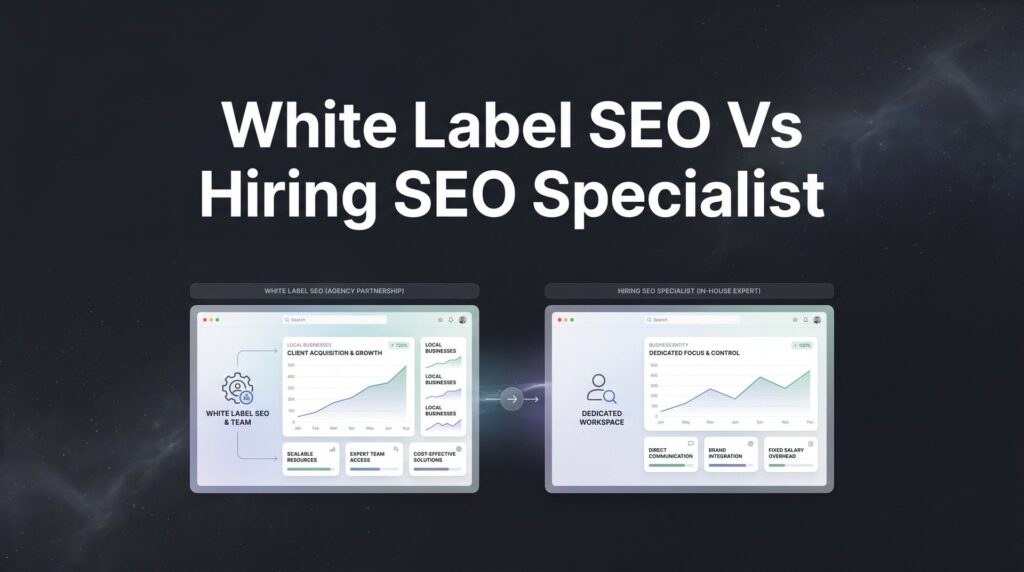
If you run a digital marketing agency or a growing local business, you’ve likely hit the same crossroads: should you outsource SEO through a white label partner, or hire a dedicated SEO specialist in-house? It’s not a trivial decision. The wrong choice can drain your budget, slow your growth, and leave your clients (or your own business) with lackluster results.
The right choice can unlock scalable revenue, sharper expertise, and a competitive edge that compounds over time.
This guide breaks down 7 battle-tested strategies for making this decision with confidence. We won’t give you vague pros-and-cons lists. Instead, each strategy gives you a concrete framework to evaluate your specific situation, whether you’re a solo agency owner looking to expand your service offerings or a local business owner deciding how to invest in organic growth.
By the end, you’ll know exactly which model fits your budget, your growth trajectory, and your operational capacity—so you can stop second-guessing and start executing.
1. Audit Your Current Capacity Before Committing to Either Model
The Challenge It Solves
Most agency owners and business leaders skip this step entirely. They jump straight into pricing comparisons or vendor demos without first asking the most important question: what does our operation actually need right now? Without a clear picture of your current workload, skill gaps, and bandwidth, you’re essentially choosing between two solutions before you’ve fully defined the problem.
The Strategy Explained
A capacity audit is a structured review of three things: what SEO work currently exists or is coming in, who on your team can handle it, and where the gaps are. Start by listing every active client or project that requires SEO support. Then map the specific tasks involved, whether that’s technical audits, content strategy, link building, local citation management, or reporting.
Next, honestly assess your team’s current skill level and available hours. Are you already stretched thin? Do you have someone with partial SEO knowledge who could grow into the role with support? Or is SEO completely absent from your team’s capabilities? The answers to these questions will tell you whether you need the deep, consistent expertise of a full-time hire or the flexible, scalable output of a white label partner.
Implementation Steps
1. List every current and anticipated SEO deliverable across all clients or projects for the next 90 days.
2. Map each deliverable to a team member and estimate the hours required. Flag anything that falls outside your team’s current skill set.
3. Calculate your total monthly SEO capacity gap in hours and identify whether the gap is consistent or project-based.
4. Determine whether the gap is primarily a skills problem, a bandwidth problem, or both—this distinction will guide your model choice.
Pro Tips
Be brutally honest during this audit. Agency owners often overestimate their team’s SEO capabilities because the work looks similar to other marketing tasks on the surface. SEO is a discipline with significant depth. If your audit reveals consistent, high-volume gaps with predictable scope, that points toward white label. If it reveals a need for deep strategic ownership on complex accounts, an in-house hire deserves serious consideration.
2. Run the Real Cost Comparison (Beyond Just Salary vs. Retainer)
The Challenge It Solves
The most common mistake in this decision is comparing an in-house salary to a white label retainer and calling it a day. That comparison is incomplete and often misleading. The true cost of each model is significantly higher than the headline number, and failing to account for hidden costs can make the wrong choice look attractive on paper.
The Strategy Explained
Building a total-cost-of-ownership model means accounting for every dollar associated with each option. For an in-house SEO specialist, that means salary, yes, but also employer payroll taxes, health benefits, paid time off, recruitment costs, onboarding time, SEO tools and software subscriptions, ongoing training, and the management overhead required to keep that person productive and aligned. Industry experience suggests that when you add these up, the true annual cost of a mid-level SEO hire in the US frequently exceeds the base salary figure by a meaningful margin.
For white label SEO, the cost calculation includes the monthly retainer, any markup you’re applying to pass costs to clients, and the time your team spends on communication, quality review, and client reporting. The key advantage here is that white label costs are largely variable. You pay for what you use, and you can scale up or down as your client base shifts. Comparing best white label SEO providers side by side can help you benchmark realistic retainer costs for your market.
Implementation Steps
1. Build an in-house cost model: start with target salary for your market, then add 20-30% for benefits and taxes, plus tool costs, recruitment fees (typically one to two months’ salary for a recruiter), and an estimate of management time at your hourly rate.
2. Build a white label cost model: list your current or projected monthly retainer costs per client, add internal review time, and calculate your effective margin after markup.
3. Run both models at three revenue scenarios: your current client volume, 1.5x growth, and 2x growth. See where each model breaks even and where it becomes more or less efficient.
4. Factor in opportunity cost. The time spent recruiting, onboarding, and managing an in-house hire is time not spent on business development or client strategy.
Pro Tips
Don’t forget the ramp-up period. A new in-house SEO hire typically takes several months to become fully productive. During that window, you’re paying full cost for partial output. White label partners, particularly established ones with proven processes, can often deliver from day one. That time-to-value gap matters more than most people realize when cash flow is tight.
3. Match the Model to Your Client Mix and Service Complexity
The Challenge It Solves
Not all SEO work is created equal. A local plumber needing Google Business Profile optimization and local citation building has very different requirements than an e-commerce brand running a 10,000-page site with international SEO considerations. Treating all SEO clients the same and applying a single fulfillment model across the board is a recipe for either overpaying or underdelivering.
The Strategy Explained
The smartest agencies segment their client base by SEO complexity and assign fulfillment accordingly. Think of it as a two-tier system. Tier one includes standard local SEO clients with predictable, repeatable deliverables: local keyword targeting, citation management, Google Business Profile optimization, and basic content. These clients are ideal candidates for white label fulfillment because the work is well-defined, scalable, and doesn’t require deep strategic customization.
Tier two includes high-value, complex accounts that require custom strategy, technical depth, and close client collaboration. These might be regional service businesses with competitive markets, multi-location brands, or clients in industries with nuanced compliance considerations. For these accounts, in-house expertise or a hybrid model where your team leads strategy and white label supports execution often produces better outcomes. For example, managing a campaign like SEO for general contractors in a competitive metro area may demand the hands-on strategic depth that only an in-house specialist can provide.
Implementation Steps
1. Categorize your current clients by SEO complexity using a simple scoring system: low, medium, and high. Consider factors like site size, competition level, technical requirements, and how much custom strategy the account demands.
2. Identify which tier represents the majority of your current revenue and which tier you’re targeting for growth.
3. Design a fulfillment model for each tier. Standardized white label processes for tier one, hybrid or in-house for tier two.
4. Build service packages that reflect this segmentation so your pricing and delivery align with the actual complexity of each client relationship.
Pro Tips
Many agencies discover that the majority of their clients fall into the tier one category, which makes a strong case for white label SEO as the primary fulfillment model. The revenue from these accounts, managed efficiently through a reliable white label partner, can fund the in-house expertise needed for tier two growth over time. Start where the volume is, then build up.
4. Stress-Test Quality Control and Brand Consistency
The Challenge It Solves
Whether you outsource to a white label provider or hire in-house, your clients hold you accountable for results. If the work is subpar, your reputation takes the hit, not your vendor’s and not your employee’s in the eyes of the client. Quality control is often the deciding factor that gets overlooked in the excitement of scaling, and it’s the one that can cause the most damage when it fails.
The Strategy Explained
Before you choose a fulfillment model, build your quality assurance framework first. Define what good SEO looks like for your business: which KPIs matter, what deliverable standards you expect, how client reporting should be structured, and what the escalation process looks like when something goes wrong. This framework becomes your benchmark against which both models are evaluated.
For white label partners, quality control means vetting their processes, reviewing sample deliverables, understanding their reporting cadence, and establishing clear communication protocols. For in-house hires, it means defining performance standards, building review processes into your workflow, and ensuring the person’s work is regularly audited against results. Whether you’re fulfilling SEO for real estate agents or any other niche, the discipline required is different, but the need for a quality framework is identical in both cases.
Implementation Steps
1. Define your non-negotiable quality standards: minimum deliverable requirements, reporting format, response time expectations, and how results are measured.
2. Create a QA checklist for monthly review of SEO work, regardless of who produces it. This should cover technical health, content quality, link profile, and ranking movement.
3. For white label evaluation, request sample reports and deliverables from any prospective partner. Run them through your QA checklist before signing anything.
4. Establish a review cadence. Monthly QA reviews at minimum, with quarterly deeper audits to catch drift before it becomes a client issue.
Pro Tips
The agencies that struggle most with white label quality are usually the ones who handed off the work and walked away. White label works best when your team stays engaged as strategic overseers. You don’t need to do the work, but you do need to review it, ask questions, and hold the partner accountable to the standards you’ve defined. Treat your white label partner like a high-performing contractor, not a black box.
5. Evaluate Scalability Against Your 12-Month Growth Plan
The Challenge It Solves
The model that works for your business today may not be the right one for the business you’re building. Growth creates pressure on every operational system, and SEO fulfillment is no exception. Choosing a model without stress-testing it against your actual growth trajectory is a short-term decision dressed up as a long-term strategy.
The Strategy Explained
Map your 12-month growth plan in concrete terms. How many new clients do you expect to add? What’s your target revenue increase? Will you be entering new service verticals or geographic markets? Once you have those targets, ask a simple but revealing question: can your chosen fulfillment model handle that volume without breaking?
White label SEO scales horizontally with relative ease. Adding five new local SEO clients to a white label arrangement typically means adjusting your retainer scope, not hiring new staff or restructuring your team. For instance, onboarding a batch of niche clients—like campaigns for pest control companies—is straightforward when your white label partner already has repeatable processes in place. In-house scaling is more vertical and more expensive. Each significant increase in workload eventually requires another hire, which means more recruitment, more onboarding, and more management overhead.
That said, in-house expertise scales in a different way. A strong SEO specialist can develop proprietary processes, train junior team members, and build institutional knowledge that compounds in value over time. The scalability question isn’t just about volume, it’s about what kind of growth you’re chasing.
Implementation Steps
1. Write out your 12-month growth targets with specific numbers: new clients, revenue, and service expansion goals.
2. Calculate the SEO workload each growth scenario creates in terms of hours, deliverables, and complexity.
3. Model how each fulfillment option handles that workload. At what point does white label become more cost-effective than hiring? At what point does in-house become more efficient than expanding retainer costs?
4. Identify your break-even crossover point and use it as a planning milestone rather than a reactive trigger.
Pro Tips
Many growing agencies find that white label SEO is the right answer for the first phase of growth, typically up to a certain revenue threshold or client count, and then a hybrid model makes more sense as the business matures. Plan for that transition deliberately rather than letting it sneak up on you. Build your white label relationships now with partners who can grow with you, and start identifying the in-house hire profile you’ll eventually need.
6. Protect Your Competitive Advantage with the Right Knowledge Structure
The Challenge It Solves
Over-reliance on a single external provider or a single employee creates fragility. If your white label partner raises prices, changes their processes, or exits the market, your business feels it immediately. If your in-house SEO specialist leaves, they take critical knowledge and client context with them. Either scenario can destabilize your operations at the worst possible time.
The Strategy Explained
The solution isn’t to avoid commitment to either model. It’s to build a knowledge retention system that keeps strategic SEO oversight inside your business regardless of who does the execution. Think of it as separating strategy from delivery. Your business owns the strategy: the client goals, the competitive landscape analysis, the keyword priorities, the content roadmap. Your fulfillment partner or employee executes against that strategy.
This structure protects you in two ways. First, if your white label partner changes, you can transition to a new one without losing the strategic foundation you’ve built for each client. Second, if your in-house hire leaves, the institutional knowledge lives in your documented systems rather than in their head. Strategic oversight should always be an internal function, even when execution is outsourced. Understanding how to effectively use SEO for niche services at a strategic level ensures you can guide any provider toward the right outcomes.
Implementation Steps
1. Create a strategy document for each SEO client that captures goals, target keywords, competitive positioning, content priorities, and historical context. This lives in your systems, not your provider’s.
2. Establish internal ownership of client reporting and performance review, even if the underlying data comes from a white label partner.
3. Document your SEO processes and standards in a central knowledge base so they’re not locked inside any one person’s expertise.
4. Build at least one internal team member who understands SEO at a strategic level, even if they don’t execute it day-to-day. This person is your quality gatekeeper and your institutional anchor.
Pro Tips
This is the strategy most agencies skip because it feels like overhead. It isn’t. The agencies that build strong internal knowledge structures are the ones that can switch vendors without client disruption, negotiate better rates because they’re not dependent, and grow their own SEO capabilities over time. Your competitive advantage lives in your strategy, not in your vendor’s processes.
7. Use a Decision Matrix to Make the Final Call With Confidence
The Challenge It Solves
After working through the previous six strategies, you’ll have a lot of information. The risk at this stage is analysis paralysis: too many variables, too many trade-offs, and no clear winner. A decision matrix cuts through the noise by forcing you to quantify what matters most to your business and score each option objectively against those priorities.
The Strategy Explained
A weighted decision matrix assigns a numerical weight to each decision factor based on its importance to your business, then scores both options against each factor. The result is a total score that reflects not just how each option performs, but how it performs on the things that matter most to you specifically.
Common factors to include are cost efficiency, scalability, quality control, speed to value, strategic flexibility, and competitive differentiation. Your weights will differ based on your situation. An agency prioritizing rapid growth might weight scalability heavily. A business with tight margins might weight cost efficiency above everything else. A brand with premium positioning might weight quality control as the top factor.
The matrix doesn’t make the decision for you, but it does make your reasoning visible and structured. It also gives you something to revisit as your business evolves, because the right answer today may not be the right answer in 18 months.
Implementation Steps
1. List your five to seven most important decision factors for this choice.
2. Assign a weight to each factor so that all weights add up to 100. Higher weight means higher importance to your business.
3. Score both white label SEO and in-house hiring on each factor using a scale of one to ten.
4. Multiply each score by its weight and sum the totals. The higher total score indicates the stronger fit for your current situation.
5. Review the matrix with a trusted advisor or colleague to check for blind spots before committing.
Pro Tips
Run the matrix twice: once for your current situation and once for where you expect to be in 12 months. If the results flip between the two scenarios, you’re likely looking at a phased approach rather than a permanent choice. Start with the model that wins today, but plan the transition to the model that wins tomorrow. This kind of forward-looking thinking is what separates strategic operators from reactive ones.
Putting It All Together: Your Implementation Roadmap
Making the choice between white label SEO and hiring an SEO specialist isn’t about finding the universally better option. It’s about finding the right fit for where your business is right now and where you’re headed.
Start with Strategy 1: audit your capacity. Then run the real cost comparison. From there, the remaining strategies help you layer in the nuance that turns a good decision into a great one.
For many growing agencies and local businesses, the answer is often a hybrid approach. Leveraging white label SEO to scale quickly and maintain margins while strategically building in-house expertise for your highest-value accounts is a proven path that many successful agencies have taken. It’s not a compromise. It’s a smart sequencing of resources.
Whatever you decide, treat this as a strategic business decision, not a gut call. Use the decision matrix, revisit it regularly, and adjust as your business grows. The frameworks in this guide are designed to be reused as your situation evolves, not filed away after a single use.
One thing is clear regardless of which model you choose: the agencies and businesses that win in organic search are the ones that commit to a structured approach, hold their partners and employees accountable to defined standards, and keep strategic oversight firmly in-house.
Clicks Geek is a Google Premier Partner agency with deep experience in white label SEO, white label PPC, and white label Facebook ads, built specifically to help agencies scale their service offerings without the overhead of building everything from scratch. If you want to explore what a proven white label SEO partnership could look like for your business, if you want to see what this would look like, we’ll walk you through how it works and break down what’s realistic in your market.