When HVAC owners ask about Google Ads versus Local Service Ads, they usually frame it as a budget question. It isn’t. It’s a strategy question, and the answer depends on where your business is right now, what your close rate looks like, and whether you’ve cleared the verification hurdles LSAs require.
Both platforms live on Google. Both can generate phone calls. Both can burn money fast if set up wrong. The difference is in how they work, who they work best for, and what supporting infrastructure you need around each one to actually measure results.
This guide breaks down each platform, the tools HVAC operators need to run them properly, and how to think about sequencing if you’re deciding where to put your next dollar. If you want the short answer: most established HVAC companies should run both, but the split and order matter. Here’s how to think through it.
1. Clicks Geek
Best for: HVAC operators who want both Google Ads and LSAs managed under one team with active dispute handling included.
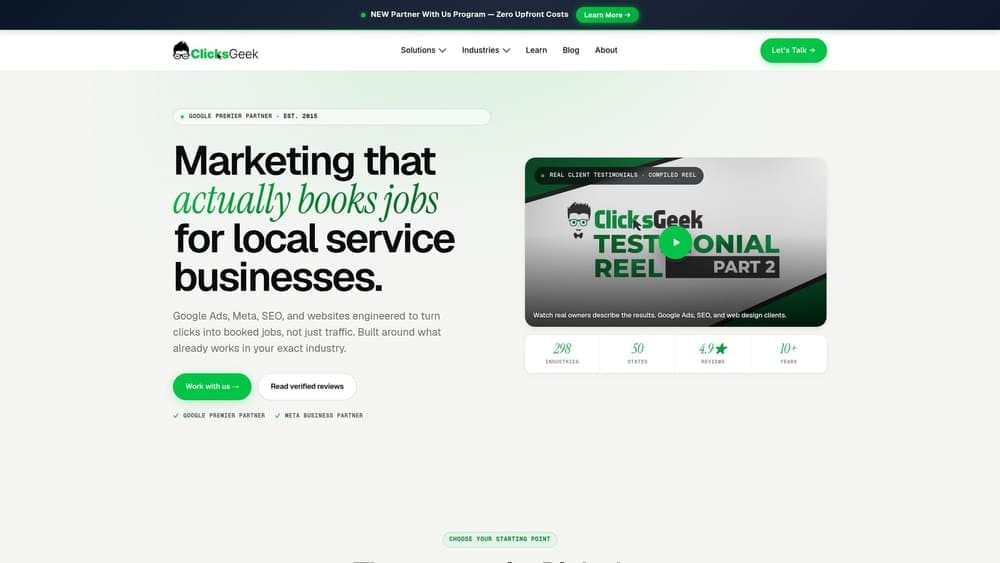
Clicks Geek is a Google Premier Partner agency that has managed HVAC paid search campaigns since 2015, with over $100M in total managed spend across 298 industry verticals.
Where This Tool Shines
HVAC is one of the most competitive local service categories in paid search, and the account structure decisions that work for a general contractor don’t translate directly to an HVAC operator managing emergency calls, seasonal demand swings, and high-ticket replacement jobs simultaneously. Clicks Geek builds campaigns from HVAC-specific playbooks, not generic templates.
The other practical advantage is dispute management. LSA disputes require active monitoring and submission within a 30-day window. Most agencies treat this as an add-on or ignore it entirely. Clicks Geek handles it as part of standard account management, which matters when you’re paying per lead and some of those leads are spam or wrong-service-area calls.
Key Features
HVAC-Specific Campaign Architecture: Campaigns built from 298 industry playbooks, not repurposed from adjacent verticals.
Google Ads and LSA Management Together: Both platforms handled under one account team, so budget decisions and attribution aren’t siloed.
Active LSA Dispute Management: Included in account management, not billed separately.
No Lock-In Contracts: Performance-based engagement model; you’re not locked into a 12-month commitment.
Google Premier Partner and Meta Business Partner: Verified credentials that come with access to Google support escalation paths most agencies don’t have.
Best For
HVAC companies doing enough volume to justify managed services, particularly those running or planning to run both Google Ads and LSAs who want unified attribution and active account management rather than a set-it-and-check-monthly approach.
Pricing
Custom based on scope and market. No lock-in contracts. Reach out directly at clicksgeek.com for a scope conversation.
2. Google Local Services Ads
Best for: HVAC operators who need fast trust signals for emergency service calls and want pay-per-lead billing rather than pay-per-click.
Google Local Services Ads is Google’s verified contractor platform that puts HVAC companies above traditional search ads with a Google Guaranteed badge.
Where This Tool Shines
LSAs exist above everything else in the search results for eligible local queries. That position, combined with the Google Guaranteed badge, matters most when someone’s AC goes out at 7pm in July and they’re calling the first number they trust. The badge signals that Google has verified your license and background check, which is a meaningful trust shortcut in an emergency.
The pay-per-lead model also changes the risk profile compared to Google Ads. You’re not paying for clicks that bounce; you’re paying for actual phone calls and messages. The catch is that you have limited control over which searches trigger your ads, and ranking is driven by review count, recency, and responsiveness rather than bid strategy.
Key Features
Pay-Per-Lead Billing: You pay for calls and messages, not clicks, which eliminates click fraud exposure.
Google Guaranteed Badge: Displayed on every ad; requires passing background and license verification.
Dispute Process: Invalid leads can be disputed within 30 days for spam, wrong service area, or wrong job type.
Review-Driven Ranking: Review count and recency are active ranking factors, not passive signals.
SERP Position: LSAs appear above traditional Google Ads for eligible local searches.
Best For
HVAC operators with strong review profiles who handle emergency calls and want a lower-friction entry into paid Google placement. Also a strong starting point for companies new to paid search who want pay-per-lead billing while building conversion data.
Pricing
Pay per lead. CPL varies by market, service type, and competition. Home services Google Ads CPL benchmarks run $18-35; LSA CPLs in dense markets can run higher depending on local competition and dispute management discipline.
3. Google Ads (Search)
Best for: HVAC operators targeting planned replacements, maintenance agreements, and high-ticket installation queries where ad copy and landing pages can actually influence the decision.
Google Ads Search campaigns give HVAC operators keyword-level control that LSAs simply don’t provide, which matters most for non-emergency, research-heavy purchase decisions.
Where This Tool Shines
Someone searching “heat pump installation cost” or “HVAC replacement financing” is not in emergency mode. They’re researching. LSAs won’t let you tailor your message to that intent; Google Ads will. You can write ad copy that speaks directly to the replacement buyer, send them to a landing page built around that decision, and track whether they called, submitted a form, or booked online.
The control cuts both ways. Google Ads rewards good account structure and punishes sloppy management with wasted spend on irrelevant clicks. Negative keyword lists, match type discipline, and geographic bid adjustments all require active management. But for HVAC operators who invest in the setup, the targeting precision is something LSAs can’t match.
Key Features
Full Keyword Control: Match types and negative keywords let you exclude job seekers, DIYers, and wrong-geography searches from the start.
Ad Scheduling and Bid Adjustments: Increase bids during peak hours and pull back during low-conversion windows, critical for seasonal HVAC demand.
Audience Layering: In-market and remarketing audiences let you bid more aggressively for high-value segments.
Conversion Tracking: Call, form, and booking events can all be tracked and fed into Smart Bidding once volume builds.
Smart Bidding: Target CPA and Target ROAS work well once an account has sufficient conversion history; new accounts typically perform better on manual or enhanced CPC first.
Best For
Established HVAC operators with a call tracking system in place, a landing page that converts, and enough monthly budget to build conversion data. Not ideal as a first platform for operators with no attribution infrastructure.
Pricing
Pay per click. Home services CPL benchmarks run $18-35. Actual CPL depends heavily on account structure, geographic market, and landing page conversion rate.
4. CallRail
Best for: HVAC operators running both Google Ads and LSAs who need to know which platform is actually booking jobs, not just generating calls.
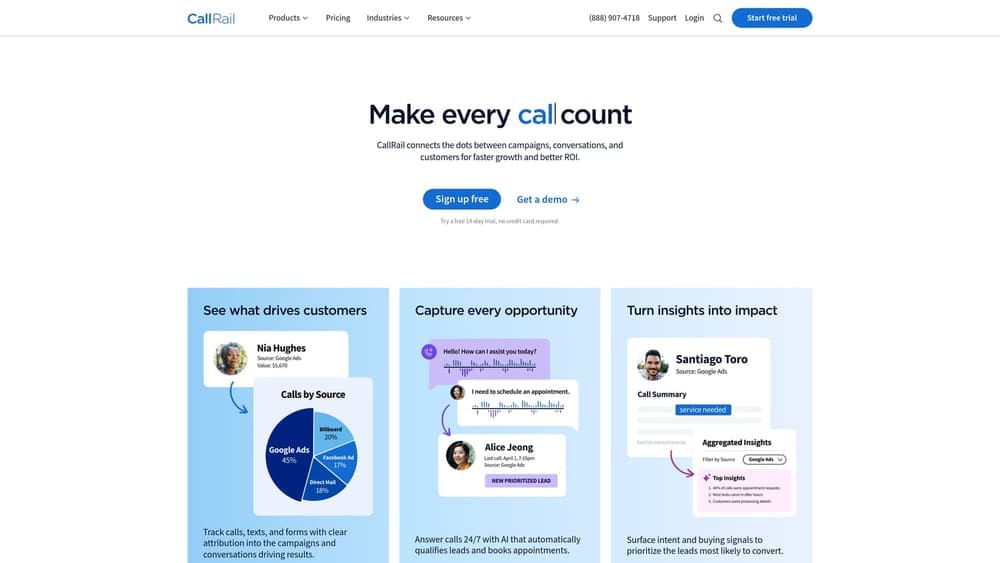
CallRail is a call tracking and analytics platform that attributes phone leads back to specific campaigns, keywords, and ads.
Where This Tool Shines
Between 40 and 70 percent of home service leads come in by phone. If you’re running Google Ads and LSAs simultaneously without call tracking, you’re making budget decisions based on incomplete data. CallRail’s dynamic number insertion ties each call to the specific keyword or campaign that drove it, which is the only way to know whether your Google Ads spend or your LSA spend is producing booked jobs.
The conversation intelligence feature is worth noting for HVAC operators specifically. It can flag calls by service type and outcome, which lets you audit lead quality rather than just lead volume. A hundred calls that produce twenty booked jobs tells a different story than a hundred calls that produce sixty booked jobs, and you need call recording to know which situation you’re in.
Key Features
Dynamic Number Insertion: Ties each call to the specific keyword and campaign that drove it.
Call Recording and Transcription: Lets you audit lead quality and CSR performance without listening to every call manually.
Google Ads and GA4 Integration: Closes the attribution loop between ad spend and phone conversions.
Conversation Intelligence: Flags calls by service type, outcome, and keywords for automated lead quality scoring.
Form Tracking: Captures form submissions alongside calls for a complete lead picture across both channels.
Best For
Any HVAC operator running paid search on either platform. Call tracking is not optional if you want to make informed budget decisions. It’s the minimum infrastructure for attribution.
Pricing
Starts at $45/month. Scales with call volume and feature set. Most HVAC operations fit comfortably in the mid-tier plans.
5. ServiceTitan
Best for: HVAC operations doing $1M+ in revenue that need marketing attribution tied directly to dispatched jobs and closed invoices, not just leads.
ServiceTitan is a field service management platform built specifically for HVAC, plumbing, and electrical contractors that connects marketing spend to revenue, not just lead count.
Where This Tool Shines
Cost per lead is a useful metric. Cost per booked job is a better one. Cost per booked job by channel is the metric that actually tells you where to spend your next dollar. ServiceTitan’s Marketing Pro module tracks a lead from its source channel through to the dispatched job and closed invoice, which is attribution that Google Ads and LSA dashboards can’t provide on their own.
The automated review request feature is directly relevant to LSA performance. Review count and recency are active LSA ranking factors, and ServiceTitan triggers review requests post-job automatically, which compounds over time into a meaningful competitive advantage in LSA rankings.
Key Features
Revenue-Level Attribution: Marketing Pro tracks lead source through to booked job and invoice, not just to the call.
Google Ads and LSA Integration: Pulls channel data into a single reporting view alongside job and revenue data.
Automated Review Requests: Post-job triggers build review volume over time, which directly affects LSA ranking.
Dispatch Integration: Inbound lead flow connects directly to scheduling and dispatch, reducing the gap between lead and booked job.
Cost Per Booked Job Reporting: Shows actual channel efficiency rather than surface-level CPL.
Best For
HVAC operations at $1M+ revenue with multiple technicians and a real need for integrated dispatch, marketing attribution, and review management in one platform.
Pricing
Custom pricing at the enterprise tier. Meaningful investment; best suited for operations where the attribution data justifies the platform cost.
6. Jobber
Best for: Small to mid-size HVAC operators under $1M revenue who need lead source tracking and automated review collection without the enterprise price tag.
Jobber is a CRM and job management platform that gives smaller HVAC operations the attribution and review automation they need to run paid search intelligently.
Where This Tool Shines
Most owner-operators running LSAs have no idea which jobs came from which channel because they’re tracking it in a spreadsheet or not at all. Jobber’s lead source tagging on every job gives you channel-level revenue attribution without the complexity of a full enterprise platform. You can see that your LSA spend produced X dollars in booked jobs last month, which is the number that actually matters.
For LSA performance specifically, Jobber’s automated review requests via text and email post-job completion are directly valuable. More reviews, more recent reviews, and faster response times all influence LSA ranking. Automating the ask removes the step that most operators skip because they’re busy.
Key Features
Lead Source Tagging: Every job tagged by channel for revenue attribution without manual tracking.
Automated Review Requests: Text and email triggers post-job completion to build review volume systematically.
Client Hub and Online Booking: Reduces friction for planned-purchase leads who want to book without calling.
QuickBooks Integration: Revenue data ties back to accounting without manual export.
Mobile-First Interface: Built for operators managing in the field, not just from a desktop.
Best For
HVAC owner-operators and small crews who need functional attribution and review automation at an accessible price point. A practical step up from spreadsheet tracking for anyone running paid search.
Pricing
Starts at $49/month. The Core plan covers most small HVAC operations without requiring an upgrade.
7. Google Analytics 4
Best for: HVAC operators running Google Ads who need on-site conversion tracking and remarketing audience building without adding another paid tool.
Google Analytics 4 is Google’s free web analytics platform that connects ad clicks to on-site behavior and conversion events when configured correctly.
Where This Tool Shines
GA4 is free and directly integrated with Google Ads, which makes it the default attribution layer for operators who aren’t ready to invest in CallRail or a full CRM. The catch is that GA4 requires proper configuration to report anything useful for HVAC lead gen. Out of the box, it tracks sessions and pageviews. Configured correctly, it tracks form submissions, phone click events, and booking completions, which are the events that feed Smart Bidding and inform budget decisions.
The audience building function is underused by most HVAC operators. GA4 can build remarketing audiences of people who visited your replacement or financing pages without converting, which you can then target in Google Ads with specific messaging. That’s a practical use case that doesn’t require any additional spend on a third-party tool.
Key Features
Event-Based Tracking: Captures form submissions, phone click events, and booking completions when configured properly.
Google Ads Integration: Conversion data flows directly into Google Ads for Smart Bidding and reporting.
Audience Building: Creates remarketing segments from on-site behavior for use in Google Ads campaigns.
No Cost: Free with any Google account; no per-visit or per-conversion fees.
Requires Configuration: Default setup does not report meaningful conversion data for HVAC lead gen; goal setup is a required step, not optional.
Best For
Any HVAC operator running Google Ads. GA4 should be installed and configured before a Google Ads campaign goes live, not added later as an afterthought.
Pricing
Free. GA4 360 (enterprise) is available at custom pricing but not necessary for most HVAC operations.
8. Google Business Profile
Best for: Every HVAC operator running LSAs. This is not optional infrastructure; it’s the foundation that LSA ranking and Map Pack placement are built on.
Google Business Profile is the free Google listing that powers Map Pack visibility and feeds review data directly into LSA rankings.
Where This Tool Shines
The Map Pack captures roughly 42% of local clicks for service searches. That’s not a secondary consideration; that’s nearly half the available traffic for your market. LSA ranking is influenced by your review count, review recency, and the completeness of your business information, all of which live in your Google Business Profile. Running LSAs without actively managing your GBP is a meaningful and common mistake.
The connection between GBP and LSA performance is direct. Review requests that flow through ServiceTitan or Jobber post-job land on your GBP, which then feeds into your LSA ranking position. It’s a compounding system: more jobs booked, more review requests sent, more reviews collected, higher LSA ranking, more jobs booked. But it only compounds if the GBP is set up correctly and actively maintained.
Key Features
Review Data Feeds LSA Ranking: Review count and rating are active ranking factors in the LSA algorithm.
Verified Business Information: Syncs with your LSA profile; inconsistencies can affect verification status.
Map Pack Placement: Approximately 42% of local clicks go to Map Pack results, making this high-value real estate.
Service Categories and Q&A: Affect organic visibility alongside paid placements.
Photo and Update Activity: Active profiles signal business legitimacy to Google’s ranking systems.
Best For
Every HVAC operator, full stop. There is no paid search strategy for HVAC that makes sense without a complete and actively managed Google Business Profile underneath it.
Pricing
Free.
Which Setup Is Right for Your HVAC Business
Most HVAC companies don’t have a platform problem. They have a setup and attribution problem. LSAs are faster to launch and easier to dispute, but they cap your reach and give you almost no targeting control. Google Ads give you full control but punish sloppy account management with wasted spend.
The operators who win tend to run both. LSAs handle the emergency calls where trust signals matter most. Google Ads handle the planned replacements, heat pump installations, and maintenance agreement upsells where intent research and ad copy actually move the needle.
If you’re under-reviewed or just entering paid search, start with LSAs. Get your Google Business Profile dialed in, collect reviews systematically through Jobber or ServiceTitan, and install GA4 before you spend a dollar. Add Google Ads once you have call tracking in place and know your close rate. Without those two things, you’re optimizing blind.
If your Google Ads aren’t performing the way they should, the problem is almost never the platform itself. It’s the account structure, the keyword list, or the landing page. Performance Max, in particular, has produced mixed results for local HVAC operators due to limited keyword and geographic transparency. If you’re running it and wondering why results feel unpredictable, that’s a common experience, not a unique one.
For related reading on how these platforms interact with organic Maps placement, see our breakdowns at Google Maps vs. Local Service Ads for HVAC and Google Maps vs. Google Ads for HVAC.
Clicks Geek has managed over $100M in ad spend across 298 industry verticals, and HVAC is one of the most competitive local service categories we work in. We’ve been doing this since 2015 as a Google Premier Partner, and we build campaigns from HVAC-specific playbooks, not generic frameworks repurposed from other industries. If you want a straight read on what’s broken in your current setup, if you want to see what this would look like for your market, we’ll walk you through exactly what we’d do and what’s realistic to expect.