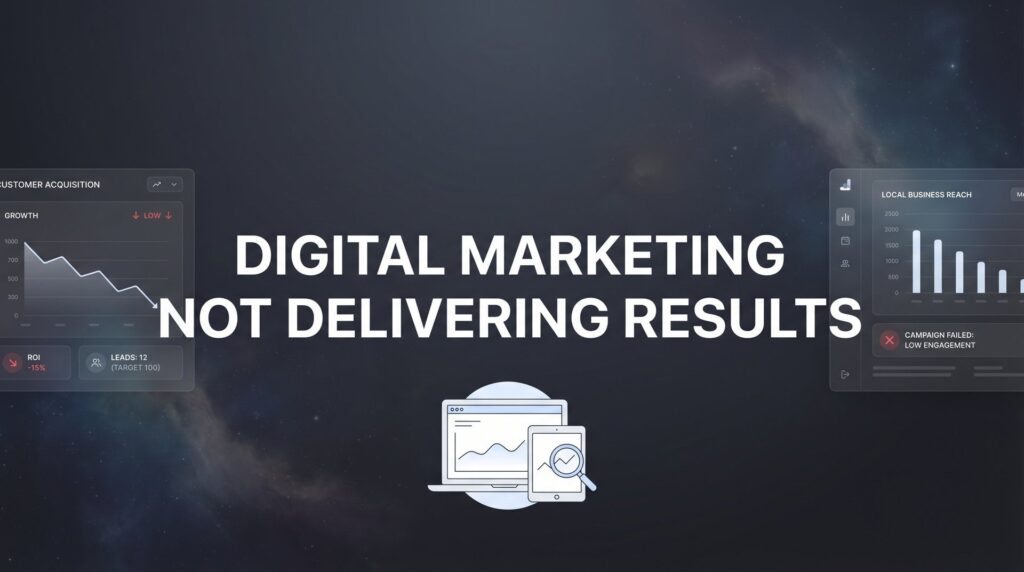
You check the dashboard every week. The numbers look fine—thousands of impressions, hundreds of clicks, engagement metrics trending up. Your marketing agency sends colorful reports highlighting all this activity. But when you look at your bank account, nothing has changed. The phone isn’t ringing more often. New customer appointments haven’t increased. Your revenue is exactly where it was six months ago, except now you’re also paying for marketing that’s supposed to be working.
This disconnect between marketing activity and actual business results is one of the most frustrating experiences for business owners. You’re doing what you’re supposed to do—investing in digital marketing, tracking performance, working with professionals—but the promised growth never materializes. The worst part? You can’t quite put your finger on what’s wrong because everything looks like it’s working on the surface.
The truth is, digital marketing that doesn’t deliver results isn’t failing randomly. There are specific, identifiable reasons why campaigns generate impressive-looking data but zero revenue impact. This article will walk you through the most common culprits behind underperforming marketing and, more importantly, how to fix them. By the end, you’ll know exactly what questions to ask, what metrics actually matter, and how to build marketing that drives real business growth instead of just pretty reports.
The Vanity Metrics Trap: When ‘Good Numbers’ Mean Nothing
Let’s start with the most common deception in digital marketing: impressive numbers that have zero relationship to your bottom line. An agency shows you that your Facebook ads reached 50,000 people last month. Your website traffic is up 200%. Your Instagram following grew by 500 new followers. These numbers feel good. They sound like success. But here’s the question that matters: how many of those people became paying customers?
Vanity metrics are measurements that look impressive in reports but don’t correlate with revenue. Impressions tell you how many times your ad appeared on someone’s screen—not whether they cared, clicked, or bought anything. Website visits tell you people landed on your site—not whether they were qualified prospects or random browsers who left immediately. Followers tell you people clicked a button once—not whether they’ll ever spend money with you.
These metrics aren’t completely worthless, but they’re leading indicators at best. They measure the top of your marketing funnel—the awareness stage. For a local business trying to generate customers and revenue, what happens at the bottom of the funnel is what pays your bills. That’s where vanity metrics reveal their fundamental problem: they let underperforming marketing hide behind busy-looking activity.
Here’s what actually matters for local businesses: leads generated, cost per lead, lead-to-customer conversion rate, and customer acquisition cost. These metrics have a direct mathematical relationship to your revenue. If you know it costs you $150 to acquire a customer and that customer is worth $2,000 in lifetime value, you can make intelligent decisions about how much to invest in marketing. If all you know is that 10,000 people saw your ad, you know nothing useful about whether your marketing is working.
The shift from vanity metrics to revenue metrics requires asking different questions. Don’t ask “how many people saw our ad?” Ask “how many qualified leads did we generate and what did each one cost?” Don’t ask “how much traffic did we get?” Ask “what percentage of that traffic converted into contact form submissions or phone calls?” Understanding what performance marketing actually means can help you reframe these conversations around results rather than activity.
Many agencies default to vanity metrics because they’re easier to improve and better for client retention. It’s much simpler to increase impressions than to increase actual sales. But if you’re paying for marketing, you deserve to know whether it’s generating customers or just generating reports. The moment you start demanding accountability for revenue-driving metrics, you’ll discover whether your marketing is actually working or just looks busy.
Targeting the Wrong Audience (Or Everyone at Once)
Picture this: you run a high-end kitchen remodeling company. Your average project costs $45,000 and targets homeowners with household incomes above $150,000. But your Facebook ads are being shown to everyone in your city between ages 25-65 who has shown any interest in home improvement. You’re paying for clicks from apartment renters browsing Pinterest for decorating ideas, first-time homebuyers who just want to paint their cabinets, and people who will never spend more than $5,000 on their kitchen.
Broad targeting is one of the fastest ways to burn through a marketing budget while generating zero qualified leads. The logic seems sound—cast a wide net to reach more people—but it ignores a fundamental reality: not everyone who could theoretically use your service is actually a viable customer for your business. When you target everyone, you pay for attention from people who will never buy, which means you’re subsidizing awareness for your competitors who target more precisely.
The most common targeting mistake local businesses make is confusing geographic presence with purchase intent. Yes, you serve a specific city or region, so geographic targeting makes sense. But geography alone is almost never sufficient. A personal injury attorney doesn’t need to reach everyone in Phoenix—they need to reach people in Phoenix who have recently been in an accident and are researching legal representation. A commercial HVAC company doesn’t need to reach all business owners—they need to reach facility managers and property owners dealing with aging equipment or planning renovations.
Purchase intent is the difference between someone who might theoretically need your service someday and someone who is actively looking to buy right now. Google Search ads excel at capturing high purchase intent because people are literally typing in what they need: “emergency plumber near me” or “divorce attorney Phoenix” or “commercial refrigeration repair.” Social media platforms can also target purchase intent, but it requires more sophisticated audience building—retargeting people who visited specific pages on your site, creating lookalike audiences based on your existing customers, or targeting people whose online behavior indicates they’re in-market for your service.
Here’s how to tell if your campaigns are reaching browsers instead of buyers: look at your cost per lead and lead quality. If you’re generating lots of clicks but very few contact form submissions or phone calls, your targeting is too broad. If you’re getting leads but they’re unqualified—people asking for services you don’t offer, people outside your service area, people price-shopping with no intent to buy—your targeting isn’t specific enough. This is one of the core reasons why marketing isn’t working for many businesses.
The fix isn’t to target narrower geography—it’s to layer additional targeting criteria that identify genuine prospects. For service businesses, this often means targeting based on homeownership status, household income, life events (recent move, recent marriage, recent home purchase), or demonstrated interest in related services. For B2B companies, it means targeting by job title, company size, industry, and behavioral signals that indicate active buying consideration.
Effective targeting means accepting that you’ll reach fewer people, but the people you reach will be exponentially more likely to become customers. That’s the entire point. Marketing isn’t about maximizing reach—it’s about maximizing return on investment. Would you rather pay to reach 10,000 people and generate five leads, or pay to reach 2,000 people and generate twenty leads? The math is simple once you stop measuring success by vanity metrics.
Your Landing Pages Are Killing Your Conversions
You’re running ads that target the right people with the right message. Clicks are coming in. People are visiting your website. And then… nothing. They look around for fifteen seconds and leave. Your conversion rate hovers around 1-2% when it should be closer to 10-15%. The problem isn’t your ads—it’s where you’re sending the traffic.
Sending paid traffic to your homepage is like inviting someone to a sales presentation and then handing them your company brochure and walking away. Your homepage serves multiple purposes: it introduces your company, explains your full range of services, tells your story, and provides navigation to different sections of your site. That’s fine for organic visitors who found you through search and want to explore. But someone who clicked on an ad promising a specific solution to a specific problem doesn’t want to explore—they want to take the next step toward solving their problem.
A proper landing page is a focused conversion tool designed for one purpose: turning a visitor into a lead. It speaks directly to the problem mentioned in the ad, reinforces that you have the solution, removes distractions that might cause the visitor to leave, and makes the next step (calling you or filling out a form) as easy and compelling as possible. Everything on the page serves the conversion goal. Nothing competes for attention.
The essential elements of a landing page that actually converts start with message match. If your ad promised “free roof inspection for storm damage,” your landing page headline should immediately confirm they’re in the right place: “Get Your Free Storm Damage Roof Inspection.” Visitors decide whether to stay or leave within seconds based on whether they feel they’ve found what they were looking for. Message match creates that instant recognition.
Next comes a clear value proposition that answers the visitor’s internal question: “What’s in this for me?” This isn’t about listing your credentials or explaining how long you’ve been in business—it’s about articulating the specific benefit they’ll receive by taking the next step. For a lead generation offer, this might be “Find out if you qualify for a full roof replacement covered by insurance.” For a service request, it might be “Get an accurate quote in 24 hours with no pressure sales tactics.”
Trust signals matter enormously because you’re asking strangers to give you their contact information or call you. Include customer testimonials that speak to the specific concern addressed by the landing page. Show recognizable certifications, awards, or affiliations. Display your Google rating if it’s strong. For higher-ticket services, consider including a photo of your team or facility to add human credibility. The goal is to reduce the perceived risk of reaching out to you.
Your call-to-action needs to be impossible to miss and frictionless to complete. Use a contrasting color for your CTA button. Make the button text specific and benefit-oriented: “Schedule My Free Inspection” works better than “Submit.” If you’re using a form, ask only for information you absolutely need—every additional field decreases conversion rates. Name, phone, and email is usually sufficient for initial contact. You can gather details later.
Then there are the technical failures that kill conversions before visitors even see your message. Slow load times are conversion poison. If your landing page takes more than three seconds to load, you’ll lose a significant percentage of visitors before they see anything. Optimize images, minimize code, use fast hosting. Mobile responsiveness is non-negotiable—more than half your traffic likely comes from mobile devices, and if your landing page doesn’t work perfectly on a phone, those visitors are gone.
The difference between a homepage and a landing page is the difference between a general store and a specialty shop. When someone clicks your ad, they came looking for something specific. Give them exactly what they came for, make it easy to take the next step, and remove everything that might distract them from converting. That’s how you turn paid traffic into actual leads.
The Follow-Up Gap: Leads Are Coming In, But Nobody’s Home
Your marketing is actually working. Ads are targeted correctly. Landing pages are converting. Qualified leads are submitting forms and calling your number. And then your business drops the ball so completely that you might as well have flushed that marketing budget down the toilet. Because what happens in the minutes and hours after a lead comes in determines whether your marketing investment produces revenue or just produces wasted opportunities.
Here’s what kills more leads than bad targeting or poor landing pages combined: slow response times. A potential customer fills out your contact form at 2 PM on a Tuesday. They’re actively shopping, comparing options, ready to make a decision. Your company doesn’t respond until 10 AM the next day—twenty hours later. By that time, they’ve already talked to three of your competitors, formed opinions, and likely made a decision. Your response arrives too late to matter.
The research on lead response time is brutal. Leads contacted within five minutes are exponentially more likely to convert than leads contacted an hour later. After an hour, conversion probability drops dramatically. After 24 hours, you’re essentially cold calling someone who has already moved on mentally. This isn’t theory—this is the reality of how buying behavior works in markets where customers have options and competitors respond quickly.
The problem compounds for local service businesses where customers often contact multiple providers simultaneously. When someone’s air conditioner dies in Phoenix in July, they’re not filling out one form and waiting patiently for a response. They’re calling or submitting forms to five companies, and they’re hiring whoever responds first with a reasonable offer. The company that responds in ten minutes gets the job. The company that responds the next day gets nothing, regardless of how much they spent on the marketing that generated that lead.
Many businesses assume they have a lead follow-up system when what they actually have is chaos. Leads come into an email inbox that three people have access to but nobody owns. Or they go to a voicemail that gets checked twice a day. Or they feed into a CRM that sends a notification to someone’s phone, but that person is in meetings or with clients and doesn’t see it for hours. These aren’t systems—these are gaps where revenue falls through and disappears.
A real lead follow-up system has clear ownership and accountability. Every lead that comes in triggers an immediate response—either automated (a text message confirming receipt and setting expectations for when they’ll hear from someone) or human (a phone call or personalized email within minutes). Implementing call tracking for your marketing campaigns helps ensure every phone lead gets attributed and followed up properly.
For businesses that can’t guarantee immediate human response during business hours, automation bridges the gap. An automated text message that says “Thanks for your interest in our roofing services. We’ll call you within 30 minutes to discuss your project” does two things: it acknowledges the lead immediately, and it sets a clear expectation that creates accountability for your team. The lead knows when to expect contact, and your team has a specific deadline to meet.
After-hours leads require a different approach. If someone submits a form at 8 PM, they don’t expect an immediate call, but they do expect acknowledgment. An automated response that says “We received your request and will contact you first thing tomorrow morning” manages expectations and keeps you top of mind. Then your team needs a system to ensure those after-hours leads get contacted first thing the next morning—not whenever someone gets around to checking the inbox.
The follow-up gap is the most fixable problem in this entire article, which makes it the most frustrating. You can have perfect targeting, perfect landing pages, and perfect ads, but if nobody calls the leads back quickly, you’ve built an expensive lead generation machine that produces nothing. Fix your follow-up system before you spend another dollar on marketing.
Misaligned Strategy: Using the Wrong Tools for Your Goals
A business owner calls and says their SEO isn’t working. They’ve been paying an agency for six months, rankings have improved for several keywords, organic traffic is up, but they haven’t seen any increase in customers or revenue. The problem isn’t that the SEO is failing—the problem is that SEO was the wrong tool for what they actually needed.
Different marketing channels serve different purposes and operate on different timelines. SEO is a long-term investment that builds sustainable organic visibility over months and years. It makes sense when you have the time and budget to wait for results, when your market has sufficient search volume for your services, and when you’re committed to ongoing content creation and technical optimization. PPC advertising delivers immediate visibility and leads, but it requires ongoing budget and stops working the moment you stop paying. It makes sense when you need results now, when you’re launching a new service or entering a new market, or when you want predictable lead flow you can scale up or down.
The mistake isn’t choosing SEO or PPC—it’s choosing based on what sounds good rather than what aligns with your business situation and goals. A brand new business with zero online presence and an urgent need for customers shouldn’t invest heavily in SEO as their primary strategy. They need leads now, which means PPC, local service ads, or other paid channels that can generate immediate results while they build long-term SEO in the background. An established business with strong cash flow and a long-term growth mindset might prioritize SEO because the compounding returns over time outweigh the slower start.
Another common misalignment happens when businesses copy their competitors’ marketing strategies without understanding the context. You see a competitor running Facebook ads, so you assume Facebook ads must work for your industry. But you don’t know their numbers. Maybe those ads are barely breaking even and they’re only running them for brand awareness. Maybe they have a completely different business model that makes lower-margin leads profitable. Maybe they’re targeting a different customer segment than you serve. Copying tactics without understanding strategy is a recipe for wasted budget.
The right marketing channel depends on your specific customer journey and buying cycle. High-ticket services with long consideration periods (like kitchen remodeling or legal services) benefit from multi-touch strategies that combine immediate response channels with nurture mechanisms. Someone researching kitchen remodeling might visit your site multiple times over several weeks before requesting a quote. Retargeting ads that keep you visible during that consideration period can be more valuable than just capturing the initial click. This is why building a digital marketing strategy for home services requires understanding the full customer journey.
Emergency services with immediate need and short decision windows (like plumbing, locksmith, or towing) require different approaches. These customers aren’t browsing and comparing—they need help right now. Google Search ads for high-intent keywords and Google Local Service Ads that put you at the top of results are often the most effective channels. Social media ads rarely work well for true emergency services because people in emergencies aren’t scrolling Facebook—they’re searching Google.
Seasonal businesses need strategies that ramp up lead generation before peak season and maintain visibility during slow periods. An HVAC company in Phoenix shouldn’t wait until June to start marketing air conditioning services—they should be building awareness and capturing early-season leads in March and April when people start thinking about summer. Pool builders should be most aggressive in late winter and early spring when homeowners are planning summer projects, not in July when construction timelines push completion into fall.
The question isn’t “what marketing channel is best?”—it’s “what marketing channel is best for my specific business, goals, timeline, and customer behavior?” Answer that honestly, and you’ll stop wasting money on strategies that work for someone else’s business but not yours.
Building a Marketing System That Actually Delivers Revenue
Everything we’ve covered points to a fundamental shift in how you need to think about digital marketing. Stop asking whether your marketing is active and start asking whether it’s accountable. Stop accepting reports full of impressive-sounding metrics and start demanding proof of revenue impact. Stop hoping marketing will eventually work and start building systems that make it work predictably.
An accountable marketing system starts with clear definitions of success that tie directly to business outcomes. You should know exactly how many leads you need to generate per month to hit your revenue goals. You should know your target cost per lead based on your profit margins and conversion rates. You should know what percentage of leads should convert to customers and what that means your marketing needs to deliver. These aren’t nice-to-know numbers—they’re the foundation of intelligent marketing investment.
Set realistic timelines and benchmarks for different channels. PPC campaigns should start generating leads within days and should reach stable performance within 30-60 days of optimization. If you’re three months into a PPC campaign and leads still aren’t flowing, something is fundamentally wrong with targeting, messaging, or landing pages. SEO requires more patience—meaningful ranking improvements typically take 3-6 months, and building authority in competitive markets can take a year or more. But you should see directional progress within 90 days. If organic traffic and rankings aren’t trending upward after three months of active SEO, the strategy needs adjustment.
Demand transparency about what you’re actually paying for. If you’re working with an agency, you should know exactly where your budget goes: how much is media spend, how much is management fees, what services are included in those fees. Understanding what digital marketing agencies actually charge helps you evaluate whether you’re getting fair value. You should have access to the actual ad accounts and analytics platforms, not just summary reports. You should be able to see campaign performance in real-time, not just in monthly PDF reports. If an agency resists giving you direct access to your own data, that’s a red flag about what they might be hiding.
Before you invest another dollar in digital marketing, ask these questions: What specific business outcome are we trying to achieve? How will we measure whether marketing is contributing to that outcome? What’s our target cost per lead based on our margins and conversion rates? How quickly should we expect to see results with this channel? What does success look like at 30, 60, and 90 days? Who is responsible for lead follow-up and what’s our response time standard? If you can’t answer these questions clearly, you’re not ready to scale marketing investment.
The businesses that get real results from digital marketing treat it as a system with measurable inputs and outputs, not as an expense they hope will somehow work. They know their numbers. They hold their marketing accountable to revenue metrics. They fix problems quickly instead of letting underperforming campaigns run for months. They invest in what’s working and cut what isn’t. Learning how to increase sales with digital marketing starts with this disciplined, results-focused approach.
Putting It All Together
Digital marketing that doesn’t deliver results isn’t a mystery—it’s a diagnosis. The campaigns generating reports but not revenue are failing for specific, identifiable reasons. They’re measuring the wrong metrics. They’re targeting the wrong people. They’re sending traffic to pages that don’t convert. They’re generating leads that nobody follows up with quickly enough. They’re using strategies misaligned with actual business goals. Every one of these problems has a solution.
The difference between marketing that looks busy and marketing that drives revenue comes down to accountability and systems. Accountable marketing is measured by leads, conversions, and customer acquisition cost—not impressions, clicks, and engagement. Systematic marketing has defined processes for targeting, converting, and following up with leads—not ad hoc approaches that depend on whoever has time that day.
If you’re reading this and recognizing your own situation—spending money on marketing that generates activity but not growth—you have a choice. You can keep doing what you’re doing and hope something changes. Or you can demand better. Demand metrics that matter. Demand targeting that reaches real prospects. Demand landing pages that convert. Demand lead follow-up systems that actually work. Demand strategies aligned with your goals.
Tired of spending money on marketing that doesn’t produce real revenue? We build lead systems that turn traffic into qualified leads and measurable sales growth. If you want to see what this would look like for your business, we’ll walk you through how it works and break down what’s realistic in your market. No vanity metrics. No vague promises. Just clear expectations about what performance-focused marketing actually delivers when it’s done right.