It’s 11 PM on a Tuesday. A homeowner stands in their driveway, keys locked inside the car, phone battery at 15%. They open Google and type “locksmith near me.” Three businesses appear at the top. One has 247 five-star reviews and a Google Guaranteed badge. Another shows “Open Now” with a phone number that clicks to call. The third has outdated hours and a generic website. Which one gets the call?
This scenario plays out thousands of times every day across every city in America. The locksmith who wins isn’t necessarily the closest or the cheapest. They’re the one who appears first, looks trustworthy, and makes it effortless to get help immediately.
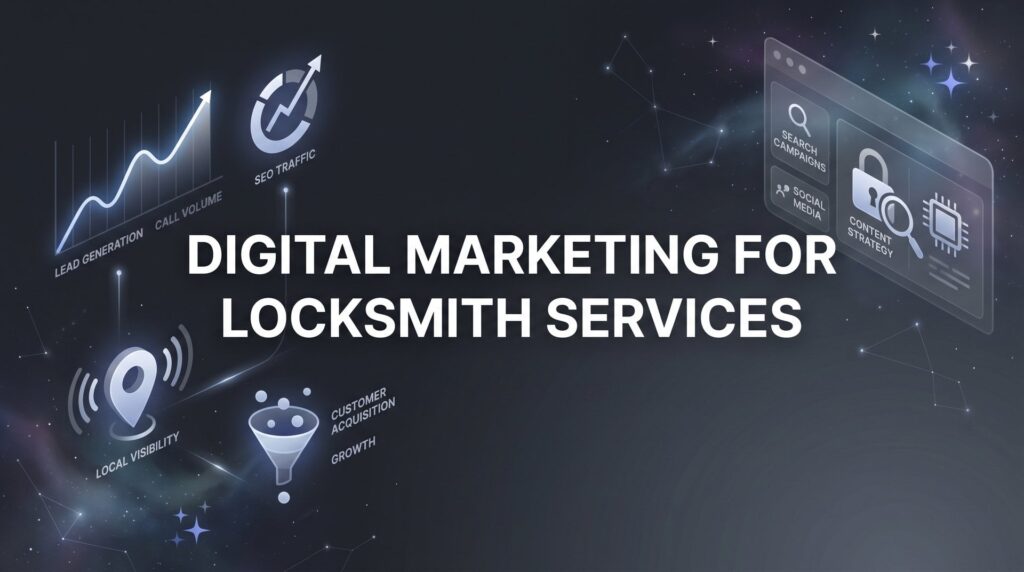
Digital marketing for locksmith services isn’t about fancy branding or clever social media campaigns. It’s about being visible at the exact moment someone needs you, presenting yourself as the obvious safe choice, and making it ridiculously easy for that panicked person to pick up the phone and call. The locksmiths who master this formula don’t worry about where their next customer is coming from. The ones who don’t? They’re fighting for scraps from lead aggregator sites that charge them for the privilege of competing against three other locksmiths for the same job.
The High-Stakes Reality of Emergency Service Marketing
Locksmith marketing operates in a fundamentally different universe than most other businesses. When someone searches for a restaurant, they might browse reviews, check menus, compare prices, and make a decision over the course of hours or days. When someone searches for a locksmith, they’ve usually already made their decision before they even open Google: they need help right now, and they’re calling the first option that looks legitimate.
This compressed decision-making window creates an environment where visibility isn’t just important. It’s everything. If you’re not in the top three results when that search happens, you might as well not exist. The customer isn’t scrolling to page two. They’re not comparing five different options. They’re scanning the first few results, looking for trust signals, and dialing a number within sixty seconds.
The competition for those top positions is brutal. You’re not just competing against other legitimate local locksmiths. You’re competing against national lead generation companies that have spent millions optimizing their websites to rank for every locksmith-related search in every city. These aggregators collect the lead, then sell it to you and two or three of your competitors simultaneously. You pay for the lead whether you win the job or not.
Then there’s the trust problem that haunts the entire industry. Customers know the locksmith scam stories. They’ve heard about the person who quoted $50 on the phone and charged $500 on-site. They’ve read warnings about fake locksmiths who damage locks unnecessarily or aren’t properly licensed. This background noise of distrust means that even when you appear in search results, you’re fighting an uphill battle to prove you’re one of the good ones. Understanding why marketing isn’t working often comes down to these trust barriers that many service businesses face.
Your marketing has to overcome all of this simultaneously. It needs to make you visible when it matters, establish trust instantly, and convert that visitor into a caller before they move on to the next result. That’s not a traditional marketing challenge. That’s a high-stakes visibility and conversion problem that requires a completely different approach.
Dominating the Map Pack: Local SEO That Actually Generates Calls
When someone searches for locksmith services, the first thing they see isn’t organic search results. It’s the Google Map Pack: those three businesses that appear with their locations, ratings, and phone numbers right at the top of the page. If you’re not in that pack, you’re already losing 70% of potential customers before they scroll down.
Getting into the map pack starts with your Google Business Profile, but most locksmiths treat it like a one-time setup task instead of the lead generation machine it actually is. Your profile needs to be completely filled out, not just with basic information but with every element that signals to Google and to customers that you’re the best option available.
Photos matter more than most locksmiths realize. Not stock photos of keys or generic locksmith imagery, but real photos of your actual work, your vehicles with your branding, your team members, and the specific services you provide. Google wants to show businesses that are real, active, and local. A profile with two photos from 2019 doesn’t communicate that. A profile with 50 recent photos of completed jobs, happy customers, and your service area tells Google this is a legitimate, active business worth ranking.
Your service area settings need to be configured precisely. If you serve a 25-mile radius from your location, set it. If you cover specific cities or neighborhoods, list them all. Google uses this information to determine when to show your business in search results. Vague or incomplete service areas mean you’re not appearing for searches you should be winning. This is a core principle of digital marketing for home services that applies directly to locksmith businesses.
Reviews are the currency of local SEO for service businesses. Google looks at review quantity, review recency, and review ratings when deciding map pack rankings. A locksmith with 200 reviews from the past year will outrank a locksmith with 50 reviews from three years ago, even if the second locksmith has a slightly higher average rating. This means review generation can’t be passive. You need a system that consistently asks satisfied customers to leave reviews without being pushy or violating Google’s guidelines.
Response time matters too. When customers message your business through Google, how quickly you respond affects your rankings. Set up notifications so you’re responding within minutes, not hours. Google is tracking this data and using it to determine which businesses provide better customer service.
Beyond your Google Business Profile, local SEO requires building a foundation of consistent business information across the web. Your business name, address, and phone number need to be identical on every directory, citation site, and listing where you appear. Inconsistencies confuse Google and dilute your local SEO authority. This means auditing and claiming your listings on sites like Yelp, Yellow Pages, Angi, and industry-specific directories, then ensuring the information matches exactly.
Local keyword strategy for locksmiths needs to target both emergency and service-specific searches. Someone searching “emergency locksmith” is in a different mindset than someone searching “rekey locks” or “commercial locksmith.” Your content, your Google Business Profile posts, and your website need to address all of these search intents with location-specific variations. “Emergency locksmith in [City],” “car lockout service near [Neighborhood],” and “commercial lock installation [City]” are all different opportunities to appear in search results.
Paid Advertising That Puts Your Phone Number in Front of Emergency Searchers
Local SEO builds long-term visibility, but what about the customer searching for a locksmith right now? That’s where paid advertising comes in, and for locksmiths, there are two primary options that actually work: Google Local Services Ads and traditional Google Search Ads.
Google Local Services Ads appear at the very top of search results, above everything else. They show your business with a Google Guaranteed badge, your rating, your phone number, and your service area. When someone clicks or calls, you pay. The Google Guaranteed badge is huge for locksmiths because it addresses the trust problem immediately. Google has verified your license, insurance, and background. That badge communicates legitimacy in a way that traditional ads simply can’t.
To get into Local Services Ads, you need to pass Google’s screening process, which includes license verification, insurance verification, and background checks. Once you’re in, you set your budget, define your service area, and choose which services you want to advertise. The platform operates on a pay-per-lead model, not pay-per-click. You only pay when someone actually contacts you through the ad. This is the essence of performance marketing—paying for results rather than impressions.
Traditional Google Search Ads give you more control over messaging, targeting, and when your ads appear. For locksmiths, search ads work best when they’re hyper-focused on high-intent emergency keywords. Someone searching “locked out of car” is ready to call immediately. Someone searching “how to pick a lock” is not a customer. Your ad campaigns need to target the first group and exclude the second.
Ad copy for locksmith services needs to do three things simultaneously: establish urgency, communicate trust, and make calling effortless. Your headline should acknowledge the emergency: “Locked Out? We’re On Our Way.” Your description should build trust: “Licensed & Insured • 15-Minute Response • Upfront Pricing.” Your call extension should make the phone number impossible to miss. Every element of the ad should reduce friction and increase the likelihood that the searcher calls you instead of scrolling to the next result.
Budget allocation for locksmith PPC requires understanding when your customers actually need you. Emergency lockouts spike during certain times of day and certain days of the week. Running the same budget 24/7 wastes money during slow periods and leaves you underfunded during peak times. Dayparting lets you increase bids during high-demand hours and reduce them when call volume is low. If most of your emergency calls come between 6 PM and midnight, that’s when your budget should be concentrated.
Geographic targeting needs to be precise. If you serve a 20-mile radius, targeting a 50-mile radius just dilutes your budget with clicks from people you can’t actually help. Radius targeting around your location ensures your ads appear to searchers who are actually within your service area. For locksmiths who serve multiple cities, separate campaigns for each city with city-specific ad copy often outperform broad regional campaigns.
Your Website: The Conversion Tool That Turns Clicks Into Customers
Here’s the uncomfortable truth about locksmith websites: most of them are actively losing customers. A searcher clicks your ad or your Google Business Profile, lands on your website, and within three seconds they’re hitting the back button because they can’t immediately figure out how to call you or whether you can actually help them.
Mobile-first design isn’t a nice-to-have for locksmith websites. It’s the entire game. Over 80% of emergency locksmith searches happen on mobile devices. If your website isn’t designed specifically for a smartphone screen, you’re losing the majority of your potential customers. That means large, tappable phone buttons at the top of every page. It means content that’s readable without zooming. It means forms that work with mobile keyboards. It means load times under three seconds even on slower connections.
The click-to-call button is the most important element on your entire website. It should be impossible to miss. It should be at the top of the page, in a contrasting color, large enough to tap easily, and it should stay visible as the user scrolls. If someone has to search for your phone number, you’ve already lost them. They’re going back to Google to find a locksmith whose number is easier to access.
Live chat can work for locksmiths, but only if it’s actually live. An automated chatbot that asks someone locked out of their car to fill out a form is worse than no chat at all. If you implement chat, it needs to be monitored during business hours with real humans who can immediately answer questions and schedule service. Otherwise, remove it. A phone number that actually gets answered is infinitely more valuable than a chat widget that frustrates people.
Service pages need to target specific search queries and answer the exact questions someone has when they land on that page. A generic “Locksmith Services” page doesn’t help someone searching for “car key replacement” or “commercial lock installation.” Create dedicated pages for each major service you offer, written with the specific keywords and questions associated with that service. This helps with SEO and it helps with conversion because the visitor immediately sees that you specifically handle their exact problem. Learning how to increase sales with digital marketing starts with these conversion-focused website improvements.
Location pages work the same way. If you serve five different cities, create a dedicated page for each one that talks specifically about your locksmith services in that city. This helps you rank for location-specific searches and it builds trust with local customers who want to know you actually serve their area. A page titled “Locksmith Services in [City Name]” with content about response times, local service areas, and city-specific information converts better than a generic homepage.
Trust signals need to be visible throughout your website. Your licensing information, insurance details, years in business, and certifications should be prominently displayed. Photos of your actual team and vehicles build credibility. Testimonials from real customers with real names and real photos are far more persuasive than generic stock photo testimonials. Every element of your website should answer the unspoken question every visitor has: “Can I trust this person with access to my home or car?”
Reviews: The Trust Currency That Separates You From Scammers
In an industry plagued by scam operations and fly-by-night operators, your reputation isn’t just a marketing asset. It’s your primary competitive advantage. A locksmith with 300 recent five-star reviews doesn’t need to convince people they’re legitimate. The reviews do it for them. A locksmith with 12 reviews from 2022 is fighting an uphill battle against every negative story customers have heard about locksmith scams.
Review generation needs to be systematic, not occasional. Every satisfied customer should be asked to leave a review, but the way you ask matters. You can’t offer incentives or rewards for reviews without violating platform guidelines. You can’t pressure customers or make reviews a condition of service. What you can do is make it easy and make it part of your standard post-service process.
The best approach is a simple follow-up message or email after completing a job. Thank them for their business, ask if everything went well, and if they’re happy with the service, provide a direct link to leave a review on Google. The link should take them directly to the review form, not to your profile where they have to figure out how to leave a review themselves. Reducing friction increases response rates.
Timing matters. Ask for the review within 24 hours of completing the job while the experience is still fresh and positive. Wait a week and they’ve forgotten the details. Wait a month and they’ve forgotten you entirely. The window for capturing reviews is narrow, so your system needs to be immediate and consistent. Many growth marketing services emphasize review generation as a core component of sustainable business growth.
Negative reviews will happen. How you respond to them determines whether they hurt or help your reputation. A defensive, argumentative response makes you look unprofessional and validates the customer’s complaint. A professional, empathetic response that acknowledges the issue and explains what you’re doing to resolve it shows future customers that you take problems seriously and stand behind your work.
When responding to negative reviews, address the specific issue, apologize for the experience even if you don’t agree with the complaint, and offer to make it right. Then take the conversation offline by providing a phone number or email to resolve the issue privately. Future customers reading the review see that you’re responsive and committed to customer satisfaction, which often matters more than the complaint itself.
Leverage your reviews everywhere. Feature them on your website. Include review snippets in your ad copy when platforms allow it. Reference your rating and review count in your email signatures and proposals. Social proof is one of the most powerful persuasion tools available, and you’ve earned it through good work. Make sure potential customers see it before they make their decision.
Tracking What Actually Drives Revenue
Most locksmiths track the wrong metrics. They look at website traffic, ad impressions, and click-through rates. None of that matters if it’s not translating into calls and completed jobs. The metrics that actually impact your profitability are cost per lead, cost per acquisition, and lifetime customer value.
Cost per lead tells you how much you’re spending to generate each potential customer. If your Google Ads campaign costs $1,000 per month and generates 50 calls, your cost per lead is $20. If your Local Services Ads cost $600 per month and generate 25 leads, your cost per lead is $24. This comparison tells you which channel is more efficient at generating leads, but it doesn’t tell you which channel generates better quality leads.
Cost per acquisition is the metric that matters most. It tells you how much you spent to acquire each actual paying customer, not just each lead. If half of your Google Ads leads turn into jobs and only a third of your Local Services Ads leads convert, then even though Local Services Ads have a higher cost per lead, they might have a lower cost per acquisition. This is why tracking conversions all the way through to completed jobs is essential.
Implementing call tracking for marketing campaigns is the only way to accurately attribute leads to specific marketing channels. Use different phone numbers for your website, your Google Ads, your Local Services Ads, and your organic listings. When a call comes in, you know exactly which marketing effort generated it. This data lets you make informed decisions about where to increase spend and where to cut back.
Don’t just track volume. Track quality. Not all leads are equal. A call from someone locked out of their house at midnight who needs immediate service is worth more than a call from someone shopping around for the cheapest price on a rekey job they’re planning for next month. Tag your calls by type and urgency so you understand which marketing channels are generating your most valuable customers.
Seasonal patterns significantly affect locksmith demand. Lockouts increase during extreme weather when people are rushing and distracted. Commercial locksmith services spike during lease turnover periods and at the beginning of fiscal years when businesses are opening or relocating. Residential rekey requests increase after home purchases and during summer when people move. Understanding these patterns lets you adjust your marketing spend to match demand rather than running the same budget year-round.
If you’re spending the same amount on marketing in February as you do in July, you’re either overspending during slow months or underinvesting during peak months. Look at your historical call volume by month, identify your busy seasons, and shift budget to align with demand. This maximizes ROI by putting more money behind your marketing when customers are actively searching.
Putting It All Together
Digital marketing for locksmith services isn’t about implementing every tactic that exists. It’s about building a system that makes you visible when people need you, establishes trust immediately, and converts that visibility into actual revenue. Most locksmiths fail because they try to do everything at once or they focus on the wrong priorities.
Start with local SEO. Optimize your Google Business Profile, build consistent citations, and create a review generation system. This is your foundation for organic visibility that generates leads without ongoing ad spend. It takes time to build, but once it’s working, it compounds. The locksmith with 500 reviews and a fully optimized profile doesn’t need to spend as much on ads as the locksmith starting from zero.
Layer in paid advertising for immediate results. Google Local Services Ads give you the Google Guaranteed badge and top-of-page placement. Traditional search ads give you control over messaging and targeting. Use both strategically based on your budget and your market competition. Track everything so you know which campaigns are actually generating profitable jobs.
Make sure your website converts the traffic you’re paying for. A mobile-optimized site with prominent click-to-call buttons, service-specific pages, and visible trust signals turns visitors into callers. A poorly designed website wastes every dollar you spend on ads by letting potential customers slip away.
Build and protect your reputation systematically. Reviews are the trust currency that separates legitimate locksmiths from scammers. A strong reputation reduces your cost per acquisition because more leads convert when customers trust you before they even call.
The locksmiths who dominate their markets aren’t doing anything magical. They’re executing these fundamentals consistently and tracking the metrics that actually matter. They’re not guessing which marketing channels work. They’re measuring cost per acquisition and adjusting spend based on data. They’re not hoping for reviews. They’re asking every satisfied customer and making it easy to say yes.
If you want to see what this would look like for your specific market and service area, we can walk you through exactly how these systems would work for your business. We’ll break down the competitive landscape, show you where the opportunities are, and give you a realistic projection of what’s actually achievable. No generic proposals or cookie-cutter strategies—just a clear plan based on how locksmith marketing actually works in your area.