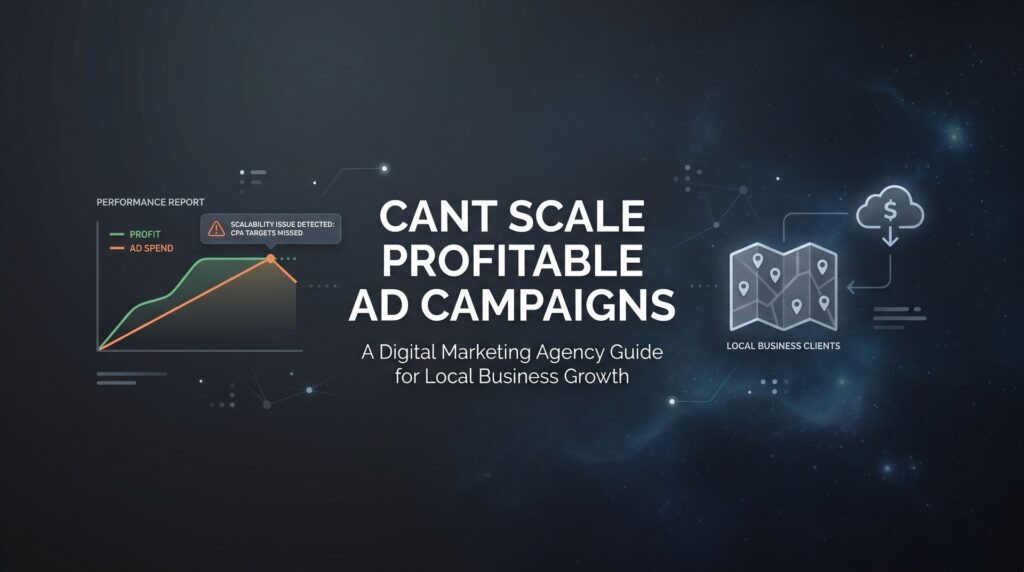
You’ve got a campaign that’s working. Leads are coming in, cost per acquisition looks good, and you’re finally seeing real ROI. So you increase the budget—and everything falls apart. Cost per lead spikes, conversion rates tank, and suddenly your profitable campaign is bleeding money.
Sound familiar? This is the scaling wall, and it’s one of the most frustrating problems in paid advertising. You did everything right. You found an angle that works. You proved the concept. And then the moment you try to grow it, the whole thing unravels.
Most business owners hit this wall and assume the fix is simple: spend more, get more. But throwing money at a campaign that isn’t structurally ready to scale is like pouring water into a bucket full of holes. The volume increases, but so does the waste.
The problem isn’t your budget. It’s your foundation.
Campaigns that can’t scale profitably almost always have one or more of the same core issues: broken tracking that masks real performance, profitability metrics that don’t hold up under pressure, conversion processes that collapse under volume, or campaign structures that were never built for growth. Fix these, and scaling becomes a controlled, repeatable process instead of a gamble.
In this guide, we’ll walk you through the exact steps to diagnose why your campaigns stall when you try to grow them, fix the structural issues holding you back, and increase your ad spend while maintaining or even improving profitability. Whether you’re running Google Ads, Facebook Ads, or both, these steps apply directly.
Let’s fix this.
Step 1: Audit Your Tracking Before You Touch a Single Budget
Before you change a single bid, add a dollar to your budget, or restructure a single ad group, you need to answer one question honestly: are you actually measuring what you think you’re measuring?
Bad tracking is the silent killer of scaling. When your data is unreliable, every decision you make downstream is built on a shaky foundation. You might think a campaign is profitable when it isn’t. You might be scaling a campaign that’s actually losing money while pausing the one that was quietly carrying your results.
Start with conversion tracking verification. Log into Google Ads or Meta Ads Manager and check which conversion actions are actively firing. Then cross-reference those numbers against your CRM or actual closed deals from the same period. If your ad platform says you got 40 leads last month but your CRM shows 22, you have a tracking problem. The gap could be duplicate conversions firing twice per form submission, broken UTM parameters that aren’t attributing traffic correctly, or form submissions being counted that never actually reached your team.
Check for duplicate conversions. This is more common than most people realize. A “thank you page” view and a form submission event can both fire for the same lead, doubling your reported conversion count and making your cost per lead look artificially low.
Verify call tracking is working end-to-end. If phone calls are a significant lead source for your business, confirm that call tracking for ad campaigns is properly linked to your ad platform and that call duration thresholds are set realistically. A two-second call is not a lead.
Import offline conversions if you’re closing deals away from the browser. For many local businesses, the real conversion happens on the phone or in person. If you’re not importing those closed deals back into Google Ads, the algorithm has no idea which clicks are actually making you money.
The success indicator here is simple: your ad platform data and your actual business results should tell the same story. If they don’t, stop everything and fix the tracking first. Scaling on bad data doesn’t just waste money—it actively trains the algorithm to optimize for the wrong outcomes.
Step 2: Know Your Real Numbers Before You Spend More
Once your tracking is clean, you need to get brutally honest about what profitability actually looks like at your current spend level—before you try to grow it.
Most business owners focus on cost per click or cost per lead. These are useful indicators, but they’re not the numbers that determine whether your business is growing or shrinking. The metrics that matter are cost per acquisition (the actual cost to win a paying customer) and customer lifetime value (what that customer is worth to your business over time).
Here’s the exercise: take your total ad spend for the last 60 to 90 days. Divide it by the number of customers you actually closed from those campaigns. That’s your real cost per acquisition. Now subtract your cost of service delivery and overhead from the average revenue per customer. What’s left is your actual profit per customer from paid ads.
If that number is positive, great. Now ask: what’s the maximum I can pay to acquire a customer and still be profitable? This is your maximum allowable CPA, and it becomes the ceiling you build every scaling decision around. Understanding this is essential to building profitable marketing campaigns that hold up under pressure.
Why campaigns look profitable at low spend but aren’t at scale. At small budgets, you’re often capturing the highest-intent, easiest-to-close leads first. As you scale, you reach broader audiences, lead quality tends to soften, and your close rate can drop. A campaign with a $50 cost per lead that closes at 30% has a very different CPA than the same campaign at $50 per lead closing at 15%.
Build a simple scaling model. Take your current CPA and ask: if I double my spend, and my close rate drops by 20%, is this still profitable? Run the numbers before you commit the budget. This kind of scenario planning takes 20 minutes and can save you from a very expensive mistake.
Hidden costs also deserve attention here. No-show rates for appointments, time spent on unqualified leads, and customer churn all affect real profitability. If your ads are producing a negative ROI from advertising, make sure your CPA calculation accounts for the full picture, not just the ad platform’s version of it.
Step 3: Fix the Conversion Bottlenecks That Collapse Under Volume
Here’s something most agencies won’t tell you: the reason your campaigns fall apart when you scale often has nothing to do with the ads themselves. The problem is what happens after the click.
Your landing page, intake process, and lead follow-up speed are the first things to break when volume increases. They work fine at low volume because there’s enough slack in the system. But when you double or triple the traffic, cracks become craters.
Start with your landing page. Load speed is the most overlooked conversion killer. On mobile, a page that takes more than three seconds to load loses a significant portion of visitors before they ever see your offer. Use Google’s PageSpeed Insights to check your score and address the top recommendations. Then look at your mobile experience critically: is the form easy to fill out on a phone? Is the call-to-action visible without scrolling? Is the page cluttered with information that distracts from the one thing you want visitors to do?
Evaluate your lead response time. General industry consensus among sales professionals is clear: the faster you follow up with a new lead, the higher your contact rate and close rate. Response times over five minutes dramatically reduce your chances of reaching that lead while they’re still engaged. If your team is responding to leads hours later, no amount of improving ad campaign performance will fix your CPA problem. The leads are going cold before anyone picks up the phone.
Stress-test your sales process. Can your team realistically handle two or three times the current lead volume without quality dropping? If scaling means your salespeople are overwhelmed, response times slow down, and close rates fall, you haven’t actually scaled the business. You’ve just spent more money to get the same results.
The principle of scaling headroom is worth understanding here. Improving your conversion rate on existing traffic is often more profitable than buying more traffic. If your landing page converts at 8% and you improve it to 12%, you’ve effectively reduced your cost per lead by a third without touching your ad budget. That headroom gives you room to scale spend while keeping your CPA in check.
Step 4: Restructure Your Campaigns for Scalable Architecture
Many campaigns that work at small budgets are built for convenience, not scale. A single campaign with broad match keywords and a general audience targeting everyone in a metro area might generate decent leads at $1,000 per month. But push it to $5,000 and the wheels come off.
The reason is simple: without structural segmentation, you have no control over where your budget goes. You can’t tell which service line is profitable and which is draining spend. You can’t allocate more budget to your highest-converting geography. You can’t protect your proven winners when you’re testing new approaches. Following Google Ads account structure best practices is essential for building campaigns that can handle increased spend.
Segment campaigns by intent level. High-intent keywords like “emergency plumber near me” behave very differently from informational queries like “how to fix a leaky pipe.” They deserve separate campaigns with separate budgets, bids, and landing pages. Mixing them together means you’re either underbidding on your best opportunities or overspending on traffic that rarely converts.
Segment by service type and geography. If you offer multiple services, each deserves its own campaign. This gives you the ability to scale your most profitable service lines independently without dragging down overall performance. Similarly, if you serve multiple cities or regions, separate geographic campaigns let you allocate budget to your best-performing markets first.
Use tiered bidding based on performance. Your highest-intent, highest-converting segments should receive the most budget. Build your campaign structure so that you can clearly see which segments are performing and shift spend accordingly without everything being lumped together.
Build dedicated scaling campaigns. When you want to test a new keyword set, audience, or offer, do it in an isolated campaign. This prevents experiments from cannibalizing the performance of your proven winners. Your core campaigns keep running efficiently while your test campaigns generate learnings without risk.
Match type strategy matters at scale. Exact match gives you control but limits volume. Broad match delivers volume but requires aggressive negative keyword management. A common approach is to start scaling with phrase and exact match, then layer in broad match with strong negative keyword lists once you have enough data to know what to exclude. If you’re dealing with poor Quality Score in Google Ads, fixing that before scaling will dramatically improve your cost efficiency. The right balance depends on your budget and how mature your campaign data is.
Step 5: Scale Budget in Controlled Increments
This is where most business owners make the most expensive mistake. They find a campaign that’s working, get excited, and double or triple the budget overnight. Then they wonder why performance collapsed.
Both Google Ads and Meta Ads use machine learning algorithms that require data stability to optimize effectively. These algorithms are constantly learning which users to target, when to show ads, and how to allocate spend within your budget. When you make a sudden, large budget change, you disrupt that learning process. The algorithm essentially resets, and performance can tank for days or weeks while it recalibrates. This is well-documented in Google’s own Ads Help documentation under the concept of algorithm learning phases.
The 15-20% budget increase rule. Many experienced PPC practitioners recommend increasing budgets by no more than 15 to 20% at a time as a general guideline to preserve algorithmic stability. This isn’t a hard rule set in stone, and it varies by platform and campaign maturity, but the principle is sound: gradual increases give the algorithm time to adjust without triggering a full reset. If you’re finding that ads are spending too much with no results, a sudden budget jump is often the culprit.
Build a scaling schedule. Increase budget, then wait. Let the data stabilize over five to seven days before evaluating performance. If your CPA is holding within your acceptable range, increase again. If it’s drifting toward your ceiling, hold and investigate before spending more. Document what happens at each budget tier so you build a clear picture of exactly where your profitability ceiling sits.
Set a clear pull-back threshold. Before you scale, decide in advance: if my CPA exceeds X, I reduce budget immediately. Having this number defined before you’re in the middle of a bad week removes emotion from the decision. You’re not reacting to fear; you’re following a system.
Monitor CPA and conversion rate daily during active scaling periods. Weekly reporting isn’t frequent enough when you’re actively increasing spend. Small problems caught early are easy to fix. The same problems left unaddressed for a week can cost you significantly.
Step 6: Expand Reach Without Diluting Quality
Once your core campaigns are scaled and performing consistently within your target CPA, you’ve built a solid base. Now you can look outward for new growth without risking what you’ve already built.
The key word is isolation. New growth experiments should always run in separate campaigns so they can’t drag down your proven performers if they underperform.
Test adjacent keywords and services. If your core campaign targets “HVAC repair,” adjacent opportunities might include “AC installation” or “furnace replacement.” These are related services with different intent profiles and often different margins. Test them separately before integrating them into your main budget allocation.
Expand geographically with intention. If you’ve maxed out performance in your primary market, adjacent cities or suburbs can be a natural next step. But don’t assume performance will transfer automatically. Run new geographic targets as separate campaigns, evaluate their individual CPA, and scale the ones that prove themselves. Understanding how to scale lead generation methodically is what separates sustainable growth from expensive experiments.
Address audience saturation on social platforms. This is a real phenomenon on Meta and other social channels. As you increase spend targeting a fixed audience, ad frequency rises and performance degrades because you’re showing the same ads to the same people too many times. The fix is to expand your audience targeting, build lookalike audiences from your best customers, or refresh your creative regularly to maintain engagement.
Use negative keyword lists aggressively. As you broaden targeting to scale, the risk of irrelevant traffic increases. Robust negative keyword lists are what keep your expanded campaigns from hemorrhaging spend on searches that will never convert for your business.
Consider adding a second channel. If you’re running exclusively on Google, testing Meta Ads with your proven offer can open a new traffic source without touching your existing campaigns. Google Ads remarketing services are particularly effective at this stage: they capture visitors who showed interest but didn’t convert, improving your overall return on ad spend without requiring new audience acquisition.
Breaking Through for Good: Your Scaling Action Plan
Let’s bring this together into something you can act on immediately. Scaling profitable ad campaigns isn’t a single move—it’s a disciplined sequence of decisions, each one building on the last.
Your six-step checklist:
1. Verify your tracking is accurate and your ad platform data matches your actual business results before making any budget changes.
2. Calculate your true cost per acquisition and establish your maximum allowable CPA so every scaling decision has a clear profitability boundary.
3. Audit and fix your post-click experience: landing page speed, mobile usability, lead response time, and sales capacity.
4. Restructure campaigns by intent level, service type, and geography so you have granular control over where your budget goes.
5. Scale budget in 15-20% increments, wait for data to stabilize, evaluate against your CPA threshold, then decide on the next move.
6. Expand reach through adjacent keywords, new geographies, audience expansion, and additional channels—always in isolated campaigns.
The ongoing discipline is what separates businesses that scale successfully from those that stay stuck. Scaling isn’t a one-time fix. It’s a continuous optimization loop: measure, adjust, test, scale, repeat. The businesses that grow their ad spend profitably over time aren’t doing anything magical. They’re just more systematic about it.
If you’re working through these steps and finding that the issues run deeper than a quick fix, that’s a sign your campaigns may need professional management to reach the next level. The tell-tale signs are persistent CPA instability despite structural fixes, tracking issues you can’t resolve internally, or campaign architecture that’s become too complex to manage alongside running a business.
Tired of spending money on marketing that doesn’t produce real revenue? Clicks Geek builds lead systems that turn traffic into qualified leads and measurable sales growth. As a Google Premier Partner agency, we specialize in exactly the problems this guide addresses: PPC strategy, conversion rate optimization, and scalable lead generation for local businesses. If you want to see what this would look like for your business, we’ll walk you through how it works and break down what’s realistic in your market.