Most local service business owners have tried at least one marketing tactic that burned money without producing a single booked job. A Facebook ad that got likes but no calls. An SEO agency that promised page-one rankings and delivered a report instead of revenue. A Google Ads campaign that ran for three months before anyone noticed the phone number was wrong.
The problem usually isn’t the channel. It’s the sequence. Businesses jump to tactics before they’ve built the foundation those tactics depend on. A Google Ads campaign without a converting landing page is just an expensive experiment. Local SEO without a claimed and optimized Google Business Profile is dead on arrival.
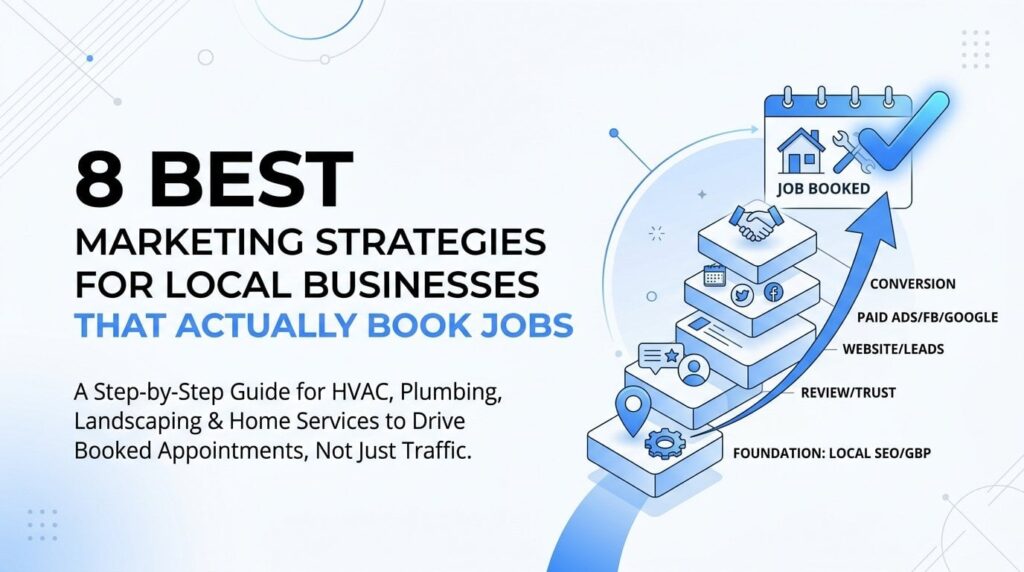
These eight strategies are ordered by how most local service businesses should actually approach them, starting with what costs the least and builds the most durable foundation, then moving into paid channels that accelerate growth once the basics are solid. Whether you run an HVAC company, a plumbing shop, a landscaping crew, or any of the other trades competing for local customers, the same core principles apply. The tactics get adjusted for your vertical. The strategy stays the same.
One number worth knowing before you start: most service businesses past the startup phase should plan to spend 8 to 12 percent of revenue on marketing. Under that, you’re probably leaving growth on the table. Over it without a clear return, something in the system is broken.
1. Claim and Optimize Your Google Business Profile
The Challenge It Solves
The Map Pack captures roughly 42% of local clicks, which means your Google Business Profile (GBP) is often the first thing a potential customer sees before they ever visit your website. Most businesses claim their profile and stop there, leaving it half-empty while competitors with fully optimized profiles scoop up the calls.
The Strategy Explained
GBP is the highest-leverage free asset available to local service businesses, and it’s the foundation everything else depends on. A complete profile includes accurate business categories, service areas, hours, and a keyword-rich description. But “complete” isn’t enough. Active profiles with recent photos, weekly posts, answered Q&A, and consistent review responses outperform static ones in both ranking and conversion.
Your primary category matters more than most people realize. An HVAC company that lists itself as “Air Conditioning Contractor” instead of “HVAC Contractor” may miss searches for heating work entirely. Get the primary category right first, then stack relevant secondary categories.
Phone remains the dominant lead channel for local service businesses, with 40 to 70 percent of leads coming in by call. Your GBP phone number needs to be correct, tracked, and answered.
Implementation Steps
1. Claim and verify your profile at Google Business Profile Manager if you haven’t already. If someone else claimed it incorrectly, request ownership through Google’s process.
2. Set your primary and secondary categories deliberately. Research what categories your top-ranking local competitors use.
3. Add at least 10 photos covering your team, vehicles, equipment, and completed work. Update photos monthly.
4. Enable messaging and set up automated responses so leads don’t go cold while you’re on a job.
5. Post weekly updates using the Posts feature. Seasonal promotions, completed projects, and service reminders all work well.
Pro Tips
Answer every question in the Q&A section yourself before a stranger does it incorrectly. Seed the section with your own frequently asked questions and answer them. This controls the narrative and adds keyword-rich content to your profile without any extra effort from Google’s side.
2. Build Local SEO That Compounds Over Time
The Challenge It Solves
Paid ads stop the moment you stop paying. Local SEO builds something that keeps working. At 12 months or more, local SEO typically delivers a cost per lead of $7 to $15, which is the lowest of any marketing channel available to service businesses. The tradeoff is time. Most businesses either skip it entirely or do it wrong and wonder why nothing happens.
The Strategy Explained
Local SEO for service businesses isn’t about writing blog posts. It’s about building city-specific service pages, maintaining consistent citations across directories, adding schema markup so Google understands your business structure, and earning local links from real sources like chambers of commerce, supplier directories, and local press.
City pages work because search intent is hyper-local. Someone searching “plumber in Allentown” isn’t going to call a company whose website only mentions “serving the greater Pennsylvania area.” A dedicated page for each city you serve, with real content about that service in that location, closes that gap.
Citation consistency matters because Google cross-references your name, address, and phone number (NAP) across the web. Inconsistent listings create doubt about which information is correct and suppress rankings.
Implementation Steps
1. Audit your existing citations using a tool like BrightLocal or Whitespark. Fix NAP inconsistencies across the major directories first: Google, Yelp, Bing, Apple Maps, and Angi.
2. Build individual service-area pages for each city or town you serve. Each page should include the service name, the city, local landmarks or context where natural, and a clear call to action.
3. Add LocalBusiness schema markup to your website so search engines can parse your business details accurately.
4. Pursue local links by getting listed with your local chamber, trade associations, and supplier directories. One real local link is worth more than dozens of generic directory submissions.
Pro Tips
Don’t build 50 thin city pages at once. Build 5 to 10 genuinely useful ones and let them gain traction before expanding. Google can tell the difference between a real local page and a template with the city name swapped in.
3. Run Google Ads for Immediate Lead Flow
The Challenge It Solves
SEO takes time. If you need calls this week, Google Ads is the most direct path. It puts your business in front of people who are actively searching for exactly what you offer right now. The challenge is that it’s easy to spend money on clicks that never convert, and most campaigns are set up in ways that guarantee waste.
The Strategy Explained
Google Ads for home services typically runs a cost per lead of $18 to $35. That’s a workable number if your average job value is $300 or more. It becomes a problem when the campaign is generating clicks from people searching for DIY tutorials, competitor brand names, or services you don’t offer.
Campaign structure determines profitability more than budget. Separate campaigns for separate services let you control bids and budgets by what actually makes money. A roofing company bidding the same amount on “roof inspection” and “emergency roof repair” is leaving money on the table. Those two searches represent very different intent and very different job values.
Call tracking is non-negotiable. If you can’t trace a booked job back to the keyword that generated the call, you’re flying blind. This is how the phone number ends up wrong for three months without anyone noticing.
Implementation Steps
1. Build separate campaigns for your highest-value services rather than one broad campaign covering everything.
2. Build a negative keyword list before you launch. Start with obvious exclusions: “DIY,” “how to,” “free,” competitor names, and adjacent services you don’t offer.
3. Set up call tracking through Google Ads call extensions or a third-party tool like CallRail. Every lead source needs a trackable number.
4. Send ad traffic to dedicated landing pages, not your homepage. A page built around one service with one clear call to action converts significantly better than a general homepage.
Pro Tips
Review your search term reports weekly for the first 60 days. The queries people actually used to trigger your ads will tell you exactly where your negative keyword list has gaps. This is where most of the early waste lives.
4. Use Local Service Ads to Buy Trust at a Fixed Price
The Challenge It Solves
Regular search ads require you to compete on bids and landing page quality. Local Service Ads (LSAs) appear above everything else on the results page and carry Google’s Guaranteed badge, which signals to homeowners that your business has passed background checks, license verification, and insurance review. That badge does a lot of conversion work before the customer even clicks.
The Strategy Explained
LSAs use a pay-per-lead model instead of pay-per-click. You’re charged when someone contacts you through the ad, not just when they see it. That changes the math considerably, especially for trades where a single job can justify a higher lead cost.
The verification requirements that feel like a hassle are actually a competitive filter. Contractors who can’t or won’t complete the licensing and insurance verification don’t show up. That narrows the field and improves your odds with homeowners who are specifically looking for someone they can trust.
LSAs work particularly well for HVAC, plumbing, electrical, and roofing because those verticals have clear licensing requirements that Google can verify. The badge carries more weight in trades where homeowners are worried about hiring someone unqualified.
Implementation Steps
1. Check whether your business category is eligible for LSAs in your market. Not all service types are available in all areas.
2. Complete the verification process: business license, insurance documentation, and background check for the business owner and any employees who appear in the profile.
3. Set your weekly budget based on how many leads you can actually handle. LSAs let you pause when you’re at capacity, which prevents paying for leads you can’t follow up on quickly.
4. Dispute leads that don’t match your services. Google allows you to flag and request credits for calls that were clearly outside your scope.
Pro Tips
Your review count and rating directly affect your LSA ranking. This is another reason the review engine in Strategy 6 isn’t optional. A business with 80 reviews at 4.8 stars will outrank a competitor with 12 reviews at 4.6, even with a similar budget.
5. Run Facebook and Instagram Ads to Create Demand
The Challenge It Solves
Google and LSAs capture existing demand. Facebook and Instagram create it. These platforms reach people who aren’t searching yet but are in exactly the right situation to need your service soon. That’s a different kind of marketing, and it requires a different mindset about what a successful campaign looks like.
The Strategy Explained
Facebook CPL for local service businesses typically runs $10 to $25, which is lower than Google Ads on average. The tradeoff is intent. Someone who clicked a Facebook ad for gutter cleaning was scrolling through their feed, not actively looking for you. The lead is real, but it requires faster and more persistent follow-up to convert into a booked job.
Social ads work best for services where demand can be created or anticipated rather than purely captured. Seasonal services like landscaping, pest control, and gutter cleaning are ideal candidates. So are higher-ticket planned projects like HVAC replacements, where homeowners might not be searching yet but would respond to the right message at the right time.
Geographic and demographic targeting is where Facebook earns its keep for local service businesses. You can target homeowners by zip code, household income, home age, and dozens of other parameters that search engines can’t replicate.
Implementation Steps
1. Define your audience before you build the ad. Homeowners in specific zip codes, within a certain age range, with household income that matches your typical customer. Start narrow and expand once you see what converts.
2. Lead generation campaigns with instant forms work well for quote requests and seasonal offers. Drive phone calls for emergency or high-urgency services.
3. Retarget website visitors with a separate campaign. Someone who visited your site and didn’t call is a warm prospect. A retargeting ad with a specific offer often converts them.
4. Set a realistic expectation for follow-up speed. Facebook leads go cold faster than search leads. Same-day follow-up is the minimum.
Pro Tips
Don’t judge a Facebook campaign by likes or reach. Judge it by cost per booked job. A campaign with lower reach that generates 10 booked appointments beats a viral post with zero calls every single time.
6. Build a Review Engine That Runs Without You
The Challenge It Solves
Reviews affect two things at once: where you rank in the Map Pack and whether someone calls you once they find you. Most businesses treat reviews as a passive outcome, something that happens when a happy customer feels like leaving one. That approach produces inconsistent results and hands the advantage to competitors who are more systematic about it.
The Strategy Explained
The highest-leverage moment to ask for a review is immediately after the job is complete and the customer has expressed satisfaction. Not a week later in a bulk email. Right there, while the technician is still on-site or within hours of completion.
Text-based review requests outperform email in most service verticals because the customer can tap the link and leave a review in under two minutes without switching devices. A short, direct text with a first-name greeting and a direct link to your Google review page is all you need.
Responding to every review, positive and negative, signals to Google that the profile is active and signals to potential customers that you’re accountable. A thoughtful response to a negative review often does more for your reputation than a dozen five-star reviews because it shows how you handle problems.
Implementation Steps
1. Create a short review request text template that your team can send immediately after job completion. Include a direct link to your Google review page (not your homepage).
2. Build the ask into your job completion checklist. It should happen every time, not when someone remembers.
3. Set up a simple system to monitor new reviews daily. Respond to every review within 24 hours.
4. If you get a negative review, respond calmly, acknowledge the concern, and offer to resolve it offline. Never argue in the response.
Pro Tips
Aim for consistent volume over time rather than a sudden spike. A business that gets 3 to 5 new reviews every month looks more credible than one that got 40 reviews in a week and nothing since. Google’s algorithm notices the pattern.
7. Convert More of the Leads You’re Already Paying For
The Challenge It Solves
Most businesses optimize for lead volume. More ads, more budget, more traffic. But if your booking rate on incoming leads is low, adding more leads just means spending more money on the same broken process. Fixing conversion is the highest-ROI activity available to most service businesses because the improvement flows through every channel simultaneously.
The Strategy Explained
Speed to lead is the most documented factor in whether a phone lead becomes a booked job. Research in sales consistently shows that response time matters enormously, with leads that are contacted quickly converting at substantially higher rates than those left waiting hours or days. For local service businesses, where 40 to 70 percent of leads come in by phone, a missed call is often a lost job.
The second variable is call handling quality. A technician who answers the phone is not the same as a trained CSR who knows how to handle objections, quote with confidence, and book the appointment before hanging up. These are trainable skills, and they’re often the difference between a 30 percent booking rate and a 60 percent booking rate on the same lead volume.
If you’re running any paid channel and you’re not tracking calls from first touch to booked job, you don’t actually know which campaigns are working. You know which ones are generating calls. That’s not the same thing.
Implementation Steps
1. Audit your missed call rate for the last 30 days. If more than 10 percent of incoming calls go unanswered during business hours, that’s the first thing to fix.
2. Implement call tracking across all lead sources so you can connect calls to campaigns, not just count them.
3. Record and review a sample of inbound calls monthly. Listen for where bookings are lost: pricing objections, scheduling friction, or lack of urgency in the close.
4. Set up after-hours call handling through a live answering service or an automated booking option. Emergency service calls that go to voicemail at 9 PM almost never convert.
Pro Tips
If you’re running Google Ads and your booking rate from calls is under 50 percent, pause and fix the conversion process before increasing budget. More spend into a leaky system just accelerates the loss.
8. Reactivate Past Customers Before Chasing New Ones
The Challenge It Solves
Acquiring a new customer costs significantly more than keeping or reactivating an existing one. Past customers already trust you, know your work, and don’t need to be convinced you’re legitimate. Yet most service businesses spend almost nothing on this group and almost everything on finding strangers who have never heard of them.
The Strategy Explained
A customer who used your HVAC service two summers ago and hasn’t heard from you since is probably getting a competitor’s maintenance reminder right now. Reactivation doesn’t require a sophisticated system. It requires a list and a reason to reach out.
Email and SMS reactivation campaigns work because the cost is near zero and the conversion rate on warm contacts is substantially higher than cold traffic. A seasonal reminder, a maintenance offer, or a simple “we haven’t heard from you in a while” message will generate calls from customers who simply forgot to book their annual service.
Referral programs formalize what already happens informally. Happy customers refer people they know. A structured program with a clear incentive makes that behavior more consistent and trackable.
Maintenance agreements are the most durable version of this strategy. A customer on a recurring agreement generates predictable revenue, books your schedule in advance, and is far less likely to call a competitor when something goes wrong.
Implementation Steps
1. Export your customer list from your CRM or job management software. Segment by last service date and service type.
2. Build a simple reactivation sequence: an email or text at 6 months, another at 12 months, and a seasonal reminder tied to your busiest periods.
3. Create a referral program with a clear, simple incentive. A discount on the next service or a gift card for a referred job that books are both straightforward options.
4. Introduce a maintenance agreement or service plan if you don’t have one. Even a basic annual inspection program creates recurring touchpoints and revenue.
Pro Tips
Don’t wait until your slow season to start reactivation campaigns. Build the sequence now and let it run automatically. The businesses that feel the least pain during slow periods are usually the ones who started communicating with past customers before they needed the revenue.
Putting It All Together
Implementation order matters more than doing everything at once. Start with your Google Business Profile because it costs nothing and affects every other channel. Get your local SEO foundation in place next. If you need leads while SEO ramps up over those first 30 to 90 days, run Google Ads or LSAs in parallel.
Facebook and Instagram ads make sense once you’ve proven your conversion process works. There’s no point driving cheaper traffic into a booking system that isn’t closing. Fix Strategy 7 before you scale any paid channel.
The review engine and customer reactivation programs should run from day one. They’re the lowest-cost, highest-return activities most businesses neglect, and they compound quietly in the background while everything else is ramping up.
One honest note: the businesses that get the best results from these strategies aren’t the ones with the biggest budgets. They’re the ones who track what’s working, cut what isn’t, and stay consistent for 12 months or more. Marketing that compounds beats marketing that sprints every time.
Tired of spending money on marketing that doesn’t produce real revenue? We build lead systems that turn traffic into qualified leads and measurable growth. If you want to see what this would look like for your business, we’ll walk you through how it works and break down what’s realistic in your market.