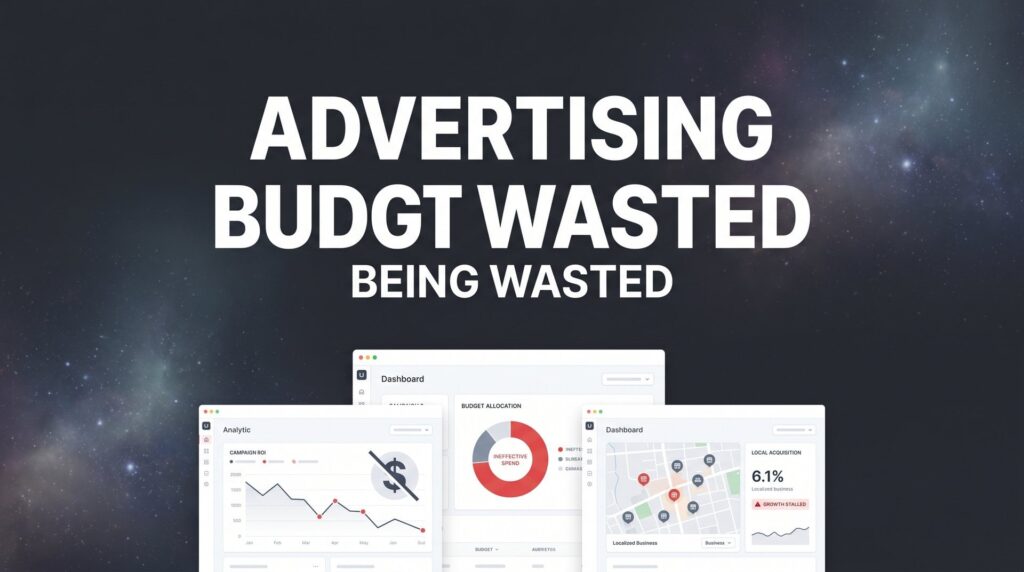
You check your advertising dashboard and see the numbers: 2,847 clicks this month. The graph trends upward. Traffic is flowing. But when you check your bank account, the math doesn’t add up. You’ve spent $4,200 on ads, generated exactly three new customers, and you’re starting to wonder if everyone who promised you that “digital advertising works” was lying to you.
They weren’t lying. But here’s the uncomfortable truth: most businesses unknowingly waste nearly half of their advertising budget on clicks that will never convert into customers. Not because advertising doesn’t work, but because small inefficiencies compound into massive budget drains that silently bleed accounts dry.
The disconnect between activity and results is the defining characteristic of failing advertising campaigns. Clicks look like progress. Impressions feel like brand building. But neither pays your bills. What separates businesses that profit from paid advertising and those that hemorrhage money isn’t budget size—it’s knowing where the leaks are and how to plug them. This article exposes the seven hidden drains killing your ROI and shows you exactly how to reclaim that wasted spend.
The Silent Budget Killers Most Business Owners Never See
The most dangerous budget drains are the ones that hide behind metrics that look good on paper. When your dashboard shows 1,500 impressions and 75 clicks, it feels like something is working. The numbers are moving in the right direction. But impressions and clicks are vanity metrics—they measure activity, not outcomes.
Think of it like this: if you owned a retail store, would you measure success by how many people walked past your window? Or by how many came inside, picked up products, and actually bought something? Impressions are people walking past. Clicks are people who glanced in your direction. Neither guarantees a sale, yet most advertising platforms train you to celebrate these hollow victories.
The real killer is how small inefficiencies compound over time. A keyword that costs $3.50 per click but converts at 0.5% instead of 2% doesn’t look catastrophic on day one. But over a month, that’s the difference between spending $175 per customer and $700 per customer. Multiply that across ten keywords, three campaigns, and six months, and you’ve burned through enough money to hire a full-time employee. Understanding why digital advertising delivers low ROI is the first step toward fixing these compounding losses.
Here’s what makes this particularly insidious: advertising platforms have zero incentive to tell you about these inefficiencies. Google Ads and Facebook don’t make money when your campaigns are lean and efficient. They make money when you spend more. Their default settings—broad match keywords, automatic audience expansion, placement across their entire network—are designed to maximize your spend, not your results.
When you launch a campaign with platform defaults, you’re essentially telling Google or Facebook: “Show my ads to as many people as possible, regardless of whether they’re likely to buy.” The platform happily obliges, your budget disappears quickly, and they’ve done exactly what you technically asked for. The question isn’t whether platforms are malicious—they’re not. They’re just optimized for their business model, not yours.
Targeting Gone Wrong: Paying for the Wrong Eyeballs
Geographic targeting sounds simple until you realize how expensive simple mistakes become. A plumber in Austin sets their geographic radius to 25 miles because they want “good coverage.” Seems reasonable. But that 25-mile radius includes areas they don’t actually service, neighborhoods where permit costs make jobs unprofitable, and zip codes where their ideal customers don’t live.
Every click from someone outside their service area is money lighting on fire. They fill out the form, the plumber calls them back, discovers they’re 30 miles away in an area they don’t cover, and both parties have wasted their time. The plumber paid $12 for that click. Multiply by 40 clicks per month from the wrong geography, and that’s $480 monthly burning for zero return.
Local businesses face a particularly brutal challenge: competing against national brands with unlimited budgets. When your roofing company bids on “roof repair,” you’re competing with HomeAdvisor, Angi, and every lead generation company that will happily sell your potential customer’s information to five of your competitors. Your $8 cost-per-click becomes $15 becomes $23 as you fight for visibility against companies that can afford to lose money on customer acquisition because they monetize differently. This is why paid search advertising for local services requires a fundamentally different approach than national campaigns.
Then there’s the audience settings disaster. Platforms offer “audience expansion” features that sound helpful: “Reach people similar to your target audience.” What this actually means is: “We’ll show your ads to people who share some vague characteristics with your audience, dramatically increasing your spend while diluting your results.”
A B2B software company targeting “marketing directors at companies with 50-200 employees” watches their cost per lead triple when Facebook decides to expand their audience to include “people interested in marketing” which apparently includes college students, MLM participants, and anyone who once clicked on a marketing-related article. The clicks keep coming. The qualified leads don’t.
But nothing burns budgets faster than keyword match type misunderstandings. A lawyer sets up a campaign for “personal injury attorney” using broad match because it’s the default setting. Within 48 hours, their ads are showing for “personal injury attorney salary,” “how to become a personal injury attorney,” “personal injury attorney jokes,” and “worst personal injury attorney stories.” If you’re new to paid search, our beginner’s guide to paid search campaigns explains how to avoid these costly match type mistakes.
They’re paying for clicks from law students researching career paths, people looking for attorney memes, and individuals reading horror stories about bad lawyers. None of these people need legal representation. All of them cost money. The attorney sees 200 clicks and wonders why nobody’s calling. The answer is simple: they’re advertising to everyone except potential clients.
The Landing Page Disconnect That Destroys Conversions
Sending paid traffic to your homepage is the digital equivalent of inviting someone to your store, then making them wander through a maze before they can find what they came for. Yet businesses do this constantly, usually because “that’s where our website starts” or “we want people to see everything we offer.”
Here’s what actually happens: someone searches “emergency water damage repair,” clicks your ad, and lands on your homepage featuring your company history, a photo slideshow of your team, links to five different services, and a generic “contact us” form. They came ready to solve an urgent problem. You gave them homework. They leave, click your competitor’s ad, and find a landing page that says “24/7 Emergency Water Damage Repair – Call Now” with a phone number in 48-point font.
Your competitor gets the customer. You paid for the click that educated them about their options. This happens hundreds of times per month, and most businesses never realize they’re functioning as an expensive research tool for their competitors’ customers. This is one of the core reasons marketing campaigns fail to drive sales—the disconnect between ad promise and landing page delivery.
Message match failures compound the problem. Your ad promises “Free Roof Inspection – No Obligation Quote in 24 Hours.” The person clicks, lands on a page about your company’s 30-year history and comprehensive roofing services, and has to hunt for any mention of the free inspection. The disconnect between what you promised and what you delivered creates friction. Friction kills conversions.
Think about your own behavior as a consumer. When you click an ad for “20% off running shoes,” you expect to land on a page about running shoes with a clear 20% discount. If you land on a general athletic wear homepage where you have to search for shoes and can’t immediately see the discount, you bounce. You don’t think “well, I’m sure the discount is here somewhere.” You think “this is annoying” and leave.
Your customers do the same thing to you. Every second of confusion, every extra click required, every moment where they have to think about what to do next—these are opportunities for them to decide that finding what they need is too much work.
Mobile experience gaps are the final conversion killer. Over 60% of paid search traffic comes from mobile devices, yet countless landing pages are desktop-first designs that barely function on phones. Buttons are too small to tap accurately. Forms require zooming and panning. Phone numbers aren’t click-to-call. The page loads slowly because it’s optimized for desktop.
Someone searching for “emergency locksmith” on their phone at 11 PM isn’t going to carefully navigate a clunky mobile experience. They’re going to hit back and call the next locksmith whose mobile page actually works. You paid for that click. Your poor mobile experience handed them to your competitor.
Measurement Blind Spots: Flying Without Instruments
Imagine flying a plane where your altimeter shows altitude from three hours ago, your fuel gauge is broken, and your compass points in the general direction of north but might be off by 30 degrees. You’d never take off. Yet this is exactly how most businesses run their advertising—making decisions based on incomplete, delayed, or fundamentally misleading data.
Attribution gaps create the most expensive blind spots. A potential customer sees your Facebook ad on Monday, thinks about it, searches your company name on Wednesday, clicks through from your Google ad, browses your site, leaves, receives your retargeting ad on Friday, clicks through, and finally converts. Which campaign gets credit for that sale?
In most tracking setups, the Friday retargeting ad gets 100% of the credit. Your Facebook ad that introduced them to your company? Zero credit. Your branded search campaign that captured them mid-funnel? Zero credit. You look at your data and conclude that retargeting is your best performer, so you increase retargeting budget. But retargeting only works because your other campaigns are feeding it prospects. Learning how Facebook remarketing ads fit into your overall funnel helps you understand this attribution puzzle.
Last-click attribution is the default setting in most platforms because it’s simple to track and makes every campaign look more effective than it actually is. But last-click tracking lies to you systematically. It overvalues bottom-of-funnel activities and undervalues everything that happens earlier in the customer journey.
The consequences are expensive. You cut budget from campaigns that aren’t getting last-click credit, not realizing those campaigns are generating awareness and consideration that your other campaigns depend on. Your overall performance drops, you can’t figure out why, and you conclude that advertising just doesn’t work for your business anymore.
Then there’s the true cost of decisions made on incomplete data. A home services company sees that their “emergency repair” keywords have a $45 cost per lead while their “routine maintenance” keywords have a $15 cost per lead. Based on this data, they shift budget toward routine maintenance. Six months later, their revenue is down 30%.
What they didn’t measure: emergency repair leads close at 60% and have an average job value of $3,500. Routine maintenance leads close at 12% and average $400. The $45 emergency lead generates $2,100 in revenue (60% × $3,500). The $15 maintenance lead generates $48 in revenue (12% × $400). They optimized for the wrong metric and destroyed their profitability. Implementing call tracking for marketing campaigns would have revealed which leads actually generated revenue.
This happens constantly because most businesses track leads, not revenue. They optimize for volume, not value. They celebrate low cost-per-lead without asking whether those leads actually turn into profitable customers. It feels like progress. It’s actually a slow-motion business failure.
The Set It and Forget It Fallacy
Campaign performance doesn’t stay static. It degrades. Sometimes gradually, sometimes suddenly, but always inevitably if left unmanaged. The campaign that delivered a $25 cost per customer in January is delivering a $75 cost per customer by June, and nobody noticed because they stopped checking after the initial setup “worked.”
Here’s what happens during those six months: your competitors adjust their bids, driving up costs. They launch new offers that make yours look less compelling. They improve their landing pages, increasing their conversion rates, which allows them to bid more aggressively. Your Quality Score drops because your ads and landing pages haven’t been updated while theirs have. The platform’s algorithm shifts, favoring different ad formats or bidding strategies.
None of these changes announce themselves. There’s no alert that says “your competitor just improved their landing page and is now winning auctions you used to dominate.” You just see your costs creeping up and your results declining, and you assume that’s normal market fluctuation. It’s not. It’s the result of active management on their part and passive neglect on yours. This is why performance marketing emphasizes continuous optimization over set-and-forget approaches.
Audience fatigue compounds the problem. The same people see your ads repeatedly, become blind to them, and stop clicking. Your click-through rate drops. The platform interprets this as your ads being less relevant, increases your costs, and shows your ads less frequently. Your performance spirals downward, and you’re paying more for worse results.
Seasonal and market shifts require constant adjustment. A tax preparation service that doesn’t dramatically increase budget in January through April is leaving money on the table during their highest-intent season. A landscaping company that doesn’t shift messaging from “spring cleanup” to “fall aeration” to “snow removal” is advertising the wrong service at the wrong time.
Most business owners lack time to actively manage campaigns. They’re running their actual business—serving customers, managing employees, handling operations. Advertising becomes something they set up once and hope continues working. The problem is that hope isn’t a strategy, and passive campaigns are dying campaigns.
The businesses winning in paid advertising treat it like a competitive sport that requires constant attention, adjustment, and optimization. They’re testing new ad copy weekly. They’re adjusting bids based on performance data. They’re pausing underperforming keywords and scaling winners. They’re updating landing pages based on conversion data. They’re treating advertising as a system that requires active management, not a set-it-and-forget-it magic button.
Reclaiming Your Wasted Ad Spend: A Recovery Roadmap
The path to stopping budget waste starts with knowing exactly where your money is going. Not where you think it’s going based on campaign names and monthly totals, but where it’s actually going at the keyword, audience, and placement level. This requires an audit that most business owners have never conducted.
Pull your last 90 days of campaign data. Export everything—keywords, audiences, placements, devices, times of day, geographic locations. Now sort by spend. Look at your top 20 spending items. For each one, calculate the actual cost per conversion, not just cost per click. How many of your highest-spending items are actually generating profitable results?
In most accounts, you’ll find that 60-70% of your budget is going to 20-30% of your campaigns, keywords, or audiences. That’s normal. What’s not normal—but extremely common—is discovering that half of that concentrated spend is generating zero conversions. You’re spending $1,500 monthly on keywords that have never produced a single customer. Nobody noticed because the account “as a whole” was generating some results. Our guide on how to increase ROI on advertising walks through exactly how to identify and eliminate these hidden budget drains.
Quick wins emerge immediately from this audit. Pause anything that’s spent more than 10× your target cost per conversion without generating a conversion. That’s not “gathering data”—that’s lighting money on fire. Tighten geographic targeting to exclude areas that consistently produce clicks but no conversions. Switch broad match keywords to phrase match or exact match to eliminate irrelevant traffic.
These changes can recover 20-40% of wasted budget within 30 days. The money doesn’t disappear—it gets reallocated to campaigns and keywords that actually work. Your total spend might stay the same, but your results improve dramatically because you’ve stopped paying for traffic that will never convert.
Next, fix your tracking. If you can’t measure which campaigns generate revenue, you can’t optimize for revenue. Implement conversion tracking that follows customers from click to purchase. Set up call tracking so you know which campaigns drive phone calls. Create unique landing pages for each major campaign so you can measure performance accurately.
This isn’t optional. Flying blind guarantees waste. You’ll make decisions based on incomplete information, optimize for the wrong metrics, and wonder why your results don’t match your effort. Businesses that track revenue per campaign, not just leads per campaign, consistently outperform those that don’t by 3-5× because they’re optimizing for the metric that actually matters.
Then optimize your landing pages. Match your landing page headline to your ad headline. Remove navigation menus that give people exits before they convert. Make your call-to-action obvious and singular. Ensure your mobile experience is fast, simple, and conversion-focused. Test different versions to see what actually improves conversion rates, not what you think should work.
Finally, implement ongoing management systems. Schedule weekly reviews of performance data. Set up automated rules that pause poor performers before they burn too much budget. Create a testing calendar for new ad copy, audiences, and offers. Treat advertising as a system that requires regular maintenance, not a one-time setup.
The businesses that win with paid advertising aren’t necessarily spending more—they’re spending smarter. They’ve eliminated waste, focused budget on what works, and built systems that prevent new waste from creeping back in. The money was always there. They just stopped letting it leak out through a hundred small holes.
Putting It All Together
Wasted advertising budget isn’t inevitable. It’s not the cost of doing business in digital marketing. It’s a symptom of fixable problems—targeting mistakes, measurement gaps, optimization neglect, and platform defaults that prioritize their revenue over your results.
The uncomfortable reality is that most businesses are losing nearly half their advertising spend to these hidden drains. The encouraging reality is that those leaks can be plugged, often quickly and with immediate impact on ROI. The difference between businesses that profit from advertising and those that hemorrhage money isn’t budget size or market conditions. It’s knowing where the waste occurs and having systems in place to prevent it.
Your competitors who are winning with paid advertising aren’t smarter or luckier. They’re just more systematic. They audit regularly, track accurately, optimize continuously, and treat advertising as a competitive advantage that requires active management. They’ve turned advertising from an expensive hope into a predictable system for customer acquisition.
The question isn’t whether your advertising budget is being wasted—if you’re not actively managing and optimizing, it almost certainly is. The question is whether you’re going to continue accepting that waste as normal, or whether you’re ready to plug those leaks and turn your advertising into a profitable growth engine.
Tired of spending money on marketing that doesn’t produce real revenue? We build lead systems that turn traffic into qualified leads and measurable sales growth. If you want to see what this would look like for your business, we’ll walk you through how it works and break down what’s realistic in your market.