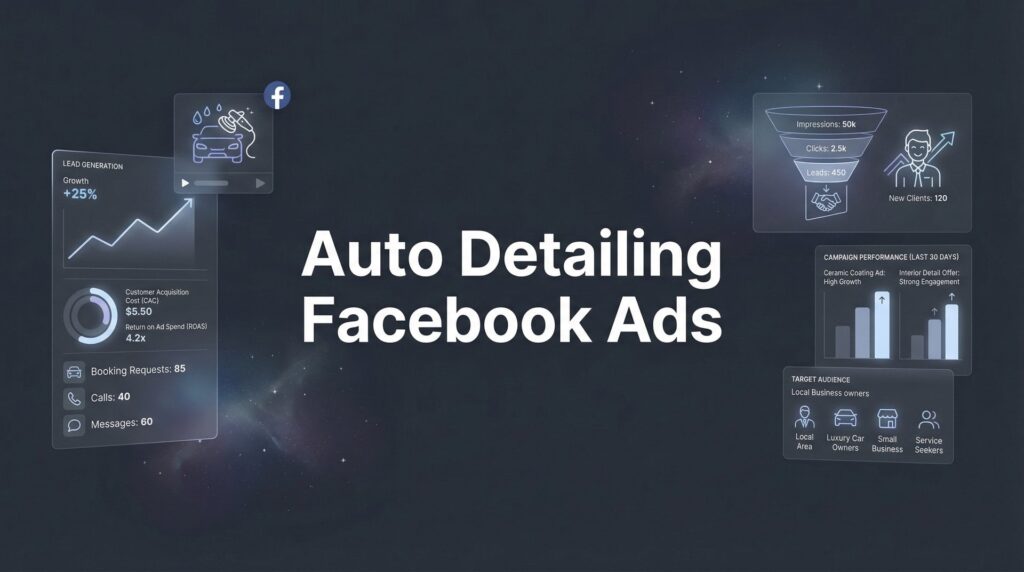
Your detailing bay sits empty while competitors down the street stay booked solid. You know your work is better—the swirl-free paint corrections, the mirror-like finishes, the interior transformations that make ten-year-old cars look showroom fresh. But none of that matters if potential customers never see what you can do.
Facebook advertising has become the secret weapon for auto detailing businesses looking to fill their calendars with high-paying customers. The platform’s visual nature is perfect for showcasing dramatic before-and-after transformations, while its targeting capabilities let you reach car enthusiasts and vehicle owners in your exact service area.
But here’s the problem: most detailers waste money on generic ads that scroll right past potential customers. They boost a few posts, throw some budget at random images, and wonder why their phone isn’t ringing.
This guide reveals the specific strategies that separate profitable auto detailing Facebook campaigns from expensive failures—tactics designed to turn scrollers into booked appointments. These aren’t theoretical concepts. They’re the exact approaches that fill detailing calendars while competitors complain that “Facebook ads don’t work.”
1. Before-and-After Transformation Content That Stops the Scroll
The Challenge It Solves
Facebook users scroll fast. Really fast. Your ad has maybe half a second to capture attention before it disappears into the feed forever. Generic photos of clean cars don’t cut it—they look like every other car wash or detailing ad competing for attention.
The transformation format works because it creates an instant visual story. The human brain is wired to notice contrast and change. When someone sees a neglected, swirl-covered hood transform into mirror-like perfection in a split-screen image, they stop scrolling. That pause is everything.
The Strategy Explained
Your before-and-after content needs to showcase dramatic transformations that make people think “I didn’t know that was possible.” Focus on the most visually striking work you do—paint corrections that remove years of swirls, interior restorations that look impossible, headlight restorations that go from cloudy yellow to crystal clear.
The key is contrast. Don’t just show clean versus dirty. Show transformation that seems almost unbelievable. A slightly dusty car cleaned up doesn’t create impact. A paint surface covered in swirls and scratches transformed to mirror perfection does.
Video performs even better than static images for this format. A 15-second video that shows the before state, then transitions to the after result, then pans across the finished work creates multiple moments of visual impact. Add text overlay that calls out the specific service: “Paint Correction – 5 Years of Swirls Removed.”
Implementation Steps
1. Document your most dramatic transformations with consistent lighting and angles—take before photos from the exact same position and distance as your after photos for maximum visual impact.
2. Create split-screen images using free tools like Canva or paid options like Adobe Photoshop, ensuring the dividing line is perfectly vertical to emphasize the contrast between before and after states.
3. Test multiple transformation types in separate ad sets—paint correction, interior restoration, headlight restoration, and ceramic coating applications each appeal to different customer segments and pain points.
Pro Tips
Include the vehicle make and model in your ad copy. “2018 BMW 3-Series Paint Correction” performs better than generic descriptions because it helps viewers imagine their own vehicle transformed. Also, mention the time investment: “6-Hour Paint Correction” justifies your premium pricing by demonstrating the thoroughness of your work. For more creative approaches, explore these auto detailing advertising ideas that can complement your Facebook strategy.
2. Precision Geographic and Interest Targeting That Reaches Ready Buyers
The Challenge It Solves
Broad targeting wastes money showing your ads to people who will never become customers. Someone thirty miles outside your service area might love your work, but they’re not driving that distance for detailing. Someone who drives a fifteen-year-old economy car with 200,000 miles probably isn’t your ideal customer for a $500 paint correction.
Facebook’s targeting tools let you get incredibly specific about who sees your ads, but most detailers either target too broadly (wasting budget) or too narrowly (missing potential customers). The sweet spot is targeting people who own the right vehicles, live in the right area, and have demonstrated interest in vehicle care.
The Strategy Explained
Start with geographic targeting based on realistic drive times to your location. For mobile detailing, this might be a 15-mile radius. For a fixed location offering premium services, you might target a 25-mile radius around affluent neighborhoods where your ideal customers live.
Layer in interest targeting that identifies car enthusiasts and people who care about vehicle appearance. Facebook lets you target based on interests like luxury vehicles, car modifications, automotive detailing products, specific car brands (BMW, Mercedes, Audi, Tesla), and automotive publications.
The magic happens when you combine geographic and interest targeting. You’re not just reaching everyone in your area—you’re reaching vehicle owners in your area who have demonstrated they care about their cars through their Facebook behavior. Understanding the nuances of Facebook ads for local business targeting can dramatically improve your campaign performance.
Implementation Steps
1. Create separate campaigns for different service tiers—one targeting luxury vehicle owners with premium services, another targeting everyday vehicle owners with maintenance packages, ensuring your ad creative and pricing match each audience’s expectations.
2. Use Facebook’s detailed targeting options to include interests like “Car detailing,” “Luxury vehicles,” “BMW,” “Tesla,” “Car modification,” and “Auto racing” while excluding interests that indicate DIY preferences like “Car wash supplies” or “Detailing products.”
3. Test lookalike audiences based on your existing customer list—upload your customer email list or phone numbers to Facebook, then create a lookalike audience of people who share characteristics with your best customers.
Pro Tips
Don’t ignore the age and income targeting options. Someone in their early twenties driving a used economy car has different service needs than someone in their forties driving a luxury SUV. Create separate ad sets for these demographics with appropriate service offerings and price points for each segment.
3. First-Time Customer Offers That Convert Without Devaluing Your Services
The Challenge It Solves
New customers don’t know you yet. They’ve never experienced your work, don’t understand the difference between your services and the $20 car wash down the street, and aren’t ready to invest $400 in paint correction from someone they found on Facebook.
But if you discount too heavily, you attract price shoppers who will never become regular customers and you train the market to expect low prices. The goal is creating an offer that lowers the barrier to trying your services while still maintaining your premium positioning.
The Strategy Explained
The most effective first-time customer offers focus on entry-level services that showcase your quality without requiring huge commitments. Think “Interior Detail Special – First-Time Customers $99” rather than slashing prices on your premium services.
This approach accomplishes three things. First, it gives hesitant customers a low-risk way to experience your work quality. Second, it gets their vehicle in your bay where you can identify additional services they need. Third, it preserves your premium pricing on higher-ticket services for customers who are ready to invest.
The offer structure matters as much as the discount. “First-Time Customer Special” sounds exclusive and time-sensitive. “New Customer Discount” sounds desperate. Frame your offer as welcoming new clients into your service family, not begging for business. If your current campaigns aren’t producing results, you may need to diagnose why your Facebook ads aren’t converting before investing more budget.
Implementation Steps
1. Select an entry-level service that demonstrates your quality—exterior wash and wax, interior detail, or headlight restoration work well because they’re affordable enough to attract trial customers while showcasing your attention to detail.
2. Create urgency with clear expiration dates or limited availability—”This Week Only: 10 Spots Available” or “New Customer Special – Valid Through Month End” converts better than open-ended offers that prospects can ignore indefinitely.
3. Build an upsell path into your booking process—when customers book the entry offer, present them with package options that include additional services at bundled pricing, capturing higher-value bookings from ready buyers.
Pro Tips
Include the regular price in your ad creative. “Interior Detail – Regularly $149, First-Time Customers $99” creates perceived value and anchors the discount against your normal pricing. This prevents customers from thinking $99 is your standard rate and expecting that price on future visits.
4. Retargeting Systems That Convert Warm Leads Into Booked Appointments
The Challenge It Solves
Most people don’t book detailing services the first time they see your ad. They might be at work, scrolling mindlessly, or not ready to schedule yet. They think “that looks good, I should do that sometime” and then forget about you completely as they continue scrolling.
You’ve paid to get their attention, sparked their interest, and then lost them forever. That’s expensive. Retargeting solves this by staying in front of people who have already shown interest in your services, dramatically increasing conversion rates while lowering your cost per booking.
The Strategy Explained
Retargeting works by showing follow-up ads specifically to people who have already interacted with your business. Someone who clicked your ad, visited your website, or watched your video sees different ads than cold traffic—ads designed to overcome specific objections and push them toward booking.
The most effective retargeting sequences use a three-tier approach. First, you retarget people who engaged with your content but didn’t visit your website—show them social proof and customer results. Second, you retarget website visitors who didn’t book—address common objections and offer time-sensitive incentives. Third, you retarget people who started but didn’t complete booking—remove final barriers with simplified scheduling or direct contact options. For a comprehensive breakdown of this approach, read our guide on Facebook remarketing ads strategies.
Each retargeting audience sees progressively more direct calls to action. Your cold traffic ads might focus on showcasing results. Your retargeting ads say “You checked us out earlier this week—ready to book? Here’s a direct link to our calendar.”
Implementation Steps
1. Install the Facebook Pixel on your website immediately—this tracking code captures every visitor and lets you build custom audiences of people who viewed specific pages, spent certain amounts of time on site, or took specific actions.
2. Create custom audiences for different engagement levels—separate audiences for video viewers (watched 50% or more), website visitors (any page), service page viewers (people who looked at specific services), and booking page visitors who didn’t complete scheduling.
3. Build retargeting campaigns with messaging that addresses why they didn’t book initially—use testimonials to overcome trust concerns, showcase your facility or process to address quality questions, and include time-sensitive offers to create urgency for fence-sitters.
Pro Tips
Set frequency caps on your retargeting campaigns so you don’t annoy people by showing them the same ad fifteen times in three days. Showing your retargeting ads two to three times per week strikes the balance between staying top-of-mind and becoming obnoxious. Also, exclude people who already booked appointments—there’s no point spending money to advertise to customers who are already scheduled.
5. Process Videos That Justify Premium Pricing Through Demonstrated Expertise
The Challenge It Solves
Price objections kill detailing bookings. Potential customers see your $300 interior detail and think “I can get my car detailed for $50 at the car wash.” They don’t understand the difference between a quick vacuum and wipe-down versus the meticulous process you use to actually restore their interior.
Process videos solve this by showing exactly what goes into your services. When someone watches you spend three minutes just on cleaning the air vents with specialized tools, they start to understand why your services cost more. You’re not just charging premium prices—you’re delivering premium results through premium processes.
The Strategy Explained
Process videos work as educational content that simultaneously builds trust and justifies pricing. They show potential customers the tools you use, the techniques you employ, the attention to detail you bring, and the time investment required to deliver exceptional results.
The most effective process videos focus on specific techniques that demonstrate expertise. A video showing your paint correction process—clay bar treatment, compound application, polishing stages, final inspection under specialized lighting—educates viewers while showcasing capabilities they didn’t know existed. Combining video content with strong auto detailing SEO practices helps these assets generate organic traffic long after your ad campaigns end.
These videos perform double duty in your Facebook advertising. They work as top-of-funnel content that attracts interest from people who appreciate quality, and they work as retargeting content that overcomes price objections by demonstrating value.
Implementation Steps
1. Film short process videos (30-60 seconds) showing specific high-value techniques—paint correction under inspection lights, steam cleaning interior crevices, ceramic coating application and curing, or engine bay detailing with specialized degreasers and protectants.
2. Add text overlays that call out specific steps and time investments—”Step 3: Clay Bar Treatment to Remove Embedded Contaminants” or “This Process Takes 4 Hours” helps viewers understand the thoroughness of your approach.
3. Create separate ad campaigns for different process videos targeting people interested in specific services—paint correction videos to luxury car owners, interior restoration to families with kids, ceramic coating to new car buyers protecting their investment.
Pro Tips
Shoot your process videos in real time, not sped up. Watching you slowly, methodically work on a paint panel for thirty seconds communicates care and precision better than a quick time-lapse. The goal isn’t entertainment—it’s demonstrating that you don’t rush, you don’t cut corners, and you deliver results worth paying for.
6. Social Proof Integration That Builds Instant Credibility With Skeptical Prospects
The Challenge It Solves
Nobody wants to be the first customer to try an unknown detailing service. The stakes feel too high—their vehicle is often their second-largest investment, and they’re trusting you not to damage it. Without social proof, you’re asking prospects to take a leap of faith based solely on your claims about quality.
Reviews and testimonials from real customers short-circuit this skepticism. When someone sees that fifty other people trusted you with their vehicles and loved the results, the perceived risk drops dramatically. Social proof transforms you from an unknown option into a validated choice.
The Strategy Explained
The most effective social proof integration uses actual customer reviews and testimonials directly in your ad creative. This means screenshot reviews from Google, Facebook, or Yelp and incorporating them into your ad images, or using video testimonials from satisfied customers as your ad content.
Specific testimonials outperform generic praise. “Great service!” doesn’t convince anyone. “I thought the swirls in my black BMW were permanent. After the paint correction, my car looks better than when I bought it new. Worth every penny of the $450.” tells a story, addresses a specific pain point, mentions a specific vehicle type, and validates your pricing. Learning how to generate qualified leads online involves mastering this type of trust-building content.
The key is matching testimonials to your targeting. Show luxury vehicle testimonials to luxury vehicle owners. Show family vehicle testimonials to parents. Show performance car testimonials to enthusiasts. The prospect needs to see themselves in the customer providing the testimonial.
Implementation Steps
1. Collect detailed testimonials from satisfied customers by asking specific questions—what was the condition before, what specific results did you see, what surprised you most, would you recommend this service and why.
2. Create ad variations that feature different testimonials with photos of the customer’s vehicle—pair each testimonial with before-and-after images of that specific customer’s car to maximize credibility and visual impact.
3. Highlight your aggregate ratings prominently in ad copy—”4.9 Stars from 200+ Reviews” or “Rated #1 Auto Detailing in [City]” in your ad headline immediately establishes credibility before prospects even read your offer.
Pro Tips
Video testimonials convert better than text reviews because they’re harder to fake and more emotionally compelling. Ask satisfied customers if you can record a quick 30-second video testimonial in exchange for a discount on their next service. Most happy customers will gladly help you, and the resulting content is advertising gold that builds trust instantly.
7. Mobile Landing Pages Designed for Facebook’s Thumb-Scrolling Traffic
The Challenge It Solves
Most Facebook users access the platform on mobile devices. When they click your ad, they’re on a phone, probably scrolling with one hand, possibly standing in line or sitting in traffic. If your landing page loads slowly, requires zooming to read text, or makes booking complicated, they’re gone in seconds.
You’ve paid for the click. You’ve captured their interest. Then you lose them because your website wasn’t designed for mobile traffic. This is like paying for customers to walk through your front door, then slamming it in their face.
The Strategy Explained
Mobile landing pages need to be radically simplified compared to desktop sites. One clear headline. One compelling offer. One obvious call-to-action button. Minimal text. Fast loading. Everything optimized for someone making a decision in fifteen seconds while holding a phone.
The most effective mobile landing pages follow a simple structure: headline with your offer, three to five bullet points highlighting key benefits, social proof (star rating or testimonial count), large prominent booking button, and optional FAQ section below the fold. That’s it. No complex navigation, no lengthy explanations, no distractions. If you’re also running search campaigns, consider how Google Ads for auto detailing can complement your Facebook efforts with intent-based traffic.
Your booking process matters as much as your landing page design. If clicking “Book Now” takes them to a complex scheduling system with twelve dropdown menus and required fields, you’ll lose them. The best mobile booking experiences use simple calendar interfaces, minimal required information, and confirmation in two or three taps.
Implementation Steps
1. Create dedicated landing pages for each major service offering—don’t send all Facebook traffic to your homepage, create specific pages for interior detailing, paint correction, ceramic coating, and other services with messaging that matches your ad copy.
2. Test your landing page speed using Google PageSpeed Insights and optimize until you achieve load times under three seconds—compress images, minimize code, use fast hosting, and eliminate anything that slows down the initial page load.
3. Implement click-to-call functionality prominently on mobile landing pages—many prospects prefer calling to book, especially for premium services, so make your phone number a large tappable button that instantly initiates a call.
Pro Tips
Use Facebook Lead Ads for the ultimate mobile-friendly experience. These ads let people submit their information without ever leaving Facebook—they tap your ad, their contact information auto-fills from their Facebook profile, they hit submit, and you receive their lead. This eliminates the landing page entirely for initial lead capture, though you’ll still need to follow up to convert leads into booked appointments.
Your Implementation Roadmap
Start with strategy one and strategy two as your foundation. Create compelling before-and-after content and target it to the right geographic and interest-based audiences. These two strategies alone will start generating leads for your detailing business.
Once you’re generating consistent traffic, implement strategy three—the first-time customer offer that converts cold traffic into booked appointments. Test different entry-level services and price points to find what works best in your market.
Layer in strategy four next. Set up your Facebook Pixel, build retargeting audiences, and create follow-up campaigns for people who engaged but didn’t book. This is where your cost per booking drops significantly because you’re focusing budget on warm leads instead of just cold traffic.
Strategies five and six—process videos and social proof—work as content assets you develop over time. Film one process video per week. Collect one detailed testimonial from every satisfied customer. Build your library of trust-building content that you can rotate through your campaigns.
Strategy seven—mobile optimization—should be happening in parallel with everything else. Every landing page you create, every booking form you implement, needs to work flawlessly on mobile devices from day one.
The auto detailing businesses that dominate Facebook advertising aren’t necessarily spending more money than their competitors. They’re executing these fundamentals better. They understand that Facebook advertising for service businesses is about showcasing transformation, building trust, and making booking effortless.
Most detailers will read this guide and do nothing. They’ll keep running the same generic ads that produce mediocre results. They’ll keep wondering why their calendar has gaps while competitors stay booked solid.
The opportunity exists precisely because most of your competition won’t implement these strategies. They’ll keep wasting money on boosted posts and random ads that look nice but don’t drive bookings.
These strategies work, but only when implemented correctly. The difference between profitable Facebook advertising and wasted budget comes down to execution details—the specific targeting parameters you choose, the way you structure your offers, how you follow up with leads, whether your landing pages actually convert mobile traffic.
Tired of spending money on marketing that doesn’t produce real revenue? We build lead systems that turn traffic into qualified leads and measurable sales growth. If you want to see what this would look like for your business, we’ll walk you through how it works and break down what’s realistic in your market.
Want More Leads for Your Business?
Most agencies chase clicks, impressions, and “traffic.” Clicks Geek builds lead systems. We uncover where prospects are dropping off, where your budget is being wasted, and which channels will actually produce ROI for your business, then we build and manage the strategy for you.