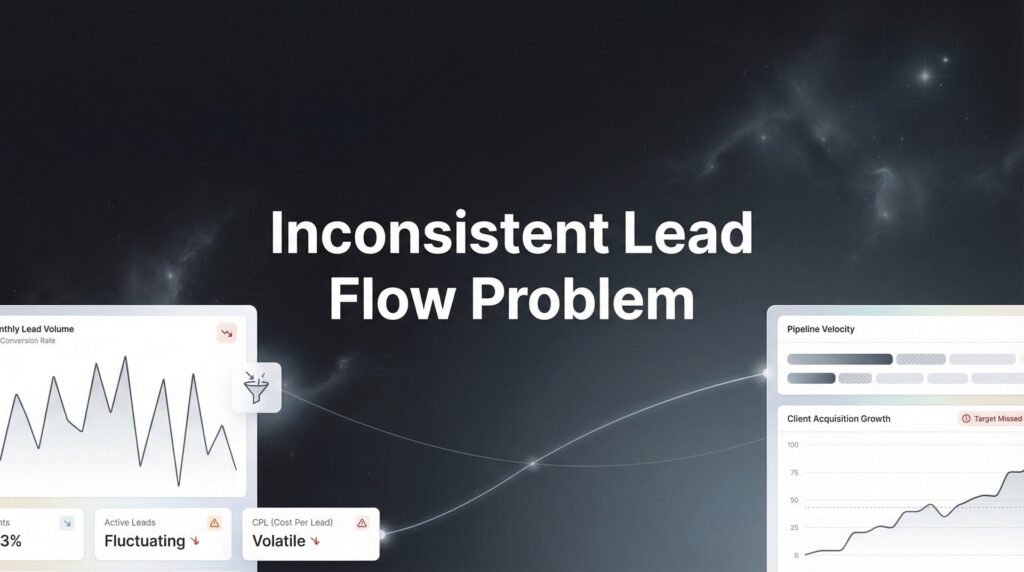
You know the feeling. One week your phone won’t stop ringing, and the next week it’s so quiet you’re wondering if your website is even working. This feast-or-famine cycle isn’t just frustrating—it’s actively sabotaging your business growth, making it impossible to plan staffing, manage cash flow, or scale with confidence.
The inconsistent lead flow problem is one of the most common challenges local business owners face, yet most try to solve it by simply “doing more marketing” without understanding why their lead generation is so unpredictable in the first place.
The truth is that consistent lead flow doesn’t happen by accident. It requires a systematic approach that combines multiple channels, tracks the right metrics, and creates redundancy in your acquisition strategy.
In this guide, you’ll learn exactly how to diagnose what’s causing your lead inconsistency, build a multi-channel system that generates predictable results, and finally break free from the revenue rollercoaster that’s been holding your business back.
Step 1: Diagnose Where Your Lead Leaks Are Happening
Before you can fix your inconsistent lead flow problem, you need to understand exactly where it’s coming from. Most business owners have a vague sense of which channels bring in leads, but they can’t tell you the actual numbers.
Start by mapping every lead source you’ve used in the past 90 days. Create a simple spreadsheet that lists each channel—Google Ads, organic search, referrals, social media, email marketing, directory listings—and count how many leads came from each one monthly.
Calculate the percentage each channel contributes to your total lead volume. This is where most businesses discover their vulnerability: if one channel provides 70% or more of your leads, you have a single-source dependency problem. When that channel hiccups, your entire business feels it.
Picture this: you’re relying heavily on referrals, which brought you 80% of your leads last quarter. Then your biggest referral partner retires or switches industries. Your lead flow doesn’t just dip—it collapses.
Next, track your lead volume week by week for the past three months. Don’t just look at monthly totals. Weekly tracking reveals patterns that monthly averages hide. You might discover that leads spike at the beginning of each month but crater in weeks three and four. Or that certain weeks consistently underperform due to seasonal factors you hadn’t noticed.
Look for conversion bottlenecks in your data. If you’re getting plenty of website traffic but few actual leads, the problem isn’t visibility—it’s conversion. Your landing pages, contact forms, or offers likely need work. Traffic without leads means people are interested enough to click but not compelled enough to reach out.
Check your Google Analytics or website tracking to see where visitors drop off. Are they bouncing from your homepage? Abandoning your contact form halfway through? These patterns tell you exactly where to focus your optimization efforts.
The diagnosis phase isn’t glamorous, but it’s essential. You can’t fix what you can’t measure, and most inconsistent lead generation for small business problems stem from blind spots in your tracking and over-reliance on channels you can’t control.
Step 2: Build Your Always-On Lead Foundation with PPC
Once you’ve identified your vulnerabilities, it’s time to build stability. The most controllable and scalable lead source available to local businesses is paid search advertising, specifically PPC campaigns on Google.
Why PPC first? Because it’s the only channel where you can directly control lead volume through budget adjustments. Need more leads this week? Increase your daily budget. Need to dial it back? Decrease it. This level of control doesn’t exist with organic channels, referrals, or even social media advertising.
Start by setting up campaigns that target high-intent keywords specific to your service. These are searches where people are actively looking for what you offer right now—not just browsing or researching. Think “emergency plumber near me” rather than “how to fix a leaky faucet.”
High-intent keywords typically include modifiers like “near me,” “services,” “company,” “hire,” or location-specific terms. They signal that someone is ready to make a decision, not just gathering information.
Establish daily budgets that guarantee minimum lead volume regardless of what’s happening with your other channels. If you need at least 10 leads per week to maintain operations, calculate what daily budget delivers that baseline. This becomes your safety net—the floor below which your lead flow never drops.
Here’s where most businesses go wrong: they send PPC traffic to their homepage. Don’t do this. Create dedicated landing pages designed specifically to convert paid traffic into inquiries. These pages should have one clear goal, minimal navigation distractions, and a prominent contact form or phone number.
Your landing page should speak directly to the search intent. If someone searches “roof repair Atlanta,” they should land on a page about roof repair in Atlanta—not your general roofing services homepage. Relevance drives conversion rates, and conversion rates determine whether your PPC investment pays off.
Include trust signals like reviews, certifications, years in business, and guarantees. Paid traffic is often skeptical traffic. They know you paid to show up in their search results, so you need to work harder to establish credibility.
The beauty of PPC as your foundation is predictability. Once you know your average cost per click and conversion rate, you can calculate exactly how much budget you need to generate your target lead volume. This transforms marketing from guesswork into math. If you’re struggling with high cost per lead, optimizing your landing pages and targeting is often the fastest fix.
Step 3: Layer in Organic Channels for Long-Term Stability
PPC gives you control, but organic channels give you sustainability. While paid advertising requires constant budget to maintain lead flow, organic strategies compound over time, eventually providing leads at a fraction of the cost.
Develop content that captures search demand at different stages of the buyer journey. Not everyone who searches is ready to buy today. Some are just starting to research their problem, others are comparing solutions, and only a small percentage are ready to make a decision immediately.
Create content for each stage. Educational blog posts answer early-stage questions and build awareness. Service pages target mid-stage comparison searches. Location-specific pages capture bottom-of-funnel “near me” searches.
Optimize your Google Business Profile aggressively. For local businesses, showing up in the map pack often drives more qualified leads than ranking first in organic results. Complete every section of your profile, upload high-quality photos regularly, post updates weekly, and respond to every review.
Build review generation systems that run automatically. Reviews compound your credibility over time and directly influence your local search rankings. Set up email sequences that ask satisfied customers for reviews at the optimal moment—right after you’ve delivered great results but before the positive experience fades.
Make leaving a review as easy as possible. Send direct links to your Google Business Profile review page. Don’t just say “leave us a review”—tell them exactly where and how, then remove every friction point from the process.
Organic channels take longer to produce results than paid advertising. You won’t see significant lead flow from content marketing in the first month or even the first quarter. But this is precisely why they provide insulation against rising ad costs and market changes. Understanding the full scope of lead generation for local business helps you build a sustainable system.
When your organic presence is strong, you’re less dependent on paid channels. If ad costs spike or your budget gets cut, your organic traffic continues delivering leads. This redundancy is what transforms unpredictable lead flow into consistent growth.
Step 4: Create a Retargeting System That Recaptures Lost Opportunities
Most businesses focus exclusively on new traffic, but they’re ignoring their warmest opportunities: people who already visited their website but didn’t convert. These visitors are significantly more likely to become leads than cold traffic, yet most businesses let them disappear forever.
Install tracking pixels on your website immediately. Facebook Pixel, Google Ads remarketing tag, and LinkedIn Insight Tag all allow you to build custom audiences of website visitors. These audiences become the foundation of your retargeting campaigns.
Set up retargeting campaigns specifically for visitors who didn’t convert on their first visit. Show them ads that remind them of your services, highlight different benefits, or offer an incentive to take action. The goal is to stay visible during their decision-making process.
Think about your own buying behavior. How often do you purchase something the first time you visit a website? Rarely. You browse, compare options, get distracted, and come back later when you’re ready to decide. Your prospects do the same thing.
Retargeting keeps you in consideration during that research phase. When they’re ready to make a decision, your brand is still top of mind because they’ve seen your ads multiple times across different platforms. Choosing between Google Ads vs Facebook Ads for lead generation depends on where your audience spends their time online.
Use email sequences to nurture leads who aren’t ready to buy immediately. If someone downloads a guide, requests a quote, or fills out a contact form but doesn’t move forward, they enter a nurture sequence that provides value over time. Share case studies, answer common objections, and make it easy for them to re-engage when timing improves.
Calculate how much revenue you’re losing by not following up with warm traffic. If your website gets 1,000 visitors per month and converts at 2%, you’re generating 20 leads. But that means 980 people visited and left without converting. If retargeting could convert just 1% of those lost visitors, that’s nearly 10 additional leads per month—a 50% increase in lead volume without spending more on new traffic.
The math gets even more compelling when you consider that retargeting typically costs less per conversion than cold traffic campaigns. You’re advertising to people who already know who you are, which means higher engagement rates and lower costs.
Step 5: Establish Lead Flow Monitoring and Early Warning Systems
Consistent lead flow requires consistent monitoring. Most businesses only look at their lead numbers when they notice a problem, but by then they’re already in crisis mode. You need systems that catch drops before they become emergencies.
Set up weekly lead tracking dashboards that show trends over time. Don’t just count total leads—track them by source, by week, and by conversion rate. Use a simple spreadsheet or a tool like Google Data Studio to visualize the data so patterns become obvious at a glance. The best lead generation tools include built-in analytics that make this tracking automatic.
Define minimum acceptable lead thresholds for your business. What’s the lowest weekly lead volume you can sustain without impacting operations? That number becomes your red line. When lead flow approaches that threshold, you trigger immediate action rather than waiting to see if things improve on their own.
Create response protocols for different severity levels. If leads drop 20% from your baseline, what do you do? If they drop 40%? If they drop 60%? Having predetermined responses eliminates the panic and indecision that often makes problems worse.
Your 20% drop protocol might include reviewing recent campaign changes, checking for technical issues, and increasing retargeting budgets. Your 40% drop protocol might involve emergency budget increases on proven channels and launching new promotional campaigns. Your 60% drop protocol should include all of the above plus immediate consultation with your marketing team or agency.
Track leading indicators, not just lagging ones. Lead volume is a lagging indicator—by the time it drops, the problem has already been developing for days or weeks. Leading indicators like impression share, click-through rates, and website traffic give you early warning signs.
If your impression share drops, you’re losing visibility in search results. If your click-through rate declines, your ads or listings are becoming less compelling. If your website traffic decreases, your top-of-funnel channels are underperforming. These signals appear before lead volume drops, giving you time to respond proactively.
Weekly reviews beat monthly reviews every time. Monthly reviews tell you what happened last month, when it’s too late to salvage those lost leads. Weekly reviews let you spot trends early and make adjustments while you still have time to recover.
Step 6: Build Redundancy with a Multi-Channel Budget Strategy
The final step in solving your inconsistent lead flow problem is building true redundancy into your marketing budget. This means distributing your investment across multiple channels so that no single failure can tank your entire lead generation system.
Allocate marketing budget across at least three distinct channels. If you’re spending $3,000 per month on marketing, don’t put it all into Google Ads. Split it between paid search, organic content development, and retargeting campaigns. Or between Google Ads, Facebook Ads, and local SEO. The specific mix matters less than the diversification itself.
Keep reserve budget available to scale winning channels when others underperform. Think of this as your marketing emergency fund. If one channel suddenly becomes less effective, you can shift that reserve budget to channels that are performing well, maintaining overall lead volume while you diagnose and fix the underperforming channel.
This flexibility is what separates businesses with consistent lead flow from those riding the revenue rollercoaster. When you’re locked into fixed budgets with no ability to shift resources, you’re forced to accept whatever results each channel delivers that month.
Test new channels quarterly so you always have options in development. Don’t wait until your current channels fail to start exploring alternatives. Dedicate a small portion of your budget—maybe 10-15%—to testing new platforms, strategies, or approaches each quarter. Exploring lead generation strategies for businesses can reveal untapped opportunities in your market.
These tests might not produce immediate results, but they give you data about what works in your market. When you eventually need to scale or diversify, you’re not starting from zero. You already know which channels show promise and which ones don’t fit your business.
Review and rebalance your channel mix monthly based on cost-per-lead performance. Just because you started the quarter with budget split evenly across three channels doesn’t mean you should end it that way. If one channel is delivering leads at $50 each while another costs $200 per lead, shift budget toward the more efficient channel.
This doesn’t mean abandoning higher-cost channels entirely. Sometimes those channels reach different audiences or provide other strategic value. But your budget allocation should reflect actual performance, not arbitrary percentages you set months ago. Understanding lead generation services cost benchmarks helps you evaluate whether your channels are performing competitively.
Document what you learn from each channel. Which audiences respond best? What messaging works? What times of year perform strongest? This institutional knowledge becomes increasingly valuable as you refine your approach over time.
Putting It All Together
Solving your inconsistent lead flow problem isn’t about finding one magic channel—it’s about building a system with multiple touchpoints, clear tracking, and the flexibility to adapt when market conditions change.
Start by diagnosing your current vulnerabilities. Map your lead sources, identify single-source dependencies, and track weekly patterns that monthly averages hide. You can’t fix problems you can’t see.
Then systematically layer in paid, organic, and retargeting channels that work together. PPC gives you controllable baseline lead volume. Organic channels provide long-term stability and lower costs. Retargeting recaptures opportunities you’d otherwise lose forever.
Build monitoring systems that catch problems early. Weekly dashboards, defined thresholds, and response protocols transform you from reactive to proactive. You stop fighting fires and start preventing them.
Finally, create budget redundancy across multiple channels. Diversification protects you from the inevitable fluctuations that affect every marketing channel eventually. When one dips, others compensate.
The businesses that achieve predictable growth are the ones that treat lead generation as an ongoing system rather than a series of one-off campaigns. They understand that consistency comes from redundancy, monitoring, and continuous optimization.
Use this checklist to get started: audit your lead sources this week, identify your biggest single-point-of-failure, and take action to add redundancy where you need it most. Calculate your minimum acceptable weekly lead volume and set up tracking that alerts you when you’re approaching that threshold.
Review your landing pages and conversion paths. Are you making it easy for prospects to become leads, or are you creating unnecessary friction? Small improvements in conversion rates can dramatically increase lead volume without spending more on traffic.
Most importantly, commit to weekly reviews instead of monthly check-ins. The difference between catching a 15% lead drop in week one versus discovering a 60% drop at month-end is the difference between a minor adjustment and a full-blown crisis.
Tired of spending money on marketing that doesn’t produce real revenue? We build lead systems that turn traffic into qualified leads and measurable sales growth. If you want to see what this would look like for your business, we’ll walk you through how it works and break down what’s realistic in your market.