You’re staring at two marketing proposals on your desk. One promises “guaranteed impressions” through local radio and billboard placements—$5,000 upfront, results uncertain. The other offers Google Ads with “pay only for clicks”—no minimum spend, track every conversion. Both sales reps swear their approach is better. Both have compelling case studies. And you’re left wondering: which one actually drives revenue for a business like yours?
This isn’t just a budget decision. It’s a fundamental question about how you acquire customers and grow your business. Performance marketing promises accountability—you pay for results, track every dollar, and optimize in real-time. Traditional advertising offers something different: broad reach, local presence, and the kind of brand recognition that can’t always be measured in a spreadsheet.
Here’s what most marketing advice gets wrong: they treat this as an either-or choice. Performance marketing versus traditional advertising. Digital versus legacy. New school versus old school. That binary thinking costs local businesses thousands in wasted spend every year.
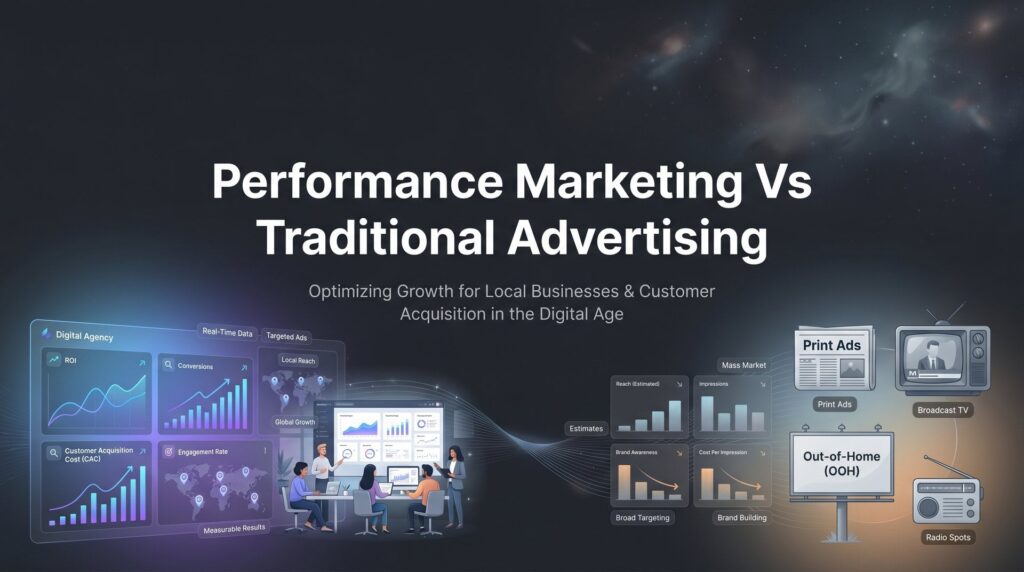
The reality? The best marketing strategies use both approaches strategically. Performance marketing drives immediate, measurable results. Traditional advertising builds the brand equity and market presence that makes your performance campaigns more effective. The question isn’t which one to choose—it’s how to evaluate both for your specific situation and build a mix that maximizes ROI.
This guide breaks down seven practical strategies to make that evaluation. You’ll learn how to calculate true costs, match your budget to the right model, and build a hybrid approach that leverages the strengths of both. Whether you’re spending $1,000 or $100,000 monthly, these frameworks will help you make smarter decisions about where every marketing dollar goes.
1. Define Your Primary Marketing Objective First
The Challenge It Solves
Most local businesses start with the channel instead of the goal. They ask “Should we do Facebook ads or radio?” before clarifying what they’re actually trying to achieve. This backwards approach leads to mismatched expectations and disappointing results. A campaign optimized for immediate lead generation looks completely different from one designed to build brand recognition, even if they use the same channels.
The Strategy Explained
Before evaluating any marketing channel, get crystal clear on your primary objective. Performance marketing excels at direct response goals: generating leads, driving sales, capturing email signups, booking appointments. It’s built for measurable actions with short conversion windows. Traditional advertising shines for awareness and positioning: establishing your business as the go-to option in your market, building trust with audiences who aren’t ready to buy yet, creating top-of-mind awareness for when purchase decisions happen.
Think of it this way: if you need 50 qualified leads next month to hit your revenue target, performance marketing gives you the tools to make that happen. If you need your brand to be the first name people think of when they need your service six months from now, traditional advertising builds that mental real estate.
Implementation Steps
1. Write down your specific goal with a number and timeline: “Generate 40 qualified leads in the next 30 days” or “Increase unaided brand recall among local homeowners by 25% over six months.”
2. Identify where your ideal customer is in their buying journey—are they actively searching for solutions right now (performance marketing territory) or do they need to become aware of their problem first (traditional advertising opportunity)?
3. Assess your urgency level—if you need results this quarter to stay in business, performance marketing’s immediate feedback loops are essential; if you’re playing a longer game, traditional’s brand-building compounds over time.
Pro Tips
Don’t let sales reps define your objective for you. A radio station will tell you that you need “brand awareness.” A PPC agency will insist you need “qualified traffic.” Start with your revenue goal, work backwards to the customer actions that drive it, then evaluate which approach best generates those actions. Your objective should drive your channel selection, never the reverse.
2. Calculate Your True Cost Per Acquisition for Both Channels
The Challenge It Solves
Performance marketing makes ROI calculation look deceptively simple: you spent $500, got 25 clicks, 5 converted, that’s $100 per customer. Traditional advertising seems impossible to measure: you spent $3,000 on radio ads, and… did anyone actually come in because of them? This measurement gap creates unfair comparisons where performance marketing always “wins” because it’s the only one being properly tracked.
The Strategy Explained
To make genuine comparisons, you need attribution models that capture impact from both approaches. Performance marketing gives you direct attribution—someone clicked your ad, filled out your form, you can draw a straight line. Traditional advertising requires indirect attribution through baseline analysis, promo codes, unique phone numbers, and customer surveys asking “How did you hear about us?”
The key insight: traditional advertising often influences the performance of your direct response campaigns. When someone hears your radio ad three times, then later searches for your business name and clicks your Google ad, which channel gets credit? Most analytics give it all to Google, but the radio created the awareness that triggered the search.
Implementation Steps
1. Set up proper tracking for performance campaigns—conversion pixels, call tracking, CRM integration—so you know exactly which ads drove which customers and at what cost.
2. Create attribution mechanisms for traditional campaigns: unique landing pages for print ads, dedicated phone numbers for each traditional channel, specific offer codes for radio spots, post-purchase surveys that ask how customers discovered you.
3. Calculate a baseline of organic traffic and conversions before launching traditional campaigns, then measure the lift during and after the campaign runs—this captures the indirect impact traditional advertising has on all your channels.
Pro Tips
Watch for what marketers call “assisted conversions.” Traditional advertising rarely gets the last touch before a sale, but it often provides crucial early touches that make later performance marketing more effective. A customer who’s seen your billboard is more likely to click your Google ad and convert. Your attribution model should account for these multi-touch journeys, not just last-click conversions.
3. Match Your Budget Structure to the Right Model
The Challenge It Solves
Cash flow kills more marketing strategies than poor creative or targeting ever will. Traditional advertising demands large upfront commitments—you’re buying a month of radio spots or a quarter of print ads before you see any results. Performance marketing offers variable costs that scale with results, but those costs can spike unpredictably when competition increases or algorithms change. Mismatching your budget structure to your cash flow situation creates either wasted opportunity or dangerous financial exposure.
The Strategy Explained
Performance marketing works on a variable cost model. You set daily budgets, pay for actions (clicks, impressions, conversions), and can pause spending instantly if results don’t materialize. This makes it ideal when cash flow is tight, when you’re testing new markets, or when you need the flexibility to scale up or down quickly based on results.
Traditional advertising operates on fixed costs with longer commitments. You commit to a media buy upfront—whether it’s a month of radio, a quarter of billboard space, or a year of local newspaper ads. This works well when you have predictable cash flow, when you’re committed to a market long-term, and when you can afford to wait for compounding brand effects rather than needing immediate returns.
Implementation Steps
1. Map your cash flow for the next 6-12 months—identify periods where you have surplus capital for upfront investments versus months where you need tighter control over spending.
2. Calculate your “marketing runway”—how long can you invest in marketing before you need to see positive cash flow from those efforts? If it’s 30-60 days, performance marketing’s faster feedback loops are essential. If it’s 6-12 months, traditional’s brand-building becomes viable.
3. Determine your risk tolerance for marketing spend—if a $5,000 campaign that produces zero measurable results would hurt your business, stick with performance marketing’s pay-per-performance model; if you can weather that investment for long-term positioning, traditional becomes an option.
Pro Tips
Many local businesses use a hybrid budget structure: allocate 70-80% to performance marketing for predictable lead generation and cash flow, then invest 20-30% in traditional advertising for brand building when cash flow allows. This gives you the stability of measurable results while still building long-term market presence. Start with performance to prove your model works, then layer in traditional as your business grows.
4. Evaluate Your Sales Cycle and Customer Journey
The Challenge It Solves
Not all purchases happen the same way. Someone with a burst pipe needs a plumber right now—they’ll search Google, click the first ad, and call immediately. Someone considering a kitchen remodel will research for months, talk to friends, drive past businesses, and eventually reach out when they’re ready. Using the same marketing approach for both scenarios wastes money and misses opportunities at critical decision points.
The Strategy Explained
Map your customer’s actual journey from “unaware of problem” to “signed customer.” Performance marketing dominates the bottom of the funnel—when someone is actively searching for solutions, comparing options, ready to buy. Your Google search ads, retargeting campaigns, and conversion-optimized landing pages capture this high-intent traffic.
Traditional advertising owns the top and middle of the funnel—creating awareness of problems, positioning your brand as the solution, building familiarity over time. Your local radio presence, community sponsorships, and strategic outdoor advertising keep your business top-of-mind during the long consideration phase before someone is ready to search.
For businesses with short sales cycles (emergency services, immediate needs, impulse purchases), performance marketing should dominate your budget. For businesses with long sales cycles (home services, professional services, considered purchases), traditional advertising becomes more valuable because it maintains presence throughout the extended decision period.
Implementation Steps
1. Interview your last 20 customers and ask them to describe their journey from first awareness to purchase—how long did it take? What touchpoints influenced them? When did they finally decide to reach out?
2. Identify the “trigger moments” that convert consideration into action—for home services it might be a specific problem occurring, for professional services it might be a life change or business milestone.
3. Match marketing channels to journey stages: use traditional advertising to create awareness and maintain presence during long consideration periods, deploy performance marketing to capture people at trigger moments when they’re actively searching for solutions.
Pro Tips
Sales cycle length directly impacts how you should split your budget. Businesses with 0-7 day sales cycles can put 80-90% into performance marketing. Those with 30-90 day cycles should consider 60% performance, 40% traditional. Businesses with 6-12 month sales cycles need significant traditional investment to maintain presence throughout the consideration phase. Your customer’s timeline should dictate your channel mix.
5. Assess Your Competitive Landscape and Market Saturation
The Challenge It Solves
When every competitor in your market is running Google Ads, cost-per-click skyrockets and ROI plummets. When everyone’s buying the same radio spots, your message gets lost in the clutter. Smart businesses look for the gaps—the channels where competition is lighter and your message can break through. Following the herd into saturated channels is expensive. Finding underserved opportunities is strategic.
The Strategy Explained
Performance marketing channels can become oversaturated quickly. When ten local businesses are bidding on the same keywords, click costs rise and conversion rates fall. Traditional advertising faces different saturation—not price-based competition, but attention-based competition where your message competes with dozens of others for mental space.
The strategic opportunity: analyze where your competitors are concentrating their spend, then evaluate whether you should compete there or find alternative channels. Sometimes the smartest move is zigging when everyone else zags. If all your competitors are heavy on digital performance marketing, strategic traditional advertising might give you differentiated visibility. If your market still relies heavily on traditional channels, aggressive paid search advertising could capture the growing segment of digital-first consumers.
Implementation Steps
1. Audit your top 5-10 competitors’ marketing presence—search for their keywords to see their ad copy and bidding strategy, listen to local radio during peak times to hear their spots, drive your market to spot their outdoor advertising and local presence.
2. Use tools like SEMrush or SpyFu to analyze competitor digital ad spend and identify high-competition versus low-competition keyword opportunities in your market.
3. Identify the “white space”—channels or tactics your competitors aren’t using heavily—then test whether that white space represents an opportunity (underserved audience) or a dead end (channel doesn’t work in your market).
Pro Tips
Market saturation changes the performance marketing versus traditional advertising equation. In highly competitive digital markets, traditional advertising can actually deliver better ROI because fewer competitors are fighting for that attention. In markets where traditional is saturated but digital is underdeveloped, performance marketing becomes your competitive advantage. Don’t just copy what competitors do—analyze where they’re creating saturation and look for the gaps.
6. Build a Hybrid Strategy That Leverages Both Strengths
The Challenge It Solves
The either-or mentality leaves money on the table. Businesses that go all-in on performance marketing generate leads but struggle with brand recognition and trust-building. Those that rely solely on traditional advertising build awareness but lack the direct response mechanisms to convert interest into revenue. The most effective marketing strategies use both approaches synergistically, where each amplifies the effectiveness of the other.
The Strategy Explained
A hybrid strategy recognizes that performance marketing and traditional advertising serve different but complementary functions. Traditional advertising creates the brand awareness and trust that makes performance marketing more effective—people are more likely to click your ad and convert when they’ve seen your brand before. Performance marketing provides the direct response mechanism that converts the awareness traditional advertising creates into measurable revenue.
Think of traditional advertising as building your brand’s “credit score” in the market. It creates familiarity, trust, and top-of-mind awareness. Performance marketing is the transaction mechanism that cashes in on that credit when people are ready to buy. The combination is more powerful than either alone.
Implementation Steps
1. Start with performance marketing to prove your offer converts—test your messaging, optimize your conversion funnel, and establish baseline cost-per-acquisition metrics before investing in harder-to-measure traditional channels.
2. Layer in traditional advertising strategically to amplify your performance campaigns—use local radio or outdoor advertising to build brand recognition in your geographic market, then watch your performance marketing metrics improve as brand awareness grows.
3. Create message consistency across both channels—your traditional advertising should drive people to search for your brand or visit your website, where your performance marketing captures them with retargeting and conversion-focused experiences.
Pro Tips
Watch for the “halo effect” when you launch traditional advertising. Your organic search traffic will likely increase as more people search for your brand name. Your paid search conversion rates should improve as brand familiarity reduces friction. Your social media engagement typically grows as traditional advertising drives awareness. These indirect benefits are real ROI from traditional advertising, even if they’re harder to measure directly. Track all your marketing metrics, not just the directly attributed conversions.
7. Implement Proper Tracking Before Spending a Dollar
The Challenge It Solves
You can’t optimize what you can’t measure. Most local businesses launch campaigns—both performance and traditional—without the tracking infrastructure to determine what’s actually working. They make budget decisions based on gut feel rather than data, continue investing in channels that don’t perform, and miss opportunities in channels that could scale. Without proper measurement, you’re flying blind regardless of which approach you choose.
The Strategy Explained
Measurement systems need to be in place before you launch campaigns, not added afterwards. For performance marketing, this means conversion tracking, call tracking, CRM integration, and analytics that connect marketing spend to actual revenue. For traditional advertising, it means establishing baselines, creating unique tracking mechanisms for each channel, and building attribution models that capture indirect impact.
The goal isn’t just tracking conversions—it’s understanding the full customer journey and the role each channel plays. Which touchpoints create awareness? Which build consideration? Which trigger action? This journey-level understanding lets you allocate budget based on actual impact rather than assumptions about which channels “should” work.
Implementation Steps
1. Set up comprehensive tracking for digital channels—install conversion pixels, configure Google Analytics goals, implement call tracking with dynamic number insertion, integrate your CRM to track leads through to closed sales and revenue.
2. Create tracking mechanisms for traditional channels—use unique phone numbers for each traditional media buy, create channel-specific landing pages and URLs for print ads, implement offer codes for radio spots, add “How did you hear about us?” to every customer intake process.
3. Build a marketing technology stack that shows performance across all channels in one view—track not just cost per lead but cost per customer, customer lifetime value, and actual ROI by channel so you can make informed budget allocation decisions.
Pro Tips
The most common tracking mistake is only measuring last-touch attribution. A customer might hear your radio ad, see your billboard, search for your brand, click your Google ad, visit your website three times, then finally convert. Last-touch attribution gives all credit to that final Google ad click, ignoring the traditional advertising that created the awareness and interest. Use multi-touch attribution models that recognize the role each channel plays throughout the customer journey.
Putting It All Together: Your Marketing Mix Action Plan
The performance marketing versus traditional advertising debate misses the point. The question isn’t which approach is better—it’s how to strategically combine both for your specific business situation. Performance marketing delivers measurable, scalable results when you need direct response and accountability. Traditional advertising builds the brand equity and market presence that makes everything else more effective.
Start with clarity about your primary objective. If you need leads this month to hit revenue targets, performance marketing gives you the tools to make that happen. If you’re building long-term market position, traditional advertising creates the awareness and trust that compounds over time. Most successful local businesses need both: performance marketing for consistent lead generation, traditional for brand building that reduces customer acquisition costs over time.
Your implementation roadmap depends on your current stage. If you’re just starting or have limited budget, begin with performance marketing. Prove your offer converts, optimize your funnel, establish baseline metrics. Once you’re generating consistent results and have positive cash flow, layer in strategic traditional advertising to amplify your performance campaigns. This sequence reduces risk while building toward a comprehensive marketing mix.
Remember that these approaches work synergistically. Traditional advertising makes your performance marketing more effective by creating brand familiarity that improves click-through and conversion rates. Performance marketing provides the direct response mechanism that converts the awareness traditional advertising creates into measurable revenue. The businesses that win aren’t choosing one or the other—they’re strategically leveraging both.
The measurement systems you build matter more than the channels you choose. Without proper tracking, you can’t determine what’s working, optimize underperforming campaigns, or confidently scale successful ones. Invest in the infrastructure to measure impact across both performance and traditional channels before you invest heavily in either. Data-driven decisions beat gut-feel marketing every time.
Your competitive landscape should influence your channel mix. When digital channels are saturated with competitors, strategic traditional advertising can provide differentiated visibility. When your market still relies heavily on traditional channels, aggressive performance marketing can capture the growing digital-first segment. Look for the gaps where your message can break through rather than fighting in oversaturated channels.
Tired of spending money on marketing that doesn’t produce real revenue? We build lead systems that turn traffic into qualified leads and measurable sales growth. If you want to see what this would look like for your business, we’ll walk you through how it works and break down what’s realistic in your market.