Your agency just landed a promising new client. They’re excited, the contract is signed, and then they ask: “Can you also handle our Facebook advertising?” You pause. You know Facebook ads are essential for their growth. You know they’re willing to pay for expert management. But you also know that hiring a full-time Facebook ads specialist means salaries starting at $60,000 annually, plus benefits, training costs, and management overhead—not to mention the months it takes to find the right person and get them up to speed.
This is where smart agencies are making a different choice.
Instead of building expensive in-house teams or turning away revenue, they’re partnering with white label Facebook ads services that deliver expert campaign management under their brand. The client gets professional results. The agency expands its service offerings and increases revenue. And nobody has to navigate the hiring process or absorb the fixed costs of full-time specialists.
The White Label Model: What Actually Happens Behind the Curtain
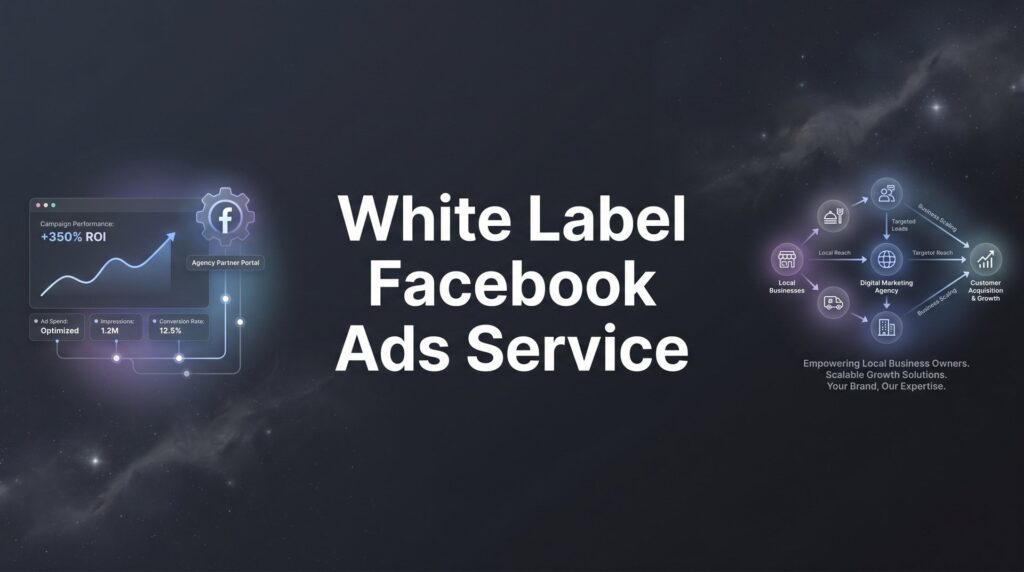
White label Facebook ads service operates on a simple but powerful premise: a specialized team manages your clients’ campaigns while remaining completely invisible to those clients. Every deliverable, every report, every communication appears to come directly from your agency. The white label partner exists in the background, executing the technical work while you maintain the client relationship and your brand positioning.
Here’s how the operational flow typically works. You bring a new client onboard and gather their business objectives, target audience details, and creative assets. This information passes to your white label partner, who develops the campaign strategy, builds the ad sets, and launches the campaigns. Throughout the month, they monitor performance, make optimization adjustments, and prepare performance reports branded with your agency’s logo and styling.
You receive these reports and campaign updates through your designated account manager at the white label service. You then present this information to your client in your own meetings and communications. From your client’s perspective, your agency is handling everything directly. The white label partner never appears in client-facing materials, meetings, or correspondence.
This differs fundamentally from traditional outsourcing or subcontracting. When you outsource work, the third party is often visible to the client—they might join calls, send emails directly, or be acknowledged as a partner. Subcontractors typically work on specific project components while maintaining their own brand identity. White label partnerships are designed for complete invisibility. The provider operates as an extension of your team, not as a separate entity.
The distinction matters for your market positioning. Clients hire agencies because they want a trusted partner managing their marketing, not a middleman coordinating with other vendors. White label arrangements preserve that direct relationship while giving you access to specialized expertise you might not have in-house.
Why the In-House Team Math Doesn’t Add Up for Most Agencies
The case for hiring a Facebook ads specialist seems straightforward until you calculate the actual numbers. A mid-level Facebook ads manager commands $60,000 to $80,000 in salary. Add employer taxes, health benefits, paid time off, and other benefits, and you’re looking at $75,000 to $100,000 in total compensation. Then factor in recruiting costs, onboarding time, ongoing training for Meta’s constantly evolving platform, and the software subscriptions they’ll need.
But here’s where it gets more complicated. One specialist can typically manage 8 to 12 active client accounts effectively, depending on campaign complexity. To justify that $100,000 investment, you need enough Facebook ads clients to cover the cost plus margin. For many agencies, that means waiting months or even years to build sufficient client volume—while competitors offering Facebook ads marketing services are capturing opportunities you’re leaving on the table.
White label partnerships flip this equation. Instead of fixed overhead, you pay variable costs that scale with your client load. Your first Facebook ads client generates revenue and profit immediately, without requiring you to have hired anyone months earlier in anticipation. As your client roster grows, your white label costs increase proportionally, but so does your revenue.
The speed advantage is equally compelling. Hiring takes time—posting positions, reviewing candidates, conducting interviews, checking references. Even a smooth hiring process typically requires 60 to 90 days. Training a new hire on your processes, your clients’ industries, and your quality standards adds another 30 to 60 days before they’re operating at full capacity. A white label partnership can have you delivering client work within days of signing the agreement.
Then there’s the risk factor. What happens when that expensive hire doesn’t work out? You’ve invested months of salary and training, and now you’re starting the search over while your clients wait for results. Or consider the key person risk: your star Facebook ads manager leaves for a competitor, taking their knowledge and potentially some client relationships with them. White label partnerships distribute this risk across a team of specialists rather than concentrating it in a single employee.
What Separates Exceptional White Label Partners from Mediocre Ones
Not all white label Facebook ads services deliver the same value. The difference between a high-performing partnership and one that creates headaches for your agency comes down to specific capabilities and operational standards.
Strategic Campaign Development: The best white label Facebook ads partners don’t just execute your instructions—they bring strategic expertise to the table. They should understand conversion funnel strategy, audience segmentation beyond basic demographics, and how to structure campaigns that align with your client’s specific business model. When you brief them on a new client, they should ask insightful questions about the customer journey, typical sales cycles, and key performance indicators that matter for that business.
Creative Capabilities: Facebook advertising is increasingly visual and video-driven. Your white label partner needs in-house creative resources or reliable partnerships for ad copywriting, graphic design, and video production. Agencies that lack this capability will constantly create bottlenecks, asking you to source creative assets or deliver subpar ads that underperform. Ask potential partners for creative samples and understand their process for developing thumb-stopping content.
Optimization Expertise: Facebook’s algorithm rewards advertisers who test aggressively and optimize based on data. Your white label partner should have documented processes for A/B testing ad creative, audience segments, and campaign structures. They should proactively identify underperforming elements and recommend changes without waiting for you to notice problems. During your evaluation, ask how they approach testing and what metrics they prioritize for different campaign objectives.
Communication Standards: This is where many white label relationships break down. Your clients expect responsive service, and delays from your white label partner damage your reputation. Establish clear expectations upfront: What’s the response time for routine questions? How quickly will they address urgent client requests? What’s the escalation process when something goes wrong? The best partners assign dedicated account managers who become familiar with your agency’s standards and your clients’ needs.
Reporting Transparency: Your white label partner should provide detailed performance reports that you can confidently present to clients. These reports need to be fully branded with your agency’s identity, clearly explain results in business terms (not just platform metrics), and highlight both successes and areas for improvement. Transparency builds trust—partners who only report wins or obscure poor performance create problems when clients ask tough questions.
Watch for red flags during your evaluation. Partners who promise unrealistic results or guarantee specific returns are setting you up for disappointed clients. Those who resist giving you direct access to campaign data or ad accounts may be hiding poor performance. If a potential partner is difficult to reach during the sales process, they’ll be worse after you’ve signed the contract. And if their own marketing and communication are sloppy or unprofessional, that’s likely how they’ll represent your agency to clients.
Pricing Strategies That Protect Your Margins While Staying Competitive
The markup model you choose for white label Facebook ads service directly impacts your profitability and competitiveness. Get it wrong, and you’ll either leave money on the table or price yourself out of opportunities.
Many agencies start with percentage-based markups, adding 30% to 50% on top of what they pay the white label provider. If your white label partner charges $1,500 monthly for campaign management, you bill the client $1,950 to $2,250. This approach is straightforward and scales automatically as white label costs increase with campaign complexity or ad spend. The challenge is that clients sometimes question why management fees vary when the core service appears similar.
Flat-fee retainers offer more predictability for both you and your clients. You might charge clients $3,000 monthly for Facebook ads management regardless of what you pay your white label partner. This creates room for higher margins on smaller accounts while giving you flexibility to invest more white label resources in complex campaigns without renegotiating client pricing. Understanding white label Facebook ads pricing structures helps you build sustainable margins. The risk is that you might underprice larger accounts or find yourself squeezed on margin when white label costs increase.
Hybrid models combine both approaches: a base retainer plus variable costs tied to ad spend or campaign complexity. For example, $2,000 monthly base plus 5% of monthly ad spend. This protects your margins on high-spend accounts while maintaining competitive pricing for smaller clients. It also aligns your fee structure with the reality that larger ad budgets typically require more management time and optimization work.
Consider how white label Facebook ads integrate with your other services when structuring pricing. Clients who engage you for comprehensive digital marketing—SEO, content marketing, email campaigns, and Facebook ads—represent more valuable relationships than those buying a single service. You might accept thinner margins on Facebook ads management for these full-service clients, knowing the overall relationship profitability is strong.
Package your services strategically. Instead of pricing Facebook ads as a standalone line item, bundle it with landing page optimization, conversion tracking setup, and monthly strategy consultations. This increases the perceived value, justifies higher pricing, and makes it harder for clients to comparison shop based solely on Facebook ads services pricing.
Your pricing should also reflect the client’s business value, not just the technical work involved. A Facebook ads campaign generating $50,000 in monthly revenue for a client justifies higher fees than one producing $5,000, even if the campaign management effort is similar. Value-based pricing recognizes that your service’s worth is tied to business outcomes, not just hours worked or ads launched.
Maintaining Client Relationships When You’re Not in the Ad Account Daily
The biggest fear agencies have about white label partnerships is losing credibility with clients. How do you maintain authority and expertise when someone else is actually running the campaigns? The answer lies in how you position yourself and manage client interactions.
Your role shifts from tactical execution to strategic oversight. You’re not personally adjusting bids or testing ad creative—but you are interpreting performance data, connecting campaign results to business objectives, and advising clients on how Facebook ads fit into their broader marketing strategy. This is actually a stronger position than being buried in daily campaign management, because you maintain the big-picture perspective that clients value most.
When clients ask technical questions about their campaigns, you have two options. For straightforward questions, your white label partner should brief you regularly enough that you can answer confidently based on your knowledge of the account. For complex technical inquiries, it’s perfectly acceptable to say, “Let me check with my team and get you the specific details.” This positions you as a leader managing specialists, not as someone who doesn’t understand their own service.
Proactive communication prevents most client concerns. Don’t wait for clients to ask about performance—schedule regular check-ins where you walk them through results, explain what’s working, and outline upcoming optimization plans. Your white label Facebook ads management partner provides the data and insights, but you deliver them in the context of the client’s business goals and competitive landscape.
Handle client requests and changes through a clear process. When a client wants to test a new audience or adjust campaign budgets, you’re the strategic filter. You evaluate whether the request aligns with their objectives, discuss implications, and then coordinate with your white label partner for execution. This prevents clients from making impulsive changes that hurt performance while maintaining your position as the trusted advisor.
Build trust through consistency and transparency. Clients don’t expect perfection—they expect honest communication about what’s working and what isn’t. When campaigns underperform, address it directly with the client, explain what you’re changing, and set realistic expectations for improvement. Your white label partner should support you with this transparency, providing clear explanations for performance issues and documented optimization efforts.
The strongest client relationships come from demonstrating that you’re invested in their success, not just managing their ads. Connect Facebook campaign performance to their revenue, lead quality, and customer acquisition costs. Show how you’re optimizing for their specific business outcomes, not just platform metrics. When clients see you as a strategic partner focused on their growth, the question of who’s clicking buttons in the ad account becomes irrelevant.
Your Roadmap: From First Partnership to Full Service Integration
Implementing a white label Facebook ads service successfully requires a methodical approach. Rush the process, and you’ll end up with a partner who doesn’t meet your standards or clients who receive inconsistent service.
Vetting and Selection (Weeks 1-3): Start by identifying 3 to 5 potential white label partners. Review their case studies, client testimonials, and service offerings. Schedule discovery calls to understand their processes, communication standards, and team structure. Request sample reports and creative work. Ask for references from other agencies they serve and actually call those references to ask about responsiveness, quality, and how they handle problems. Researching top white label Facebook ads providers gives you a solid starting point for your evaluation.
Trial Period (Weeks 4-8): Before committing fully, test your top choice with a pilot client—ideally one who’s lower-risk but representative of your typical accounts. This trial period reveals how the partnership actually functions beyond the sales conversation. Pay attention to communication speed, report quality, strategic input, and how they handle your feedback and requests.
Process Documentation (Weeks 9-10): Once you’ve selected a partner, document everything. Create internal processes for client onboarding, information handoff to your white label partner, report delivery, and client communication. Establish templates for briefing documents, performance reports, and client presentations. The goal is consistency—every client should receive the same high-quality experience regardless of which team member manages the relationship.
First 90 Days Metrics: Measure success beyond just campaign performance. Track client satisfaction through regular check-ins and feedback. Monitor your internal efficiency—how much time does managing the white label relationship require compared to the revenue it generates? Evaluate the quality and timeliness of deliverables. Identify any friction points in the process and address them before scaling.
Scaling Strategy (Months 4-6): As you gain confidence in the partnership, begin actively selling Facebook ads to new clients and cross-selling to existing ones. Train your sales team on positioning the service and setting appropriate expectations. Develop case studies from your early client successes to support sales conversations. Consider tiered service packages that allow you to serve different client segments profitably. You might also explore expanding into white label Instagram ads to offer clients a complete social advertising solution.
Success metrics should evolve as you scale. Initially, focus on client retention and satisfaction—are clients renewing and happy with results? As the service matures, track contribution margin (revenue minus white label costs) and client lifetime value. The goal is building a profitable service line that strengthens your agency’s overall positioning, not just adding revenue for its own sake.
The Strategic Advantage of Getting This Right
White label Facebook ads service isn’t a shortcut or a compromise—it’s a strategic decision that lets you compete with larger agencies while maintaining the operational efficiency that keeps your business profitable. The agencies winning in today’s market aren’t trying to build every capability in-house. They’re strategically partnering to deliver comprehensive services while focusing their internal resources on what they do best: building client relationships, understanding business strategy, and driving measurable growth.
The right white label partnership gives you the confidence to say yes when clients ask about Facebook advertising, knowing you have expert execution backing you up. It lets you present yourself as a full-service digital marketing agency without the overhead and risk of building a large internal team. And it creates the foundation for expanding into other specialized services—Instagram ads, LinkedIn campaigns, TikTok advertising—using the same partnership model.
Most importantly, it positions your agency for sustainable growth. You’re not limited by how many specialists you can afford to hire or how quickly you can train new team members. Your capacity scales with client demand, your costs remain variable, and your focus stays where it belongs—on delivering results that grow your clients’ businesses and strengthen your agency’s reputation.
The agencies that will dominate their markets over the next five years aren’t the ones trying to do everything themselves. They’re the ones who’ve figured out how to deliver exceptional results by combining their strategic expertise with the right partnerships. White label Facebook ads service is one of the most powerful tools in that strategy.
Tired of spending money on marketing that doesn’t produce real revenue? We build lead systems that turn traffic into qualified leads and measurable sales growth. If you want to see what this would look like for your business, we’ll walk you through how it works and break down what’s realistic in your market.