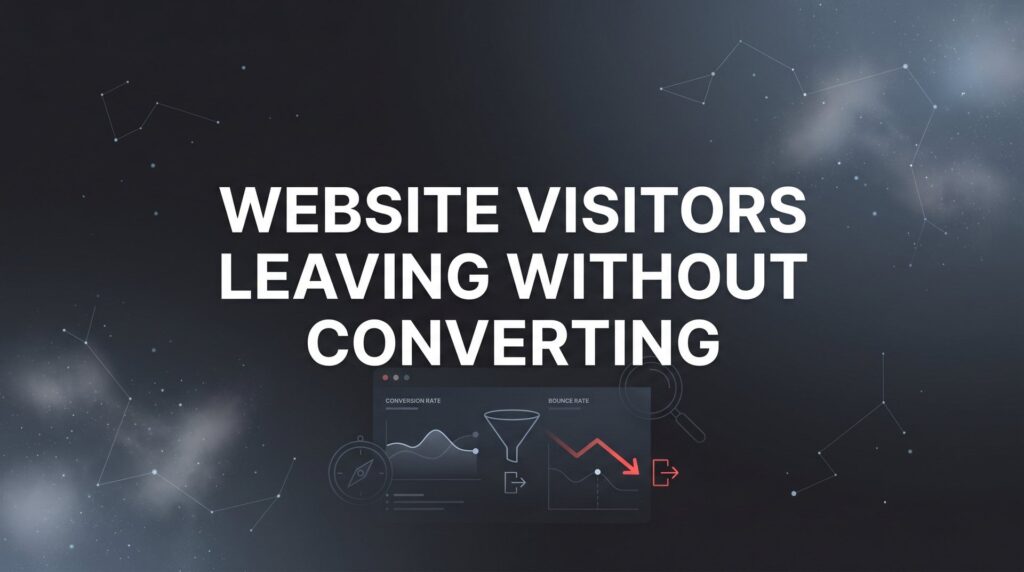
You check your analytics dashboard and see the numbers: 847 visitors last week. Your heart lifts for a moment—until you scroll down to conversions. Three. Three people out of 847 actually did what you needed them to do. Three people filled out your contact form, downloaded your guide, or made a purchase. The rest? They looked around and left.
If you’re paying for ads, that’s money evaporating. If you’re investing time in content and SEO, that’s effort producing minimal return. You’re not alone in this frustration. The gap between traffic and conversions represents one of the most expensive problems in digital marketing—and paradoxically, one of the most fixable.
Here’s what most business owners don’t realize: the problem usually isn’t getting people to your website. The problem is what happens after they arrive. Your site is either making the sale for you or actively preventing it. There’s rarely a middle ground. The good news? Once you understand why visitors leave without converting, you can systematically fix it. Let’s break down exactly what’s happening and how to turn those browsers into buyers.
The Hidden Expense of Traffic That Doesn’t Convert
Let’s talk numbers for a moment, because the real cost of poor conversion rates goes far beyond the obvious.
Say you’re spending $2,000 per month on Google Ads, driving 500 visitors to your website. At a 1% conversion rate, you’re getting 5 leads. That’s $400 per lead. Now imagine you improve your conversion rate to 3%—not exceptional, just better. Same traffic, same ad spend, but now you’re getting 15 leads at $133 each. You’ve tripled your lead volume without spending an extra dollar on advertising.
That’s the leverage point most businesses miss entirely.
The opportunity cost compounds over time. Every month you operate with a subpar conversion rate, you’re essentially leaving money on the table. If your competitor figures out conversion funnel optimization before you do, they’re extracting more value from the same market, the same keywords, the same potential customers. They can afford to bid higher on ads, invest more in content, and dominate the space—all because their website actually converts the traffic it receives.
Here’s the distinction that matters: most business owners think they have a traffic problem when they actually have a conversion problem. They keep pouring budget into getting more visitors, assuming that’s the solution. More ads, more SEO, more social media. But if your website converts at 1% instead of 3%, you need three times the traffic to achieve the same results. That’s three times the ad spend, three times the effort, three times the cost.
The math is brutal but simple. Fixing conversion issues delivers exponentially better ROI than just buying more traffic. A website that converts at even a moderately healthy rate transforms your entire marketing equation. Suddenly, channels that seemed too expensive become profitable. Campaigns that barely broke even start generating serious returns.
This is why conversion rate optimization isn’t a nice-to-have—it’s the foundation that makes everything else work.
Five Conversion Killers Hiding on Your Website
Your website might be sabotaging your success in ways you haven’t noticed. These are the most common culprits that send visitors running before they convert.
Slow Load Times and Mobile Disasters: Page speed isn’t just a technical detail—it’s a conversion factor. Google has made it clear through their Core Web Vitals guidelines that site performance matters for both rankings and user experience. When someone clicks your ad or search result and waits more than a few seconds for the page to load, they’re already forming a negative impression. Many will simply hit the back button and try your competitor instead.
Mobile experience failures are even more damaging. With mobile traffic representing the majority of web visits for most industries, a site that doesn’t work seamlessly on phones is actively turning away potential customers. Buttons too small to tap accurately, text requiring zooming to read, forms that don’t function properly on mobile browsers—these aren’t minor inconveniences. They’re conversion killers.
Navigation Confusion and Unclear Value: Visitors arrive with a question or need. If they can’t immediately understand what you offer and how it helps them, they leave. It’s that simple. Your value proposition should be crystal clear within seconds of landing on your site. Not buried in paragraph three of your About page. Not hidden behind industry jargon. Front and center, in plain language.
Navigation that requires detective work to understand creates the same problem. When visitors can’t find what they’re looking for quickly, they don’t persist—they bounce. Your site structure should guide people naturally toward conversion, not create an obstacle course. Understanding why your website isn’t converting often starts with examining these basic usability issues.
Missing Trust Signals: People need reassurance before they hand over their contact information or credit card details. Reviews, testimonials, credentials, certifications—these elements build the credibility that converts skeptics into customers. If your trust signals are missing or buried where visitors won’t see them, you’re asking people to take a leap of faith they’re not willing to make.
For a digital marketing agency, displaying Google Premier Partner status isn’t bragging—it’s providing the proof point that helps visitors feel confident choosing you. For any business, showing real customer reviews, industry certifications, or media mentions serves the same purpose. Without these elements prominently displayed, visitors have no reason to trust you over the next option in their search results.
Friction-Heavy Forms: Every field you add to a form reduces completion rates. Asking for too much information too soon creates a barrier that many visitors won’t cross. Do you really need their company size and annual revenue just to send them a PDF guide? Probably not. Forms should ask for the minimum information necessary to accomplish the immediate goal.
Beyond length, forms fail when they’re poorly designed. Error messages that don’t clearly explain the problem, fields that don’t work properly on mobile, unclear labeling—all of these create friction that prevents conversions.
Weak or Invisible Calls-to-Action: If visitors don’t know what you want them to do next, they won’t do it. Your call-to-action needs to be obvious, compelling, and repeated at logical points throughout the page. A single “Contact Us” button buried in the footer doesn’t cut it. Your CTA should guide visitors naturally toward the next step, appearing wherever someone might be ready to take action.
Weak language hurts too. “Submit” and “Click Here” don’t inspire action. “Get Your Free Audit” or “See How This Works for Your Business” tells visitors exactly what they’re getting and why they should care.
The Psychology Behind Why Visitors Bounce
Understanding why people leave without converting requires looking beyond the technical elements to the psychological factors at play.
Decision Fatigue Paralyzes Action: When you present visitors with too many options, you’re not helping them—you’re overwhelming them. The paradox of choice is real: more options often lead to fewer decisions. A homepage that offers ten different services, five CTAs, and multiple navigation paths creates cognitive overload. Visitors freeze, unsure which option is right for them, and often choose the easiest path: leaving.
Effective conversion-focused pages do the opposite. They present a single, clear path forward. They remove distractions and competing options. They make the decision simple: take this specific action or don’t. That clarity converts.
The Trust Gap Stops Conversions Cold: Every visitor arrives with skepticism. They’ve been burned by misleading ads, poor service, and broken promises. They’re not looking for reasons to trust you—they’re looking for reasons not to. Your job is to close that trust gap before they make a decision.
This is why social proof works so powerfully. When visitors see that others have successfully worked with you and achieved results, it reduces their perceived risk. Testimonials, case studies, review ratings—these elements don’t just make you look good. They provide the psychological reassurance people need to move forward. Mapping out your customer journey helps identify exactly where these trust signals need to appear.
The trust gap widens when visitors can’t find basic information. No clear contact details? No team photos or bios? No evidence that you’re a real business with real people? Each missing element raises doubt and increases the likelihood they’ll bounce.
Mismatched Expectations Kill Conversions: This happens constantly with paid advertising. Your ad promises one thing, but the landing page delivers something different. The disconnect creates immediate distrust and sends visitors away.
If your ad highlights a specific service or offer, the landing page needs to match that message exactly. Not kind of. Not close enough. Exactly. When someone clicks an ad about local SEO services and lands on a generic homepage about all your marketing services, they feel misled. Even if the information is technically there, the mismatch between expectation and reality triggers an instant bounce.
This principle extends beyond ads. Your SEO meta descriptions, social media posts, and any other traffic source create expectations. Your landing pages need to fulfill those expectations immediately and obviously.
Diagnosing Your Specific Conversion Leaks
Generic advice only gets you so far. To fix your conversion problems, you need to know exactly where visitors are dropping off and why.
Heatmaps and Session Recordings Reveal the Truth: Tools like Hotjar, Crazy Egg, and Microsoft Clarity let you see your website through your visitors’ eyes. Heatmaps show where people click, how far they scroll, and which elements attract attention. Session recordings let you watch actual visitor behavior—where they hesitate, where they get confused, where they give up. Investing in the best conversion rate optimization tools makes this diagnostic process far more effective.
This isn’t theoretical. You can watch someone land on your pricing page, scroll down, pause at your form, and then leave. You can see them click a button that doesn’t work or try to tap a phone number that isn’t clickable on mobile. These insights are gold because they show you the exact friction points preventing conversions.
The patterns become obvious quickly. If 80% of visitors never scroll past your hero section, your opening message isn’t compelling enough. If everyone clicks your CTA button but abandons the form on the next page, the form is the problem. If mobile visitors behave completely differently than desktop users, you have a responsive design issue.
Exit Pages and Bounce Rates Identify Problem Areas: Your analytics platform shows which pages visitors leave from most frequently. High exit rates on key conversion pages signal a problem. If your contact page has a 70% exit rate, something on that page is preventing people from completing the action.
Bounce rate—the percentage of visitors who leave after viewing only one page—tells a different story. High bounce rates often indicate a mismatch between what brought visitors to the page and what they found there. Or it means the page failed to engage them enough to explore further.
Look for patterns. Are certain traffic sources producing higher bounce rates? That suggests a messaging mismatch. Are mobile visitors bouncing more than desktop users? Mobile experience problem. Are people leaving from specific pages in your conversion funnel? Those pages need immediate attention.
Proper Conversion Tracking Measures What Matters: You can’t fix what you don’t measure. Setting up conversion tracking correctly means defining what actions actually matter for your business and ensuring you’re capturing that data accurately.
For some businesses, a conversion is a completed purchase. For others, it’s a form submission, a phone call, a chat interaction, or a resource download. Whatever drives revenue for your business needs to be tracked consistently across all traffic sources.
Many businesses think they’re tracking conversions but are actually missing critical data. Phone calls from mobile users who tap your click-to-call button? Those need tracking. Form submissions that don’t trigger your analytics event? Those aren’t being counted. Chat conversations that lead to sales? Those should be in your conversion data.
When your tracking is accurate, you can make informed decisions. You know which traffic sources produce actual conversions, not just clicks. You know which landing pages perform and which ones waste budget. You can calculate actual cost per conversion and make strategic choices based on real ROI.
Practical Fixes That Turn Browsers Into Buyers
Diagnosis is valuable, but action is what changes results. These are the fixes that consistently improve conversion rates across different businesses and industries.
Single-Focus Landing Pages Convert Better: Every conversion-focused page should have one primary goal. Not three goals. Not five options. One clear action you want visitors to take. This means removing navigation menus that let people wander off. It means eliminating competing CTAs that create decision paralysis. It means stripping away everything that doesn’t support the primary conversion goal.
This feels counterintuitive to many business owners. Won’t removing options hurt conversions? The opposite is true. When you give visitors a clear, singular path forward, more of them take it. Learning how to create high converting landing pages is one of the most valuable skills for any business owner focused on growth.
The structure matters too. Your landing page should follow a logical progression: grab attention with a compelling headline, explain the benefit clearly, provide proof that it works, address objections, and present a clear call-to-action. Each element builds toward the conversion.
Strategic Trust Element Placement: Trust signals work best when they appear at the exact moment visitors need reassurance. That’s usually right before the conversion point. If you want someone to fill out a form, place testimonials immediately above it. If you’re asking for a purchase, show security badges and review ratings near the buy button.
Don’t just dump all your trust elements in one section at the bottom of the page. Distribute them strategically throughout the conversion path. Early on the page, use credentials and certifications to establish authority. Mid-page, include customer testimonials that address common objections. Near the CTA, reinforce with specific results or guarantees.
For a digital marketing agency, displaying Google Premier Partner status near your service descriptions isn’t random—it’s strategic placement of a trust signal that matters to potential clients evaluating your expertise.
Creating Urgency While Reducing Friction: Urgency motivates action, but it needs to be authentic. Fake countdown timers and manufactured scarcity backfire when visitors see through them. Real urgency comes from legitimate business factors: limited consultation slots, seasonal offers, or capacity constraints.
At the same time, you need to remove every unnecessary barrier between the visitor and conversion. Simplify forms to ask only essential information. Make CTAs large and obvious on mobile devices. Ensure every step of the process works flawlessly across all devices and browsers. Enable autofill for forms. Provide multiple contact options for people who prefer phone over email or chat over forms.
The combination is powerful: give people a reason to act now while making it as easy as possible to do so.
Test, Iterate, and Compound Results: Conversion optimization isn’t a one-time project—it’s an ongoing process. A/B testing lets you make data-driven decisions instead of guessing. Test different headlines, CTA button colors, form lengths, page layouts. But test one variable at a time so you know what actually drove the change.
Small improvements compound over time. A 10% improvement in conversion rate might not seem dramatic, but if you make that improvement monthly through systematic testing and optimization, you’ve doubled your conversion rate in less than a year. Those compounding gains transform your marketing ROI completely. Our guide on how to improve website conversion rate walks through this testing process step by step.
The businesses that win at conversion optimization aren’t necessarily the ones with the biggest budgets or the fanciest designs. They’re the ones that consistently test, learn, and improve. They treat their website as a living system that can always get better, not a static brochure that gets updated every few years.
Recognizing When You Need Professional CRO Expertise
Some conversion problems you can fix yourself. Others require specialized expertise, tools, and experience to solve properly.
Signs You Need Professional Help: If you’ve made basic improvements but conversions remain stubbornly low, that’s a signal. If you’re spending significant money on advertising but can’t figure out why it’s not converting, that’s another. When your ads aren’t converting to sales, professional help will save you time and money in the long run.
The complexity of your conversion funnel matters too. Simple lead generation might be manageable on your own. Multi-step sales processes with different audience segments, multiple products, and complex customer journeys? That typically requires professional CRO expertise to optimize effectively.
Revenue at stake is the ultimate factor. If improving your conversion rate by even 1% would generate significant additional revenue, the ROI case for professional optimization becomes clear. You’re not paying for a service—you’re investing in measurable business growth.
What to Look for in a CRO Partner: Experience with businesses like yours matters enormously. An agency that optimizes e-commerce sites may not understand the conversion dynamics of local service businesses. Look for demonstrated expertise in your industry or business model.
Methodology matters more than promises. Be wary of anyone guaranteeing specific conversion rate improvements without analyzing your situation. Quality CRO work involves systematic analysis, hypothesis-driven testing, and data-backed decisions. It’s not about implementing a template or copying what worked for someone else.
Transparency in reporting is non-negotiable. You should understand exactly what’s being tested, why it’s being tested, and what the results mean for your business. Good CRO partners educate you throughout the process, not just hand you a report full of jargon. Many businesses also appreciate contract-free marketing services that let them evaluate results without long-term commitments.
The ROI Case for CRO Investment: Professional conversion optimization pays for itself through improved results from your existing traffic and marketing spend. If you’re spending $5,000 monthly on ads and converting at 2%, improving to 4% doubles your lead volume with zero increase in ad budget. The value of those additional leads almost always exceeds the cost of optimization work.
The improvements persist too. Unlike advertising, where you stop getting results when you stop paying, conversion rate improvements continue delivering value. A better-converting website keeps working for you month after month, compounding returns over time.
Turning Visitors Into Revenue
Website visitors leaving without converting isn’t an inevitable cost of doing business. It’s a specific, solvable problem with identifiable causes and proven fixes.
The diagnostic process reveals where you’re losing people: slow load times, confusing navigation, missing trust signals, friction-heavy forms, weak CTAs. The psychology explains why they leave: decision fatigue, trust gaps, mismatched expectations. The solutions—single-focus pages, strategic trust placement, reduced friction, systematic testing—turn those insights into improved results.
Small conversion rate improvements create disproportionate business impact. The difference between 1% and 3% conversion isn’t marginal—it’s transformational. It changes what you can afford to spend on marketing, which channels become profitable, and how quickly your business can grow.
Start with the basics: ensure your site loads quickly, works flawlessly on mobile, and clearly communicates your value proposition. Add trust signals where they matter most. Simplify your conversion paths. Track everything properly so you know what’s working.
Then test and iterate. Every improvement compounds. Every conversion barrier you remove opens the door for more visitors to become customers.
Tired of spending money on marketing that doesn’t produce real revenue? We build lead systems that turn traffic into qualified leads and measurable sales growth. If you want to see what this would look like for your business, we’ll walk you through how it works and break down what’s realistic in your market.