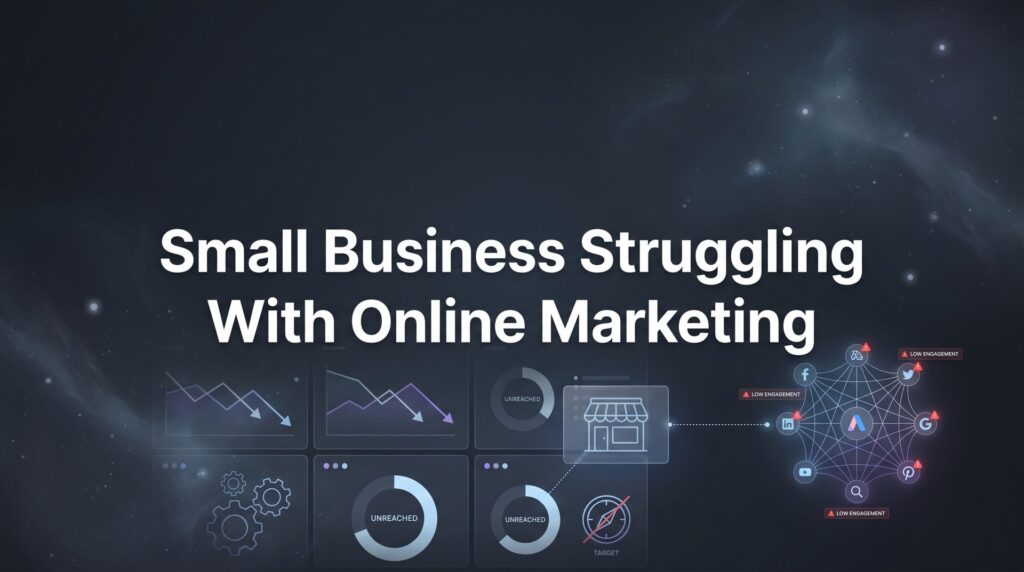
You’ve built something real. Your customers come back, they refer their friends, and when someone actually finds you, they’re happy they did. But getting found? That’s where things fall apart. You’ve posted on social media, maybe boosted a few posts, perhaps even dipped your toes into Google Ads. And yet the phone isn’t ringing the way it should be.
If this sounds familiar, you’re not alone. Countless small business owners are in exactly the same position: a great product or service, genuine value to offer, and an online presence that just isn’t pulling its weight. The frustrating part isn’t the lack of effort. It’s that the effort doesn’t seem to translate into actual customers.
Here’s the honest truth: most small businesses struggling with online marketing aren’t failing because they’re bad at business. They’re failing because the approach is off. The strategy is scattered, the execution has gaps, or the fundamentals are broken in ways that aren’t obvious until you know what to look for. This guide is designed to be your diagnostic. We’re going to walk through the most common reasons online marketing underperforms for small businesses and, more importantly, give you a clear path to fixing each one. No fluff, no buzzwords. Just a direct look at what’s actually going wrong and what to do about it.
The ‘Do Everything at Once’ Trap That Drains Your Budget
There’s a reason the “do everything” approach feels logical at first. You’ve heard that you need to be on Instagram, you should be running Google Ads, you need to send email newsletters, you should be posting on TikTok, and you absolutely can’t ignore SEO. So you try a little of everything. And then you get mediocre results everywhere.
This is one of the most common patterns among small businesses struggling with online marketing. When you spread your time, energy, and budget across six channels, you’re not giving any of them enough fuel to actually work. Marketing channels reward focus. The business that goes all-in on two channels will almost always outperform the one that half-commits to six. Understanding how to build a multi-channel marketing approach the right way can help you avoid this trap entirely.
The fix starts with a simple question: where do your actual customers spend time online, and how do they typically search for what you offer? For most local service businesses, the answer is Google. Someone needs a plumber, a dentist, a landscaper, or a tax preparer. They search. They click. They call. That means Google Search and your local listings are likely your highest-ROI starting point, not Instagram Reels.
A practical framework that works for most small businesses looks like this:
Pick one paid channel: For most local businesses, Google Ads is the strongest starting point because it captures demand that already exists. People searching for your service are already buyers. You’re not convincing them they need you; you’re just showing up when they’re ready.
Pick one organic channel: Local SEO and your Google Business Profile are the most powerful organic plays for local businesses. They take time to build but deliver compounding returns without ongoing ad spend.
Commit to 90 days: Give your chosen channels a genuine 90-day window with consistent effort and proper tracking. Then review the data and decide whether to expand, adjust, or double down.
The discipline here is saying no. No to the shiny new platform. No to the “we should be on Pinterest” conversation. No to spreading yourself thin. Focus is what separates businesses that see results from those that stay frustrated. Cutting online advertising waste starts with this kind of intentional focus. Once you’ve proven what works, you can build from there. But you have to start somewhere with intention, not desperation.
Why Your Website Isn’t Turning Visitors into Customers
Here’s a scenario that plays out constantly: a business owner spends money driving traffic to their website, visitors show up, and then… nothing. No calls, no form fills, no bookings. The traffic is real. The problem is what happens when it arrives.
Most small business websites are what you’d call brochure websites. They tell you who the company is, list the services, maybe have a photo gallery, and include a contact page buried in the navigation. They’re informational. What they’re not is persuasive. There’s a meaningful difference between a website that describes your business and one that’s built to convert visitors into leads. If your marketing is not bringing customers, your website is often the first place to look.
A lead generation website is structured around one goal: getting the visitor to take action. That means a clear, prominent headline that immediately communicates what you do and who you do it for. It means a phone number visible at the top of every page. It means trust signals like customer reviews, certifications, and before-and-after photos placed strategically near your calls to action. It means a simple form that doesn’t ask for ten pieces of information when three will do.
Conversion rate optimization, or CRO, is the practice of improving these elements systematically. You don’t need a complete website rebuild to start. Some of the highest-impact changes are surprisingly small:
Page speed: A slow-loading website loses visitors before they even see your content. If your site takes more than three seconds to load on mobile, a significant portion of your traffic is bouncing before engaging. Tools like Google PageSpeed Insights will show you exactly where the problem is.
Clear calls to action: Every page should have an obvious next step. “Call us today,” “Get a free quote,” “Book your appointment.” If a visitor has to hunt for how to contact you, most won’t bother.
Social proof above the fold: Reviews, star ratings, and recognizable trust badges should appear near the top of your key pages, not hidden at the bottom. People make trust decisions quickly, and visible proof accelerates that process.
Mobile experience: The majority of local searches happen on smartphones. If your website is hard to navigate on a phone, you’re losing customers at the very moment they’re most ready to hire you.
The shift from brochure website to lead generation machine doesn’t require a massive investment. It requires understanding that your website is a salesperson, and right now, it might be a bad one. Fix the fundamentals first, and the traffic you’re already getting starts working harder for you.
Clicks Without Customers: The Paid Advertising Disconnect
Running paid ads and getting clicks but no customers is one of the most demoralizing experiences in small business marketing. You can see the money leaving your account, you can see the clicks coming in, and yet the phone stays quiet. This isn’t bad luck. It’s almost always a structural problem with the campaign itself. Understanding why marketing campaigns aren’t driving sales is the first step toward fixing this disconnect.
The most common culprits are predictable once you know what to look for. Broad match keywords without proper controls will show your ads to people searching for things that have nothing to do with your business. A roofing company bidding on “roofing” in broad match might end up paying for clicks from people searching for “roofing nails” or “roofing video games.” These clicks cost real money and produce zero customers.
Sending paid traffic to your homepage is another frequent mistake. Your homepage is designed for everyone. A paid ad landing page should be designed for one specific person with one specific intent. If someone clicks an ad for “emergency HVAC repair,” they should land on a page entirely focused on emergency HVAC repair, with a prominent phone number and a compelling reason to call right now. Sending them to your homepage forces them to figure out where to go next, and most won’t.
Then there’s the metrics problem. Many small businesses judge their ad campaigns on impressions and clicks, which are what the industry calls vanity metrics. They look good in a report but don’t tell you whether you’re making money. The metrics that actually matter are cost per lead, cost per acquisition, and return on ad spend. Learning how to track marketing ROI effectively is essential if you want to stop flying blind.
A properly structured paid campaign looks very different from what most beginners set up:
Tight keyword targeting: Use phrase match and exact match keywords focused on high-intent searches. Add negative keywords aggressively to block irrelevant traffic.
Dedicated landing pages: Each ad group or campaign should drive traffic to a page built specifically for that audience and intent, not your homepage.
Conversion tracking: Set up call tracking and form submission tracking before spending a dollar. If you can’t measure it, you can’t improve it.
Ad copy that qualifies: Your ad should attract the right people and repel the wrong ones. Be specific about what you offer, who it’s for, and what action you want them to take.
Paid advertising done correctly is one of the fastest ways to generate leads for a local business. Done incorrectly, it’s one of the fastest ways to burn through budget with nothing to show for it. The difference is almost entirely in the setup and ongoing management.
The Local SEO Blind Spot Most Business Owners Miss
Ask most small business owners about SEO and they’ll picture something complicated and expensive: blog posts, backlinks, technical audits. What many don’t realize is that for local and service-area businesses, the most impactful form of SEO has nothing to do with any of that. It’s local SEO, and it’s often the most underutilized channel available.
When someone searches “electrician near me” or “best pizza in [city],” Google serves up a map pack: three local businesses displayed prominently at the top of the results page, above the organic listings. Ranking in that map pack can deliver a consistent stream of high-intent leads without ongoing ad spend. And yet many small businesses either haven’t claimed their Google Business Profile or have one that’s incomplete and unoptimized. Exploring local business digital marketing services can help you understand what’s available to close this gap.
Getting the fundamentals right here isn’t complicated. It just requires attention:
Claim and fully complete your Google Business Profile: This means accurate business name, address, phone number, hours, service categories, photos, and a compelling business description. An incomplete profile signals to Google that you’re not an active, trustworthy business.
Consistent NAP across directories: NAP stands for name, address, and phone number. These details need to be identical across every online directory where your business appears: Yelp, Yellow Pages, Apple Maps, Bing Places, and others. Inconsistencies confuse search engines and can hurt your local rankings.
Customer reviews: Reviews are a significant local ranking factor, and they’re also the primary trust signal for potential customers. Actively ask satisfied customers to leave a Google review. Make it easy by sending them a direct link. Respond to every review, positive or negative. This signals engagement to Google and professionalism to prospects.
Localized content: If you serve multiple areas, create service pages that mention the specific cities or neighborhoods you serve. Setting up targeted advertising for local businesses alongside your organic efforts can accelerate results while your SEO builds momentum.
For many small businesses, getting local SEO right is the single highest-ROI marketing activity available. It takes time to build, but once you’re ranking in the map pack for your key services, you’re generating leads around the clock without paying for each click.
DIY vs. Hiring Help: Knowing When to Make the Call
Most small business owners start with DIY marketing. It makes sense. Budget is tight, you know your business better than anyone, and there are enough free tools and YouTube tutorials to get started. There’s nothing wrong with this approach in the early stages.
The problem comes when DIY stops being cost-effective. And it usually does, faster than most owners expect. The real cost of doing your own marketing isn’t just the ad spend. It’s the hours you spend on it instead of running your business, the learning curve that costs money while you figure things out, and the revenue you’re not generating because campaigns aren’t optimized. At a certain point, the opportunity cost of doing it yourself exceeds what a professional would charge. If your local business is struggling to grow, this is often the inflection point where outside expertise makes the difference.
When you do decide to bring in outside help, knowing what to look for matters as much as knowing when. Here’s what separates a genuinely good marketing partner from one that will drain your budget and deliver reports full of numbers that don’t mean anything:
Transparency in reporting: A good partner shows you exactly what’s happening with your money. You should be able to see your ad account, your campaign performance, and the metrics that actually connect to revenue, not just impressions and clicks.
Focus on leads and revenue: The conversation should be about cost per lead, conversion rates, and return on ad spend. If an agency talks mostly about traffic and brand awareness, that’s a mismatch for a small business that needs customers now.
Verified credentials: Certifications like Google Premier Partner status aren’t just badges. They indicate that an agency has met Google’s performance and spend thresholds and has demonstrated expertise managing ad accounts. It’s a meaningful differentiator when evaluating who to trust with your budget. Clicks Geek holds Google Premier Partner status, which puts it in a relatively small group of agencies that have earned that designation. Knowing how to compare local marketing agencies will help you make a confident decision.
Red flags to avoid: Be cautious of agencies that require long-term contracts with no performance benchmarks, won’t give you access to your own ad accounts, or can’t clearly explain what they’re doing and why. You should always own your accounts and data, regardless of who’s managing them.
The right agency doesn’t just run your campaigns. It acts as a growth partner that understands your business goals, communicates clearly, and measures success the same way you do: in customers and revenue.
Your 30-Day Plan to Start Turning Things Around
Knowing what’s wrong is only useful if you do something about it. Here’s a concrete, week-by-week plan to start making real progress, even if you’re starting from a frustrating place.
Week 1: Audit what you have. Before spending another dollar, take stock. Check your website’s load speed on mobile using Google PageSpeed Insights. Locate and review your Google Business Profile. Pull up any active ad accounts and note what campaigns are running, what they’re spending, and whether conversion tracking is set up. You can’t fix what you haven’t measured. Setting up a proper marketing dashboard and reporting system will make this audit far more effective.
Week 2: Fix the biggest conversion killer and optimize your GBP. Based on your audit, identify the single biggest barrier to conversions on your website. Slow load time? No clear call to action? Missing phone number on mobile? Fix that one thing. Simultaneously, complete every field in your Google Business Profile, add recent photos, and reach out to five to ten satisfied customers to ask for a review.
Week 3: Launch or restructure one paid campaign. If you’re running ads, restructure the worst-performing campaign with tighter keyword targeting, a dedicated landing page, and proper conversion tracking. If you’re starting fresh, launch a single focused campaign targeting your highest-value service in your primary service area. Our paid advertising tutorial walks through this process step by step for beginners.
Week 4: Review the data and make decisions. Look at what’s producing leads and what isn’t. Kill the keywords and ad variations that are eating budget without results. Double down on what’s working. This weekly review habit is what separates businesses that improve continuously from those that run campaigns on autopilot and wonder why nothing changes.
One note that applies to every week: tracking is non-negotiable. Set up call tracking so you know which marketing activities are driving phone calls. Set up form submission tracking in Google Analytics or your ad platform. Without this foundation, you’re making decisions based on gut feeling instead of data, and gut feeling is expensive.
If you work through this plan and still feel overwhelmed, that’s a signal worth paying attention to. Many agencies, including Clicks Geek, offer free consultations that can surface quick wins and give you a clear picture of where the biggest opportunities are in your specific market.
The Bottom Line for Small Businesses Winning Online
Struggling with online marketing doesn’t mean your business is broken. In almost every case, it means the strategy needs focus, the execution has gaps, or the fundamentals haven’t been set up correctly. These are fixable problems.
The businesses winning online right now aren’t necessarily bigger or better funded than yours. They’re more intentional. They’ve picked the right channels for their audience, built websites that convert visitors into leads, structured their paid campaigns around revenue metrics, and invested in the local SEO work that keeps delivering long after the initial effort.
You can do the same. Start with the audit. Fix the conversion killers. Focus on one paid and one organic channel. Build from there.
And if you’re tired of spending money on marketing that doesn’t produce real revenue, there’s a faster path. Clicks Geek builds lead systems that turn traffic into qualified leads and measurable sales growth. If you want to see what this would look like for your business, we’ll walk you through how it works and break down what’s realistic in your market. No pressure, no jargon. Just a clear look at what’s possible.