You’ve asked three different agencies what PPC management costs, and you’ve gotten three completely different answers. One quoted you a flat monthly fee. Another talked about a percentage of your ad spend. A third sent over a proposal so dense with jargon you weren’t sure what you were actually paying for. Sound familiar?
This is one of the most common frustrations local business owners face when shopping for paid advertising help. The pricing feels opaque, the structures vary wildly, and it’s nearly impossible to compare what one agency offers against another. You’re trying to make a smart financial decision, but the information you need to do that keeps getting buried under sales pitches.
This article is going to cut through that noise. We’ll break down how PPC management monthly retainer cost actually works, what drives pricing up or down, what a quality retainer should include, and how to evaluate whether you’re getting real value or just paying for someone to log into your account once a month. At Clicks Geek, we believe you deserve complete clarity before you sign anything. So let’s get into it.
How PPC Retainer Pricing Actually Works
Before you can evaluate what you’re being quoted, you need to understand the different PPC agency pricing models agencies use. They’re not all the same, and the differences matter more than most business owners realize.
The Monthly Retainer Model: This is a fixed monthly management fee you pay the agency regardless of how much you spend on ads. The fee covers the agency’s time, expertise, and ongoing work managing your campaigns. It’s predictable, easy to budget for, and the most common structure for small and mid-sized businesses.
Percentage of Ad Spend: Some agencies charge a percentage of your monthly ad budget instead of a flat fee, typically somewhere in the range of 10 to 20 percent. The upside is that their fee scales with your investment. The downside is that their incentive becomes tied to increasing your spend, not necessarily improving your results.
Flat Fee Per Campaign: Less common, but some agencies charge a one-time setup fee plus a flat monthly fee per active campaign. This can work well for very simple account structures but gets complicated fast as your advertising grows.
Hybrid Models: Many agencies combine elements of the above, such as a base retainer plus a performance component, or a flat fee that adjusts based on spend thresholds.
When most business owners ask about a “retainer,” they’re typically asking about the fixed monthly management fee. And here’s the most important thing to understand: that management fee is always separate from your actual ad spend budget. If an agency charges a $1,500/month retainer and you want to run $3,000/month in Google Ads, your total monthly investment is $4,500. The two numbers never combine into one.
This distinction trips up a lot of first-time PPC buyers. They hear “$1,500 a month” and think that’s their total cost. Then they find out the ad spend is on top of that, and the sticker shock sets in. Getting clear on this upfront saves a lot of frustration. For a deeper dive into what those fees actually cover, our breakdown of PPC management fees is worth reading.
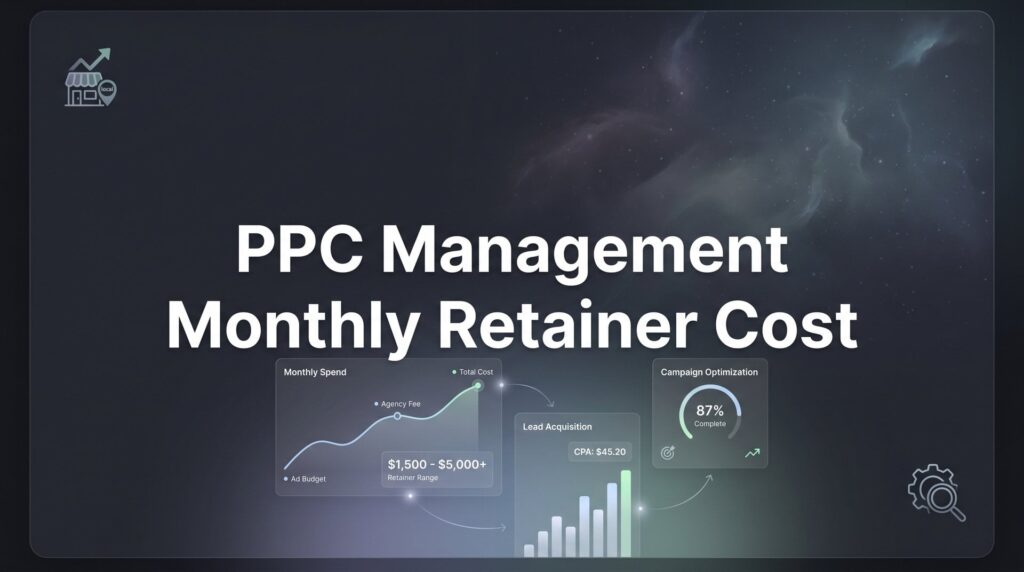
As for where retainers actually fall in terms of pricing, general industry ranges suggest that small and local business retainers typically fall between $500 and $2,500 per month. Mid-market businesses with more complex needs often see retainers in the $2,500 to $7,500 range. Enterprise-level accounts with multiple campaigns across multiple platforms can go well above that. These are approximate ranges based on common agency pricing structures, not guarantees, and there’s significant variation within each tier depending on what’s actually included.
What Drives Your Monthly Retainer Up or Down
Two businesses in the same city can get wildly different quotes for PPC management. That’s not agencies being arbitrary. It reflects real differences in what’s required to manage their campaigns effectively. Here are the primary factors that move the needle on your retainer cost.
Campaign Complexity: The single biggest driver of management cost is how complex your account is. A straightforward single-service campaign targeting one city with one landing page requires far less ongoing work than an account running multiple campaigns across different services, locations, and platforms simultaneously. More campaigns mean more ad groups, more keywords, more ad variations to test, and more data to analyze every month. That work has to be priced accordingly.
Platform Scope: Running campaigns on Google Ads alone is one level of complexity. Add Microsoft Ads (Bing), and you’ve added a second platform to manage, optimize, and report on. Some businesses also run paid social alongside search, which multiplies the management workload. Each additional platform increases the time investment required, and that’s reflected in the retainer.
Industry Competitiveness and CPC: Not all industries are created equal in the paid search world. Personal injury law, water damage restoration, addiction treatment, and similar high-stakes service categories are among the most competitive in Google Ads. Cost-per-click in these industries can be significantly higher than in lower-competition niches. That means bid management becomes more critical, the margin for error is smaller, and the expertise required to run campaigns profitably is greater. Agencies that specialize in PPC management for lawyers and similar high-CPC verticals typically charge more because the stakes and the skill required are both higher.
Geographic Targeting Scope: A local business targeting one city or metro area has a naturally limited campaign scope. You’re bidding on a defined set of searches in a defined geographic area. That’s manageable. A multi-location business targeting several cities, or a company running statewide or regional campaigns, has exponentially more variables to manage. Different locations may have different competitive landscapes, different messaging needs, and different performance patterns. All of that requires more active management, which affects what a reasonable retainer looks like.
Account History and Starting Point: A brand-new account with no historical data requires more upfront work to build, structure, and optimize than a mature account that already has performance history. Some agencies charge a one-time setup fee to account for this, while others fold it into the first few months of the retainer. Either way, expect that getting a new account off the ground properly takes more intensive work than ongoing management of an established one.
The takeaway here is simple: when you get a quote, ask what’s driving it. A good agency should be able to explain exactly why your retainer is priced where it is based on the specifics of your business, not just give you a number pulled from a pricing page.
What a Quality Retainer Should Include (And Red Flags It Doesn’t)
Not all retainers are built the same, and the price tag doesn’t always tell you much about what’s actually included. Here’s what you should expect from a quality PPC management retainer, and what should make you pause if it’s missing.
Core Deliverables Worth Paying For
Keyword Research and Ongoing Refinement: This isn’t a one-time task. Search behavior evolves, new opportunities emerge, and underperforming keywords need to be identified and addressed regularly. Ongoing keyword management is foundational to keeping your campaigns efficient.
Ad Copywriting and Testing: Effective PPC management includes writing compelling ads and systematically testing variations to find what resonates with your audience. If your agency writes your ads once and never revisits them, you’re leaving performance on the table.
Bid Management: Adjusting bids based on time of day, device, location, audience segment, and performance data is a continuous process. In competitive industries especially, poor bid management is one of the fastest ways to burn through budget without results.
Negative Keyword Management: This is one of the most underrated elements of PPC management. Negative keywords prevent your ads from showing up for irrelevant searches, protecting your budget from wasted clicks. It requires regular attention as new search queries come in.
Conversion Tracking Setup and Maintenance: If you don’t know which clicks are turning into leads or customers, you’re flying blind. Proper conversion tracking is non-negotiable, and a quality retainer should include setting it up correctly and keeping it working. Understanding cost per lead in marketing starts with having this tracking dialed in.
Landing Page Recommendations: Your ads can only do so much. If the page someone lands on after clicking doesn’t convert, the best campaign management in the world won’t save your results. Good agencies provide landing page feedback and recommendations as part of their service.
Regular Reporting with Actionable Insights: You should receive clear, consistent reporting that shows you what’s happening with your campaigns, what it means, and what’s being done about it. Not just data dumps, but context and direction.
Red Flags That Signal a Low-Quality Retainer
No Conversion Tracking: If an agency isn’t tracking conversions, they have no idea whether your campaigns are working. This is a fundamental failure, not a minor oversight.
No Access to Your Own Ad Account: Your ad account should belong to you. Any agency that refuses to give you access to your own Google Ads account is protecting themselves, not you. Walk away.
Set-It-and-Forget-It Management: PPC campaigns require active, ongoing optimization. If your account is barely touched between monthly reports, you’re paying for the appearance of management, not actual management.
Long Contracts with No Performance Benchmarks: A 12-month lock-in with no defined performance expectations is a red flag. It means the agency is more interested in securing revenue than delivering results. Before signing anything, make sure you understand the PPC management contract terms thoroughly.
The CRO Element Most Cheap Retainers Skip
Conversion rate optimization is where a lot of budget savings from cheap retainers quietly evaporate. A low-cost agency might keep your management fee down by skipping the deeper work of improving how well your traffic converts. You pay less per month in fees, but you waste far more in ad spend sending traffic to pages that don’t turn visitors into leads. The math rarely works in your favor when CRO is absent from the equation.
Cheap Retainers vs. Profitable Retainers: The Real Math
Here’s where the conversation gets practical. Many business owners approach PPC management shopping the same way they shop for a commodity: find the lowest price for what appears to be the same service. The problem is that PPC management is not a commodity. The quality of management has a direct, measurable impact on your cost per conversion and your return on ad spend.
Consider a conceptual scenario. A business is paying $500 per month for PPC management. The campaigns run, clicks come in, and leads trickle through. But the cost per lead is high because the campaigns aren’t tightly optimized, the ads aren’t being tested, and the landing page is mediocre. The business is spending $3,000 per month in ad budget to generate a handful of leads.
Now consider the same business working with an agency charging $1,500 per month. The retainer is three times higher. But the campaigns are actively managed, the bids are dialed in, negative keywords are cutting wasted spend, and the landing page has been improved based on conversion data. The same $3,000 in ad spend generates significantly more leads at a meaningfully lower cost per lead.
Which retainer is actually more expensive? Not the $1,500 one. The management fee is a fraction of the total PPC investment. Skimping on it to save $1,000 per month in agency fees while wasting $1,500 or more in ad spend from poor optimization is the definition of a false economy.
This is the reframe that changes how smart business owners think about retainer cost. The question isn’t “how cheap can I get PPC management?” The question is “what return does this management fee generate?” A $2,000 monthly retainer that cuts your cost per lead in half and doubles your lead volume isn’t a cost. It’s an investment with a clear return. Learning how to increase ROAS in PPC is ultimately what separates profitable retainers from money pits.
Wasted ad spend is the silent killer of PPC budgets. It doesn’t show up on an invoice labeled “waste.” It shows up as clicks that never convert, search terms that have nothing to do with your business, and campaigns that run on autopilot while your budget drains. Quality management eliminates or dramatically reduces this waste, and the savings often dwarf the difference in management fees between a cheap retainer and a good one.
The management fee is almost always a small fraction of the total PPC investment. Treating it as the primary variable to minimize is like buying the cheapest tires for a race car. You saved money on tires. You lost the race.
Questions to Ask Before Signing Any PPC Retainer Agreement
Before you commit to any agency, you need answers to specific questions. Not vague assurances. Specific, clear answers. Here’s what to ask.
What’s included in the retainer? Get a written breakdown of every deliverable. Keyword management, ad copy, bid management, negative keywords, reporting cadence, conversion tracking, landing page recommendations. If it’s not in writing, it may not happen.
How is performance measured? An agency should be able to tell you exactly how success is defined for your campaigns. Cost per lead, lead volume, conversion rate, return on ad spend. If they can’t articulate this clearly, that’s a problem. Knowing what a good conversion rate for PPC looks like gives you a baseline to hold agencies accountable.
What’s the reporting cadence? Monthly reports are the minimum. Many quality agencies provide bi-weekly check-ins or more frequent updates. Know what communication to expect and in what format.
Do I own my ad account? The answer should always be yes. Your account, your data, your history. Non-negotiable.
What happens if results don’t meet expectations? A confident agency has an answer to this. They’ll describe their optimization process, their escalation path, and their commitment to continuous improvement. An agency that deflects this question or gives a vague answer is telling you something important.
Is there a minimum contract length? Month-to-month agreements signal that an agency is confident enough in their results to not need a long-term lock-in to retain your business. Six or twelve-month contracts with no performance clauses often protect the agency, not you. If a long-term agreement is required, insist on defined performance benchmarks and exit provisions if those benchmarks aren’t met.
Transparency about tracking and attribution deserves special attention. If an agency can’t show you exactly where your leads come from, what they cost, and how they’re attributed to specific campaigns or keywords, you’re operating in a black box. Our guide on how to choose a PPC agency covers the full vetting process in detail. You should be able to see, at any time, what your campaigns are doing and why. Anything less is a red flag.
Finding the Right Fit for Your Business and Budget
Matching your business to the right retainer tier starts with an honest assessment of your needs and goals. A solo local business running a single service in one city has fundamentally different requirements than a multi-location company targeting several markets. Both deserve excellent management, but the scope, complexity, and corresponding investment will look different.
If you’re a local business just getting started with PPC, a well-structured retainer in the lower to mid tier of the market can absolutely deliver strong results if the agency is genuinely active and focused on conversion. The key is ensuring that even at a lower price point, the fundamentals are in place: conversion tracking, active optimization, and regular communication. Our resource on PPC management for small business pricing breaks down what to expect at each investment level.
If you’re a growing business with multiple campaigns, competitive keywords, or multi-location targeting, expect to invest more in management. The complexity demands it, and the returns from doing it right are proportionally larger. Cutting corners on management at this scale is where businesses lose significant money.
The best PPC management pays for itself. Not as a marketing talking point, but as a measurable reality. Lower cost per lead, higher conversion rates, eliminated wasted spend, and campaigns that actually grow your business rather than just consume budget. That’s what quality management delivers.
Clicks Geek is a Google Premier Partner agency, a credential that reflects meeting Google’s performance and spend thresholds across our client base. Our focus is on exactly the outcomes that matter to local business owners: leads that convert, cost-per-acquisition that makes sense, and transparent reporting that shows you exactly what your investment is doing.
We don’t believe in black-box management or long-term contracts held together by fine print. We believe in earning your business every month through performance. If you want to see what this would look like for your specific business, we’ll walk you through how it works and break down what’s realistic in your market.
The Bottom Line on PPC Management Costs
PPC management monthly retainer cost varies widely across the industry, and that variation exists for real reasons. Campaign complexity, industry competitiveness, geographic scope, and the depth of service included all influence where your retainer lands. The ranges are real, the differences matter, and the cheapest option is rarely the most profitable one.
Stop shopping for PPC management on price alone. Start evaluating agencies on the things that actually determine whether your investment pays off: conversion tracking, active optimization, transparent reporting, and a willingness to be accountable to results. Those are the variables that determine your cost per lead and your return on ad spend, not the management fee in isolation.
An agency that charges more but delivers leads at half the cost of a cheaper alternative isn’t expensive. It’s the better financial decision. The math is straightforward once you stop looking at the management fee as the total cost and start looking at the full picture of what your PPC investment produces.
Tired of spending money on marketing that doesn’t produce real revenue? We build lead systems that turn traffic into qualified leads and measurable sales growth. If you want to see what this would look like for your business, we’ll walk you through how it works and break down what’s realistic in your market. No vague promises. Just a transparent conversation about what PPC management can actually do for your business.