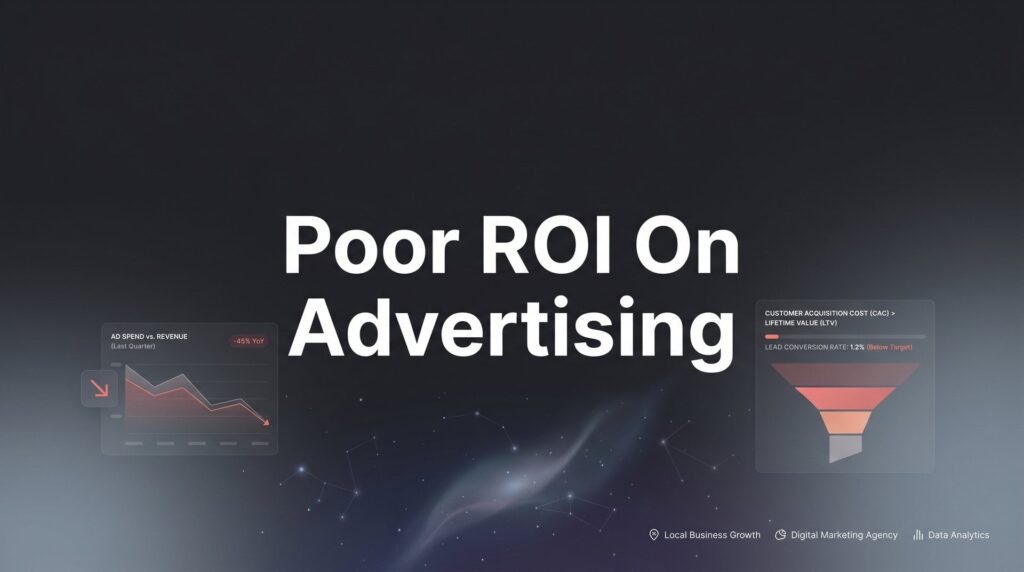
You pull up your advertising dashboard on Monday morning, coffee in hand, and the numbers stare back at you like a bad report card. $4,200 spent last month. Seventeen clicks that went nowhere. Three form submissions that turned out to be spam. Your stomach drops as you calculate the math: that’s over $1,400 per legitimate inquiry, and none of them even became customers.
This isn’t just frustrating—it’s financially devastating. Every dollar you pour into underperforming ads is a dollar you can’t invest in inventory, staff, or the marketing channels that actually work. Meanwhile, your competitors are somehow making advertising profitable, growing their market share while you’re stuck wondering if digital advertising even works for businesses like yours.
Here’s the truth: poor ROI on advertising isn’t a mystery, and it’s not because your industry is “different” or your market is “too competitive.” In our work as a Google Premier Partner agency, we’ve audited hundreds of campaigns bleeding money for the exact same reasons. The good news? These problems are fixable, often within weeks. This article will show you exactly why your campaigns are underperforming and provide a clear roadmap to turn them into profitable growth engines.
The Real Cost of Advertising That Doesn’t Convert
Let’s talk about what poor advertising ROI actually costs you—because it’s far more than just wasted ad spend.
When you’re running campaigns that don’t convert, you’re not just losing the money you spent on clicks. You’re losing the revenue those customers would have generated over their lifetime. You’re giving your competitors a head start while you spin your wheels. And perhaps most damaging, you’re training your team to distrust marketing entirely.
Think about the opportunity cost. That $5,000 you spent on underperforming Google Ads last quarter could have funded a referral program, hired a part-time salesperson, or improved your product. Instead, it vanished into clicks from people who were never going to buy from you in the first place. Understanding how to fix low ROI from digital advertising starts with recognizing just how much these failures actually cost.
Poor ROI compounds over time in ways that aren’t immediately obvious. A campaign running at break-even isn’t neutral—it’s actively harmful. While you’re treading water, competitors running profitable campaigns are reinvesting their returns into more advertising, better targeting, and market dominance. The gap between you and them widens every month.
Warning signs your advertising ROI is in serious trouble: Your cost per lead keeps climbing month over month. Your conversion rate sits below 2% despite decent traffic. Your return on ad spend hovers around 1:1 or worse. You’re getting clicks but your phone isn’t ringing. Your sales team complains that leads from advertising are “low quality.” You’ve increased budget three times but revenue hasn’t moved.
The difference between break-even advertising and profitable growth isn’t small—it’s exponential. A campaign generating a 3:1 return allows you to scale aggressively, test new markets, and build a predictable revenue engine. A campaign at 1:1 keeps you stuck, unable to grow because you can’t afford to spend more on something that barely pays for itself.
Five Hidden Culprits Sabotaging Your Ad Performance
Most businesses with poor advertising ROI are making the same five mistakes. Let’s diagnose them.
Targeting the wrong audience with broad match keywords: You’re bidding on “marketing services” when you only serve local restaurants in Phoenix. Or you’re using broad match for “plumber” and paying for clicks from people searching “plumber salary” and “how to become a plumber.” Every click from someone who can’t possibly become a customer is pure budget waste. Broad match keywords without proper negative keyword lists are like fishing with a net full of holes—you catch everything except what you actually want.
Sending traffic to your homepage instead of dedicated landing pages: This is the single biggest ROI killer we see in audits. Someone searches “emergency AC repair Phoenix,” clicks your ad, and lands on your homepage with a generic welcome message, your company history, and links to twelve different services. They came ready to book a repair appointment, but now they have to hunt for the information they need. Most don’t bother—they hit the back button and click your competitor’s ad instead.
Your homepage serves multiple purposes for multiple audiences. A landing page serves one purpose for one specific audience. When you send paid traffic to a page designed for everyone, you convert no one. This is one of the core reasons why marketing isn’t working for many businesses—the traffic is fine, but the destination kills conversions.
Neglecting negative keywords and allowing budget leakage: Every industry has search terms that sound relevant but attract the wrong people. If you sell commercial insurance, you don’t want clicks from people searching “free insurance quotes” or “how insurance works.” If you’re a B2B software company, you don’t want traffic from students searching for “free alternatives” or “download cracked version.”
Without a comprehensive negative keyword list, you’re essentially paying for an education in all the ways people can search for things related to your business without actually wanting to buy from you. This budget leakage adds up fast—often accounting for 20-30% of total ad spend in poorly managed campaigns.
Ad copy that fails to differentiate or create urgency: Your ad says “Quality HVAC Services | Licensed & Insured | Call Today.” So does every other HVAC company‘s ad. There’s nothing here that gives someone a reason to click you instead of the competition. No unique value proposition. No specific benefit. No urgency. Just generic claims that everyone makes.
Effective ad copy speaks directly to the searcher’s specific need and clearly communicates why you’re the right choice right now. It creates urgency without being pushy. It promises a specific outcome, not vague quality.
Tracking setup failures that create optimization blind spots: You’re running campaigns but you can’t actually tell which keywords generate customers versus which ones generate tire-kickers. You know you got 47 conversions last month, but you don’t know if those were contact form submissions, phone calls, or newsletter signups. You can’t distinguish between a $50 customer and a $5,000 customer in your reporting.
Without proper conversion tracking across your entire customer journey, you’re optimizing blind. You might pause a campaign that’s actually generating your highest-value customers because you’re only measuring form submissions, not closed sales. You might increase budget on a campaign that generates lots of leads but terrible customers because you can’t connect the dots between clicks and revenue.
The Landing Page Problem Most Businesses Ignore
Let’s get specific about why your homepage is killing your advertising ROI.
When someone clicks your ad, they have a very specific intent. They searched for “emergency plumber near me” because they have water flooding their basement right now. They clicked your ad because the headline promised 24/7 emergency service. Then they land on your homepage that says “Welcome to Smith Plumbing! We’ve been serving the community since 1987. We offer residential plumbing, commercial plumbing, drain cleaning, water heater installation…”
The disconnect is jarring. They came for emergency help. You gave them a history lesson and a menu of options. They needed one clear path to solving their immediate problem. You gave them navigation choices and asked them to figure it out.
This is called message match failure, and it destroys conversion rates. The solution is simple: dedicated landing pages that continue the conversation your ad started. If you’re in the home services industry, understanding digital marketing strategy for home services can help you build pages that actually convert.
Essential elements of a high-converting landing page: A headline that matches your ad copy almost word-for-word. A clear, singular call-to-action that tells people exactly what to do next. Trust signals like reviews, certifications, or recognizable client logos placed above the fold. Benefit-focused copy that explains what the visitor gets, not what you do. A form or contact method that’s impossible to miss. Zero navigation menu or links to other pages that could distract from conversion.
The landing page exists for one reason: to convert visitors into leads or customers. Every element should support that goal. Your homepage exists for multiple reasons: to introduce your brand, serve existing customers, provide company information, showcase your full service range. These are fundamentally different purposes requiring fundamentally different designs.
Mobile optimization failures cause immediate abandonment: Over 60% of local searches happen on mobile devices. If your landing page takes more than three seconds to load on a phone, most visitors are gone before they even see your offer. If your contact form requires typing in twelve fields on a tiny screen, they’ll give up halfway through. If your click-to-call button is buried below the fold, they’ll never find it.
Mobile optimization isn’t about making your desktop page smaller. It’s about redesigning the entire experience for how people actually use phones: quick decisions, minimal typing, instant gratification. A mobile-optimized landing page loads in under two seconds, has a prominent click-to-call button at the top, uses large touch-friendly buttons, and minimizes form fields to the absolute essentials.
Building a Measurement Framework That Actually Works
You can’t fix what you can’t measure. Let’s build a tracking system that shows you exactly where your money goes and what it produces.
Proper conversion tracking means following the entire customer journey, not just the first click. Someone might click your ad on Monday, visit your website on Wednesday from a Google search, and finally call you on Friday after seeing your Facebook ad. Which channel gets credit for that sale? The answer depends on your attribution model, and most businesses use the wrong one. Learning how to track marketing ROI properly is essential before you can optimize anything.
Last-click attribution gives all credit to the final touchpoint before conversion. It’s the default setting in most advertising platforms, and it systematically undervalues your awareness and consideration-stage marketing. That initial Google Ad that introduced someone to your business gets zero credit, even though without it, the customer never would have known you existed.
For local businesses with shorter sales cycles, last-click attribution might be acceptable. For businesses with longer consideration periods—anything involving significant investment or comparison shopping—it creates a distorted view of reality. You end up over-investing in bottom-funnel tactics and under-investing in the top-funnel marketing that actually fills your pipeline.
Setting up comprehensive conversion tracking: First, define what a conversion actually means for your business. Is it a phone call? A form submission? A chat conversation? An actual sale? Track all of them separately so you can understand the full picture. Use call tracking for marketing campaigns on your landing pages so you can attribute phone calls to specific campaigns. Implement event tracking for key actions like video plays, PDF downloads, or pricing calculator usage. Set up e-commerce tracking if you sell online, or integrate your CRM if you close sales offline.
The goal is to create a clear line of sight from ad click to revenue. You should be able to answer questions like: Which campaign generated the most revenue last month? What’s the average customer value from each traffic source? How many touchpoints does it typically take before someone converts? Which keywords generate the highest-value customers?
Key metrics to monitor weekly: Cost per acquisition tells you how much you’re paying to acquire each customer. Return on ad spend shows you how many dollars of revenue you generate for every dollar spent on advertising. Conversion rate by campaign reveals which campaigns are attracting qualified traffic versus tire-kickers. Quality Score in Google Ads indicates how relevant your ads and landing pages are, directly impacting your costs. Assisted conversions show you which campaigns contribute to sales even if they don’t get last-click credit.
Build a simple dashboard that displays these metrics at a glance. Review it weekly, not monthly. Waiting a month to discover a campaign is underperforming means you’ve wasted four weeks of budget that could have been reallocated to profitable channels.
Turning Underperforming Campaigns Into Profit Centers
Now that you can measure performance accurately, let’s talk about fixing what’s broken.
Start with a systematic audit. Pull performance data for the last 90 days and segment it by campaign, ad group, and keyword. You’re looking for patterns. Are certain campaigns consistently profitable while others bleed money? Do specific keywords have high click costs but low conversion rates? Are there ad groups with great click-through rates but terrible landing page conversion?
Identify quick wins versus structural problems: Quick wins are high-impact changes you can implement immediately. Adding negative keywords to stop budget waste. Pausing keywords with zero conversions and high costs. Increasing bids on profitable keywords that are limited by budget. Adjusting ad schedules to focus budget on your highest-converting hours. These changes take minutes but can improve ROI within days.
Structural problems require more significant overhauls. A campaign targeting the wrong audience entirely needs to be rebuilt from scratch. Landing pages with 1% conversion rates need redesign, not tweaking. Ad copy that generates clicks but no conversions needs a complete rewrite focused on different value propositions. Often, the issue isn’t just ROI—it’s the low quality leads problem that makes even decent traffic worthless.
Restructuring campaigns for better Quality Scores and lower costs: Google Ads rewards relevance with lower costs and better ad positions. If your Quality Scores are consistently below 7, you’re overpaying for every click. The fix often involves creating tighter ad groups with closely related keywords, writing ad copy that includes the exact keywords in each ad group, and ensuring your landing pages prominently feature those same keywords.
Instead of one ad group with 50 loosely related keywords, create five ad groups with 10 tightly themed keywords each. Write specific ads for each group that speak directly to that search intent. Send traffic to landing pages that continue that specific conversation. This granular approach takes more time to set up, but it dramatically improves Quality Scores and reduces costs.
When to pause, optimize, or rebuild: Pause campaigns that have run for at least 30 days with sufficient data and show no signs of profitability. Don’t keep throwing money at something hoping it will magically improve. Optimize campaigns that are close to profitable—maybe they have a 1.5:1 ROAS when you need 2:1. These campaigns have potential and just need refinement. Rebuild campaigns that are fundamentally flawed—wrong targeting, wrong messaging, or wrong audience entirely. Sometimes starting fresh is faster than trying to fix a broken foundation.
The key is making decisions based on data, not hope. If a campaign has spent $2,000 with zero conversions, it’s not going to suddenly start working. Cut your losses and reallocate that budget to campaigns that are actually generating results. Understanding what performance marketing actually means can help shift your mindset from spending to investing.
Putting It All Together: Your 30-Day ROI Recovery Plan
Here’s your week-by-week action plan to diagnose and fix poor advertising ROI.
Week 1 – Audit and Analysis: Pull performance reports for all active campaigns covering the last 90 days. Calculate your true cost per acquisition and return on ad spend for each campaign. Identify which campaigns are profitable, which are close, and which are disasters. Review your conversion tracking setup to ensure you’re measuring what actually matters. Create a list of immediate red flags: campaigns with zero conversions, keywords with absurdly high costs, obvious budget waste on irrelevant traffic.
Week 2 – Quick Wins Implementation: Add comprehensive negative keyword lists to stop paying for irrelevant clicks. Pause any keywords or campaigns with clear negative ROI. Adjust budgets to shift money from underperforming campaigns to profitable ones. Fix any obvious tracking gaps so you can measure results accurately going forward. Update ad schedules to focus budget on your highest-converting hours and days.
Week 3 – Landing Page Optimization: Audit your current landing pages for message match with your ads. If you’re sending traffic to your homepage, create dedicated landing pages for your top campaigns. Optimize for mobile experience—test load speed and usability on actual phones. Add clear calls-to-action, trust signals, and benefit-focused copy. Implement A/B testing to continuously improve conversion rates.
Week 4 – Campaign Restructuring: Rebuild campaigns with poor Quality Scores using tighter ad group structures. Rewrite ad copy to better differentiate your offering and create urgency. Refine targeting to focus on your most profitable audience segments. Set up automated rules to pause underperforming keywords before they waste significant budget. Create a weekly review process to monitor key metrics and make ongoing optimizations.
When to bring in expert help: If you’ve implemented these changes and still aren’t seeing improvement after 60 days, you likely need professional expertise. If your campaigns are complex with large budgets where small improvements mean big returns, expert optimization pays for itself quickly. If you simply don’t have time to manage campaigns properly while running your business, outsourcing to specialists who do this full-time makes financial sense.
The difference between DIY optimization and professional management often comes down to experience. We’ve seen thousands of campaigns across hundreds of industries. We know which strategies work in specific markets and which ones waste money. We can spot opportunities and problems you might miss because we’ve encountered them dozens of times before. If you want to see what this would look like for your specific situation, we’ll walk you through exactly where your campaigns are leaking money and what realistic improvements look like in your market.
Your Next Steps to Profitable Advertising
Poor ROI on advertising isn’t a permanent condition—it’s a symptom of specific, fixable problems. You now understand the real culprits: wrong targeting that attracts unqualified clicks, landing pages that fail to convert, measurement gaps that leave you optimizing blind, and campaigns that need restructuring rather than just tweaking.
The businesses that succeed with advertising aren’t lucky. They’re systematic. They track the right metrics, optimize relentlessly, and make decisions based on data rather than hope. They understand that advertising ROI isn’t about spending less—it’s about spending smarter on traffic that actually converts into customers.
Start with the 30-day recovery plan outlined above. Implement the quick wins first—they’ll give you immediate improvements and build momentum for the bigger changes. Fix your tracking so you can measure what matters. Optimize your landing pages so the traffic you’re paying for actually converts. Restructure campaigns to improve Quality Scores and reduce costs.
But here’s the reality: if you’re running a business, you probably don’t have time to become a PPC expert. You need campaigns that work without consuming all your attention. That’s where professional help makes sense—not as an expense, but as an investment that pays for itself through improved returns.
Tired of spending money on marketing that doesn’t produce real revenue? We build lead systems that turn traffic into qualified leads and measurable sales growth. If you want to see what this would look like for your business, we’ll walk you through how it works and break down what’s realistic in your market. No generic advice—just specific insights based on your actual campaigns, your actual market, and your actual goals.
Your advertising should be your most predictable revenue source, not your biggest headache. Let’s make that happen.