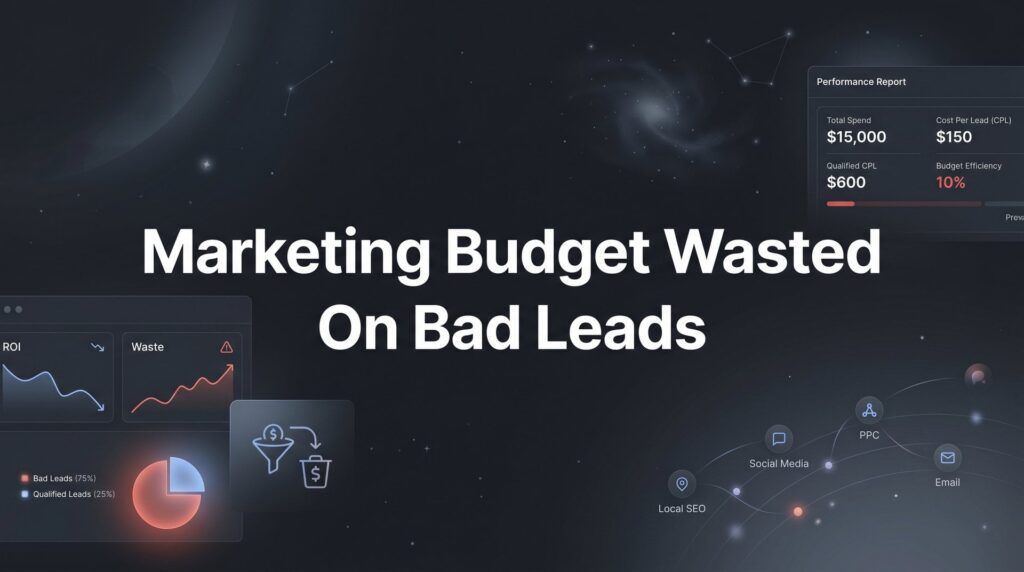
You open your marketing dashboard on Monday morning, coffee in hand, ready to review last month’s performance. The numbers look solid at first glance—hundreds of new leads, decent click-through rates, respectable cost-per-lead. Then you check the sales report.
Your stomach drops.
Half those leads never answered the phone. Another quarter were “just browsing” or looking for free advice. A handful were so far outside your service area that your sales team couldn’t help them even if they wanted to. Out of 200 leads, maybe 15 were actually worth talking to. And you just spent $8,000 to get them.
This is the hidden crisis killing businesses right now. You don’t have a traffic problem. You have a lead quality problem. And it’s bleeding your marketing budget dry while your sales team wastes hours chasing ghosts.
The frustrating part? Most of this waste is preventable. The issue isn’t that marketing doesn’t work—it’s that most campaigns are optimized for the wrong outcome. They’re built to generate volume, not value. They’re designed to make the metrics look good in reports, not to put qualified buyers in front of your sales team.
This guide is your diagnostic toolkit. We’re going to walk through exactly where the waste happens, how to spot it early, and what to do about it. No fluff, no theory—just the practical systems that separate businesses throwing money at marketing from those actually growing revenue from it.
The Financial Black Hole of Unqualified Prospects
Let’s start with what this actually costs you. Most businesses only count the obvious number—the ad spend itself. You paid $40 per lead, got 200 leads, spent $8,000. Simple math.
Except that’s not even close to the real cost.
Your sales rep spent 15 minutes on each of those 200 leads. That’s 50 hours of labor—more than a full work week—spent calling, emailing, and following up. At a fully-loaded cost of $35 per hour for a decent sales rep, you just added another $1,750 to that $8,000. And that’s assuming they only touched each lead once, which we both know isn’t true.
Now factor in the opportunity cost. While your team was chasing tire-kickers and wrong-fit prospects, they weren’t working the qualified leads that actually wanted to buy. They weren’t nurturing warm opportunities. They weren’t closing deals. How much revenue did you miss because your best salespeople were stuck on the phone with people who were never going to become customers?
The damage compounds in ways that don’t show up on any report. Your CRM is now polluted with hundreds of dead-end contacts. Your email lists are bloated with people who will never engage. Your retargeting audiences are full of browsers instead of buyers, which means your remarketing campaigns are wasting money too.
Worse, these bad leads create false confidence. Your marketing team sees 200 leads and thinks the campaign is working. They double down on the same targeting, the same messaging, the same approach—because the metrics look fine. Meanwhile, your sales team is drowning in unqualified prospects and wondering why marketing keeps sending them garbage. This disconnect is at the heart of the low quality leads problem that plagues so many businesses.
This disconnect between what marketing measures and what sales experiences is where businesses bleed money. Marketing optimizes for lead volume because that’s what they’re judged on. Sales gets frustrated because none of those leads convert. And the business owner is stuck in the middle, writing checks for marketing that doesn’t produce revenue.
The psychological toll on your sales team can’t be ignored either. Imagine spending your entire day calling people who don’t answer, aren’t interested, or were never qualified in the first place. It’s demoralizing. Your best salespeople start to burn out. They lose confidence in the leads they’re getting. They stop following up as aggressively because they’ve learned that most of these leads are dead ends anyway.
When you add it all up—the ad spend, the labor costs, the opportunity cost, the CRM pollution, the team morale—that $8,000 in marketing spend probably cost you closer to $15,000 in real economic impact. And if it prevented you from closing deals with qualified prospects, the true cost could be double that.
Why Your Ads Keep Attracting the Wrong Crowd
Here’s the trap most businesses fall into: they think more leads equals better results. It’s intuitive—if 10 leads produce 1 sale, then 100 leads should produce 10 sales, right?
Wrong. Because those extra 90 leads aren’t just neutral—they’re actively harmful. They consume resources, waste time, and hide the signal in the noise.
The problem usually starts with targeting that’s way too broad. You’re a commercial HVAC contractor serving a 50-mile radius around Dallas. But your Google Ads campaign is set to target anyone searching for “HVAC repair” within 100 miles. Now you’re paying for clicks from homeowners, people in suburbs you don’t serve, and DIYers looking for YouTube tutorials.
Or maybe you’re targeting the right geography, but your keywords are attracting the wrong intent. You bid on “how to fix air conditioner” because it has high search volume. The problem? People searching that phrase want to fix it themselves. They’re not looking to hire someone. They’re looking for free advice. Every click costs you money, and none of them were ever going to become customers.
Then there’s the messaging mismatch. Your ad promises “affordable HVAC solutions” because you think that’s what people want to hear. And it works—you get tons of clicks. But “affordable” attracts bargain hunters. People who are going to call five companies and pick whoever quotes the lowest price. They’re not your ideal customer, but your ad copy invited them in. Understanding why marketing isn’t working for your business often starts with recognizing these messaging mistakes.
Landing page disconnects amplify the problem. Your ad talks about commercial HVAC services, but your landing page is generic—it mentions both residential and commercial, talks about “all your HVAC needs,” and doesn’t clearly communicate who you actually serve. So now you’re getting leads from homeowners who clicked on a commercial ad, and commercial prospects who aren’t sure if you’re serious about serving businesses.
The curiosity click is another silent killer. Your headline says “The #1 HVAC Company in Dallas” but doesn’t explain what makes you different or who you serve. People click out of curiosity, not intent. They fill out your form because it’s there, not because they’re ready to buy. You get the lead, pay for the click, and your sales team calls someone who was just browsing.
Geographic mismatches are surprisingly common. Your campaign targets “Dallas” but Google interprets that broadly—suddenly you’re getting leads from Fort Worth, Plano, and suburbs an hour away. Your sales rep calls, confirms the address, and realizes you can’t even serve that area. That’s money down the drain before the conversation even starts.
Many businesses also make the mistake of optimizing campaigns for clicks or impressions instead of conversions. Google’s algorithms are happy to send you traffic—they get paid either way. But if you’re not explicitly telling the system to optimize for actual conversions (form fills, calls, purchases), it’ll send you whoever is most likely to click, not whoever is most likely to buy.
Spotting the Warning Signs Before They Drain Your Budget
The good news? Lead quality problems leave fingerprints. You just need to know where to look.
Start with your close rate. If you’re converting 20% of leads into customers, that’s solid. If you’re converting 5%, you have a quality problem. The math is simple: if you need 100 leads to close 5 deals, but you could get 25 leads that close at 20%, you’d spend a fraction of the budget for the same revenue.
Call duration is another tell. Pull your phone records and look at average call length by traffic source. If leads from Google Ads average 3 minutes while leads from referrals average 15 minutes, that’s a signal. Short calls usually mean wrong-fit prospects, people who hung up when they heard the price, or leads who weren’t actually interested. Implementing call tracking for marketing campaigns makes this analysis possible.
Form abandonment patterns matter too. If people are filling out the first field of your form but bailing before they submit, something’s wrong. Either your form is too long, you’re asking for information too early, or the people clicking your ads aren’t serious enough to complete the process.
Watch for patterns in which sources produce duds. Maybe your Facebook ads generate high volume but terrible close rates. Or your broad-match keywords in Google Ads bring in lots of traffic but nobody converts. Track this by source, by campaign, and by individual keyword if possible. The data will tell you where the waste is concentrated.
Geographic patterns reveal problems fast. If 30% of your leads are coming from areas you don’t serve, your targeting is broken. Pull a report of lead addresses and map them. You’ll see immediately if there’s a mismatch between where your leads are coming from and where you can actually do business.
The “just looking” ratio is brutal but honest. Have your sales team track how many leads say some version of “I’m just getting quotes” or “I’m not ready to buy yet” or “I’m just researching options.” If that’s more than 40% of your leads, your campaigns are attracting researchers, not buyers.
Here’s a simple audit process you can run this week: Pull your last 50 leads. Go through them one by one with your sales team. Mark each lead as “qualified buyer,” “wrong fit,” “not ready,” or “couldn’t reach.” Calculate the percentages. If less than 40% were qualified buyers, you’re wasting more than half your marketing budget.
Look at time-to-close by source too. Leads that take 6 months to close aren’t necessarily bad, but if one traffic source consistently produces leads that take forever to convert while another source produces leads that close in two weeks, that’s valuable intelligence. You might be better off spending more on the source that produces ready-to-buy prospects, even if the cost per lead is higher.
Engineering a System That Filters Out the Noise
Once you know you have a quality problem, the fix isn’t to get better at convincing unqualified people to buy. It’s to stop letting them into your pipeline in the first place.
Pre-qualification starts with your landing page copy. Be specific about who you serve and who you don’t. If you only work with commercial clients, say that. If you have a minimum project size, mention it. If you don’t serve certain areas, state it clearly. Yes, this will reduce your lead volume. That’s the point. You want fewer, better leads.
Pricing transparency is controversial but effective. You don’t have to list exact prices, but giving people a range or a starting point filters out bargain hunters before they become leads. A line like “Our typical projects start at $10,000” will scare off people with $2,000 budgets. That’s not a bug, it’s a feature.
Your form fields are a filtering mechanism. Don’t just ask for name, email, and phone number. Add fields that help you qualify: “What’s your timeline?” “What’s your budget range?” “What type of property?” These questions serve two purposes—they give your sales team better information, and they make casual browsers think twice before submitting. Learning how to generate qualified leads online requires mastering these pre-qualification techniques.
Lead scoring helps you prioritize the leads you do get. Assign point values based on behaviors and characteristics. Someone who visited your pricing page gets more points than someone who only saw the homepage. Someone in your service area gets more points than someone outside it. Someone who selected “within 30 days” for timeline gets more points than “just researching.”
The key is connecting these scores to action. High-score leads get immediate follow-up from your best salesperson. Medium-score leads get added to a nurture sequence. Low-score leads get minimal attention unless they re-engage. This ensures your team spends time where it matters most.
Create a feedback loop between sales and marketing. Have your sales team mark leads as “qualified” or “unqualified” in your CRM. Then pull monthly reports showing which campaigns, keywords, and sources produce the highest percentage of qualified leads. Double down on what works. Cut what doesn’t.
This feedback loop is critical because marketing can’t fix what they don’t know is broken. If sales is drowning in bad leads but marketing only sees volume metrics, nothing changes. But when marketing can see that Facebook ads produce 100 leads with a 5% close rate while Google Ads produce 30 leads with a 25% close rate, they can make intelligent decisions about where to allocate budget.
Consider adding a qualification call before you even book appointments. Some businesses have an inside sales team that does a quick 5-minute screening call to verify budget, timeline, and fit before passing leads to closers. This adds a step, but it protects your expensive sales resources from being wasted on prospects who were never going to buy.
Rebuilding Campaigns Around Buyer Intent
Now let’s talk about fixing the campaigns themselves. The goal is to attract buyers, not browsers. People who are ready to make a decision, not people who are just starting to think about it.
Start with your audience targeting. If you’re running Facebook or LinkedIn ads, build custom audiences based on your existing customer data. Upload your customer list and create lookalike audiences. These are people who match the characteristics of your actual buyers—not just anyone who might be interested in your industry.
Use exclusion lists aggressively. Exclude people who have already converted. Exclude geographic areas you don’t serve. Exclude job titles or demographics that don’t match your ideal customer. Every exclusion narrows your reach, but it improves your quality.
For Google Ads, shift your keyword strategy toward high-intent, transactional terms. Instead of “how to choose an HVAC system” (informational), target “commercial HVAC installation Dallas” (transactional). Instead of “HVAC tips” (browsing), target “emergency HVAC repair near me” (ready to buy). This approach is central to what performance marketing is all about.
Add negative keywords religiously. If you don’t serve residential clients, add “home,” “house,” “residential” as negatives. If you don’t do DIY products, add “DIY,” “how to,” “tutorial” as negatives. This prevents your ads from showing to people who were never going to hire you.
Your ad copy should pre-qualify aggressively. Don’t try to appeal to everyone. Be specific about who you serve: “Commercial HVAC for 10,000+ sq ft facilities.” Mention pricing ranges if appropriate: “Premium installations starting at $15K.” Call out your service area: “Serving Dallas-Fort Worth metro.” Every specific detail filters out bad fits before they click.
Use ad extensions strategically. Add callout extensions that highlight your qualifications: “20+ years experience,” “Licensed & insured,” “Commercial specialists.” These build credibility with serious buyers while doing nothing for casual browsers—which is exactly what you want.
Test different landing pages for different audience segments. Someone searching “emergency HVAC repair” has different needs than someone searching “HVAC maintenance contract.” Send them to different pages with messaging that matches their intent. The emergency searcher gets a page about fast response times and 24/7 availability. The maintenance searcher gets a page about preventive care and long-term savings.
Retargeting should focus on engaged visitors, not everyone who landed on your site. Create audiences based on meaningful actions: people who visited your pricing page, people who spent more than 2 minutes on site, people who viewed multiple pages. These are warmer prospects worth investing in. Don’t waste retargeting budget on someone who bounced in 10 seconds. For more on this, explore Facebook remarketing ads strategies that target the right audiences.
Tracking Revenue, Not Vanity Metrics
Here’s where most businesses get lost: they measure the wrong things. Cost per lead feels like an important metric. It’s not. What matters is cost per customer and lifetime value of those customers.
A campaign that generates leads at $30 each sounds better than one that generates leads at $100 each. But if the $30 leads close at 5% and the $100 leads close at 30%, the expensive campaign is actually five times more profitable. You’re paying $600 per customer from the cheap leads versus $333 per customer from the expensive leads.
Set up proper conversion tracking that follows the entire customer journey. You need to know which campaign, which ad, which keyword generated each lead. Then you need to know which of those leads became customers. And ideally, you need to know how much revenue each customer generated. If you’re struggling with this, our guide on fixing your marketing conversion tracking walks through the entire process.
This requires connecting your ad platforms to your CRM, and your CRM to your sales data. Google Ads should be tracking not just form fills, but actual sales. Facebook should know which leads closed. Your dashboard should show you revenue by source, not just leads by source.
Create reports that show the full funnel. Clicks to leads to qualified leads to opportunities to closed deals to revenue. When you can see the entire path, you can identify where the breakdown happens. Maybe you’re getting plenty of clicks but few leads—that’s a landing page problem. Maybe you’re getting plenty of leads but few qualified leads—that’s a targeting problem. Maybe you’re getting qualified leads but they’re not closing—that’s a sales process problem.
Focus on metrics that actually correlate with business growth. Return on ad spend (ROAS) tells you how much revenue you generated for every dollar spent on ads. Customer acquisition cost (CAC) tells you how much it costs to acquire a new customer across all channels. Lifetime value (LTV) tells you how much each customer is worth over their entire relationship with your business. Understanding how to track marketing ROI is essential for making these calculations meaningful.
The magic ratio to watch is LTV:CAC. If your average customer is worth $10,000 over their lifetime and it costs you $2,000 to acquire them, that’s a 5:1 ratio—healthy and scalable. If it costs you $8,000 to acquire a $10,000 customer, that’s a 1.25:1 ratio—you’re barely profitable and you can’t scale without fixing something.
Build dashboards that your entire team can understand. Marketing needs to see which campaigns drive revenue, not just which ones drive clicks. Sales needs to see which lead sources close at the highest rates. Leadership needs to see overall ROAS and whether marketing is generating profitable growth or just activity.
Turning Waste Into Profit
The pattern is clear: businesses waste marketing budget not because marketing doesn’t work, but because they’re optimizing for the wrong outcomes. They chase lead volume when they should chase lead quality. They celebrate activity when they should measure results. They focus on metrics that look good in reports instead of metrics that actually drive revenue.
The fix isn’t complicated, but it requires a fundamental shift in how you think about marketing. Stop trying to reach everyone. Start focusing on reaching the right people. Stop measuring success by how many leads you generate. Start measuring success by how much revenue those leads produce.
Implement the systems we’ve covered: understand your true costs, diagnose where quality problems are happening, build pre-qualification into your campaigns, target buyer intent instead of casual interest, and measure what actually matters. Each of these shifts will reduce your lead volume. That’s the goal. Fewer leads, higher quality, better close rates, more revenue per dollar spent.
The businesses winning right now aren’t the ones with the biggest marketing budgets. They’re the ones who’ve figured out how to stop wasting money on leads that were never going to buy. They’ve built systems that attract qualified prospects, filter out bad fits, and put their sales teams in front of people who are ready to make decisions.
Your marketing budget is either an investment that produces measurable returns or an expense that generates activity without results. The difference comes down to lead quality. Fix that, and everything else gets easier.
Tired of spending money on marketing that doesn’t produce real revenue? We build lead systems that turn traffic into qualified leads and measurable sales growth. If you want to see what this would look like for your business, we’ll walk you through how it works and break down what’s realistic in your market.