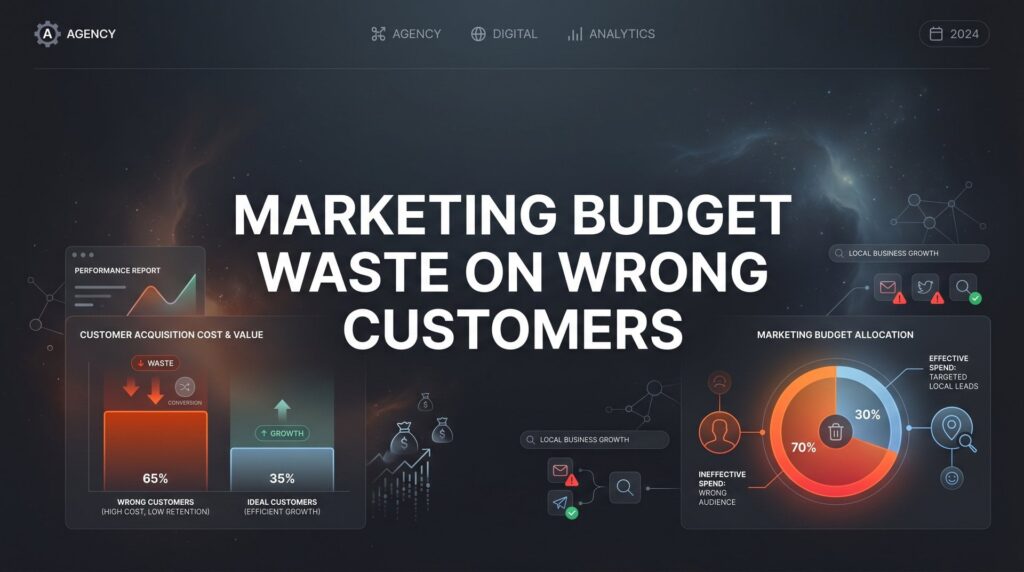
Every dollar spent attracting customers who will never buy is a dollar stolen from your bottom line. For local businesses, marketing budget waste on wrong customers isn’t just frustrating—it’s often the hidden reason why seemingly solid campaigns fail to deliver profitable growth.
The problem isn’t usually your ads, your website, or even your offer. It’s that your marketing is reaching people who were never going to become paying customers in the first place.
Think about it: You’re paying the same cost per click whether that visitor is a serious buyer ready to spend or someone casually browsing with no intention to purchase. You’re investing the same effort nurturing leads who can’t afford your services as you are with qualified prospects who need exactly what you offer.
This guide delivers seven battle-tested strategies to identify exactly who your profitable customers are, eliminate wasteful spending on poor-fit prospects, and redirect every marketing dollar toward people who actually want what you sell. These aren’t theoretical concepts—they’re the same approaches that transform unprofitable campaigns into customer acquisition machines.
1. Build a Profitable Customer Profile
The Challenge It Solves
Most businesses target “everyone who might be interested” rather than “customers who actually generate profit.” This creates a fundamental mismatch: your marketing attracts a broad audience, but only a small segment of that audience delivers meaningful revenue. The result? You’re spending heavily to acquire customers who cost more to serve than they’ll ever pay you.
Without a clear profile of your most profitable customers, you’re essentially guessing at who to target. You might attract plenty of leads, but if those leads don’t convert at profitable rates, your marketing is just expensive noise.
The Strategy Explained
Building a profitable customer profile means analyzing your existing customer base to identify the specific characteristics shared by customers who generate the most revenue with the least friction. This goes beyond basic demographics like age and location.
Look at purchase behavior, project size, decision-making speed, referral patterns, and lifetime value. Many businesses discover that their most profitable customers share surprising traits—they might come from specific industries, have particular pain points, or exhibit certain buying behaviors that distinguish them from less profitable segments.
The goal is to create a detailed picture of who actually makes your business money, not just who expresses interest. This profile becomes your targeting blueprint for every marketing channel.
Implementation Steps
1. Pull data on your last 50-100 customers and segment them by total revenue, profit margin, and cost to acquire and serve.
2. Identify the top 20% most profitable customers and analyze what they have in common: industry, company size, specific problems they needed solved, how they found you, and how quickly they made buying decisions.
3. Document these patterns into a detailed customer profile that includes firmographics, behavioral traits, pain points, and buying signals that indicate serious intent.
4. Share this profile with everyone involved in marketing and sales so targeting decisions align with attracting more of these high-value customers.
Pro Tips
Don’t confuse your most frequent customers with your most profitable ones. A customer who buys often but demands heavy service and negotiates aggressively on price might be less valuable than one who pays premium rates and requires minimal support. Focus your profile on profit, not just volume. Understanding how to track marketing ROI helps you identify which customer segments actually drive profitability.
2. Implement Negative Targeting
The Challenge It Solves
Your campaigns are likely showing ads to people who will never become customers—job seekers looking for employment, students researching for school projects, competitors analyzing your approach, or bargain hunters who’ll never pay your rates. Every impression and click from these audiences drains budget without any possibility of return.
The challenge intensifies because advertising platforms default to broad targeting. They want to show your ads to as many people as possible, which sounds good until you realize “more reach” often means “more waste” when that reach includes fundamentally wrong-fit audiences.
The Strategy Explained
Negative targeting is the practice of actively excluding audiences, keywords, placements, and demographics that consistently fail to convert or attract poor-fit prospects. Instead of just defining who you want to reach, you explicitly tell advertising platforms who you don’t want to reach.
This works across channels. In search advertising, negative keywords prevent your ads from showing for irrelevant searches. In social media advertising, audience exclusions keep your ads away from people who’ll never buy. In display advertising, placement exclusions prevent your ads from appearing on sites that attract the wrong crowd.
The principle is simple: preventing one dollar of waste is as valuable as generating one dollar of revenue. Negative targeting stops the bleeding before it starts. This is a core component of marketing budget waste prevention that every advertiser should master.
Implementation Steps
1. Review search query reports in your PPC campaigns and identify searches that triggered your ads but have zero chance of converting—terms like “free,” “jobs,” “salary,” “DIY,” or “how to do it yourself.”
2. Build negative keyword lists organized by theme: job seekers, students, competitors, DIY searchers, and freebie hunters, then apply these lists across all relevant campaigns.
3. In social media campaigns, exclude audiences based on interests, behaviors, or demographics that don’t match your profitable customer profile—if your best customers are business owners, exclude people whose interests suggest they’re employees, not decision-makers.
4. Set up automated rules or alerts to flag when campaigns start spending on poor-performing segments so you can add new negative targets as patterns emerge.
Pro Tips
Start conservative with negative targeting, then expand as you gather data. It’s better to accidentally show ads to a few wrong people than to accidentally exclude potential customers. Review your negative lists quarterly—market conditions change, and what was irrelevant last year might be valuable now.
3. Use Lead Qualification Questions
The Challenge It Solves
When your lead capture process is frictionless—just name and email—you’ll get plenty of submissions. The problem? Most of those leads are curiosity seekers, price shoppers, or people who aren’t ready to buy. Your sales team wastes hours chasing leads who were never qualified in the first place.
This creates a deceptive metric problem. Your marketing looks successful because lead volume is high, but conversion rates are terrible because most leads are junk. You’re paying to acquire contact information from people who will never become customers.
The Strategy Explained
Strategic lead qualification questions add intentional friction to your lead capture process. Instead of making it as easy as possible for anyone to submit, you ask questions that help identify serious buyers while discouraging tire-kickers from completing the form.
This approach recognizes a counterintuitive truth: the best leads are often willing to invest more effort upfront. Someone who takes 90 seconds to answer qualifying questions is demonstrating real interest. Someone who bounces when they see a five-field form instead of a two-field form probably wasn’t going to convert anyway.
The key is asking questions that reveal buying intent, budget reality, timeline, and decision-making authority. These answers let you prioritize follow-up and route leads appropriately—or recognize immediately when someone isn’t a fit. Businesses struggling with poor quality leads from marketing often find that better qualification questions solve the problem.
Implementation Steps
1. Identify the three to five questions that best predict whether a lead will become a profitable customer—common examples include budget range, timeline, decision-making role, and specific problem they need solved.
2. Add these questions to your primary lead capture forms, using dropdown menus or multiple choice options to make completion easy while still gathering qualification data.
3. Set up conditional logic or lead scoring based on responses—leads who indicate appropriate budget, near-term timeline, and decision-making authority get immediate high-priority follow-up.
4. Include one question that helps poor-fit prospects self-select out, such as “What’s your budget range?” with options that include ranges below your minimum—when someone selects the lowest option, you know immediately they’re not a fit.
Pro Tips
Frame qualification questions as helping you serve them better, not as barriers. Instead of “What’s your budget?” try “To recommend the right solution, what investment range works for your situation?” The psychological framing matters—you’re not interrogating them, you’re gathering information to help them.
4. Track CAC by Source and Segment
The Challenge It Solves
When you only track overall customer acquisition cost, you miss the critical insight: some channels and campaigns acquire customers profitably while others burn money. Your average CAC might look acceptable, but that average hides the fact that certain sources deliver customers at three times the cost of others.
This blind spot causes you to keep funding campaigns that destroy value while underfunding channels that print money. You’re making budget allocation decisions based on incomplete data, which means you’re almost certainly wasting significant money on wrong-fit customer sources.
The Strategy Explained
Tracking customer acquisition cost by source and segment means measuring exactly how much it costs to acquire a customer from each marketing channel, campaign, and audience segment. This granular tracking reveals where your marketing budget generates positive ROI and where it disappears into acquisition of customers who’ll never be profitable.
The approach requires connecting marketing spend all the way through to closed customers, not just to leads or even qualified opportunities. Many businesses discover that channels generating the most leads don’t generate the most customers—or that certain audience segments convert at dramatically different rates. Proper marketing conversion tracking is essential for this analysis.
This data transforms budget allocation from guesswork into science. You can confidently invest more in sources delivering customers at profitable CAC while cutting or restructuring sources where acquisition costs exceed customer lifetime value.
Implementation Steps
1. Set up tracking that connects every customer back to their original source—use UTM parameters, CRM source fields, and closed-loop reporting to maintain this connection from first click through closed sale.
2. Calculate CAC for each significant source by dividing total marketing spend on that source by the number of customers acquired from it over a consistent time period—do this monthly or quarterly depending on your sales cycle length.
3. Segment CAC analysis by audience characteristics: geographic location, company size, industry, or any other dimension that matters for your business—you might discover that customers from certain segments cost half as much to acquire as others.
4. Create a dashboard that shows CAC by source alongside customer lifetime value by source, making it immediately obvious which channels deliver profitable customers and which ones don’t.
Pro Tips
Account for sales cycle length when calculating CAC by source. Channels that generate customers with longer sales cycles will show artificially high CAC if you measure too soon. Give each source enough time to mature before making elimination decisions—three to six months minimum for most local businesses.
5. Align Messaging to Repel Wrong Customers
The Challenge It Solves
Generic marketing messages designed to appeal to everyone end up attracting lots of wrong-fit prospects. When your ad copy emphasizes “affordable,” “fast,” or “easy,” you attract bargain hunters and people looking for quick fixes—not necessarily customers willing to invest in quality solutions.
This creates volume at the expense of quality. Your click-through rates might look great, but conversion rates suffer because the messaging attracted people who were never going to buy at your price point or appreciate your value proposition.
The Strategy Explained
Strategic messaging deliberately includes elements that appeal to your ideal customers while discouraging poor-fit prospects from engaging. This means being specific about who you serve, transparent about investment levels, and clear about the commitment required from customers.
The counterintuitive insight: the best marketing messages don’t try to appeal to everyone. They speak directly to ideal customers in language that resonates with their specific situation while including signals that help wrong-fit prospects self-select out before wasting your time or their own. This is why understanding why marketing isn’t working often comes down to messaging misalignment.
This approach recognizes that attracting fewer but better-qualified prospects is more valuable than high volume of poor-fit leads. You’re optimizing for conversion quality, not just click volume.
Implementation Steps
1. Audit your current ad copy and website messaging for generic appeals that attract everyone—phrases like “affordable solutions,” “quick and easy,” or “anyone can” are red flags that you’re not filtering effectively.
2. Rewrite messaging to include specific qualifiers that describe your ideal customer: “for established businesses ready to scale,” “for companies investing in long-term growth,” or “for decision-makers who value results over price.”
3. Add transparency about investment levels or commitment required—if your services start at a certain price point, mentioning “premium” or “investment starting at X” helps budget-conscious prospects self-select out early.
4. Use language that reflects how your best customers talk about their challenges—if they describe needing “sustainable growth” rather than “more leads,” use their language to attract more people like them.
Pro Tips
Don’t confuse being selective with being elitist. You can filter for right-fit customers while maintaining an approachable, helpful tone. The goal is clarity about who you serve best, not creating artificial exclusivity. Frame your selectiveness as ensuring you deliver results, not as gatekeeping.
6. Create Lookalike Audiences from Best Customers
The Challenge It Solves
Building audiences from scratch using demographic and interest targeting is essentially educated guessing. You’re making assumptions about who might be interested based on surface-level characteristics, but you’re not leveraging the most valuable data you have: information about people who already became profitable customers.
This guesswork approach means you’re constantly testing and adjusting targeting, hoping to stumble onto audiences that convert well. Meanwhile, you have a goldmine of data about exactly who converts—your existing customer base—that you’re not fully utilizing.
The Strategy Explained
Lookalike audience functionality, available on major advertising platforms, uses machine learning to find new prospects who share characteristics with your existing customers. You provide the platform with data about your best customers, and it identifies other users who match similar patterns.
This approach is powerful because platforms analyze hundreds of signals you couldn’t manually target: browsing behavior, purchase patterns, content engagement, and countless other data points. The algorithm identifies commonalities among your customers that you might never discover through manual analysis.
The key is feeding the algorithm high-quality source data. A lookalike audience built from your most profitable customers will perform dramatically better than one built from all leads or even all customers—because you’re teaching the platform to find more people like your best customers, not just more people like anyone who ever engaged with you. Combining this with Facebook remarketing ads creates a powerful acquisition and retention system.
Implementation Steps
1. Export a list of your top 20-30% most profitable customers, including as much information as the advertising platform accepts—email addresses, phone numbers, and physical addresses all help improve match rates.
2. Upload this customer list to create a custom audience in your advertising platform, then use that custom audience as the seed for a lookalike audience—start with a 1-3% lookalike for highest similarity.
3. Create separate lookalike audiences from different customer segments if you serve distinct markets—a lookalike from high-value customers will perform differently than one from all customers combined.
4. Test lookalike audiences against your existing targeting approaches, measuring not just cost per lead but cost per customer and customer quality—lookalikes should deliver better conversion rates even if initial cost per click is higher.
Pro Tips
Refresh your lookalike audiences quarterly as you acquire new customers. The algorithm’s effectiveness improves with more source data, and market conditions shift over time. Also consider creating lookalike audiences from specific high-value actions, like customers who made repeat purchases or provided referrals—these ultra-qualified seeds can uncover your most valuable prospects.
7. Audit Campaigns Monthly for Audience Drift
The Challenge It Solves
Advertising platforms optimize for the metrics you tell them to optimize for—usually clicks, impressions, or conversions. But their definition of success might not match yours. Over time, algorithms often expand targeting to find “easier” conversions or cheaper clicks, which frequently means drifting toward lower-quality audiences.
This audience drift happens gradually. Your campaign that started targeting business owners slowly expands to include anyone remotely interested in business topics. Your local service campaign that focused on your immediate area starts showing ads to people 50 miles away because the platform found cheaper clicks there.
Without regular audits, you won’t notice this drift until performance has degraded significantly. You’ll wonder why a campaign that worked great three months ago is now delivering terrible results—the answer is usually that the audience it’s reaching has fundamentally changed.
The Strategy Explained
Monthly campaign audits involve systematically reviewing who your ads are actually reaching versus who you intended to target. This means examining search query reports, placement reports, demographic breakdowns, and geographic performance to identify where the platform’s optimization has taken you away from your ideal audience.
The audit process catches drift early, before it wastes significant budget. You might discover your ads are showing for tangentially related searches, appearing on websites that attract the wrong demographic, or reaching age groups that never convert for your business. Implementing call tracking for marketing campaigns adds another layer of insight into which audiences actually convert.
Regular audits also reveal opportunities. Sometimes you’ll find unexpected audiences or placements that perform exceptionally well—insights you’d miss without systematic review of actual performance data.
Implementation Steps
1. Set a recurring monthly calendar reminder to audit each major campaign, spending 30-60 minutes reviewing actual delivery data versus intended targeting.
2. Check search query reports to identify irrelevant searches triggering your ads, then add new negative keywords to prevent future waste on those terms.
3. Review demographic and geographic performance data to ensure your ads are reaching the intended audience segments—if certain demographics or locations show high spend but low conversion, add them to exclusion lists.
4. Examine placement reports in display and social campaigns to identify websites, apps, or placements that consume budget without delivering results, then exclude poor performers.
5. Document changes made during each audit and track whether those changes improve performance—this creates a learning loop that makes each audit more effective.
Pro Tips
Don’t just look at what’s performing poorly—also identify what’s working exceptionally well. If certain audience segments, locations, or placements dramatically outperform others, consider creating dedicated campaigns focused exclusively on those high-performers. Audience drift cuts both ways: platforms might accidentally discover gold you should mine intentionally.
Putting It All Together
Stopping marketing budget waste on wrong customers isn’t about spending less—it’s about spending smarter. Every strategy in this guide serves one purpose: ensuring your marketing dollars reach people who will actually become profitable customers.
Start with strategy one: analyze your existing customers to identify who actually generates profit. This foundation informs everything else. Once you know who your best customers are, you can implement negative targeting to avoid wrong-fit audiences, add qualification questions to filter leads, and track CAC by source to identify where waste is happening.
Then refine your approach with strategic messaging that attracts ideal customers while repelling poor fits, lookalike audiences that find more people similar to your best customers, and regular audits that catch audience drift before it destroys campaign performance.
The businesses that master customer targeting don’t just save money—they build scalable acquisition systems that get more efficient over time. As you eliminate waste and focus spending on right-fit prospects, your cost per customer drops while customer quality rises. That combination is how you turn marketing from an expense into a profit center.
Your next step is clear: audit your current campaigns this week and identify where wrong-fit customers are draining your budget. Pick one strategy from this guide and implement it fully before moving to the next. Incremental improvement compounds quickly when you’re eliminating waste and redirecting those savings toward what actually works.
Tired of spending money on marketing that doesn’t produce real revenue? We build lead systems that turn traffic into qualified leads and measurable sales growth. If you want to see what this would look like for your business, we’ll walk you through how it works and break down what’s realistic in your market.