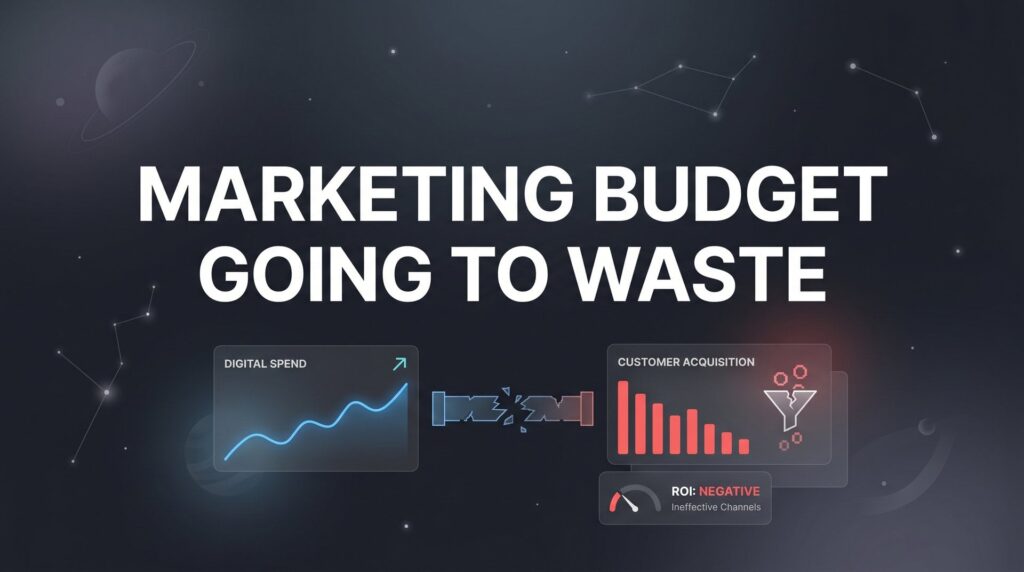
You open your bank statement and see another $3,500 charge from your Google Ads account. Your Facebook bill hit $1,200 this month. The SEO agency you hired costs another $2,000. You’re spending nearly $7,000 monthly on marketing, yet when you look at actual new customers, you can count them on one hand.
Something doesn’t add up.
You’re not alone in this frustration. Most business owners experience that sinking feeling when they realize their marketing investment isn’t producing proportional results. The reports look impressive—thousands of impressions, hundreds of clicks, growing follower counts. But your phone isn’t ringing more. Your sales pipeline hasn’t grown. And you’re left wondering if marketing actually works or if you’re just throwing money into a black hole.
Here’s the uncomfortable truth: most businesses unknowingly waste a significant portion of their marketing budget on ineffective tactics. Not because marketing doesn’t work, but because they’re missing critical optimization opportunities that silently drain thousands of dollars every month. The good news? Once you know what to look for, these budget leaks are completely fixable. Let’s identify exactly where your money is disappearing and how to plug those leaks for good.
The Hidden Drain: Why Good Marketing Dollars Disappear
There’s a dangerous misconception that more marketing spend automatically equals better results. Business owners fall into this trap constantly: “If I’m spending $5,000 and getting 10 customers, spending $10,000 should get me 20 customers, right?”
Wrong.
Marketing doesn’t scale linearly because results depend entirely on strategic allocation, not raw spending power. You could double your budget and actually get fewer customers if that money flows into the wrong channels, targets the wrong audience, or sends traffic to underperforming landing pages. Meanwhile, your competitor might spend half what you do and generate triple the revenue because they’ve optimized every step of their customer acquisition process.
The real budget killers aren’t the big, obvious mistakes. They’re the small inefficiencies that compound over time and silently drain your resources. A poorly targeted ad campaign wastes 30% of your clicks on people who will never buy. A weak landing page converts at 1% instead of 4%, meaning you’re paying four times more per customer than you should. No proper tracking means you can’t identify which campaigns actually work, so you keep funding the losers alongside the winners.
Each of these issues might seem minor in isolation. But stack them together and you’re suddenly wasting 40% of your entire marketing budget on tactics that don’t work. That’s $2,800 monthly on a $7,000 budget—over $33,000 annually—that produces zero return. Understanding why marketing isn’t working for your business is the first step toward fixing these hidden drains.
The cruelest part? Most business owners don’t discover they’re wasting money until they’ve already lost significant amounts. There’s no flashing red light that says “Warning: This campaign is hemorrhaging cash.” Instead, you get monthly reports filled with metrics that sound good but don’t connect to actual business outcomes. By the time you realize something’s wrong, you’ve already funded six months of ineffective marketing.
This is why understanding the specific warning signs of budget waste isn’t just helpful—it’s essential to your business survival. Let’s examine the red flags that indicate your marketing dollars are disappearing.
Red Flag #1: You Can’t Connect Marketing Spend to Actual Revenue
Ask yourself this simple question: “Which marketing campaign brought in my last 10 customers?”
If you can’t answer that question with specifics, you have a serious problem. You’re flying blind, making budget decisions based on guesswork instead of data. And guesswork is expensive.
The vanity metrics trap catches almost everyone. Your marketing reports show 50,000 impressions, 2,000 clicks, 500 new followers, and 100 email signups. Those numbers look impressive in a presentation. They make you feel like something is happening. But none of them answer the only question that actually matters: “Did this marketing generate revenue?”
Impressions don’t pay your bills. Clicks don’t cover payroll. Followers don’t keep the lights on. Revenue does. And if you can’t trace your marketing spend directly to the revenue it generated, you’re essentially gambling with your business capital. Learning how to track marketing ROI is essential for making informed budget decisions.
Proper tracking infrastructure changes everything. When you implement attribution systems that connect every dollar spent to actual customer conversions, you suddenly gain X-ray vision into your marketing performance. You discover that your Facebook ads generate leads at $45 each but only 5% become customers, giving you a $900 customer acquisition cost. Meanwhile, your Google search ads cost $120 per lead but convert at 25%, producing a $480 acquisition cost—half the price for better customers.
Without this visibility, you’d keep funding both campaigns equally. With it, you can shift budget from Facebook to Google and immediately cut your acquisition costs in half. That’s not a small optimization—that’s the difference between profitable growth and slowly bleeding money.
The diagnostic questions are simple but revealing. Can you tell me your cost per customer for each marketing channel? Do you know which campaigns produced your highest lifetime value customers? Can you identify which ad creative generated the most revenue, not just the most clicks?
If these questions make you uncomfortable because you don’t have the answers, your marketing budget is definitely going to waste. You’re making expensive decisions in the dark.
Red Flag #2: Your Cost Per Lead Keeps Climbing
Three months ago, you were generating leads at $35 each. Last month it was $52. This month you’re at $68 and climbing. Your first instinct might be to blame increased competition or rising ad costs across the platform.
Sometimes that’s true. But more often, rising acquisition costs signal deeper strategic issues within your own campaigns.
The audience fatigue cycle is real and brutal. You launch a campaign targeting a specific audience with a particular message. It works great initially because your offer is fresh and relevant to people who haven’t seen it before. But as weeks pass, you keep showing the same ads to the same people with the same messaging. They’ve already seen your offer. They’ve already decided not to convert. Yet you keep paying to reach them again and again.
Response rates drop. Cost per click increases. Conversion rates decline. Your cost per lead climbs steadily because you’re mining an exhausted audience. This is where Facebook remarketing ads can help you strategically re-engage warm audiences without burning through your budget on cold prospects.
This creates a compounding problem. As your cost per lead rises, you need each lead to convert at a higher rate just to maintain profitability. But fatigued audiences don’t just cost more—they convert worse. You’re paying more for lower-quality leads, which means your entire customer acquisition system becomes progressively less efficient until it eventually breaks.
The fix requires diagnosing where the breakdown occurs. Is your targeting too narrow, causing you to exhaust your audience quickly? Is your creative stale, failing to capture attention from people who’ve seen similar ads before? Is your offer weak compared to competitors who’ve entered the market?
Each root cause requires a different solution. Targeting problems need audience expansion or new segment testing. Creative fatigue demands fresh ad variations and messaging angles. Offer issues require competitive analysis and value proposition refinement. But you can’t fix what you don’t measure, which is why tracking your cost per lead trends over time is critical for catching this problem before it destroys your margins.
Red Flag #3: Traffic Is Up But Sales Are Flat
Your analytics dashboard shows a beautiful upward trend. Website visitors increased 40% this quarter. Session duration is up. Pages per visit look healthy. Your marketing team celebrates the traffic growth as a major win.
Then you check your sales numbers and see… nothing. Revenue is essentially flat despite the traffic surge. What happened?
This disconnect between attracting visitors and converting them into customers represents one of the most expensive forms of budget waste. You’re successfully paying to drive traffic—that part of your marketing works. But you’re failing to convert that traffic into revenue, which means every dollar spent on ads is effectively wasted. Businesses struggling with this issue often benefit from conversion focused marketing services that prioritize revenue over vanity metrics.
Think about the economics. If you’re spending $5,000 monthly on ads to generate 2,000 website visitors, you’re paying $2.50 per visitor. If your conversion rate is 2%, you get 40 customers at $125 each. But if your conversion rate is 0.5% because your landing pages are broken, you only get 10 customers at $500 each. Same traffic, same ad spend, dramatically different outcomes.
The landing page is where most traffic dollars die. Common failures include unclear value propositions that don’t immediately communicate why someone should buy from you. Confusing navigation that gives visitors too many options instead of one clear path to conversion. Forms that ask for too much information upfront, creating friction that kills momentum. Slow page load times that cause people to bounce before they even see your offer.
Each of these issues might only impact a small percentage of visitors individually. But combined, they create a conversion rate that’s 50-75% lower than it should be. That’s not a minor optimization opportunity—that’s the difference between profitable marketing and burning money.
This is why “more traffic” is often the wrong goal when your conversion rates are broken. Pouring more visitors into a leaky bucket doesn’t fill it faster—it just wastes more water. Fix the conversion path first, then scale traffic. Otherwise, you’re just scaling your waste.
Red Flag #4: You’re Spreading Budget Too Thin Across Channels
You’re running Google Ads, Facebook Ads, Instagram promotions, LinkedIn campaigns, email marketing, content marketing, SEO, and local directory listings. Your marketing strategy includes every channel you’ve ever heard recommended. You’re everywhere, all at once.
And you’re getting mediocre results everywhere.
The “spray and pray” approach feels safe because you’re diversifying your marketing risk. If one channel fails, you have others. But this strategy guarantees mediocre performance across the board because you’re spreading your budget so thin that no single channel gets the investment it needs to actually work.
Effective marketing requires sufficient budget to test, learn, and optimize. Google Ads needs enough spend to exit the learning phase and gather statistically significant conversion data. Facebook requires budget to test multiple audience segments and creative variations. SEO demands consistent content investment over months to build authority. When you split $5,000 across eight channels, each gets $625—barely enough to run basic campaigns, let alone optimize them properly. A well-planned multi channel marketing strategy focuses resources on your highest-performing channels rather than spreading thin across everything.
The result? You’re running eight underperforming campaigns instead of three highly optimized ones. Your Google Ads never escape the learning phase. Your Facebook ads don’t get enough conversions to optimize delivery. Your SEO efforts produce sporadic content that doesn’t build momentum. Everything performs below its potential because nothing gets the resources it needs to succeed.
The 80/20 rule applies ruthlessly to marketing channels. In most businesses, 80% of customer acquisition results come from 20% of marketing channels. Maybe Google search ads and email marketing drive most of your revenue while Instagram and LinkedIn produce almost nothing. But if you’re funding all channels equally, you’re dramatically underfunding your winners and overfunding your losers.
The fix requires brutal honesty about what’s actually working. Identify your highest-potential channels based on current performance data, then consolidate budget into those areas. Double down on what works instead of spreading resources across everything that might work. This focused approach produces better results with the same budget because you’re finally giving your best channels the fuel they need to perform.
The Fix: Building a Leak-Proof Marketing System
Identifying budget waste is useful, but fixing it requires a systematic approach. Here’s how to transform your marketing from a money drain into a reliable customer acquisition engine.
Step 1: Implement Proper Attribution Tracking Before Spending Another Dollar
Stop all marketing optimization efforts until you have accurate tracking in place. Seriously. Trying to improve marketing without proper attribution is like trying to navigate without a map—you might eventually get somewhere, but you’ll waste enormous amounts of time and money getting lost along the way.
Set up conversion tracking that connects every lead and customer back to the specific campaign, ad group, keyword, and creative that generated them. Implement call tracking for marketing campaigns so phone conversions are attributed correctly. Use UTM parameters consistently across all campaigns so you can trace traffic sources in your analytics. Configure your CRM to capture lead source data and track it through to closed sales.
This infrastructure isn’t optional. It’s the foundation that makes everything else possible. If you’re not tracking marketing conversions properly, you’re making expensive decisions based on incomplete information.
Step 2: Audit Current Campaigns Ruthlessly—Cut What Doesn’t Convert, Scale What Does
Once you have tracking data, conduct a ruthless performance audit. Calculate the actual cost per customer for every campaign, not just cost per click or cost per lead. Identify which campaigns generate profitable customers and which ones waste money.
This is where most business owners struggle emotionally. You’ve been running that Facebook campaign for eight months. You’ve invested time building those creative assets. The metrics look decent. But if it’s not generating customers at a profitable cost, it needs to be paused or dramatically restructured.
Cut the losers without mercy. Redirect that budget into campaigns that actually work. If Google search ads generate customers at $200 each with a $600 lifetime value while Facebook generates customers at $450 each with a $500 lifetime value, the math is simple: scale Google, fix or kill Facebook.
Step 3: Optimize the Conversion Path From Ad Click to Customer Purchase
Driving traffic is only half the equation. Converting that traffic into customers is where real profitability lives. Audit your entire conversion path and eliminate friction at every step.
Start with your landing pages. Does the headline immediately communicate your core value proposition? Is there one clear call-to-action, or are you giving visitors too many options? Does the page load in under three seconds? Is your form asking for only essential information?
Test different elements systematically. Try new headlines that speak directly to customer pain points. Experiment with different form lengths. Test various call-to-action buttons. Even small improvements compound significantly—increasing conversion rate from 2% to 3% means you’re getting 50% more customers from the same traffic.
Extend this optimization mindset to your entire customer journey. How quickly do you follow up with new leads? What’s your nurture sequence for leads who aren’t ready to buy immediately? Are you tracking which touchpoints influence final purchase decisions?
When to Bring in Specialists vs. Trying to Fix It Yourself
Some marketing optimization you can handle internally with time and attention. Setting up basic tracking, pausing underperforming campaigns, and improving obvious landing page issues are all manageable for most business owners.
But certain problems require specialized expertise. If your Google Ads account has complex bidding strategies, extensive negative keyword lists, and sophisticated audience targeting, a PPC specialist can often find optimization opportunities you’d miss. Understanding the digital marketing agency vs in-house marketing decision can help you determine when outside help makes financial sense.
The decision point is simple: if you’ve made basic improvements but still aren’t seeing the results you need, or if your time is better spent running your business than learning advanced marketing tactics, bringing in specialists usually pays for itself quickly through improved performance.
Putting It All Together
Marketing budget waste isn’t inevitable. It’s not just a cost of doing business that you have to accept. Every dollar you’re currently wasting is diagnosable and fixable once you know what to look for.
The warning signs are clear: inability to connect spend to revenue, rising cost per lead, traffic that doesn’t convert, and budget spread too thin across too many channels. Each of these issues has a specific solution, but they all start with the same foundation—proper tracking that shows you exactly where your money is going and what it’s producing.
Most business owners discover they’re wasting 25-40% of their marketing budget on tactics that don’t work. That’s not a small problem. On a $100,000 annual marketing budget, that’s $25,000-$40,000 thrown away every year. Money that could have been reinvested into campaigns that actually generate customers and grow your business.
The first step is always understanding where your money is actually going. Not where you think it’s going based on vanity metrics and impressive-looking reports. Where it’s actually going based on hard revenue attribution data. Once you have that visibility, the fixes become obvious. Cut what doesn’t work, scale what does, optimize the conversion path, and focus your resources on channels that produce real results.
Tired of spending money on marketing that doesn’t produce real revenue? We build lead systems that turn traffic into qualified leads and measurable sales growth. If you want to see what this would look like for your business, we’ll walk you through how it works and break down what’s realistic in your market. No fluff, no vanity metrics—just straight talk about what it takes to turn your marketing budget into a reliable customer acquisition engine that actually grows your business.