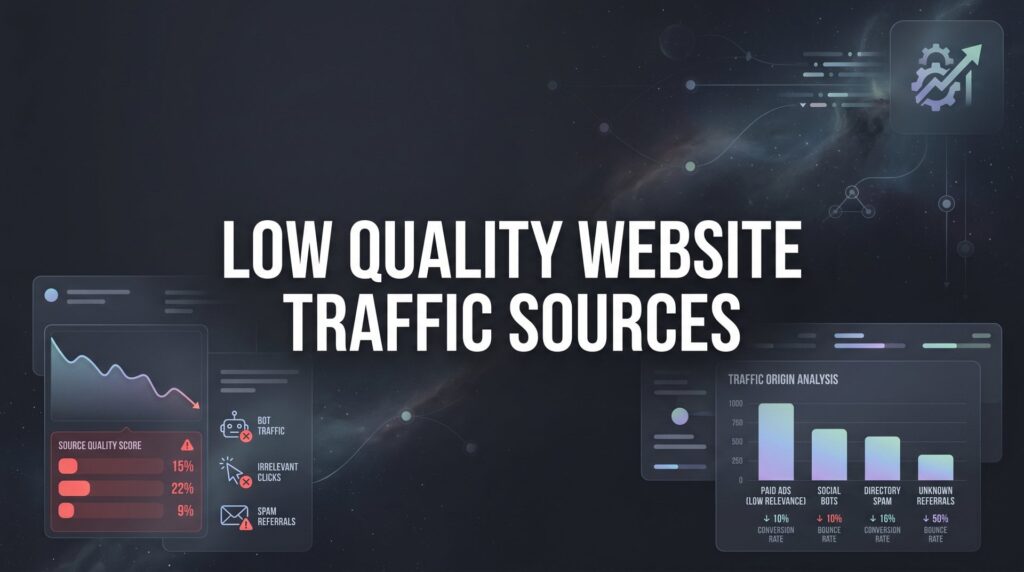
You’re watching your website traffic numbers climb, but your sales remain flat. Your bounce rate is through the roof, and those ‘leads’ coming in are either spam or completely unqualified. Sound familiar?
The harsh truth is that not all traffic is created equal—and many business owners are unknowingly paying for visitors who will never become customers.
Low quality website traffic sources drain your marketing budget, skew your analytics, and create a false sense of progress while your competitors capture the customers who actually matter. In this guide, we’ll expose the seven most common sources of junk traffic plaguing local businesses and give you actionable strategies to identify, eliminate, and replace them with visitors who convert into paying customers.
1. Bot Traffic and Click Farms
The Challenge It Solves
Your analytics show thousands of visitors, but your phone isn’t ringing and your contact forms sit empty. This disconnect often signals bot traffic—automated programs that mimic human behavior without any intention to engage with your business. Click farms compound the problem by employing low-wage workers to manually click ads, creating the appearance of legitimate traffic while delivering zero conversion potential.
These fraudulent visitors inflate your costs, corrupt your data, and make it nearly impossible to optimize campaigns based on accurate performance metrics.
The Strategy Explained
Bot traffic detection requires a multi-layered approach combining platform-level protections with manual monitoring. Google Ads automatically filters invalid clicks and provides refunds for detected fraud, but sophisticated bots slip through. The key is identifying patterns that separate human behavior from automated activity.
Look for red flags: sessions lasting exactly zero seconds, impossibly high page-per-session counts, traffic spikes from unusual geographic locations, and suspiciously uniform behavior patterns. Legitimate visitors browse unpredictably; bots follow programmed paths.
Your defense strategy should focus on prevention rather than reaction. Enable every available bot filtering option, implement CAPTCHA on conversion forms, and regularly audit traffic sources for suspicious patterns.
Implementation Steps
1. Enable bot filtering in Google Analytics under Admin > View Settings > Bot Filtering, then cross-reference with Google Ads invalid click reports to identify patterns that slip through automated detection.
2. Install security plugins or services that detect and block known bot signatures, focusing on solutions that update their databases regularly as new bot variants emerge.
3. Create custom segments in Analytics isolating traffic with zero-second sessions or impossibly high engagement rates, then exclude these IP ranges and referral sources from future campaigns.
4. Review your PPC campaign placements and exclude any sites generating high click volume with zero conversions or engagement—these are prime bot traffic sources.
Pro Tips
Check your traffic during off-hours. Legitimate local business traffic typically drops overnight, but bot traffic maintains consistent patterns around the clock. Sudden traffic spikes from foreign countries where you don’t operate are immediate red flags. Document these patterns and share them with your ad platforms to improve their fraud detection for your account.
2. Irrelevant Display Network Placements
The Challenge It Solves
Display advertising promises massive reach, but that reach means nothing when your ads appear on websites completely unrelated to your business. Your ad for commercial roofing services shows up on a gaming blog. Your HVAC promotion appears on a recipe site. Visitors click out of curiosity or accident, bounce immediately, and you pay for traffic that was never going to convert.
These misaligned placements drain budgets quickly because display networks prioritize inventory availability over relevance, especially when you haven’t implemented strict placement controls. This is a common cause of high ad spend with low conversions.
The Strategy Explained
Display network quality control requires aggressive placement management and continuous refinement. The default settings cast an impossibly wide net, showing your ads on any site Google deems remotely related to your keywords. This broad approach generates impressive impression counts but terrible conversion rates.
Successful display campaigns operate on a whitelist model: start narrow, test placements rigorously, and expand only to sites that demonstrate genuine conversion potential. Think of it like building a media buying strategy from scratch rather than accepting the network’s automated suggestions.
The goal isn’t reaching millions of people—it’s reaching the right thousands on websites where your ideal customers actually spend time and are in the right mindset to consider your services.
Implementation Steps
1. Review your display campaign placement reports weekly, sorting by cost to identify which sites are consuming budget without producing conversions or quality engagement metrics.
2. Exclude entire categories of irrelevant sites using Google Ads placement exclusions—games, entertainment, and low-quality content aggregators are common culprits for B2B and local service businesses.
3. Build a managed placement list of specific, relevant websites where your target audience congregates, then create campaigns targeting only these vetted placements rather than relying on automated expansion.
4. Implement conversion tracking that goes beyond form fills to track actual customer quality, then ruthlessly cut placements that generate leads but never close into paying customers.
Pro Tips
Set up placement performance alerts that notify you when any single site consumes more than 10% of your display budget. This prevents runaway spending on low-quality placements before they devastate your monthly budget. Consider running display campaigns only on specific industry publications and news sites rather than the broader network—the reach is smaller, but the quality is dramatically higher.
3. Purchased Traffic Packages
The Challenge It Solves
The promise sounds irresistible: “10,000 targeted visitors for $99!” Traffic packages and traffic exchanges market themselves as affordable alternatives to legitimate advertising, but they deliver the digital equivalent of empty calories. These services generate numbers without substance—visitors who arrive with zero purchase intent, bounce within seconds, and contribute nothing to your business goals.
Business owners frustrated with slow organic growth often fall for these offers, not realizing they’re essentially paying to pollute their own analytics data.
The Strategy Explained
Purchased traffic comes in several flavors, all equally worthless. Traffic exchanges operate on reciprocal viewing models where participants earn credits by visiting other sites, then spend those credits to drive visitors to their own. Nobody in this ecosystem has genuine interest in the content they’re viewing—they’re just clicking through to earn their next credit.
Bulk traffic packages typically source visitors through expired domain redirects, pop-under windows, or incentivized clicking programs. The traffic is technically human, but completely unqualified and uninterested in your offer.
The fundamental problem is misaligned incentives. Legitimate traffic comes from people actively seeking solutions you provide. Purchased traffic comes from people incentivized to click without any connection to your business category. This is why many businesses experience paid traffic not converting into actual customers.
Implementation Steps
1. Audit your current traffic sources in Google Analytics under Acquisition > All Traffic > Channels, looking for suspicious referral sources with high volume but zero engagement or conversion rates.
2. Cancel any active traffic package subscriptions immediately—the money you save in one month typically exceeds the entire annual cost of these services, and the data pollution they create takes months to clear from your analytics.
3. Redirect your traffic budget toward proven channels: search advertising for high-intent keywords, retargeting campaigns for past website visitors, or social advertising with precise demographic targeting.
4. Set up Google Analytics goals that track meaningful engagement (time on site over 60 seconds, multiple page views, specific page visits) rather than just raw traffic numbers, making it immediately obvious when traffic quality drops.
Pro Tips
If a traffic source promises specific visitor counts rather than specific results, it’s a red flag. Legitimate advertising platforms charge for ad delivery and optimize toward conversions, but they never guarantee specific traffic volumes because quality targeting naturally limits reach. The best traffic comes in smaller quantities but converts at dramatically higher rates.
4. Misaligned Social Media Traffic
The Challenge It Solves
Your social post went viral—10,000 shares, 50,000 impressions, and a massive traffic spike to your website. But when you check your sales data, nothing moved. The problem isn’t that social media doesn’t work; it’s that viral content and conversion-focused content rarely overlap. Entertainment value and purchase intent exist on opposite ends of the spectrum.
Many businesses chase engagement metrics without considering whether that engagement comes from their actual target market. A viral meme might attract thousands of viewers, but if none of them need your services, you’ve built an audience that will never convert.
The Strategy Explained
Social media traffic quality depends entirely on content alignment. Content designed to entertain, shock, or inspire sharing attracts a broad, undifferentiated audience. Content addressing specific problems your services solve attracts a narrow, highly qualified audience. Both drive traffic, but only one drives revenue.
The solution isn’t abandoning social media—it’s separating your awareness content from your conversion content. Use entertaining posts to build brand recognition and audience size, but drive traffic only from posts that speak directly to customer pain points and buying intent.
Think of social media as a funnel, not a direct sales channel. Top-of-funnel content builds awareness, middle-funnel content educates on solutions, and bottom-funnel content drives traffic to conversion-optimized landing pages. Mixing these stages creates confusion and wasted traffic. Understanding why website traffic doesn’t convert helps you design better content strategies.
Implementation Steps
1. Segment your social media analytics by content type, tracking which posts drive traffic that actually converts versus posts that generate engagement without business results.
2. Create separate content calendars for awareness content (no website links) and conversion content (direct links to service pages or landing pages with clear calls-to-action).
3. Use social media advertising to amplify only your conversion-focused content, targeting audiences based on demographics, interests, and behaviors that match your actual customer profile rather than broad engagement metrics.
4. Build retargeting campaigns that capture visitors from your viral content and re-engage them later with conversion-focused messaging when they’re further along the buying journey.
Pro Tips
Check the “New Users” metric in Google Analytics for social traffic. If 95%+ of your social visitors are new, you’re attracting one-time curiosity clicks rather than building an engaged audience. Quality social traffic shows repeat visitors who engage with multiple pieces of content over time. Focus on building that core audience rather than chasing viral moments.
5. Broad Match Keyword Disasters
The Challenge It Solves
You’re running Google Ads for “emergency plumber,” but your ads are showing for “how to become a plumber,” “plumber salary,” and “plumber jokes.” Broad match keywords cast an impossibly wide net, triggering your ads for searches that share words with your keywords but have completely different intent. Every irrelevant click drains budget that could have gone toward actual customers.
This problem compounds quickly because Google’s algorithm optimizes for clicks, not business results. The system interprets broad match as permission to expand reach aggressively, often into territories that make no sense for your business.
The Strategy Explained
Broad match keywords operate on semantic similarity rather than exact matching. Google’s systems identify searches it deems related to your keywords based on user behavior patterns, search history, and contextual signals. This technology works brilliantly for large brands building awareness, but it’s disastrous for local businesses with limited budgets who need every click to count.
The solution combines tighter match types with aggressive negative keyword management. Phrase match and exact match give you control over when your ads appear, while negative keywords prevent your ads from showing for searches you know won’t convert. This approach directly addresses poor lead quality from ads that plagues many campaigns.
Think of keyword management as continuous refinement. You’re not setting keywords once and forgetting them—you’re reviewing search term reports weekly, identifying patterns in wasted spend, and systematically eliminating irrelevant triggers.
Implementation Steps
1. Review your search terms report in Google Ads at least weekly, sorting by cost to identify expensive irrelevant searches triggering your ads, then add these as negative keywords at the campaign or account level.
2. Shift your highest-performing broad match keywords to phrase match or exact match variations, accepting lower impression volume in exchange for dramatically improved relevance and conversion rates.
3. Build comprehensive negative keyword lists organized by theme—informational searches, job-seeking searches, competitor names, DIY-related terms—then apply these lists across all campaigns to prevent systematic waste.
4. Create separate campaigns for different match types with different budgets, allocating more spend to exact and phrase match campaigns that demonstrate better conversion rates while limiting broad match to discovery budgets.
Pro Tips
Watch for branded search terms triggering your generic campaigns. If you’re paying for clicks on your own company name through broad match expansion, you’re wasting money on traffic you’d get organically. Add your own brand terms as negative keywords in generic campaigns, then create dedicated branded campaigns with exact match keywords at lower bids to capture that traffic efficiently.
6. Referral Spam and Ghost Traffic
The Challenge It Solves
Your analytics show hundreds of visits from websites you’ve never heard of—often with suspicious names or foreign domains. These visitors bounce immediately, spend zero seconds on your site, and view exactly one page. This is referral spam: fake traffic that never actually visits your website but manipulates analytics tracking to create false referral records.
Ghost traffic pollutes your data, making it impossible to accurately assess real campaign performance. When 20-30% of your reported traffic is phantom visits, you’re making business decisions based on corrupted information.
The Strategy Explained
Referral spam works by exploiting how analytics platforms track visitors. Spammers send fake tracking requests directly to Google Analytics servers without ever loading your actual website. Their goal is getting you to visit their domain when you investigate the suspicious referral source in your reports—essentially using your analytics as free advertising.
Ghost traffic takes this further by creating sessions with no interaction at all—zero pageviews, zero time on site, zero everything except a recorded visit. These phantom sessions skew your metrics and make real traffic patterns harder to identify.
Cleaning this traffic requires both reactive filtering (removing existing spam) and proactive blocking (preventing future spam from polluting your data). Without clean data, you’ll struggle to fix low ROI from digital advertising because you can’t accurately measure what’s working.
Implementation Steps
1. Enable bot filtering in Google Analytics immediately if you haven’t already—this catches known spam sources automatically and should be your first line of defense.
2. Review your referral traffic report monthly, identifying domains sending high-volume traffic with 100% bounce rates and zero time on site, then create filters excluding these specific referral sources.
3. Set up hostname filtering to ensure your analytics only records traffic from your actual domain, preventing ghost traffic that bypasses your website entirely but still creates analytics records.
4. Create a custom segment excluding all referral spam patterns (zero time on site, single pageview, suspicious domain patterns), then use this segment as your default view for accurate performance analysis.
Pro Tips
Don’t just filter spam from your reports—use it as a signal that your analytics implementation needs hardening. If spam can reach your analytics, your tracking setup has vulnerabilities. Work with a developer to implement proper hostname validation and ensure your tracking code only fires on legitimate page loads from your actual domain. This prevents the problem at its source rather than just hiding it in reports.
7. Low-Intent Content Traffic
The Challenge It Solves
Your blog post ranking for “what is SEO” drives hundreds of visitors monthly, but none of them become customers. Your comprehensive guide to “how to fix a leaky faucet” attracts DIY enthusiasts who will never hire a plumber. This is low-intent content traffic—visitors arriving at informational content without any immediate purchase intent or readiness to engage your services.
The disconnect happens because search intent exists on a spectrum from pure research to ready-to-buy. Content optimized for informational queries attracts researchers, not buyers. Without proper conversion paths, this traffic represents wasted opportunity at best and resource drain at worst.
The Strategy Explained
Low-intent traffic isn’t inherently bad—it’s mismanaged. The problem isn’t attracting researchers; it’s failing to convert them into prospects over time. Someone researching “what is SEO” today might need SEO services in three months. Your job is capturing that future intent, not expecting immediate conversion.
The solution involves strategic content architecture: create informational content to capture top-of-funnel traffic, but design clear conversion paths that move visitors toward higher-intent pages. Use content upgrades, email capture, retargeting, and strategic internal linking to transform casual researchers into engaged prospects.
Think of informational content as the entry point to a relationship, not a standalone conversion opportunity. The traffic has value, but only if you have systems to nurture it toward purchase readiness. Learning how to improve website conversion rate helps you capture more value from every visitor.
Implementation Steps
1. Audit your top-traffic pages and categorize them by search intent (informational, navigational, transactional), then calculate conversion rates for each category to identify which content types actually drive business results.
2. Add strategic calls-to-action to informational content that match visitor intent—offer downloadable guides, free consultations, or email courses rather than demanding immediate purchases from people not ready to buy.
3. Implement retargeting campaigns specifically for informational content visitors, serving them ads with stronger conversion messaging over the following 30-90 days as they move through their research process.
4. Build internal linking paths from informational content to service pages and case studies, creating natural progression routes for visitors who are ready to move from research to evaluation.
Pro Tips
Create content clusters that span the intent spectrum. Your informational post on “what is SEO” should link to “how to choose an SEO agency” (middle-intent) which links to “SEO services for local businesses” (high-intent). This architecture lets visitors self-select their progression through your funnel based on their readiness, maximizing the value of every traffic source regardless of initial intent level.
Putting It All Together
Eliminating low quality website traffic sources isn’t about reducing your numbers—it’s about improving the quality of every visitor who lands on your site.
Start by auditing your current traffic sources this week: enable bot filtering in Google Analytics, review your PPC search terms and placements, and check your referral reports for suspicious domains. Create a spreadsheet tracking traffic source, volume, bounce rate, time on site, and actual conversions. This baseline reveals exactly where your budget is bleeding.
The goal isn’t more traffic; it’s more of the right traffic. When you focus your budget on visitors with genuine purchase intent, your conversion rates climb, your cost per acquisition drops, and your marketing finally delivers the ROI it should.
Prioritize your cleanup efforts based on budget impact. If bot traffic is consuming 20% of your PPC budget, that’s your first target. If broad match keywords are triggering thousands of irrelevant impressions, tighten those match types immediately. Attack the biggest drains first, then work systematically through smaller issues.
Remember that traffic quality is an ongoing process, not a one-time fix. Schedule monthly audits to catch new sources of junk traffic before they become expensive problems. The businesses that win in digital marketing aren’t those with the most traffic—they’re the ones who ruthlessly eliminate waste and double down on what works.
Ready to stop paying for junk traffic and start attracting customers who actually convert? At Clicks Geek, we specialize in building PPC campaigns that prioritize quality over quantity—because profitable growth beats vanity metrics every time.
Tired of spending money on marketing that doesn’t produce real revenue? We build lead systems that turn traffic into qualified leads and measurable sales growth. If you want to see what this would look like for your business, we’ll walk you through how it works and break down what’s realistic in your market.